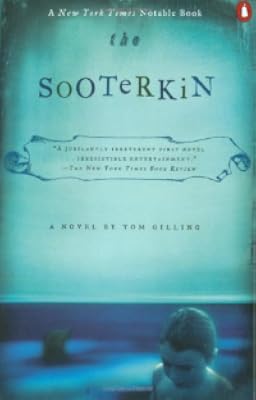
The Sooterkin
by Tom Gilling
On This Page
Description
One squally afternoon in the winter of 1821, Sarah Dyer gives birth to the strangest child ever seen in Hobart, a thing more seal than human. When a well-dressed stranger arrives, with a proposal for its future, no-one forsees the trouble ahead.Tags
Recommendations


















Member Reviews
Set in Tasmania, Tom Gilling’s ludicrous fiction The Sooterkin describes how Sarah Dyer was delivered of a monstrous seal-pup child in 1821. The novel presents a variety of comic responses to the event from an array of characters and caricatures who people the whaling town of Hobart. The place itself is rendered in its grotesque physical reality: blood, guts, mud, and ‘rancid with blubber’. It’s reminiscent of the primeval mud of the Nile, which according to the ancient writer, Pliny, breeds monsters. The land is marked by manifest signs of the colonised but these vanish into the undifferentiated as soon as the agents of ‘culture’ stray too far beyond the town. The Chaplain, Mr Kidney, finds that the country ‘seems show more primordial, uncouth, devoid of any human presence save his own.’ The darkness seems to ‘conjure disembodied noises’ (121) and he feels finally ‘taunted by a monstrosity that science and the Bible have been unable to explain.’ (183). The story parallels then, the conjoined history, one of a monstrous birth, the other the ‘birth’ of Australia. Both are essentially unreadable, despite competing theories. Crimes, like Mrs Jakes’ unnamed abortions (‘a parcel the size of a cauliflower’ (184), lie buried in the ground. ‘He didn’t ask what she was doing and he never said.’ (184). I have taught this book as part of a second-year University course on the gothic and the grotesque and can confirm that it was well-received by the majority of students. A minority of readers were irritated by the fantastic elements of the plot – though these are not materially significant and are easily exaggerated. There was a lively debate on the allegorical features of the novel: to what extent is the story a version of Australian history as a grotesque narrative of monstrous births and colonisers’ discourses? show less
One miserable day in Hobart early in the 19th century (when all days were miserable in Hobart, one feels), Sarah Dyer gives birth to a child unlike ever seen before, a baby more seal than human. The baby Arthur quickly grows, and brings fame to his family, greed to the hearts of men who would sell him as a circus freak, and consternation to the Reverend Mr Kidney.
It's an interesting cast of well drawn characters, Mr Kidney and his housekeeper Mrs Jakes, who dabbles as a midwife on the side; Mr Sculley the local man of science and a believer of physiognomy; and many other minor characters who pop in for a page or a paragraph here and there. So many that it was a bit hard to keep track of. And somehow, Arthur is the least well developed show more of the lot, he's just there really to push the other characters along.
This took a while to get into, had far too many words, and a very 19th century feel to the writing. I do like my paragraphs to have the occasional full stop somewhere in the middle, at least. But I did enjoy it by the end, it was an interesting journey with Arthur and all his ragtag crew of antipodean misfits. show less
It's an interesting cast of well drawn characters, Mr Kidney and his housekeeper Mrs Jakes, who dabbles as a midwife on the side; Mr Sculley the local man of science and a believer of physiognomy; and many other minor characters who pop in for a page or a paragraph here and there. So many that it was a bit hard to keep track of. And somehow, Arthur is the least well developed show more of the lot, he's just there really to push the other characters along.
This took a while to get into, had far too many words, and a very 19th century feel to the writing. I do like my paragraphs to have the occasional full stop somewhere in the middle, at least. But I did enjoy it by the end, it was an interesting journey with Arthur and all his ragtag crew of antipodean misfits. show less
Charming and uplifting.
Ratings
Members
- Recently Added By
Lists

BingoDOG - Books With Mythical Creatures
57 works; 16 members
Author Information

14+ Works 352 Members
Tom Gilling is an acclaimed novelist. The Sooterkin, Miles McGinty and Dreamland have all been published in Australia, London and New York. His non-fiction works include The Lost Battalions and Project Rainfall. He is also co-author with Clive Small of the highly successful Smack Express, Blood Money, Evil Life and Milat.
Awards and Honors
Awards
Common Knowledge
- People/Characters
- Sarah Dyer; William; Mrs. Jakes; Reverend Kidney; Dr. Benjamin Banes; Mr. Sculley
- Important places
- Australia; Tasmania, Australia
Classifications
Statistics
- Members
- 146
- Popularity
- 224,803
- Reviews
- 4
- Rating
- (3.02)
- Languages
- English
- Media
- Paper, Ebook
- ISBNs
- 7
- ASINs
- 2