
Steven Carroll (1) (1949–)
Author of The Time We Have Taken
For other authors named Steven Carroll, see the disambiguation page.
About the Author
Steven Carroll was born in 1949 in Melbourne, Victoria. He studied at La Trobe University. He has taught English at secondary school level, and drama at RMIT. He has been Drama Critic for The Sunday Age newspaper in Melbourne. Steven Carroll is now a full-time writer living in Melbourne. He will be show more speaking at the inaugural History Writers' Festival April 2015 in Melbourne. His title's include Remember Me, Jimmy james, The Lovers' Room, The Love Song Song of Lucy McBride and A World of Other People. He will be featured at the Mudgee Readers' Festival 2015. He made the finalist for the Melbourne Prize for Literature 2015. He also made the Victorian Premier¿s Literary Awards 2016 shortlist in the Fiction category. (Bowker Author Biography) show less
Series
Works by Steven Carroll
Tagged
Common Knowledge
- Other names
- Carroll, Steve
- Birthdate
- 1949
- Gender
- male
- Education
- La Trobe University
- Occupations
- novelist
playwright
teacher (high school English)
lecturer - Organizations
- RMIT University
- Relationships
- Carroll, J.R. (brother)
Glasson, Toni (sister-in-law) - Nationality
- Australia
- Birthplace
- Melbourne, Victoria, Australia
- Associated Place (for map)
- Victoria, Australia
Members
Reviews

Is it possible to fall in love with a book? I think I have, with The Lost Life…
This is how it happened. The publisher has sent me a copy of A New England Affair which is book #3 of Steven Carroll’s The Eliot Quartet (and just happens to have one of the most unappealing covers I’ve seen in a very long time). And I realised that #SmacksForehead I still hadn’t read not only its predecessor Book #2 A World of Other People, (with a not quite so ghastly but likewise unenticing cover) but show more also Book #1 The Lost Life, both of which I had bought as soon as they were released because I love Steven Carroll’s novels. I love his contemplative style, the way he notices the very small things about life, and his extraordinary perceptions about the inner workings of the human mind.
I found the books on the C shelf, tucked away behind a pushy double row of shiny new Ds and Es. I couldn’t believe it when I opened up The Lost Life and realised it had been sitting there since 2009! It is such a beautiful little book, the size of the original Penguins, and designed not by the Harper Collins Design Studio but by Sandy Cull of gogoGinko. The sepia toned image of the paper roses is on a separate half-sized dustjacket on gorgeous textured paper (which I carefully removed to read the book because I didn’t want to damage it). Underneath, the book boards are imprinted with the faint image of a single large rose. I was falling in love before I’d even turned a single page.
And then, the book. Steven Carroll is sheer genius. With the most intricate of allusions, in a captivating story about different kinds of love, he stirs memories of so many other pleasurable hours of reading other books. It’s like those Winter days at the beach with a loved one when you walk hand in hand remembering all the other seasons when you were falling in love and looking forward to a future together. The present is all muddled up with the past and the future, enhancing all three. Which is a very ordinary way of saying what T S Eliot says so elegantly in his poems about Time…
Alas, my copy doesn’t have the dustjacket…
It was late, and I was reading in bed, but next thing, I was up on the library steps peering at the top shelves hunting out my Faber & Faber first edition of Eliot’s Collected Poems 1909-1962. Carroll’s novel begins at Burnt Norton, a mansion in the Cotswolds, and I remembered the poem of that name. (You can see a picture of the mansion here, and also an analysis of the poem if you are keen). ‘Burnt Norton’ is the first of The Four Quartets, and it begins like this:
(I am ashamed to say that this beautiful book of poetry is marred by inane marginalia, noting such intellectual gems as ‘twist’, and ‘circular not sequential’ and ‘irregular lines’. These marks (fortunately only in pencil) date from my days at university, and they didn’t stop me re-reading the whole collection before pressing on with Carroll’s novel. But, trust me, you do not need to know a thing about TS Eliot and his poetry to love The Lost Life… show less
This is how it happened. The publisher has sent me a copy of A New England Affair which is book #3 of Steven Carroll’s The Eliot Quartet (and just happens to have one of the most unappealing covers I’ve seen in a very long time). And I realised that #SmacksForehead I still hadn’t read not only its predecessor Book #2 A World of Other People, (with a not quite so ghastly but likewise unenticing cover) but show more also Book #1 The Lost Life, both of which I had bought as soon as they were released because I love Steven Carroll’s novels. I love his contemplative style, the way he notices the very small things about life, and his extraordinary perceptions about the inner workings of the human mind.
I found the books on the C shelf, tucked away behind a pushy double row of shiny new Ds and Es. I couldn’t believe it when I opened up The Lost Life and realised it had been sitting there since 2009! It is such a beautiful little book, the size of the original Penguins, and designed not by the Harper Collins Design Studio but by Sandy Cull of gogoGinko. The sepia toned image of the paper roses is on a separate half-sized dustjacket on gorgeous textured paper (which I carefully removed to read the book because I didn’t want to damage it). Underneath, the book boards are imprinted with the faint image of a single large rose. I was falling in love before I’d even turned a single page.
And then, the book. Steven Carroll is sheer genius. With the most intricate of allusions, in a captivating story about different kinds of love, he stirs memories of so many other pleasurable hours of reading other books. It’s like those Winter days at the beach with a loved one when you walk hand in hand remembering all the other seasons when you were falling in love and looking forward to a future together. The present is all muddled up with the past and the future, enhancing all three. Which is a very ordinary way of saying what T S Eliot says so elegantly in his poems about Time…
Alas, my copy doesn’t have the dustjacket…
It was late, and I was reading in bed, but next thing, I was up on the library steps peering at the top shelves hunting out my Faber & Faber first edition of Eliot’s Collected Poems 1909-1962. Carroll’s novel begins at Burnt Norton, a mansion in the Cotswolds, and I remembered the poem of that name. (You can see a picture of the mansion here, and also an analysis of the poem if you are keen). ‘Burnt Norton’ is the first of The Four Quartets, and it begins like this:
Time present and time past
Are both perhaps present in time future
And time future contained in time past.
If all time is eternally present
All time is irredeemable.
(I am ashamed to say that this beautiful book of poetry is marred by inane marginalia, noting such intellectual gems as ‘twist’, and ‘circular not sequential’ and ‘irregular lines’. These marks (fortunately only in pencil) date from my days at university, and they didn’t stop me re-reading the whole collection before pressing on with Carroll’s novel. But, trust me, you do not need to know a thing about TS Eliot and his poetry to love The Lost Life… show less

On this hot summer's night in the middle of last century, the old and the new, diesel and steam, town and country all collide - and nobody is left unaffected.
Nothing much seems to happen in this luminous depiction of suburban Australia– but in this one night, there is a seismic shift in the lives of the people we meet walking to a neighbourhood engagement party.
Carroll is without peer in shining a light on the everyday.
This is an elegant and resonant tale of change and the loss of show more innocence – and one which meant so much to me because it could easily have been my neighbours, my parents … and me. show less
Nothing much seems to happen in this luminous depiction of suburban Australia– but in this one night, there is a seismic shift in the lives of the people we meet walking to a neighbourhood engagement party.
Carroll is without peer in shining a light on the everyday.
This is an elegant and resonant tale of change and the loss of show more innocence – and one which meant so much to me because it could easily have been my neighbours, my parents … and me. show less
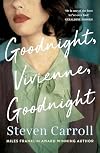
With the publication of Goodnight, Vivienne, Goodnight, Steven Carroll brings to a close his Eliot Quartet based on characters from the life of the poet T S Eliot. This final novel focusses on the Vivienne, Eliot's troubled first wife, the one who was said to be an hysteric and a harridan. In real life TSE left the marriage and she ended up in an asylum, unvisited by TSE who was busy being famous in a way that few poets are. In Carroll's novel he is a celebrity, at a time when the word had show more barely been invented.
And Britain is at war with Germany. It is July 1940 and the streets are sandbagged but the real horror of the Blitz is yet to come. Into this impending chaos comes Vivienne, successfully making her escape from the asylum with the help of her sympathetic friend Louise Purdoy and George from the Lunacy Law Reform Society. Vivienne is in the hands of a covert network of people who engineer escapes from asylums so that the inmate can take advantage of an old law which offered the possibility of freedom to anyone who could break out and stay free for 30 days. Louise Purdoy thinks that Vivienne is as sane as anybody else, and so she wants to help her.
Vivienne, of course, has to lie low, as any escapee does, but she doesn't. She likes to be out and about, as anyone does. (I suspect that Carroll's experience of Melbourne's Lockdowns influenced her realistic yearning to escape being confined indoors.) Fatally, perhaps, she just can't resist a TSE public appearance where he is to do a reading of 'East Coker', (the second of his Four Quartets, published in real life in 1940.)
Vivienne turning up and creating a scene at a public appearance is exactly what TSE fears, and he has powerful friends. She had been committed in the first place because of a public 'episode' involving a knife and hysterical rantings about TSE being beheaded. Adding to the panic is a stabbing episode involving a Lord and his ex-wife. So Detective Stephen Minter is assigned to find Vivienne ASAP.
Minter might be a fugitive too, of a sort. His parents fled anti-Semitism in Australia, and he grew up in England. They are secular Jews and have settled into English life well, but they (like Minter himself) are at risk of being interned as Aliens. He has worked hard to assimilate, masking his accent and (in passages reminiscent of The Gift of Speed (2004) from Carroll's Glenroy novels) becoming devoted to cricket. But just as TSE can't quite shake off his Missouri origins, Minter retains slight traces of his past. And just as TSE is not really part of the British Establishment, much as he would like to be, Minter isn't really on their side. He's not sure that he wants to find Vivienne. He's not convinced that she is insane. But he does have an Englishman's sense of duty...
To read the rest of my review please visit https://anzlitlovers.com/2023/02/14/goodnight-vivienne-goodnight-2022-the-eliot-... show less
And Britain is at war with Germany. It is July 1940 and the streets are sandbagged but the real horror of the Blitz is yet to come. Into this impending chaos comes Vivienne, successfully making her escape from the asylum with the help of her sympathetic friend Louise Purdoy and George from the Lunacy Law Reform Society. Vivienne is in the hands of a covert network of people who engineer escapes from asylums so that the inmate can take advantage of an old law which offered the possibility of freedom to anyone who could break out and stay free for 30 days. Louise Purdoy thinks that Vivienne is as sane as anybody else, and so she wants to help her.
Vivienne, of course, has to lie low, as any escapee does, but she doesn't. She likes to be out and about, as anyone does. (I suspect that Carroll's experience of Melbourne's Lockdowns influenced her realistic yearning to escape being confined indoors.) Fatally, perhaps, she just can't resist a TSE public appearance where he is to do a reading of 'East Coker', (the second of his Four Quartets, published in real life in 1940.)
Vivienne turning up and creating a scene at a public appearance is exactly what TSE fears, and he has powerful friends. She had been committed in the first place because of a public 'episode' involving a knife and hysterical rantings about TSE being beheaded. Adding to the panic is a stabbing episode involving a Lord and his ex-wife. So Detective Stephen Minter is assigned to find Vivienne ASAP.
Minter might be a fugitive too, of a sort. His parents fled anti-Semitism in Australia, and he grew up in England. They are secular Jews and have settled into English life well, but they (like Minter himself) are at risk of being interned as Aliens. He has worked hard to assimilate, masking his accent and (in passages reminiscent of The Gift of Speed (2004) from Carroll's Glenroy novels) becoming devoted to cricket. But just as TSE can't quite shake off his Missouri origins, Minter retains slight traces of his past. And just as TSE is not really part of the British Establishment, much as he would like to be, Minter isn't really on their side. He's not sure that he wants to find Vivienne. He's not convinced that she is insane. But he does have an Englishman's sense of duty...
To read the rest of my review please visit https://anzlitlovers.com/2023/02/14/goodnight-vivienne-goodnight-2022-the-eliot-... show less

The third story in a trilogy, Steven Carroll's The Time We Have Taken describes the events in an unnamed Melbourne suburb during its centenary celebrations in 1970.
In addition to its Miles Franklin Literary Award nomination, this book won the 2008 Commonwealth Writers Prize for Best Book in the South-East Asia and South Pacific Region.
Carroll writes the kind of still prose that invites the reader into a contemplative space. The irony is that his subject matter is restless.
He details the life show more of a suburb nine miles north of Melbourne, from the late '50s to the early '70s. It is, as Carroll notes, an age enthralled by progress and, even more, by speed. But he insists on telling the story slowly. The result is a deeply satisfying encounter with the empty spaces that the suburb failed to fill both between people and inside them.
While Carroll’s work is not overtly political, memory and the mythologising of the past are central themes, and he subtly but surely undermines the simplistic pre-lapsarian dream of the culture warriors while at the same time drawing his characters and their desires for escape or transcendence with humour, affection and empathy – and without a hint of condescension.
Although this is the third book in the series, it works just as well as a stand alone read. I haven't read the other two, but I am off to the bookshop to get them right now! show less
In addition to its Miles Franklin Literary Award nomination, this book won the 2008 Commonwealth Writers Prize for Best Book in the South-East Asia and South Pacific Region.
Carroll writes the kind of still prose that invites the reader into a contemplative space. The irony is that his subject matter is restless.
He details the life show more of a suburb nine miles north of Melbourne, from the late '50s to the early '70s. It is, as Carroll notes, an age enthralled by progress and, even more, by speed. But he insists on telling the story slowly. The result is a deeply satisfying encounter with the empty spaces that the suburb failed to fill both between people and inside them.
While Carroll’s work is not overtly political, memory and the mythologising of the past are central themes, and he subtly but surely undermines the simplistic pre-lapsarian dream of the culture warriors while at the same time drawing his characters and their desires for escape or transcendence with humour, affection and empathy – and without a hint of condescension.
Although this is the third book in the series, it works just as well as a stand alone read. I haven't read the other two, but I am off to the bookshop to get them right now! show less
Lists
Awards


You May Also Like


Associated Authors
Statistics
- Works
- 16
- Members
- 675
- Popularity
- #37,410
- Rating
- 3.6
- Reviews
- 31
- ISBNs
- 113
- Languages
- 2