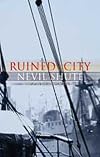
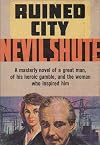
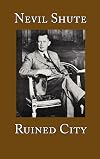
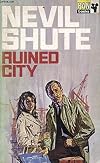
Ruined City
by Nevil Shute
On This Page
Description
When Henry Warren, director of an English bank, lands by chance in a hospital in a bleak Northern town that has been ruined by the closure of its shipyard, he discovers nothing less than a new purpose for his life. Moved by the fate of the town's inhabitants, Warren risks his fortune and reputation to save the shipyard and restore the town to its former prosperity. In seeking to change the fate of the town, he radically changes his own..
Tags
Recommendations


















Member Reviews
Wow, a book for our time too! [a:Nevil Shute|21477|Nevil Shute|http://photo.goodreads.com/authors/1206158172p2/21477.jpg]'s story is about whether companies should put workers first or investors first. This is a timeless story about an effort to put the people of a city back to work in manufacturing when the economy of the place has all but dried up and social assistance and debt are the only things keeping the place and its people alive at all. The protagonist,a banker and financier, realizes that "There's only only one thing really worth working for in the City. That's to create work. . . . the thing most worth doing in this modern world [is to] create jobs that men can work at, and be proud of, and make money by their work. There's show more no dignity, no decency, or health today for men that haven't got a job. All other things depend on work today; without work men are utterly undone". Not a straightforward feel-good, redemption story of the typical sort. The protagonist admits that though his intentions are good his methods (if they are to succeed) can not be because of the tension between serving investors and creating work where industry has failed once before . . . he says "Nobody's going to get that Yard working again and keep his hands clean" and that's what the story's about -who takes the risk, and why in a capitalist system sometimes somebody has to take a fall when you turn a place and the lives of its people around. . show less
Oh, that's good. Like A Town Like Alice, but more personal. I like Warren - including the way he's willing to take responsibility for his actions. Though his punishment was exactly what he needed - hope he can keep that going. She'll keep him straight. Only one real villain, or maybe two, in the whole book - the major opponent is circumstances. And seeing a depressed town come back to life is great in itself. This is going to be one of the regular rereads.
Another gem by Nevil Shute. This time, we're dealing with an investment banker, Henry Warren. He's rather a workaholic, and his lively, entitled spouse is carrying on an affair with a "black man", which in this instance is an Arabian prince, or perhaps a Pakastani one. At any rate, not a "black man" by modern reckoning, by which we mean someone whose origins trace to sub-Sahara Africa (Yup, the Brits were pretty racist 75 or so years ago). When, on a business trip to Paris, he sees his spouse dining with the "black man", he resolves to divorce her, unless she agrees to give up her "gay" life and retire to boredom in the country. She, of course, is unwilling to do that.
Shortly thereafter, Warren, feeling run down and depressed, heads show more north for a bit of walking. He has an attack of something in his gut (twisted intestine I believe) and ends up in the hospital of a small city. He poses as another of their charity cases, an out-of-work itinerant clerk. The time is 1934, and everyone is out of work.
This particular town was once a thriving center of ship building. "Did you know that seven destroyers from the shipyard fought in the Battle of Jutland?" is a common refrain. But the shipyard, local rolling mill, and mine have all shut down some five years previously. The town and all its inhabitants are run down, both physically and emotionally. Mortality is exceptionally high at the hospital, and it is despair, rather than poor medical attention that is killing the patients off.
Warren befriends the "Almoner" at the hospital, which I think is likely the social worker who deals with the charity patients. Through her, he learns about the town and its troubles and resolves to do something about it, but quietly if possible. Along the way, we are introduced to some international corruption and intrigue, things that always seems to be a part of high finance. We also have a budding romance between the "Almoner" and Warren, but done in the Shute style of two people developing a strong friendship. None of this jumping ino bed stuff like modern literature. Personally, I think the Shute style is more appropriate for building lasting relationships.
Anyway, it's a good book. Perhaps a bit calm for those whose taste lies more with warriors, plagues and gore. But it is an apt commentary on the lives of real people in 1934, but the book's concerns also still mostly true today. show less
Shortly thereafter, Warren, feeling run down and depressed, heads show more north for a bit of walking. He has an attack of something in his gut (twisted intestine I believe) and ends up in the hospital of a small city. He poses as another of their charity cases, an out-of-work itinerant clerk. The time is 1934, and everyone is out of work.
This particular town was once a thriving center of ship building. "Did you know that seven destroyers from the shipyard fought in the Battle of Jutland?" is a common refrain. But the shipyard, local rolling mill, and mine have all shut down some five years previously. The town and all its inhabitants are run down, both physically and emotionally. Mortality is exceptionally high at the hospital, and it is despair, rather than poor medical attention that is killing the patients off.
Warren befriends the "Almoner" at the hospital, which I think is likely the social worker who deals with the charity patients. Through her, he learns about the town and its troubles and resolves to do something about it, but quietly if possible. Along the way, we are introduced to some international corruption and intrigue, things that always seems to be a part of high finance. We also have a budding romance between the "Almoner" and Warren, but done in the Shute style of two people developing a strong friendship. None of this jumping ino bed stuff like modern literature. Personally, I think the Shute style is more appropriate for building lasting relationships.
Anyway, it's a good book. Perhaps a bit calm for those whose taste lies more with warriors, plagues and gore. But it is an apt commentary on the lives of real people in 1934, but the book's concerns also still mostly true today. show less
Review
Immensely readable Guardian Not only a brilliant fluent storyteller but also an ironic commentator on the world scene Harpers & Queen There is little that Shute does not know about choosing an appealing story and telling it in a gripping way The Times
Product Description
Henry Warren ends up in a hospital in a Northern town ruined by the closure of its shipyard. Moved by the fate of the town’s inhabitants, Warren risks his fortune and reputation to save the shipyard and restore the town.
Ratings
Members
- Recently Added By
Lists

Fictional European countries
58 works; 2 members
Author Information

56+ Works 20,272 Members
Nevil Shute Norway was born in Ealing, London, England, on January, 17 1899. At the age of 11, Norway played truant from his first preparatory school in Hammersmith. After he was discovered, he was sent to the Dragon School, Oxford, and from there to Shrewsbury. He was on holiday in Dublin at the time of the Easter rising of 1916 and acted as an show more ambulance driver, winning a commendation for gallant conduct. He then entered the Royal Military Academy, intending to be commissioned into the Royal Flying Corps, but a bad stammer led to his being failed at his final medical examination and returned to civil life. The last few months of the war were spent on home service as a private in the Suffolk Regiment. In 1919, Norway went to Balliol College, Oxford, where he took a third class honors course in engineering science in 1922. During the vacations he worked, unpaid, as an aeronautical engineer, for the Aircraft Manufacturing Company at Hendon, and then for Geoffrey de Havilland's own firm, which he joined as an employee upon finishing at Oxford. He learned to fly and gained experience as a test observer. During the evenings he diligently wrote novels and short stories unperturbed by rejection slips from publishers. In 1924 Norway took the post of Chief Calculator to the Airship Guarantee Company, to work on the construction of the R100. In 1929 he became Deputy Chief Engineer under Barnes Wallis, and in the following year he flew to and from Canada in the R100. After the end of the airship project, jobs were hard to come by due to the depression so Shute started an aircraft manufacturing company, Airspeed Limited. This company was ultimately successful and built a large number of aircraft during the war. Shute remained joint managing director until 1938. When the business became too routine, he decided to get out of the rut and live by writing. The de Havillands, the first aviation job Shute had ever had, wound up buying Airspeed Ltd. He had by then enjoyed some success as a novelist and had sold the film rights of Lonely Road and Ruined City. At the outbreak of war in 1939, Norway joined the Royal Naval Volunteer Reserve as a Sub-Lieutenant in the Miscellaneous Weapons Department. Rising to Lieutenant Commander, he found experimenting with secret weapons a job after his own heart. But he found that his growing celebrity as a writer caused him to be in the Normandy landings on 6th June 1944, for the Ministry of Information, and to be sent to Burma as a correspondent in 1945. He entered Rangoon with the 15th Corps from Arakan. Soon after demobilisation in 1945 he emigrated to Australia and made his home in Langwarrin, Victoria. His output of novels, which began with Marazan (1926) continued to the end. Shute was one of the leading aeronautical engineers in Britain during the 30's and a fellow of the Royal Aeronautical Society. When he began writing in the 20's, he feared that a reputation as a writer of fiction might harm his engineering career. For this reason he published under his two Christian names, Nevil Shute and engineered under his "real" name, Nevil S. Norway. Nevil Shute Norway died in Melbourne on January, 12 1960. (Bowker Author Biography) show less
Series
Belongs to Publisher Series
Pan Books (X204)
Work Relationships
Is contained in
Common Knowledge
- Canonical title
- Ruined City
- Alternate titles
- Kindling
- Original publication date
- 1938
- People/Characters
- Henry Warren
- Important places
- Sharples, England, UK
- First words
- During the winter the pace accelerated tremendously for Mr Henry Warren.
- Last words
- (Click to show. Warning: May contain spoilers.)Then she, too, left her desk, and ran with the rest.
- Original language
- English
- Disambiguation notice
- Ruined City and Kindling are the same work.
Classifications
Statistics
- Members
- 333
- Popularity
- 95,011
- Reviews
- 4
- Rating
- (3.80)
- Languages
- Danish, English, Norwegian (Bokmål), Swedish
- Media
- Paper, Audiobook, Ebook
- ISBNs
- 20
- ASINs
- 22