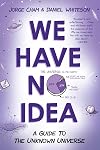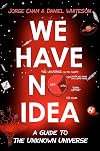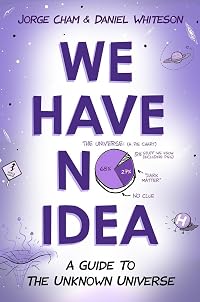
We Have No Idea: A Guide to the Unknown Universe
by Jorge Cham, Daniel Whiteson
On This Page
Description
Humanity's understanding of the physical world is full of gaps. Not tiny little gaps you can safely ignore--there are huge yawning voids in our basic notions of how the world works. Jorge Cham and Daniel Whiteson team up to explore everything we don't know about the universe, and while introducing the biggest mysteries in physics, they also helpfully demystify many complicated things we do know. And although the universe is full of weird things that don't make any sense, Cham and Whiteson show more make a compelling case that the questions we can't answer are as interesting as the ones we can, and they invite us to see the universe as a possibly boundless expanse of uncharted territory that's still ours to explore. -- show lessTags
Recommendations
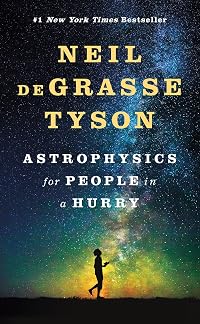
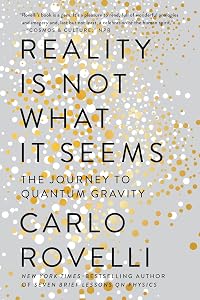
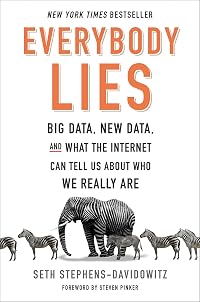
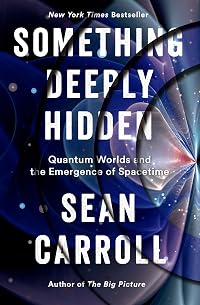
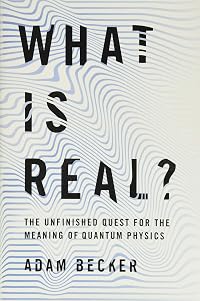
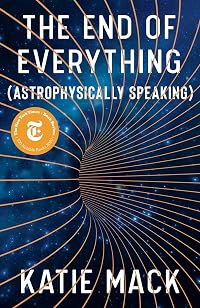
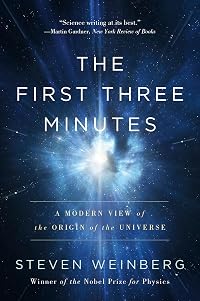
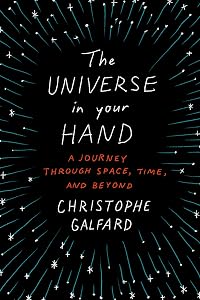



Member Recommendations
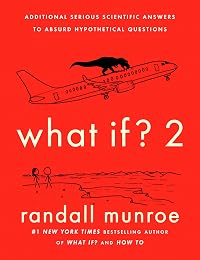
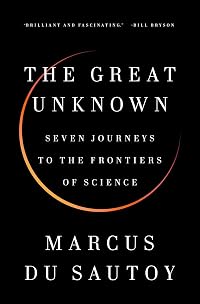
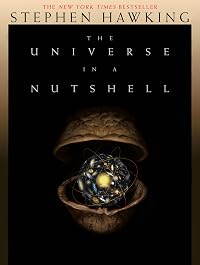
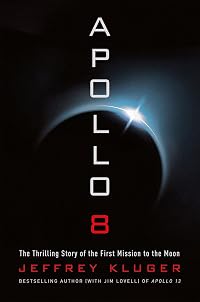
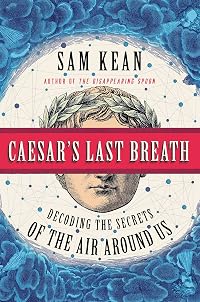
themulhern More-or-less the same topic, both have a light-sh treatment.
themulhern Both have a lightish treatment of similar topics. I think "We Have no Idea" has more verve, though.
themulhern Science or math with jokes and stick figures.
Member Reviews
Wonderful pop-science book. While it might be dismissed as not being technical enough, books like The Universe: Leading Scientists Explore the Origin, Mysteries, and Future of the Cosmos are sometimes so technical (and badly formatted) that all the scientific rigor gets in the way of actually conveying information for the reader.
In «We have no Idea», Daniel Whiteson and Jorge Cham go a bit against conventional wisdom and talk about the things we don't know about. But, how can you even know that? Long story short: what we know is a big help in defining the unknown, similar to how negative space is defined in design.
The book accomplishes what many other pop-sci writers try, which is to establish more questions than it answers. Heck, show more that's what good science does. While guiding us through the edge of physics and the universe, the authors are careful to distinguish that which we are pretty certain of and what some possible answers might be, all peppered with the soft and charming humor that you might know from PHD Comics. The book chapters are neatly organized in Big Themes (e. g. «what is matter?», «what is time»...) and conveniently paced so you almost always have either something to look forward to and something to base your new knowledge upon.
The humor is hit-or-miss for me (and certainly not as funny as What If?: Serious Scientific Answers to Absurd Hypothetical Questions by fellow webcomic author Randall Munroe) but it never gets in the way of the explanation. If you can visualize some physics concepts using ferrets, llamas and practical jokes, this might be for you.
A book worth picking up either to learn about how much we don't know or to peek into the sometimes dirty windows of how science is done. show less
In «We have no Idea», Daniel Whiteson and Jorge Cham go a bit against conventional wisdom and talk about the things we don't know about. But, how can you even know that? Long story short: what we know is a big help in defining the unknown, similar to how negative space is defined in design.
The book accomplishes what many other pop-sci writers try, which is to establish more questions than it answers. Heck, show more that's what good science does. While guiding us through the edge of physics and the universe, the authors are careful to distinguish that which we are pretty certain of and what some possible answers might be, all peppered with the soft and charming humor that you might know from PHD Comics. The book chapters are neatly organized in Big Themes (e. g. «what is matter?», «what is time»...) and conveniently paced so you almost always have either something to look forward to and something to base your new knowledge upon.
The humor is hit-or-miss for me (and certainly not as funny as What If?: Serious Scientific Answers to Absurd Hypothetical Questions by fellow webcomic author Randall Munroe) but it never gets in the way of the explanation. If you can visualize some physics concepts using ferrets, llamas and practical jokes, this might be for you.
A book worth picking up either to learn about how much we don't know or to peek into the sometimes dirty windows of how science is done. show less
I struggled to get through this. It was hard to find any redeeming features: the cartoons seem inane and certainly distracting (and frequently incomprehensible to me), and the text is all-too-frequently simply wrong. The only good thing about the book that I could think of was that it at lest points to /some/ of the problems with our current theories. But it ignores many others that are arguably more fundamental (measurement, for example), and its discussions of the ones that it does cover are misleadingly superficial. The whole thing reminded me of some of the old "Horizon" programmes that used to be on the BBC: apparently designed to leave the viewers (or in this case, the readers) with the impression that they understand an issue show more when in fact all the important (and interesting) complexities have been elided. Perhaps someone else will take this idea and implement it more thoroughly -- although then the book would be considerably thicker; but also vastly more interesting, useful and satisfying. show less
I think this book does a great job of laying out the tapestry of concepts that physics is aware of and cannot explain (yet). I'm sure I will recommend it to my gen-ed physics students; many of them have their interest piqued and I have to leave them hanging because 16 weeks is just not long enough to teach all the awesome physics. A book like this helps close the gap a little, for the students who are interested enough in reading on.
And don't get me wrong, I'm a huge fan of a good physics pun. I've been known to use puns in my classes. However, they just wore out a little after about 250 pages or so in this book. I mean, yeah, a "good" (read: horrible) dad joke every now and again is tolerable. A dad joke every page or twice every page? show more For 350 pages? You need some serious grit for that. show less
And don't get me wrong, I'm a huge fan of a good physics pun. I've been known to use puns in my classes. However, they just wore out a little after about 250 pages or so in this book. I mean, yeah, a "good" (read: horrible) dad joke every now and again is tolerable. A dad joke every page or twice every page? show more For 350 pages? You need some serious grit for that. show less
I can't speak too highly of this book. I've been a student of science for many years and have always been puzzled by the apparent certainty about scientific knowledge. Except when one keeps asking the question ...."Well what's that made of? or where does that come from?"....one starts to come up against barriers.......like "Well, we just don't know that yet". This book puts our knowledge into some perspective. All the knowledge we have about the things in the universe...stars, planets, living things, atoms, quarks, light, electricity, is knowledge about 5% of the universe. Scientists have slowly come to the realisation that some 27% of the universe is matter of some sort but we have no idea what sort of matter it is. There are some show more guesses but so far no real understanding. So it's being called "dark matter". That leaves the other 68% of the universe. Now I must admit that I'm still not totally clear on how the scientists have been able to pin this 68% to dark energy ....... that is, as opposed to the 32% that is matter (5% we know about and 27% is "dark" matter). That is, how are they relating mass and energy.......maybe via Einstein's equation....though does it still hold with Dark energy? But this big picture of our understanding sets the background for a lot more of the questions I have always wondered about such as: What is space?, What is time? The mysteries of mass....and so on. Rather alarming to find (although greatly illuminating also) that we actually have no idea about many of these fundamental questions.
I loved the book. It's illustrated with cartoons throughout. Some are maybe a bit annoying and trite but generally they are quite helpful in visualising the various issues raised. So a really helpful partnership between artist Jorge Cham and CERN particle physicist Daniel Whiteson. Strongly recommend it...in fact, I gave the book as a present to a couple of relatives who, I thought, would benefit from reading. show less
I loved the book. It's illustrated with cartoons throughout. Some are maybe a bit annoying and trite but generally they are quite helpful in visualising the various issues raised. So a really helpful partnership between artist Jorge Cham and CERN particle physicist Daniel Whiteson. Strongly recommend it...in fact, I gave the book as a present to a couple of relatives who, I thought, would benefit from reading. show less
Very well done mix of science and humor that covers how much we know and don't know about the Universe. Really eye opening!
An ideal way to catch up with what physicists and astronomers have been up to during the past few decades. The authors provide a very readable and very entertaining survey of the many unsolved mysteries in quantum mechanics and astronomy. Although light-hearted with countless puns, the book is not light reading. The reader is confronted with some very profound thoughts.
The book is strongly recommended for anyone who wants to catch up on what is new with physics or who is studying science. The success of the book is a result of focusing on the many things where we have no idea for why they are the way they are.
The book is strongly recommended for anyone who wants to catch up on what is new with physics or who is studying science. The success of the book is a result of focusing on the many things where we have no idea for why they are the way they are.
DNF about six chapters in — it’s very cute and funny, but the science is disorganized, and skimmed over in favor of jokes — and I prefer explanation.
Members
- Recently Added By
Lists

Penguin Random House
458 works; 4 members
Author Information

23 Works 2,000 Members
3 Works 861 Members
Awards and Honors
Awards
Distinctions
Common Knowledge
- Original publication date
- 2017-05
- Dedication
- For my daughter, Elinor --J.C.
To my family, for supporting all the chapters of my life, even those with bad puns in them. --D.W. - First words
- Would you like to know how the universe began, what it's made of, and how it will end?
- Last words
- (Click to show. Warning: May contain spoilers.)But it will certainly be an exciting ride.
Classifications
Statistics
- Members
- 724
- Popularity
- 39,221
- Reviews
- 24
- Rating
- (3.94)
- Languages
- 9 — Dutch, English, Estonian, French, German, Italian, Portuguese, Spanish, Swedish
- Media
- Paper, Audiobook, Ebook
- ISBNs
- 29
- ASINs
- 6