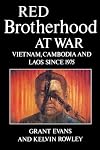
Red Brotherhood at War: Vietnam, Cambodia and Laos since 1975
by Grant Evans
On This Page
Description
This fully updated edition of Red Brotherhood at War - the most comprehensive account of events since 1975 in Indochina - explains why communist victory did not usher in a period of peace based on proletarian internationalism. While victorious revolutionaries in Vietnam and Laos strengthened their special relationship, Vietnam's relations with fraternal Cambodia and China deteriorated into full-scale war. The Vietnamese overthrow of Pol Pot's regime in 1979 was condemned by the West, which show more joined with China to support the Khmer Rouge-dominated anti-Vietnamese resistance in Cambodia. An inter-communist war thus became one of the focal points of the New Cold War in the 1980s. This complex and paradoxical tangle of events is skilfully analysed by Evans and Rowley in their frank and lively book. Drawing on a wide range of sources and first-hand research, this new edition has been thoroughly revised to chart the interaction between Vietnam, Cambodia and Laos and the changing configuration of regional and great-power politics up to the present day. show lessTags
Recommendations





























Member Reviews
Everybody knows about the Second Indochina War. That's the one that America fought conventionally from 1965 to 1972, and unconventionally for quite a few years before and after. And if you're a Vietnam War history buff, you know the First Indochina War, likely from Bernard Fall's Street Without Joy and Hell in a Very Small Place. But did you know that just a few years after the fall of Saigon, there was a Third Indochina War, this one between the Communist victors?
Red Brotherhood at War covers this Third Indochina War from political science perspective, and takes a generally bro-Vietnamese stance. The Fall of Saigon left several major issues open, among them the remaining Vietnamese forces along the Ho Chi Minh trail in Cambodia and show more Laos, border disputes remaining from French Colonial administrative zones, the nature of the governments in those countries, and Vietnam's relationships with the Soviet Union and China. There was a chance that this issues could have been resolved diplomatically, and indeed some were in Laos, where a government headed by the Pathet Lao entered into a fruitful alliance with Vietnam.
Cambodia, on the other hand, was the sparkplug of the war. The Khmer Rouge seized power from the right-wing government of Lon Nol and embarked on their genocidal self-immolation of the long Year Zero from 1975 to 1978. Ethnic Vietnamese living in Cambodia were one of the major targets of these attacks, and the Khmer Rouge took a maximally revanchist position on the borders, refusing negotiations and claiming territory to the maximum extent of the Champa kingdoms. With hundreds of thousands of refugees flooding into Vietnam, and its own troops attacked by Khmer Rouge forces, Vietnam launched an invasion of Cambodia, captured Phnom Penh, revealed the horrors of the killing fields, and set up a Communist government. In response, China attacked northern Vietnam. Vietnam, despite being outnumbered, managed to embarrassingly defeat the Chinese Army, using modern Soviet and captured US/South Vietnamese arms to establish air superiority and outgun the Chinese Army, which had languished in terms of technology and doctrine since the Korean War.
Then things got weird. The rump Khmer Rouge, operating out of refugee camps in Thailand and separatist zones in Cambodia, was still the legitimate government of Cambodia despite their crimes against humanity. Throughout the 1980s, the Khmer Rouge was maintained in official sovereignty by an alliance of enemies consisting of China, the United States, and ASEAN countries, willing to use any foil to impair Communist Vietnam. Throughout the 1980s, Cambodia remained a bleeding ulcer of a war, with guerrilla war by the Khmer Rouge and other rebel factions against the Vietnamese backed People's Republic of Cambodia, and the long war bringing the usual horsemen of famine and disease.
As mentioned, Evans and Rowley take a general pro-Vietnamese stance, which in retrospect seems reasonable against the rather hysterical propaganda from Maoist and American Conservative types. They do acknowledge that the Marxist Five-Year Plans of Vietnam were generally failures, and that hundreds of thousands of refugees fled the country due to political repression and economic conditions. And since this book came out in 1984, and was updated in 1990, it still treats the USSR as a going concern, and doesn't cover the end of the Khmer Rouge.
And personally, I was hoping for more of a military history. Thinking about it, the NVA circa-1975 is actually a pretty impressive army. After all, they endured through the Second Indochina War and defeated the ARVN. But conquering Cambodia and fending off a Chinese attack in the space of year is tactically impressive, and gets relatively little page count. Most of this book is the fumbling of states, and their willingness to accept ongoing human suffering rather than adjust their agendas an iota. show less
Red Brotherhood at War covers this Third Indochina War from political science perspective, and takes a generally bro-Vietnamese stance. The Fall of Saigon left several major issues open, among them the remaining Vietnamese forces along the Ho Chi Minh trail in Cambodia and show more Laos, border disputes remaining from French Colonial administrative zones, the nature of the governments in those countries, and Vietnam's relationships with the Soviet Union and China. There was a chance that this issues could have been resolved diplomatically, and indeed some were in Laos, where a government headed by the Pathet Lao entered into a fruitful alliance with Vietnam.
Cambodia, on the other hand, was the sparkplug of the war. The Khmer Rouge seized power from the right-wing government of Lon Nol and embarked on their genocidal self-immolation of the long Year Zero from 1975 to 1978. Ethnic Vietnamese living in Cambodia were one of the major targets of these attacks, and the Khmer Rouge took a maximally revanchist position on the borders, refusing negotiations and claiming territory to the maximum extent of the Champa kingdoms. With hundreds of thousands of refugees flooding into Vietnam, and its own troops attacked by Khmer Rouge forces, Vietnam launched an invasion of Cambodia, captured Phnom Penh, revealed the horrors of the killing fields, and set up a Communist government. In response, China attacked northern Vietnam. Vietnam, despite being outnumbered, managed to embarrassingly defeat the Chinese Army, using modern Soviet and captured US/South Vietnamese arms to establish air superiority and outgun the Chinese Army, which had languished in terms of technology and doctrine since the Korean War.
Then things got weird. The rump Khmer Rouge, operating out of refugee camps in Thailand and separatist zones in Cambodia, was still the legitimate government of Cambodia despite their crimes against humanity. Throughout the 1980s, the Khmer Rouge was maintained in official sovereignty by an alliance of enemies consisting of China, the United States, and ASEAN countries, willing to use any foil to impair Communist Vietnam. Throughout the 1980s, Cambodia remained a bleeding ulcer of a war, with guerrilla war by the Khmer Rouge and other rebel factions against the Vietnamese backed People's Republic of Cambodia, and the long war bringing the usual horsemen of famine and disease.
As mentioned, Evans and Rowley take a general pro-Vietnamese stance, which in retrospect seems reasonable against the rather hysterical propaganda from Maoist and American Conservative types. They do acknowledge that the Marxist Five-Year Plans of Vietnam were generally failures, and that hundreds of thousands of refugees fled the country due to political repression and economic conditions. And since this book came out in 1984, and was updated in 1990, it still treats the USSR as a going concern, and doesn't cover the end of the Khmer Rouge.
And personally, I was hoping for more of a military history. Thinking about it, the NVA circa-1975 is actually a pretty impressive army. After all, they endured through the Second Indochina War and defeated the ARVN. But conquering Cambodia and fending off a Chinese attack in the space of year is tactically impressive, and gets relatively little page count. Most of this book is the fumbling of states, and their willingness to accept ongoing human suffering rather than adjust their agendas an iota. show less
Members
- Recently Added By
Author Information
12 Works 176 Members
Grant Evans is reader in anthropology, department of sociology, the University of Hong Kong, PRC
Classifications
Statistics
- Members
- 32
- Popularity
- 877,406
- Reviews
- 1
- Rating
- (4.00)
- Languages
- English
- Media
- Paper
- ISBNs
- 4
- ASINs
- 1