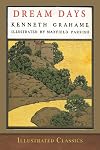
Dream Days
by Kenneth Grahame
On This Page
Description
The further adventures of five brothers and sisters growing up in the English countryside in the late nineteenth century. Sequel to "The Golden Age."Tags
Recommendations




















Member Reviews
Various episodes in the lives of five children.
3/4 (Good).
I hadn't realized this was a sequel, so I was initially a little put off by how it jumped in without bothering to orient the reader. It didn't take me long to settle in, though. The stories seem trivial on the surface, but Grahame tells them in a way that gives them poetry and gravity. I think one or two of them are going to stick with me. (Weirdly, the Reluctant Dragon, which is a cartoonish fairytale and out of place in this book, is not one of them.)
3/4 (Good).
I hadn't realized this was a sequel, so I was initially a little put off by how it jumped in without bothering to orient the reader. It didn't take me long to settle in, though. The stories seem trivial on the surface, but Grahame tells them in a way that gives them poetry and gravity. I think one or two of them are going to stick with me. (Weirdly, the Reluctant Dragon, which is a cartoonish fairytale and out of place in this book, is not one of them.)
4 1/2 stars.
I would highly recommend this to anyone who enjoys the Penrod books by Booth Tarkington. It has the same exuberant, joyful respect for the innocence and seriousness of bygone childhood imagination. And if the last story doesn't choke you up just a little, you have neither heart nor soul and should just go back to your "Twilight" collection.
I would highly recommend this to anyone who enjoys the Penrod books by Booth Tarkington. It has the same exuberant, joyful respect for the innocence and seriousness of bygone childhood imagination. And if the last story doesn't choke you up just a little, you have neither heart nor soul and should just go back to your "Twilight" collection.
4 1/2 stars.
I would highly recommend this to anyone who enjoys the Penrod books by Booth Tarkington. It has the same exuberant, joyful respect for the innocence and seriousness of bygone childhood imagination. And if the last story doesn't choke you up just a little, you have neither heart nor soul and should just go back to your "Twilight" collection.
I would highly recommend this to anyone who enjoys the Penrod books by Booth Tarkington. It has the same exuberant, joyful respect for the innocence and seriousness of bygone childhood imagination. And if the last story doesn't choke you up just a little, you have neither heart nor soul and should just go back to your "Twilight" collection.
For anyone who was accustomed to whiling away the hours in distant fantasy lands as a child, this book is for you.
Five orphaned children, being raised in the British countryside by aunts, uncles and servants but mostly by each other, experience the joys of a country childhood. Book is written entirely from a child's point of view--adults are The Olympians, who swoop down, make changes and never understand. Book is a series of sketches, lyrically written. The fractured fairy tale, the Reluctant Dragon, is part of one chapter. Sequel to the even more delightful Golden Age
A nostalgic look back at childhood imagination. I wasn't thrilled with these stories at first, but they grew on me.
A collection of children's fiction and reminiscences of childhood. A sequel to the 1895 collection The Golden Age.
Contents:
- The Twenty-First of October
- Dies Irae
- Mutabile Semper
- The Magic Ring
- Its Walls Were as of Jasper
- A Saga of the Seas
- The Reluctant Dragon
- A Departure
Contents:
- The Twenty-First of October
- Dies Irae
- Mutabile Semper
- The Magic Ring
- Its Walls Were as of Jasper
- A Saga of the Seas
- The Reluctant Dragon
- A Departure
Members
- Recently Added By
Lists

Folio Society
831 works; 49 members
Author Information

316+ Works 36,739 Members
Kenneth Grahame was born in Edinburgh on March 3, 1859. When he was five years old, his mother died of scarlet fever and he nearly died himself, of the same disease. His father became an alcoholic and sent the children to Berkshire to live with relatives. They were later reunited with their father, but after a failed year, the children never heard show more from him again. Sometime later, one of his brothers died at the age of fifteen. He attended St. Edward's School as a child and intended to go on to Oxford University, but his relatives wanted him to go into banking. He worked in his uncle's office, in Westminster, for two years then went to work at the Bank of England as a clerk in 1879. He spent nearly thirty years there and became the Secretary of the Bank at the age of thirty-nine. He retired from the bank right before The Wind in the Willows was published in 1908. He wrote essays on topics that included smoking, walking and idleness. Many of the essays were published as the book Pagan Papers (1893) and the five orphan characters featured in the papers were developed into the books The Golden Age (1895) and Dream Days (1898). The Wind in the Willows (1908) was based on bedtime stories and letters to his son and it is where the characters Rat, Badger, Mole and Toad were created. In 1930, Milne's stage version was brought to another audience in Toad of Toad Hall. Grahame died on July 6, 1932. (Bowker Author Biography) show less
Some Editions
Awards and Honors
Series
Belongs to Publisher Series
Work Relationships
Is contained in
Contains
Common Knowledge
- Original publication date
- 1898
- Related movies
- The Reluctant Dragon (1941 | IMDb)
Classifications
Statistics
- Members
- 488
- Popularity
- 62,301
- Reviews
- 14
- Rating
- (3.64)
- Languages
- English, Estonian, Finnish, French
- Media
- Paper, Audiobook, Ebook
- ISBNs
- 83
- ASINs
- 37