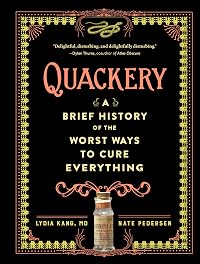
Quackery: A Brief History of the Worst Ways to Cure Everything
by Lydia Kang  , Nate Pedersen
On This Page
Description
"What won't we try in our quest for perfect health, beauty, and the fountain of youth? Well, just imagine a time when doctors prescribed morphine for crying infants. When liquefied gold was touted as immortality in a glass. And when strychnine--yes, that strychnine, the one used in rat poison--was dosed like Viagra. Looking back with fascination, horror, and not a little dash of dark, knowing humor, Quackery recounts the lively, at times unbelievable, history of medical misfires and show more malpractices. Ranging from the merely weird to the outright dangerous, here are dozens of outlandish, morbidly hilarious "treatments"--conceived by doctors and scientists, by spiritualists and snake oil salesmen (yes, they literally tried to sell snake oil)--that were predicated on a range of cluelessness, trial and error, and straight-up scams. With vintage illustrations, photographs, and advertisements throughout, Quackery seamlessly combines macabre humor with science and storytelling to reveal an important and disturbing side of the ever-evolving field of medicine"-- show lessTags
Recommendations














Member Reviews
As soon as I saw Quackery: A Brief History of the Worst Ways to Cure Everything by Lydia Kang I knew that I had to get it in my hands. If the name alone doesn't intrigue you then I don't know what will. This book is full to bursting with historical facts about crazy medical practices through the ages. It is an excellent resource about the history of the medical profession as well as education and social change. Much like when I read Soonish, I felt that it was a little heavy with the 'relatable' humor but this was easily overlooked. (I think Kang pulled it off better anyway.) As someone who has read quite a bit about the history of medicine, I was surprised by just how much I didn't know. For example, did you know that leeches have 3 show more stomachs, 3 jaws, and 100 teeth in each of those jaws?! Kang sets up the different medical practices and procedures by first giving a history of the person that started it off (generally a 'medical practitioner' or someone at least purporting to be one). She then shares accounts from the patients who endured such crazy routines (like bloodletting or ingesting arsenic) paired with diagrams of the medical equipment used to accomplish such feats. (I hope you have a strong stomach for the bloodletting chapter.) I especially enjoyed the little asides about what we now know about the concoctions put together long ago to 'cure' and how the vast majority of them were either complete hokum or actually increased the chances of the patient suffering an agonizing death. It makes you wonder how the future generations will view our supposedly 'innovative' medicines and treatments of the sick. Will we be seen as medical charlatans and blind fools or will they take into account the socioeconomic and political climate that we live in and how that shapes our view on medicine as a whole? As you read this book (and I hope you will) ponder that very question because then perhaps you won't judge past generations quite so harshly...unless it's the guys who took Strychnine in order to increase their sex drive. Always judge those guys. 9/10 show less
Equal parts mortifying, morbid and fascinating, Quackery is a guided tour through the horrifying world of medicine and health care in days gone by. I eat these kinds of books up like candy, who doesn't like lurid trivia of the not-so-good ol' days? I know I do! I really liked the layout, it's akin to my favorite magazine, Mental Floss with little factoids on every page to highlight the subject. Very well organized, full of stomach turning stories of medical mistakes and maladies, it kept me turning pages and very thankful I live in the modern day.
In Quackery, Lydia King provides a hilarious look at some of the most outrageous medical practices throughout history. Teething baby? Mercury cream will calm them right down. Want a pill you can take and still hand down to your kids? Try antimony tablets! IPA too bland for your tastes? Strychnine will provide the bitter buzz you crave! From cocaine tooth drops to lobotomies to irradiated water to tobacco smoke enemas, this book covers an amazing amount of snake oil, some touted by the medical minds of their day and some not.
The book is incredibly entertaining and liberally sprinkled with photos and drawings (some truly nightmare inspiring). This is one of those science books you can read and not even realize how much information show more you’re learning. Want to find out which cutting edge medical treatment contributed to the deaths of Byron, Mozart, and George Washington? Which animal’s testicles you should wear around your neck to prevent pregnancy? Or why corn flakes are part of an anti-masturbation diet? Look no further!
Any one who likes a good dose of humor with their nonfiction will enjoy this book. If you like Mary Roach‘s writing, Unmentionable by Therese Oneill, or any other books in that vein, this book was meant for you.
An advanced copy of this book was provided by the publisher via NetGalley in exchange for an honest review. show less
The book is incredibly entertaining and liberally sprinkled with photos and drawings (some truly nightmare inspiring). This is one of those science books you can read and not even realize how much information show more you’re learning. Want to find out which cutting edge medical treatment contributed to the deaths of Byron, Mozart, and George Washington? Which animal’s testicles you should wear around your neck to prevent pregnancy? Or why corn flakes are part of an anti-masturbation diet? Look no further!
Any one who likes a good dose of humor with their nonfiction will enjoy this book. If you like Mary Roach‘s writing, Unmentionable by Therese Oneill, or any other books in that vein, this book was meant for you.
An advanced copy of this book was provided by the publisher via NetGalley in exchange for an honest review. show less
This was a very fun and, often very gross, record of defunct medical practices through the ages. Clearly, it is not an exhaustive list but it does run through quite a lot of medical charlatans, miscalculations and just plain mistakes through medical history. It is also written to be humorous, as one may have guessed with a title like "Quackery," so it takes a light tone and is very entertaining. I can now say that I know why we have the saying "don't blow smoke up my a**" and it is even weirder than I thought. lol! A very fun read that I highly recommend.
In Quackery, Lydia King provides a hilarious look at some of the most outrageous medical practices throughout history. Teething baby? Mercury cream will calm them right down. Want a pill you can take and still hand down to your kids? Try antimony tablets! IPA too bland for your tastes? Strychnine will provide the bitter buzz you crave! From cocaine tooth drops to lobotomies to irradiated water to tobacco smoke enemas, this book covers an amazing amount of snake oil, some touted by the medical minds of their day and some not.
The book is incredibly entertaining and liberally sprinkled with photos and drawings (some truly nightmare inspiring). This is one of those science books you can read and not even realize how much information show more you’re learning. Want to find out which cutting edge medical treatment contributed to the deaths of Byron, Mozart, and George Washington? Which animal’s testicles you should wear around your neck to prevent pregnancy? Or why corn flakes are part of an anti-masturbation diet? Look no further!
Any one who likes a good dose of humor with their nonfiction will enjoy this book. If you like Mary Roach‘s writing, Unmentionable by Therese Oneill, or any other books in that vein, this book was meant for you.
An advanced copy of this book was provided by the publisher via NetGalley in exchange for an honest review. show less
The book is incredibly entertaining and liberally sprinkled with photos and drawings (some truly nightmare inspiring). This is one of those science books you can read and not even realize how much information show more you’re learning. Want to find out which cutting edge medical treatment contributed to the deaths of Byron, Mozart, and George Washington? Which animal’s testicles you should wear around your neck to prevent pregnancy? Or why corn flakes are part of an anti-masturbation diet? Look no further!
Any one who likes a good dose of humor with their nonfiction will enjoy this book. If you like Mary Roach‘s writing, Unmentionable by Therese Oneill, or any other books in that vein, this book was meant for you.
An advanced copy of this book was provided by the publisher via NetGalley in exchange for an honest review. show less
A good overview of some of the weirdest and most confusing ways that we've been trying to cure things over the lifetime of humanity. Thank goodness for the scientific method!
This book is written in a really casual and understandable style, a bit dorky and jokey. I think it's good for an overview, and anything that I wanted more in-depth information on I looked up later.
This book is written in a really casual and understandable style, a bit dorky and jokey. I think it's good for an overview, and anything that I wanted more in-depth information on I looked up later.
Quackery follows a similar format as recent releases such as Get Well Soon or Wicked Bugs. Informative, witty, and irreverent, books like these have become a new way of learning. In Quackery, Lydia Kang and Nate Pedersen present all things medical from throughout the ages. Unfortunately, they fail at the witty and irreverent aspects of presenting information in this way, making for an uneven, somewhat uncomfortable read at times as they force their modern-day knowledge onto historical actions.
The information itself is as fascinating as it is horrifying to modern ears. Organized by type of medicine like elements, plants and soils, tools, animals, and mysterious powers, each section highlights the most popular historical methods of show more healing the sick. The authors present the justifications for use of each item, the item’s uses, and the item’s eventual downfall. They present a lot of information, and while some of it may be redundant for fans of medical history, the authors’ purpose to enlighten never wavers.
The problem with Quackery is that it tries too hard. The sarcastic asides and personal interjection of opinion that works so well for Sarah Vowell does not work for Ms. Kang and Mr. Pedersen. Their asides are just not funny. Their almost constant interruption of the narrative to insert their modern-day opinions is annoying rather than amusing. The biting wit that made similar books so entertaining is missing. One might even argue that such commentary is not appropriate. After all, while the so-called medicines might make us cringe today, they were used by people who honestly thought they were helpful. It makes me feel similar to watching someone mock the handicapped for acting a certain way even though they might not have control over their physical actions. There is no sympathy that our ancestors felt that blood-letting was a legitimate way to reduce a fever or that mercury soothed a child’s colic. Instead, they use modern medical knowledge to laugh and make fun of the past.
The other area of concern is that while the book is titled Quackery, there is not much focus on quackery itself. Rather, the authors have adopted the idea that all historical medicine is quackery because all historical medicine used harmful things to heal. In each chapter, there is brief mention of specific instances of quackery, like the snake oil salesman, but it is but a fraction of the total chapter and often explained in such a way that makes you realize there were legitimate reasons for selling such things. What is missing then is the real quackery – those doctors who used sugar pills for cures or those peddlers who sold sugar water as hair tonics.
Quackery taken as a history of medicinal practices is interesting. Ms. Kang and Mr. Pedersen take care to explain each item’s usage as well as the reasoning behind it. They add to this information with anecdotes, stories of patients, and pictures from medical textbooks or advertisements. Had they left things there, the book would be much stronger for it. Instead, the authors spend too much time adding their opinionated commentary, leaving readers with a bad impression. This is such a shame because there is so much to be learned about how people used to practice medicine and attempted to heal the sick and the reasons for choosing the tools they did. Sadly, I am now stuck wondering just what we are using now in medicine that will end up being something for which the authors would mock us fifty years from today. show less
The information itself is as fascinating as it is horrifying to modern ears. Organized by type of medicine like elements, plants and soils, tools, animals, and mysterious powers, each section highlights the most popular historical methods of show more healing the sick. The authors present the justifications for use of each item, the item’s uses, and the item’s eventual downfall. They present a lot of information, and while some of it may be redundant for fans of medical history, the authors’ purpose to enlighten never wavers.
The problem with Quackery is that it tries too hard. The sarcastic asides and personal interjection of opinion that works so well for Sarah Vowell does not work for Ms. Kang and Mr. Pedersen. Their asides are just not funny. Their almost constant interruption of the narrative to insert their modern-day opinions is annoying rather than amusing. The biting wit that made similar books so entertaining is missing. One might even argue that such commentary is not appropriate. After all, while the so-called medicines might make us cringe today, they were used by people who honestly thought they were helpful. It makes me feel similar to watching someone mock the handicapped for acting a certain way even though they might not have control over their physical actions. There is no sympathy that our ancestors felt that blood-letting was a legitimate way to reduce a fever or that mercury soothed a child’s colic. Instead, they use modern medical knowledge to laugh and make fun of the past.
The other area of concern is that while the book is titled Quackery, there is not much focus on quackery itself. Rather, the authors have adopted the idea that all historical medicine is quackery because all historical medicine used harmful things to heal. In each chapter, there is brief mention of specific instances of quackery, like the snake oil salesman, but it is but a fraction of the total chapter and often explained in such a way that makes you realize there were legitimate reasons for selling such things. What is missing then is the real quackery – those doctors who used sugar pills for cures or those peddlers who sold sugar water as hair tonics.
Quackery taken as a history of medicinal practices is interesting. Ms. Kang and Mr. Pedersen take care to explain each item’s usage as well as the reasoning behind it. They add to this information with anecdotes, stories of patients, and pictures from medical textbooks or advertisements. Had they left things there, the book would be much stronger for it. Instead, the authors spend too much time adding their opinionated commentary, leaving readers with a bad impression. This is such a shame because there is so much to be learned about how people used to practice medicine and attempted to heal the sick and the reasons for choosing the tools they did. Sadly, I am now stuck wondering just what we are using now in medicine that will end up being something for which the authors would mock us fifty years from today. show less
Members
- Recently Added By
Lists

Workman Publishing
38 works; 1 member

Top Five Books of 2025
954 works; 303 members
Author Information

16+ Works 3,231 Members
Lydia Kang is a LibraryThing Author, an author who lists their personal library on LibraryThing.

6+ Works 1,034 Members
Some Editions
Awards and Honors
Notable Lists
Common Knowledge
- Canonical title
- Quackery: A Brief History of the Worst Ways to Cure Everything
- Original title
- Quackery: A Brief History of the Worst Ways to Cure Everything
- Original publication date
- 2017-10-17; 2017, Workman Publishing, New York
- Blurbers
- Thuras, Dylan
- Original language
- English
Classifications
Statistics
- Members
- 765
- Popularity
- 36,656
- Reviews
- 47
- Rating
- (3.83)
- Languages
- 5 — Czech, English, German, Polish, Portuguese (Portugal)
- Media
- Paper, Audiobook, Ebook
- ISBNs
- 14
- ASINs
- 5