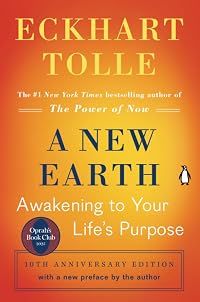
A New Earth: Awakening to Your Life's Purpose
by Eckhart Tolle
On This Page
Description
Tolle presents readers with an honest look at the current state of humanity: he implores us to see and accept that this state, which is based on an erroneous identification with the egoic mind, is one of dangerous insanity. However, there is an alternative to this potentially dire situation. Humanity now, perhaps more than in any previous time, has an opportunity to create a new, saner, more loving world. This will involve a radical inner leap from the current egoic consciousness to an show more entirely new one. In illuminating the nature of this shift, Tolle describes in detail how our current ego-based state of consciousness operates. Then gently, and in very practical terms, he leads us into this new consciousness. We will come to experience who we truly are--which is something infinitely greater than anything we currently think we are.--From publisher description. show lessTags
Recommendations
Member Recommendations
Member Reviews
Ok, I found this book to be mind blowing. In a good way. Yet I can easily see someone else reading it and saying "what a bunch of bunk." I think how you perceive this book will totally depend on your stage of life and the degree to which you are spiritual and the degree to whether that spirituality is primarily derived from your religion or not. I consider myself to be an atheist, yet this book had a religious overtone to it that I could totally embrace. The theories in this book are complex. It is not an easy read by any means. But I think there is a great truth to its message. In some ways, it delivers a similar message as The Shack, but with much, much more finesse and with some guidance on HOW to actually achieve peace and happiness show more in your life. The major message of the book is that it is absolutely of the utmost importance to recognize that life is nothing more than a series of moments that take place NOW. It puts forth a fascinating theory that our personality really consists of "ego" and then our true selves. "Ego" according to the book is the part of ourselves that is thinking and evaluating all the time. It's the part that worries. It's the part that wants. But it isn't our true personhood. The book helps you to realize that the ego can be a barrier to relationships and how to put ego in its place.
The reason I only give it four stars is that I thought the first and last chapters really weren't representative of the rest of the book. The first chapter seems way too new-agey and hard to comprehend. And the last chapter also had too many religious overtones to me and strayed away from the focus on the individual's peace and happiness. But the rest is just GREAT. Challenging and thought provoking to read, but the type of book that could change your life. I think it changed mine. show less
The reason I only give it four stars is that I thought the first and last chapters really weren't representative of the rest of the book. The first chapter seems way too new-agey and hard to comprehend. And the last chapter also had too many religious overtones to me and strayed away from the focus on the individual's peace and happiness. But the rest is just GREAT. Challenging and thought provoking to read, but the type of book that could change your life. I think it changed mine. show less
I really considered a single word review for this book, but on reflection I thought that as he took the time to....um, ... write ... it, and I took the time to actually read it it, I owe more than that to anyone taking the time to read this Goodreads comment.
Martin Gardner reviewed L. Ron Hubbard's Dianetics in his 1952 Fads and Fallacies in the Name of Science and said,
I don't know or care to spend any time finding out how long Tolle took to write this. It's rather simple - perhaps I should emphasize that there is no intellectual challenge here at all and the only real burden was page show more turning...even in electronic format - so it couldn't have taken too long, but he uses the device of Capital letters to apparently imply some deeper meaning that comes off as trite Nonsense:
Or this one:
And the mental anesthesia goes on and on. Way too much time advocating abandonment of ego. Ego bad. No...Ego not bad...Ego only help Dr. Frankenstein. (Hey! If Tolle can be silly, so can I.) Tolle somehow thinks that his parade of platitudes is "spiritual" and not religious. Okay. Call it what you want, but apparently the religious take exception to him as well.
So, why did I read this? Well, I'm curious to see if there is any value to these pop "self help" books (almost always never). I also try to figure out why something is popular (I've pretty much decided it's a systemic lack of critical thinking skills). And I wonder at the mindset of these authors - do they really believe their stuff has worth or have they cracked the code and can sleep at night with the comfort of having made a ton of money hawking bunk?
I sure wish I could drop my personal ethic and sell nonsense to a sadly increasingly gullible American populace. Oprah did the world a disservice endorsing this one.
Oh, the one-word description was...
...Blather. show less
Martin Gardner reviewed L. Ron Hubbard's Dianetics in his 1952 Fads and Fallacies in the Name of Science and said,
Dianetics is a book of impressive thickness! written in a repetitious, immature style. Hubbard claims he wrote it in three weeks. This is believable...
I don't know or care to spend any time finding out how long Tolle took to write this. It's rather simple - perhaps I should emphasize that there is no intellectual challenge here at all and the only real burden was page show more turning...even in electronic format - so it couldn't have taken too long, but he uses the device of Capital letters to apparently imply some deeper meaning that comes off as trite Nonsense:
“Each thing has Beingness, is a temporary form that has its origin within the formless one Life, the source of all things, all bodies, all forms.”
Or this one:
When forms around you die or death approaches, your sense of Beingness, of I Am, is freed from its entanglement with form: Spirit is released from its imprisonment in matter. You realize your essential identity as formless, as an all-pervasive Presence, of Being prior to all forms, all identifications. You realize your true identity as consciousness itself, rather than what consciousness had identified with.
And the mental anesthesia goes on and on. Way too much time advocating abandonment of ego. Ego bad. No...Ego not bad...Ego only help Dr. Frankenstein. (Hey! If Tolle can be silly, so can I.) Tolle somehow thinks that his parade of platitudes is "spiritual" and not religious. Okay. Call it what you want, but apparently the religious take exception to him as well.
So, why did I read this? Well, I'm curious to see if there is any value to these pop "self help" books (almost always never). I also try to figure out why something is popular (I've pretty much decided it's a systemic lack of critical thinking skills). And I wonder at the mindset of these authors - do they really believe their stuff has worth or have they cracked the code and can sleep at night with the comfort of having made a ton of money hawking bunk?
I sure wish I could drop my personal ethic and sell nonsense to a sadly increasingly gullible American populace. Oprah did the world a disservice endorsing this one.
Oh, the one-word description was...
...Blather. show less
Допреди няколко години Тишо беше блогърът, от когото се учих как да пиша и който ме вдъхнови с писанията си аз да си направя блог. От известно време обаче, нещо се случва с него – накратко, изгубил си е акъла и плещи абсолютни глупости.
Това може да се види както от блога му, дето последната публикация е за некакви Просветления, така и от коментарите му в други блогове, вкл. моя, дето ми обясняваше преди show more известно време за виделите Светлината които били на по-висше ниво на съзнание и ми пускаше некакви линкове в мега достоверния сайт феномени.бг за ДНК телепатия при плъховете след смъртта им…
В някакъв коментар мернах, че споменава книгата Нова Земя на Екхарт Толе – което привлече вниманието ми, защото ненормалния американец, фен на всякакви откачени теории на конспирацията, който работи при нас, много се опитваше да ме зарибява по тоя автор. Така че когато американеца ме накара да му купя тая книга на български, за да я подари на приятелката си, не пропуснах шанса да погледна за какво става дума.
Подходих към Нова земя с включен булшит-детектор и разбира се, не останах разочарован. Въоръжен единствено с репликата „От къде знаеш, че е така“, която прилагам подсъзнателно към всичко, което чета, още на третата страница се оказах затънал в празните, но много самочувствени твърдения на Екхарт Толе за прояснено Съзнание, световната Истина и други такива термини с главни букви.
Накратко, Толе е някакъв „духовен учител„, обединяващ философиите на йога, дзен и дао и като такъв сипва с големия черпак себепознание и сила на духа, като обяснява как да се просветлим и да познаем голямата истина – т.е. типичните глупости които гурутата ги плещят.
Имам известни съмнения относно какво кара хората да се обръщат към ученията на подобни шарлатани (шарлатани, защото това, което говорят за Познание, Истина и т.н. си го изсмукват точно от пръстите, а доказателства за него няма) – вирусът на подобни самозаблудителни психози прихваща много лесно хора с емоционални проблеми, житейски затруднения, депресии и т.н. Предвид това, надявам се Тишо да е добре и скоро да преодолее проблемите си, да изчисти тоя вирус от системата си и да се върне към нормалния живот и мислене. show less
Това може да се види както от блога му, дето последната публикация е за некакви Просветления, така и от коментарите му в други блогове, вкл. моя, дето ми обясняваше преди show more известно време за виделите Светлината които били на по-висше ниво на съзнание и ми пускаше некакви линкове в мега достоверния сайт феномени.бг за ДНК телепатия при плъховете след смъртта им…
В някакъв коментар мернах, че споменава книгата Нова Земя на Екхарт Толе – което привлече вниманието ми, защото ненормалния американец, фен на всякакви откачени теории на конспирацията, който работи при нас, много се опитваше да ме зарибява по тоя автор. Така че когато американеца ме накара да му купя тая книга на български, за да я подари на приятелката си, не пропуснах шанса да погледна за какво става дума.
Подходих към Нова земя с включен булшит-детектор и разбира се, не останах разочарован. Въоръжен единствено с репликата „От къде знаеш, че е така“, която прилагам подсъзнателно към всичко, което чета, още на третата страница се оказах затънал в празните, но много самочувствени твърдения на Екхарт Толе за прояснено Съзнание, световната Истина и други такива термини с главни букви.
Накратко, Толе е някакъв „духовен учител„, обединяващ философиите на йога, дзен и дао и като такъв сипва с големия черпак себепознание и сила на духа, като обяснява как да се просветлим и да познаем голямата истина – т.е. типичните глупости които гурутата ги плещят.
Имам известни съмнения относно какво кара хората да се обръщат към ученията на подобни шарлатани (шарлатани, защото това, което говорят за Познание, Истина и т.н. си го изсмукват точно от пръстите, а доказателства за него няма) – вирусът на подобни самозаблудителни психози прихваща много лесно хора с емоционални проблеми, житейски затруднения, депресии и т.н. Предвид това, надявам се Тишо да е добре и скоро да преодолее проблемите си, да изчисти тоя вирус от системата си и да се върне към нормалния живот и мислене. show less
A New Earth, by Eckhardt Tolle
"A New Earth" is a rather heady little book which purports to "show how transcending our ego-based state of consciousness is not only essential to our personal happiness, but also the key to ending conflict and suffering throughout the world." I would call this claim ambitious (and therefore egotistical) coming from any other man. But, because Mr. Tolle operates from the premise that he has harnessed his ego in the service of a greater good, that characterization would run counter to the spirit of the book, may seem grossly unfair, and might even reveal me as one who has not transcended his ego.
I guess ultimately the question is: has Mr. Tolle correctly gauged the utility of the ego? I think it fair to say show more that he feels the ego has no utility, except that when we eradicate the ego at every turn, we come closer to our higher purpose, which is less ego, and more spirit, or, in his words, Consciousness, also known as Presence. Presence can be defined as "consciousness without thought." Indeed, Tolle seems to distrust thought almost as much as ego, which is odd for an author churning out 300-page treatises. How can this be accomplished except with a great deal of rigorous thought? Another oddity: his fixation on the banishment of the ego from all utility, except that of affirming its opposite (spirit) resembles a Catholic argument that Error has only one use — that it helps to define and develop Truth. But Tolle is no Catholic, although he does use many of Jesus' quotes to good effect.
The problem that I have with his premise is that his rejection of the collective ego necessarily rejects a great deal more, which we might call personal ego: the unique qualities that each of us brings into this world, and the special path that we follow because we were born in a particular place and time. I feel that all of these attributes should not be discounted as merely grains of sand on an infinite beach. Surely they must be part of a higher purpose, a personal destiny, which is also worthwhile. Or, if not that, then at least they may be celebrated as defining characteristics of who we are, and how we learn, and may lead therefore to the acquisition of habits that further refine who we are. We shape our habits, and then our habits shape us. And this process is not pernicious, but simply how we develop.
To turn at every opportunity and attempt to jettison this individuality (that's what Mr. Tolle seems to be advocating) seems ungrateful at best and wrong-headed at worst. The ego is not only something to react against. It is also something to understand, come to terms with, learn from, and be grateful for. One need not be a disciple of Ayn Rand to feel that a strong ego is a good thing, on balance.
Yet Mr. Tolle finds no place in the world for the ego. Perhaps this explains why the thrust of the book is toward the otherworldly. For example, he observes on pg. 162 that "...when you realize that pain-bodies unconsciously seek more pain, that is to say, that they want something bad to happen, you will understand that many traffic accidents are caused by drivers whose pain-bodies are active at the time." Tolle's conception is that unconsciousness (overt identification with the ego) creates a negative energy field and an accumulation of pain (the so-called pain-body). Okay, someone's off-kilter energy field or pain-body may be at work, but couldn't these accidents be simply caused by jackass drivers? Left unexplained in this discussion of road rage is how Mr. Tolle or the highway patrol or a judge could possibly know when a pain-body is or is not active and therefore responsible for the accident. This may be why the book is found in the "spiritual" and not the "science" section of the bookstore.
On the positive side, Tolle has a crackerjack team of editors. I never found a typo in this 300-page book. His prose style is effective, if a bit odd. Once he starts, his batteries never run down. He forges constantly ahead with hundreds upon hundreds of small words, scarcely stopping to summarize or collect the argument. This style reminds me of a friend who was equally adept at words and philosophical argument, though his words were longer. After indulging in a helping hand from the pharmaceutical industry he would hold forth on how a certain spinning wheel was within another spinning wheel, which was within yet another other spinning wheel. He never summarized, explained, or stopped talking. Tolle's treatise is somewhat like that, although to be fair he also unearths many fascinating examples of how we trip ourselves up when we pick the wrong objectives. There are also several stories about pithy lessons from enlightened Easterners.
Verdict: as a self-help book, this is not bad, and better than most. Judged as a profound spiritual manifesto, will it really help save the earth and build a better world? I find that unlikely. It was published in 2005, and its predecessor "The Power of Now" was published 15 years ago. The last time I checked, the world seemed to be revolving as it usually does, egos, pain-bodies and all.
His fact-checkers let him down in the sections about religious intolerance (pg. 155-7). He states that "it seems certain that during a three-hundred-year period between three and five million women were tortured and killed by the "Holy Inquisition"…Tolle goes on to equate the gravity of this persecution to the Jewish Holocaust during WWII. Without pause he next compares these twin tragedies to witch-burning, and explains why the phenomenon of burning witches at the stake caught on: “What is it that suddenly made men feel threatened by the female?" he asks. He then answers himself: "The evolving ego in them. It knew it could gain full control of our planet only through the male form, and to do so, it had to render the female powerless. In time, the ego also took over most women, although it could never become as deeply entrenched in them as in men."
Where do I start? Popular history books most often cite from 30,000 to 50,000 for all burned at the stake during the 300 years of the Spanish Inquisition, and specialists come up with even lower numbers. There were other inquisitions, but the sum totals could not have been as high as Tolle claims, and they were not all or even mostly women. See Telchin (2004); and Pasachoff and Littman (2005). The slapdash comparison of the results of the various Inquisitions of the Catholic Church to the horrific extermination of millions of Jews during the Second World War is distasteful, to say the least. As for witch-hunts, certainly they were a real and regrettable phenomenon. Yet, while there were many witches burned at the stake in Europe and America, these numbers, too, have become inflated due to sloppy research, latter-day hysteria, and self-help authors stretching a point. Most professional researchers figure around 50,000 victims, with some few supporting lower figures of around 30,000, and some few who believe there were as many as 100,000 or so.
As for women having less ego than men: Mr. Tolle does not know the women I know. show less
"A New Earth" is a rather heady little book which purports to "show how transcending our ego-based state of consciousness is not only essential to our personal happiness, but also the key to ending conflict and suffering throughout the world." I would call this claim ambitious (and therefore egotistical) coming from any other man. But, because Mr. Tolle operates from the premise that he has harnessed his ego in the service of a greater good, that characterization would run counter to the spirit of the book, may seem grossly unfair, and might even reveal me as one who has not transcended his ego.
I guess ultimately the question is: has Mr. Tolle correctly gauged the utility of the ego? I think it fair to say show more that he feels the ego has no utility, except that when we eradicate the ego at every turn, we come closer to our higher purpose, which is less ego, and more spirit, or, in his words, Consciousness, also known as Presence. Presence can be defined as "consciousness without thought." Indeed, Tolle seems to distrust thought almost as much as ego, which is odd for an author churning out 300-page treatises. How can this be accomplished except with a great deal of rigorous thought? Another oddity: his fixation on the banishment of the ego from all utility, except that of affirming its opposite (spirit) resembles a Catholic argument that Error has only one use — that it helps to define and develop Truth. But Tolle is no Catholic, although he does use many of Jesus' quotes to good effect.
The problem that I have with his premise is that his rejection of the collective ego necessarily rejects a great deal more, which we might call personal ego: the unique qualities that each of us brings into this world, and the special path that we follow because we were born in a particular place and time. I feel that all of these attributes should not be discounted as merely grains of sand on an infinite beach. Surely they must be part of a higher purpose, a personal destiny, which is also worthwhile. Or, if not that, then at least they may be celebrated as defining characteristics of who we are, and how we learn, and may lead therefore to the acquisition of habits that further refine who we are. We shape our habits, and then our habits shape us. And this process is not pernicious, but simply how we develop.
To turn at every opportunity and attempt to jettison this individuality (that's what Mr. Tolle seems to be advocating) seems ungrateful at best and wrong-headed at worst. The ego is not only something to react against. It is also something to understand, come to terms with, learn from, and be grateful for. One need not be a disciple of Ayn Rand to feel that a strong ego is a good thing, on balance.
Yet Mr. Tolle finds no place in the world for the ego. Perhaps this explains why the thrust of the book is toward the otherworldly. For example, he observes on pg. 162 that "...when you realize that pain-bodies unconsciously seek more pain, that is to say, that they want something bad to happen, you will understand that many traffic accidents are caused by drivers whose pain-bodies are active at the time." Tolle's conception is that unconsciousness (overt identification with the ego) creates a negative energy field and an accumulation of pain (the so-called pain-body). Okay, someone's off-kilter energy field or pain-body may be at work, but couldn't these accidents be simply caused by jackass drivers? Left unexplained in this discussion of road rage is how Mr. Tolle or the highway patrol or a judge could possibly know when a pain-body is or is not active and therefore responsible for the accident. This may be why the book is found in the "spiritual" and not the "science" section of the bookstore.
On the positive side, Tolle has a crackerjack team of editors. I never found a typo in this 300-page book. His prose style is effective, if a bit odd. Once he starts, his batteries never run down. He forges constantly ahead with hundreds upon hundreds of small words, scarcely stopping to summarize or collect the argument. This style reminds me of a friend who was equally adept at words and philosophical argument, though his words were longer. After indulging in a helping hand from the pharmaceutical industry he would hold forth on how a certain spinning wheel was within another spinning wheel, which was within yet another other spinning wheel. He never summarized, explained, or stopped talking. Tolle's treatise is somewhat like that, although to be fair he also unearths many fascinating examples of how we trip ourselves up when we pick the wrong objectives. There are also several stories about pithy lessons from enlightened Easterners.
Verdict: as a self-help book, this is not bad, and better than most. Judged as a profound spiritual manifesto, will it really help save the earth and build a better world? I find that unlikely. It was published in 2005, and its predecessor "The Power of Now" was published 15 years ago. The last time I checked, the world seemed to be revolving as it usually does, egos, pain-bodies and all.
His fact-checkers let him down in the sections about religious intolerance (pg. 155-7). He states that "it seems certain that during a three-hundred-year period between three and five million women were tortured and killed by the "Holy Inquisition"…Tolle goes on to equate the gravity of this persecution to the Jewish Holocaust during WWII. Without pause he next compares these twin tragedies to witch-burning, and explains why the phenomenon of burning witches at the stake caught on: “What is it that suddenly made men feel threatened by the female?" he asks. He then answers himself: "The evolving ego in them. It knew it could gain full control of our planet only through the male form, and to do so, it had to render the female powerless. In time, the ego also took over most women, although it could never become as deeply entrenched in them as in men."
Where do I start? Popular history books most often cite from 30,000 to 50,000 for all burned at the stake during the 300 years of the Spanish Inquisition, and specialists come up with even lower numbers. There were other inquisitions, but the sum totals could not have been as high as Tolle claims, and they were not all or even mostly women. See Telchin (2004); and Pasachoff and Littman (2005). The slapdash comparison of the results of the various Inquisitions of the Catholic Church to the horrific extermination of millions of Jews during the Second World War is distasteful, to say the least. As for witch-hunts, certainly they were a real and regrettable phenomenon. Yet, while there were many witches burned at the stake in Europe and America, these numbers, too, have become inflated due to sloppy research, latter-day hysteria, and self-help authors stretching a point. Most professional researchers figure around 50,000 victims, with some few supporting lower figures of around 30,000, and some few who believe there were as many as 100,000 or so.
As for women having less ego than men: Mr. Tolle does not know the women I know. show less
This book was my "100th monkey." Having read many self-help books since the death of my mother--and seeing the wisdom and intelligent observations in all of them--for some reason, this one came along at the right time where i guess I was more open to hear the message.
I listened to the author read this book and I found it to be a breakthrough read for me. I obviously had a very big pain center and wanted to feed it constantly, although I very vocally denied wanting to hurt. I allowed the last 2 painful years of my mother's life to define who she was, and to dictate the rest of my life and how I was going to make my way in the world. After reading this, my eyes, mind and heart were opened to the fact that there was more to my mom and I's show more relationship than struggle, sorrow, pain, loss, emptiness and loneliness.
This book gave me a way to think about how I want to continue in life and how not to flog myself with darker thoughts. show less
I listened to the author read this book and I found it to be a breakthrough read for me. I obviously had a very big pain center and wanted to feed it constantly, although I very vocally denied wanting to hurt. I allowed the last 2 painful years of my mother's life to define who she was, and to dictate the rest of my life and how I was going to make my way in the world. After reading this, my eyes, mind and heart were opened to the fact that there was more to my mom and I's show more relationship than struggle, sorrow, pain, loss, emptiness and loneliness.
This book gave me a way to think about how I want to continue in life and how not to flog myself with darker thoughts. show less
Setting stratospheric expectations is always risky. When Oprah decided to make “A New Earth” the only book she ever selected twice in nearly three decades to grace her book club list, it spurred me to read it.
Make no mistake, Tolle’s acclaimed work offers some valuable and thought-provoking notions for unwrapping ourselves from our egos in a quest to live happier, more fulfilling lives. The fact that I jotted down a couple dozen bullet points is evidence that it was worth the effort — and it was definitely an effort — to read the book.
My issues with “A New Earth” are twofold. For starters, the book was a bit — for lack of a better word — “obtuse” for me, especially the first half. I’m convinced this has more to show more do with me than with the author. Had I been more familiar with Transcendental Meditation-like teachings, I have a hunch I would have more easily connected with some concepts.
The second issue involves the fact that I’ve read at least 30 self-help/personal growth books, and some of these works have explored similar concepts (i.e. the power of living in the present, becoming acutely aware of your breathing, etc.)
One valuable concept focuses on helping readers to rid themselves of dysfunctional thought patterns that are barriers to happiness — anger, resentment, jealousy, etc. The author argues that much of our negative compulsive thinking is repetitive and pointless.
Tolle asserts that whenever we are in a negative state, there is something in us that wants the negativity — that perceives it as pleasurable or that believes it will get us what we want. “Be aware of this every time you enter a negative state,” he writes. “If you can be aware of it, you shift from the ego to awareness.”
Tolle continues: “The ego thrives on negativity and unhappiness.” Awareness of this fact can lead us to a new consciousness. Once we accept that this negativity is hurting us, we will be able to shed this conditioned way of thinking.
Another intriguing concept is what Tolle calls the “pain body”: Old emotional pain that we carry with us — useless baggage that limits us through grievance, guilt, regret, or hostility. We often keep these alive through “mental movie-making.” He describes the pain body as “a psychic parasite, eagerly devouring every negative thought and creating a vicious circle.” The pain body is eager to undermine personal relationships, pushing the buttons of people close to us to heighten the ensuing drama. Our pain body tries to ignite other people’s pain bodies so they can feed off the drama and energize each other. I found all this an interesting spin on compulsive negative thoughts.
Some of the book’s tenets are easy to grasp. For example, Tolle also reminds us that “life isn’t as serious as (our minds) make it out to be.”
On the flip side, some premises struck me as unrealistic. For example, Tolle suggests that we move into a mental place where we “don’t mind what happens,” arguing that if we don’t mind what happens, it means we are “internally in alignment with what happens.” Easier said than done in this twist-filled life.
In summary, “A New Earth,” while flawed and occasionally repetitive serves up a number of intriguing premises. show less
Make no mistake, Tolle’s acclaimed work offers some valuable and thought-provoking notions for unwrapping ourselves from our egos in a quest to live happier, more fulfilling lives. The fact that I jotted down a couple dozen bullet points is evidence that it was worth the effort — and it was definitely an effort — to read the book.
My issues with “A New Earth” are twofold. For starters, the book was a bit — for lack of a better word — “obtuse” for me, especially the first half. I’m convinced this has more to show more do with me than with the author. Had I been more familiar with Transcendental Meditation-like teachings, I have a hunch I would have more easily connected with some concepts.
The second issue involves the fact that I’ve read at least 30 self-help/personal growth books, and some of these works have explored similar concepts (i.e. the power of living in the present, becoming acutely aware of your breathing, etc.)
One valuable concept focuses on helping readers to rid themselves of dysfunctional thought patterns that are barriers to happiness — anger, resentment, jealousy, etc. The author argues that much of our negative compulsive thinking is repetitive and pointless.
Tolle asserts that whenever we are in a negative state, there is something in us that wants the negativity — that perceives it as pleasurable or that believes it will get us what we want. “Be aware of this every time you enter a negative state,” he writes. “If you can be aware of it, you shift from the ego to awareness.”
Tolle continues: “The ego thrives on negativity and unhappiness.” Awareness of this fact can lead us to a new consciousness. Once we accept that this negativity is hurting us, we will be able to shed this conditioned way of thinking.
Another intriguing concept is what Tolle calls the “pain body”: Old emotional pain that we carry with us — useless baggage that limits us through grievance, guilt, regret, or hostility. We often keep these alive through “mental movie-making.” He describes the pain body as “a psychic parasite, eagerly devouring every negative thought and creating a vicious circle.” The pain body is eager to undermine personal relationships, pushing the buttons of people close to us to heighten the ensuing drama. Our pain body tries to ignite other people’s pain bodies so they can feed off the drama and energize each other. I found all this an interesting spin on compulsive negative thoughts.
Some of the book’s tenets are easy to grasp. For example, Tolle also reminds us that “life isn’t as serious as (our minds) make it out to be.”
On the flip side, some premises struck me as unrealistic. For example, Tolle suggests that we move into a mental place where we “don’t mind what happens,” arguing that if we don’t mind what happens, it means we are “internally in alignment with what happens.” Easier said than done in this twist-filled life.
In summary, “A New Earth,” while flawed and occasionally repetitive serves up a number of intriguing premises. show less
I have to preface my review by saying that this book is a bit too "woo-woo" for me at many points. BUT. I think Tolle also makes some very good points about living in the present, and about retraining ourselves to appreciate the present moment. There were several passages that I highlighted and really thought about. That said, there were several parts of the book (like the whole section on "pain bodies") that I found to be pretty ridiculous. I say, get it from the library and read only those sections you find compelling.
Members
- Recently Added By
Lists

Best Self Help Books
87 works; 18 members

Recommend the 20 best books you've read in the last five years
2,168 works; 601 members

Oprah's Book Club (original and 2.0)
91 works; 21 members

Books I Own But Haven't Read
144 works; 2 members

Healing resources for women
587 works; 1 member

Men's healing resources
747 works; 1 member

spirituality and self growth
84 works; 1 member

The Five Books That Represent Us
391 works; 148 members

Books Read in 2026
1,891 works; 66 members
Author Information

178+ Works 20,935 Members
Spiritual author and teacher Eckhart Tolle was born in Germany on February 16, 1948. He lived in Spain and England before settling in Vancouver, Canada in 1995. He received his education at the Universities of London and Cambridge. Following several sustained periods of depression, at the age of 29 he experienced an enlightenment that dramatically show more changed the course of his life. His subsequent spiritual teachings have focused on awareness of the present moment, freedom from negativity, and the attainment of inner peace. He does not align himself with any specific religion or tradition. He has written numerous books including The Power of Now; A New Earth; Stillness Speaks; and Practicing the Power of Now. He is a public speaker who teaches and travels throughout the world. In January 2008, A New Earth was selected for Oprah Winfrey's book club. (Bowker Author Biography) show less
Some Editions
Awards and Honors
Work Relationships
Common Knowledge
- Canonical title
- A New Earth: Awakening to Your Life's Purpose
- Original title
- A New Earth: Awakening to Your Life's Purpose
- Alternate titles
- A New Earth: Create a Better Life
- Original publication date
- 2005
- First words
- Earth, 114 million years ago, one morning just after sunrise: The first flower ever to appear on the planet opens up to receive the rays of the sun.
- Quotations
- A new species is arising on the planet. It is arising now, and you are it!
We are in the midst of a momentous event in the evolution of human consciousness. But they won’t be talking about it in the news tonight. On our planet, and perhaps simultaneously in many parts of our galaxy and beyond, con... (show all)sciousness is awakening from the dream of form. This does not mean all forms (the world) are going to dissolve, although quite a few almost certainly will. It means consciousness can now begin to create form without losing itself in it. It can remain conscious of itself, even while it creates and experiences form. - Last words
- (Click to show. Warning: May contain spoilers.)A new species is arising on the planet. It is arising now, and you are it!
- Original language*
- Inglés
*Some information comes from Common Knowledge in other languages. Click "Edit" for more information.
Classifications
- Genres
- Religion & Spirituality, Philosophy, General Nonfiction, Nonfiction
- DDC/MDS
- 204.4 — Religion The Bible & Christianity Religious experience, life, practice Religious life and practice
- LCC
- BL624 .T635 — Philosophy, Psychology and Religion Religions. Mythology. Rationalism Religions. Mythology. Rationalism Religious life
- BISAC
Statistics
- Members
- 7,729
- Popularity
- 1,468
- Reviews
- 113
- Rating
- (3.99)
- Languages
- 21 — Catalan, Chinese, Czech, Danish, Dutch, English, Estonian, Finnish, French, German, Hindi, Hungarian, Italian, Norwegian (Bokmål), Norwegian, Polish, Portuguese, Russian, Croatian, Spanish, Swedish
- Media
- Paper, Audiobook, Ebook
- ISBNs
- 97
- UPCs
- 3
- ASINs
- 43