On This Page
Description
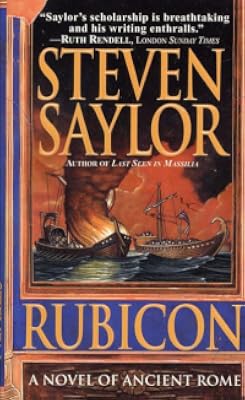
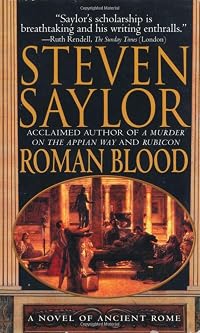
In Ancient Rome, sleuth Gordianus the Finder investigates the death by garroting of Pompey's cousin. The probe plays out amid political turmoil as Julius Caesar invades from Gaul, starting a civil war.Tags
Recommendations








Member Reviews
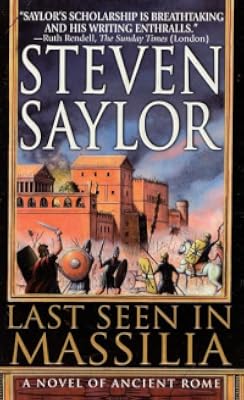
Another good entry in the Roma Sub Roma series. I love the interweaving of late Republican history and a good mystery. Pretty shocking revelation as concerns the mystery at the end (though perhaps predictable to more savvy mystery readers), and interesting conjectures going beyond the evidence of Cicero's letters and Caesar's commentaries on the civil war. Good cliffhanger to get us going to the next book, Last Seen in Massilia.
This story is set at the death of the Roman Republic, and the start of the civil wars from which the Empire emerged. Saylor eschews political analysis or a detailed retelling of the major historical events. Instead he develops a storyline that does bring Gordianus in contact with the famous (Pompeius, Caesar, and Cicero) but still retains a personal and intimate character.
It is well done. Arguably that plot is somewhat contrived and implausible, and serves to create dramatic scenes far more than the puzzle of a whodunnit. As to the murder at the center of the personal story, it is fairly obvious who did it, if you think logically. Saylor as usual tries to hide the truth in plain sight. The resolution is too heart-wrenching to be show more entirely satisfactory, but fits the author’s development of a complex dynamic between Gordianus and Meto, which spans several books.
There are too many implausibilities to make this a great story, but it is a fun book if you have any interest in Roman history. show less
It is well done. Arguably that plot is somewhat contrived and implausible, and serves to create dramatic scenes far more than the puzzle of a whodunnit. As to the murder at the center of the personal story, it is fairly obvious who did it, if you think logically. Saylor as usual tries to hide the truth in plain sight. The resolution is too heart-wrenching to be show more entirely satisfactory, but fits the author’s development of a complex dynamic between Gordianus and Meto, which spans several books.
There are too many implausibilities to make this a great story, but it is a fun book if you have any interest in Roman history. show less
Once again Steven Saylor breathes life and msytery into the world of late Republican Rome, and honor and ethic into ours. Gordianus and his family share the stage with Pompey, Caesar, Cicero and the Senate and People of Rome in a way which impels the reader to enter Gordianus' world - and examine his own in its context. While the historical backdrop makes the novel available, perhaps enjoyable, to readers who have not explored the full Roma sub Rosa series, the development of Gordianus and his family through the series is a rich reward for the reader who will explore the whole. One does nor turn back after crossing the Rubicon, whether en route to Rome or on a journey of the soul. Saylor invites one to cross the Rubicon with Gordianus, show more and to examine oneself in the crucible of the Soul. Caesar risked his honor and his life to cross that river. Caught like all of Rome between Pompey and Caesar, with his son in Caesar's tent and his son-in-law in Pompey's power, Gordianus comes to the bank of that dreadful river and stares into the unknown. Gordianus makes crossing the Rubicon personal, and Saylor brings the crossing forward to your soul. You cannot come away from Saylor's novel without knowing when and what you can and will risk when you stand on the far bank and stare into the mystery across your Rubicon. Cross it. show less
This story cleverly manages to twist itself in amongst historical characters and situations - Caesar, Pompey and Cicero and the threat of civil war. Although the detective element of the plot gets a bit lost in the middle because of those events it is worth reading to the end.
Another cracking book in this series, with a shocking twist near the end. Shorter than his others, but very pacy and tense, so no worse for that (one or two have felt a bit padded).
For me, this did not work as well as the other Gordianus novels I have read. The story did not have the usual investigative process with the answer becoming apparent towards the end of the novel, rather, we had a tour (well written, well researched, and intense—admittedly), through civil war Italy, but then BANG, the answer to the mystery thrown into our laps. All in all, a bit of a let down.
In this episode of Gordianus, the Finder's stories, he finds himself walking a tightrope between the armed camps of Caesar and Pompey. One of Pompey's close advisors shows up at Gordianus's house and is killed in minutes. Why had he come? A close search of his body turns up some incriminating encoded papers. With his daughter, Diana's help, he deciphers one and finds intimate information about his adopted son, Meta, who is Caesar's personal secretary. The implication is that Meta is a spy for Pompey.
Gordianus has to find his son and determine the truth and falls in with Tiro, Cicero's protege, who has a pass signed by Pompey. The two proceed to Brundidium to find Meta. When they reach their destination, Caesar has laid siege to the city show more where Pompey and his troops are secure behind fortress walls. Caesar is also building rafts to close off the harbor to prevent Pompey from escaping by sea.
Gordianus gives us a close up view of the battle that ensues, both from Caesar's camp and then from inside the fortress. History was never so interesting (at least for me).
Saylor continues to weave the story of Gordianus and his family with the real history of the time placing us in the middle of the action. show less
Gordianus has to find his son and determine the truth and falls in with Tiro, Cicero's protege, who has a pass signed by Pompey. The two proceed to Brundidium to find Meta. When they reach their destination, Caesar has laid siege to the city show more where Pompey and his troops are secure behind fortress walls. Caesar is also building rafts to close off the harbor to prevent Pompey from escaping by sea.
Gordianus gives us a close up view of the battle that ensues, both from Caesar's camp and then from inside the fortress. History was never so interesting (at least for me).
Saylor continues to weave the story of Gordianus and his family with the real history of the time placing us in the middle of the action. show less
Members
- Recently Added By
Lists

Books Read in 2014
2,344 works; 89 members
Author Information

61+ Works 13,636 Members
Steven Saylor (born March 23, 1956) is an American author of historical novels. He is a graduate of the University of Texas at Austin, where he studied history and Classics. Although he also has written novels about Texas history, Saylor's best-known work is his Roma Sub Rosa series, set in ancient Rome. The novels' hero is a detective named show more Gordianus the Finder, active during the time of Sulla, Cicero, Julius Caesar, and Cleopatra. He divides his time residing in California and texas. (Bowker Author Biography) show less
Series

Work Relationships
Common Knowledge
- Canonical title
- Rubicon
- Original publication date
- 1999-05-01
- People/Characters
- Gordianus the Finder; Meto; Julius Caesar; Gnaeus Pompeius Magnus; Tiro; Gordiana (show all 13); Bethesda; Marcus Antonius; Marcus Tullius Cicero; Davus; Soscarides; Lucius Domitius Ahenobarbus; Marcus Vitruvius Pollio
- Important places
- Rome, Italy; Ancient Rome
- Important events
- Caesar crosses the Rubicon
- Dedication
- For Eliza. Welcome to the world.
Classifications
Statistics
- Members
- 768
- Popularity
- 36,620
- Reviews
- 15
- Rating
- (3.76)
- Languages
- 8 — Dutch, English, Finnish, French, Hungarian, Polish, Portuguese, Spanish
- Media
- Paper, Audiobook, Ebook
- ISBNs
- 26
- ASINs
- 6