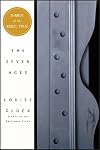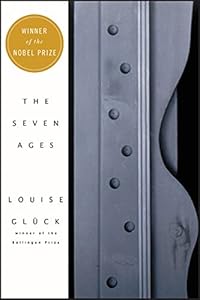
The Seven Ages
by Louise Glück
On This Page
Description
Louise Gluck has long practiced poetry as a species of clairvoyance. She began as Cassandra, at a distance, in league with the immortal; to read her books sequentially is to chart the oracle's metamorphosis into unwilling vessel, reckless, mortal and crude. The Seven Ages is Gluck's ninth book, her strangest and most bold. In it she stares down her own death, and, in so doing, forces endless superimpositions of the possible on the impossible--an act that simultaneously defies and embraces show more the inevitable, and is, finally, mimetic. Over and over, at each wild leap or transformation, flames shoot up the reader's spine. show lessTags
Recommendations
Member Reviews
From a Journal
I had a lover once,
I had a lover twice,
easily three times I loved.
And in between
my heart reconstructed itself perfectly
like a worm.
And my dreams also reconstructed themselves.
After a time, I realized I was living
a completely idiotic life.
Idiotic, wasted –
And sometime later, you and I
began to correspond, inventing
an entirely new form.
Deep intimacy over great distance!
Keats to Fanny Brawne, Dante to Beatrice –
One cannot invent
a new form in
an old character. The letters I sent remained
immaculately ironic, aloof
yet forthright. Meanwhile, I was writing
different letters in my head,
some of which became poems.
So much genuine feeling!
So many fierce declarations
of passionate longing!
I loved once, I loved twice,
and suddenly
the show more form collapsed: I was
unable to sustain ignorance.
How sad to have lost you, to have lost
any chance of actually knowing you
or remembering you over time
as a real person, as someone I could have grown
deeply attached to, maybe
the brother I never had.
And how sad to think
of dying before finding out
anything. And to realize
how ignorant we all are most of the time,
seeing things
only from the one vantage, like a sniper.
And there were so many things
I never got to tell you about myself,
things which might have swayed you.
And the photo I never sent, taken
the night I looked almost splendid.
I wanted you to fall in love. But the arrow
kept hitting the mirror and coming back.
And the letters kept dividing themselves
with neither half totally true.
And sadly, you never figured out
any of this, though you always wrote back
so promptly, always the same elusive letter.
I loved once, I loved twice,
and even though in our case
things never got off the ground
it was a good thing to have tried.
And I still have the letters, of course.
Sometimes I will take a few years’ worth
to reread in the garden,
with a glass of iced tea.
And I feel, sometimes, part of something
very great, wholly profound and sweeping.
I loved once, I loved twice,
easily three times I loved. show less
I had a lover once,
I had a lover twice,
easily three times I loved.
And in between
my heart reconstructed itself perfectly
like a worm.
And my dreams also reconstructed themselves.
After a time, I realized I was living
a completely idiotic life.
Idiotic, wasted –
And sometime later, you and I
began to correspond, inventing
an entirely new form.
Deep intimacy over great distance!
Keats to Fanny Brawne, Dante to Beatrice –
One cannot invent
a new form in
an old character. The letters I sent remained
immaculately ironic, aloof
yet forthright. Meanwhile, I was writing
different letters in my head,
some of which became poems.
So much genuine feeling!
So many fierce declarations
of passionate longing!
I loved once, I loved twice,
and suddenly
the show more form collapsed: I was
unable to sustain ignorance.
How sad to have lost you, to have lost
any chance of actually knowing you
or remembering you over time
as a real person, as someone I could have grown
deeply attached to, maybe
the brother I never had.
And how sad to think
of dying before finding out
anything. And to realize
how ignorant we all are most of the time,
seeing things
only from the one vantage, like a sniper.
And there were so many things
I never got to tell you about myself,
things which might have swayed you.
And the photo I never sent, taken
the night I looked almost splendid.
I wanted you to fall in love. But the arrow
kept hitting the mirror and coming back.
And the letters kept dividing themselves
with neither half totally true.
And sadly, you never figured out
any of this, though you always wrote back
so promptly, always the same elusive letter.
I loved once, I loved twice,
and even though in our case
things never got off the ground
it was a good thing to have tried.
And I still have the letters, of course.
Sometimes I will take a few years’ worth
to reread in the garden,
with a glass of iced tea.
And I feel, sometimes, part of something
very great, wholly profound and sweeping.
I loved once, I loved twice,
easily three times I loved. show less
Gluck is an amazing conceptual poet. And its here her ideas shine. Gluck tends to be very academic and sometimes inaccessible, however here she bends down the branch for you to pick from. Not every poem was great, and her style is ordinary, but there were a few poems that really shone, and I think they're worth reading and remembering.
Winner of the Bollingen Prize
Ratings
Members
- Recently Added By
Author Information

40+ Works 6,381 Members
Louise Elizabeth Gluck, 1943 - Louise Gluck was born April 22, 1943 in New York City, New York. She grew up on Long Island and attended Sarah Lawrence College and Columbia University, both in New York State. She is best known for her award winning collection entitled "The Wild Iris". After graduation, Gluck began teaching poetry, accepting show more positions at various colleges and universities. In 1968, her first collection entitled "Firstborn" was published. Seven years later she published "The House on the Marshland", and in 1985, "The Triumph of Achilles" won the National Book Critics Circle Award for poetry. In 1993, she was an editor of The Best American Poetry anthology. Her last appointment was as Senior Lecturer in English at Williams College. Louise Gluck is considered one of the most gifted poets of her generation. Known for her well-crafted use of verse and meter, she first garnered attention with "Firstborn", a collection of poetry from 1968. Full of angry emotion and disturbing tone, her poetry deals with the horrible and painful. In 1985, "The Triumph of Achilles" was released to thunderous applause, gaining awards in every category. It received the National Book Circle Award, the Boston Globe Literary Press Award and the Poetry Society of America's Melville Kane Award. Gluck has received the Bollingen Prize in Poetry, the Lannas Literary Award for Poetry, fellowships from the Guggenheim and Rockefeller foundations and the National Endowments for the Arts. Her collection "Ararat", (1990) received the Rebekah Johnson Bobbett National Prize for Poetry. Other collections include "The Garden" and "The Wild Iris". The "Wild Iris", perhaps her most award winning collection acquired the highest honor possible in 1993, the Pulitzer Prize for Poetry. It also received the Poetry Society of America's William Carlos Williams Award In 1994 she was named Poet Laureate of Vermont, and was elected as a Chancellor of the Academy of American Poets. In 2003, she was named Poet Laureat of the United States. She was awarded the 2020 Nobel Prize for Literature. (Bowker Author Biography) show less
Awards and Honors
Work Relationships
Is contained in
Classifications
Statistics
- Members
- 283
- Popularity
- 113,470
- Reviews
- 4
- Rating
- (4.06)
- Languages
- English, Spanish
- Media
- Paper, Ebook
- ISBNs
- 5
- ASINs
- 2