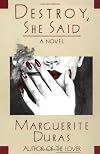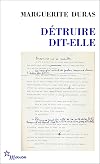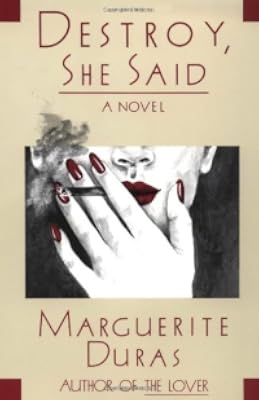
Destroy, She Said
by Marguerite Duras
On This Page
Description
In this classic novel by the best-selling author of The Lover, erotic intrigue masks a chillingly deceptive form of madness. Elisabeth Alione is convalescing in a hotel in rural France when she meets two men and another woman. The sophisticated dalliance among the four serves to obscure an underlying violence, which, when the curtain of civilization is drawn aside, reveals in her fellow guests a very contemporary, perhaps even new, form of insanity. Like many of Duras's novels, Destroy, She show more Said owes much to cinema, displaying a skillful interplay of dialogue and description. There are recurring moods and motifs from the Duras repertoire: eroticism, lassitude, stifled desire, a beautiful woman, a mysterious forest, a desolate provincial hotel. Included in this volume is an in-depth interview with Duras by Jacques Rivette and Jean Narboni. show lessTags
Recommendations



























Member Reviews
Dry as dust, I found this book. I prefer it when characters come to life. Here they have a meaning that they portray.They are all different. I just didn't get it. The novel reads more like a play. The dialogue is short, sharp and concise. It all seems very experimental, nouveau roman like, loved by literary critics but not so much by readers who want some snap and a good read.
I started this but soon realized that there was some kind of printing error, an early page seemed just completely out of place, and I couldn't make it fit in, so I moved it from the to read pile to the to bookcross pile.
En Destruir, dice, como en El amor, entre las miradas indiferentes de cuatro personajes, probablemente en un balneario de la costa normanda, tan presente siempre en las novelas de la Duras, va tejiéndose palabra a palabra las complejas tramas del deseo. Aquí, el diálogo entre dos hombres y dos mujeres es el que conduce al lector en el laberinto de las miradas anhelantes, de las intenciones no cumplidas, de los actos fallidos y de los proyectos truncados. Un diálogo narrador, aunque escueto y lacónico, hecho de supuestos, de inflexiones sutiles. Todos parecen esperar a alguien o algo, todo está siempre a punto de ocurrir : ¿cuándo ?, En qué frase precisa de este diálogo incesante, que se funde con las lánguidas y cálidas show more siestas y las refrescantes noches de verano que no querría tener fin, aparecerá esa persona deseada o ese instante que lo trastocará todo ? show less
Dec 22, 2022Spanish
On sait que Marguerite Duras a le goût de l'étrangeté. A cet égard, Détruire, dit-elle est peut-être le livre le plus étrange qu'elle ait écrit.
Il n'y a pas grand-chose à comprendre de l'histoire. C'est celle de quatre personnages, résidents d'un hôtel en bord de forêt qui se côtoient. Deux femmes, deux hommes.
L'un des deux femmes, Anissa, est très jeune et mariée à un certain Max Thor. L'autre femme, Elisabeth Alione, est soignée pour les nerfs après avoir perdu un enfant mort-né. Le quatrième personnage s'appelle Stein ; il est l'amant d'Anissa.
Le désir et le voyeurisme sont au coeur du texte (dédié à Dionys Mascolo), sans que l'on sache vraiment néanmoins où Marguerite Duras veut vraiment en venir.
Ecrit show more sous la forme d'un roman, le livre est en réalité davantage une pièce de théâtre, car quasiment intégralement fait de dialogues et de descriptions des mouvements ou attitudes des personnages, de l'environnement.
Livre d'insomnie, en clair-obscur, entre réalité et fantasme, Marguerite Duras joue une fois de plus avec un langage brut, voire brutal. Un des attraits du texte provient de la manière directe dont les personnages posent des questions aux autres. C'est une marque d'intérêt. Et si l'on nous posait finalement trop rarement des questions personnelles ? show less
Il n'y a pas grand-chose à comprendre de l'histoire. C'est celle de quatre personnages, résidents d'un hôtel en bord de forêt qui se côtoient. Deux femmes, deux hommes.
L'un des deux femmes, Anissa, est très jeune et mariée à un certain Max Thor. L'autre femme, Elisabeth Alione, est soignée pour les nerfs après avoir perdu un enfant mort-né. Le quatrième personnage s'appelle Stein ; il est l'amant d'Anissa.
Le désir et le voyeurisme sont au coeur du texte (dédié à Dionys Mascolo), sans que l'on sache vraiment néanmoins où Marguerite Duras veut vraiment en venir.
Ecrit show more sous la forme d'un roman, le livre est en réalité davantage une pièce de théâtre, car quasiment intégralement fait de dialogues et de descriptions des mouvements ou attitudes des personnages, de l'environnement.
Livre d'insomnie, en clair-obscur, entre réalité et fantasme, Marguerite Duras joue une fois de plus avec un langage brut, voire brutal. Un des attraits du texte provient de la manière directe dont les personnages posent des questions aux autres. C'est une marque d'intérêt. Et si l'on nous posait finalement trop rarement des questions personnelles ? show less
Apr 1, 2021French
Duras,Marguerite
Dec 5, 2022French
Ratings
Members
- Recently Added By
Lists

le donne raccontano
116 works; 1 member
Author Information

226+ Works 18,867 Members
Marguerite Duras was born in Gia-Dinh, Indochina on April 4, 1914. After attending school in Saigon, she moved to Paris, France to study law and political science. After graduation, she worked as a secretary in the French Ministry of the Colonies until 1941. During World War II, she joined the Resistance and published her first books. After the show more liberation, she became a member of the French Communist Party, and though she later resigned, she always described herself as a Marxist. Her first book, Les Impudents, was published in 1943. During her lifetime, she wrote more than 70 novels, plays, screenplays and adaptations. Her novels include The Sea Wall, The Lover, The Lover from Northern China, The War, and That's All. In 1959, she wrote her first film scenario, Hiroshima, Mon Amour, and has since been involved in a number of other films, including India Song, Baxter, Vera Baxter, Le Camion (The Truck), and The Lover. She died on March 4, 1996 at the age of 81. (Bowker Author Biography) show less
Some Editions
Series
Belongs to Publisher Series
Common Knowledge
- Canonical title
- Destroy, She Said
- Original title
- Détruire, dit-elle
- Original publication date
- 1969
- People/Characters
- Elisabeth Alione; Max Thor; Alissa Thor; Stein; Bernard Alione
- Related movies
- Destroy, She Said (1969 | IMDb)
- Dedication
- For Dionys Mascolo
- First words
- An overcast sky.
- Last words
- (Click to show. Warning: May contain spoilers.)"Music to the name of Stein," she says.
Classifications
Statistics
- Members
- 305
- Popularity
- 104,486
- Reviews
- 5
- Rating
- (3.67)
- Languages
- 10 — Danish, Dutch, English, French, German, Italian, Japanese, Portuguese, Spanish, Swedish
- Media
- Paper, Ebook
- ISBNs
- 17
- ASINs
- 4