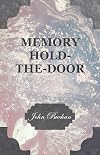
Memory Hold-the-Door
by John Buchan
On This Page
Description
John Buchan 1st Baron Tweedsmuir, had a remarkable life and here is his wonderfully written and fascinating memoir. Buchan can very readily be described as a man of empire, serving in the army during the Boer war and becoming a diplomat and well read historian of the First World War, he settled as Governor General of Canada in 1935 having travelled the world in official posts for the British government. This autobiography was one of John F. Kennedy's favourite books.Tags
Recommendations

















Member Reviews
I picked this up after reading that John F. Kennedy considered it one of his favorite books and after finishing it I can see why. John Buchan, who held the awesomely P.G. Wodehouse-esque peerage of 1st Baron Tweedsmuir, was a pioneering Scottish crime fiction author who became Governor General of Canada back in 1935 when it was necessary to import bored British aristocrats for the position instead of bored local personalities. This is his memoir, and I took away two main things from it. First, he's a seriously great writer; all that Greek and Latin study that the British school system went for in those days really paid off, and I spent a large part of the book paying more attention to his prose than what he was talking about just show more because of the shining clarity of it. I can see why JFK, who had an expensive prep school education himself, would like it so much. Second, he's one of the all time champion brown-nosers and name-droppers: if there's a way to mention that he Knows People, he will find it, and in the process deliver some of the most preposterous compliments you will ever read. There's just no way for me to convey the awe-inspiring magnitude of the rhetorical handjobs he delivers in the book; each page-long encomium, packed with multilingual poetry, ethereal philosophical musings, and lengthy classical allusions is a work of art that has to be read in full to be properly appreciated. When I get famous I'm definitely going to pay someone to write like this about me. As far as his actual life went, a lot of it struck me as dull (Oxford College back around the turn of the 20th century is almost unbearably uninteresting to an American like me) or bizarrely self-obsessed. He served as a colonial administrator in South Africa during the Boer War, one of the most brutal wars in modern history, and according to the book it seems to have consisted almost entirely of hiking in the veldt, reading Euripides, and loads of smashingly erudite jawing about the Meaning of Empire with the jolly good chaps in the Foreign Office. I guess that's a reasonable takeaway for a person whose entire career seems to have been to hang out with famous people, but it was a big struggle to reconcile Buchan's obvious intelligence with his frequently stunningly banal observations; I got frequent vibes of "Other than that Mrs. Lincoln, how was the play?". Other than that, though, he seems to have had a pretty eventful life, and the ending rumination on his experiences is a highly recommended display of thoughtful erudition in action. He was probably one of the most entertaining dinner guests of all time. show less
Oddly enough, though this was in my parents' collection and I can recall seeing it on their shelves for many years, and i like much of Buchan's work and have read that this was one of JFK's favorite books, I have never actually sat down to read this, perhaps being daunted by the sheer size f t. Tasting the first chapter I have found it very good, with Buchan's usual beautifully vivid descriptive writing especally abou the little wood near his childfhood home.
Beautifully written prose, but the content is probably only of interest to Buchan fans, or those interested in early 20th century politics.
Tweedsmuir or John Buchan led a full and interesting life. In this memoir he describes the various government roles he held during the first half of the 20th Century. He was also a writer of serious biography and history augmented by adventure stories such as Greenmantel and The Thirty Nine Steps. He died in 1940 while serving as Canada's Governor-General.
Buchan knew most of the important British politicians and military leaders of the early 20th Century plus many of England's literary figures. He was a close friend of T.E. Lawrence, knew Thomas hardy and Virgina Wolfe and was a friend of King George V. He loved the outdoors and thought nothing of walking 30 miles on a Sunday stroll. He was a passionate fisherman and includes many of show more this ideas about successful fly fishing in this memoir. This was a very pleasant read. show less
Buchan knew most of the important British politicians and military leaders of the early 20th Century plus many of England's literary figures. He was a close friend of T.E. Lawrence, knew Thomas hardy and Virgina Wolfe and was a friend of King George V. He loved the outdoors and thought nothing of walking 30 miles on a Sunday stroll. He was a passionate fisherman and includes many of show more this ideas about successful fly fishing in this memoir. This was a very pleasant read. show less
If you are a lover of Buchan (and you know who you are) this is a book for you. The man was as he appeared.
Also called Pilgrim’s Way
Ratings
Members
- Recently Added By
Lists

Best Autobiographies and Memoirs
370 works; 67 members

Best of Scottish Literature
35 works; 6 members
Author Information

280+ Works 17,557 Members
John Buchan was born in Perth on 26th August, 1875. Educated at Glasgow University and Brasenose College, Oxford, in 1898 Buchan won the Newdigate Prize for poetry. Although trained as a lawyer, Buchan became private secretary to Lord Alfred Milner, high commissioner for South Africa. In 1903 he returned to England where he became a director of show more the publishing company, Thomas Nelson & Sons. In 1910 Buchan had his first novel, Prester John, published. In July 1914, Blackwood's Magazine began serializing Buchan's The Thirty-Nine Steps. With Britain on the verge of war, the nation was obsessed with German spy fever and its subject matter made it an immediate success. When it was published in book form, it sold over 25,000 copies in three months. Charles Masterman, the journalist, was appointed head of the government's War Propaganda Bureau. Masterman recruited Buchan and asked him to organise the publication of a history of the war in the form of a monthly magazine. Published by his own company, the first installment of the Nelson's History of the War appeared in February, 1915. A further twenty-three appeared at regular intervals throughout the war. In the spring of 1915, Buchan agreed to become one of the five journalists attached to the British Army. He was given responsibility for providing articles for The Times and the Daily News. In June 1916, Buchan was recruited by the British Army to draft communiqués for Sir Douglas Haig and other members of the General Headquarters Staff. Given the rank of Second Lieutenant in the Intelligence Corps, Buchan was also provided with the documents needed to write the Nelson's History of the War. Buchan's History of the War provided the public with a completely false impression of what was going on the Western Front. Buchan also wrote a series of propoganda pamphlets published by Oxford University Press. In February, 1917, the government established a Department of Information. Given the rank Lieutenant Colonel, Buchan was put in charge on the department on an annual salary of £1,000 a year. After the war Buchan continued to write adventures stories such as Huntingtower, The Three Hostages, and Witch Wood (1927). He also became involved in politics and in 1927 was elected Conservative MP for the Scottish Universities. Buchan held the seat until granted the title Baron Tweedsmuir in 1935. Buchan was president of the Scottish History Society from 1929 to 1932, and wrote biographies of Montrose and Sir Walter Scott. Buchan also served as governor-general of Canada from 1935 to 1937 and chancellor of Edinburgh University from 1937 to 1940. John Buchan died on 12th February, 1940. (Bowker Author Biography) show less
Work Relationships
Is contained in
Common Knowledge
- Alternate titles
- Pilgrim's Way: An Essay In Recollection; Memory-Hold-The-Door
- Original publication date
- 1940-06
- People/Characters
- John Buchan, 1st Baron Tweedsmuir
- Important places
- Scotland, UK; University of Oxford, Oxford, Oxfordshire, England, UK; Ottawa, Ontario, Canada; Rideau Hall
- First words
- As a child I must have differed in other things besides sanctity from the good Bernard of Clairvaux, who, we are told, could walk all day by the Lake of Geneva and never see the lake.
(Preface)
This book is a journal of certain experiences, not written in the experiencing moment, but rebuilt out of memory. - Last words
- (Click to show. Warning: May contain spoilers.)And not the least there is Emily Brontë: "I lingered round them under that benign sky; watched the moths fluttering among the heath and the harebells, listened to the soft wind breathing through the grass, and wondered how anyone could ever imagine unquiet slumbers for the sleepers in that quiet earth."
- Disambiguation notice
- British title: Memory Hold-the-Door
American title: Pilgrim's Way
Classifications
Statistics
- Members
- 220
- Popularity
- 147,505
- Reviews
- 6
- Rating
- (4.00)
- Languages
- English
- Media
- Paper, Ebook
- ISBNs
- 8
- ASINs
- 21