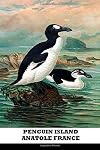
Penguin Island
by Anatole France
On This Page
Description
This masterwork of satire is a must-read for anyone who has ever rolled their eyes at the soft-focus, heavily romanticized histories of Europe's origins that were popular in the eighteenth and nineteenth centuries. In Anatole France's hilarious account, a half-blind missionary lands on a remote island and immediately sets about converting all the natives (which are actually penguins) to Christianity. Centuries' worth of historical hijinks ensue..
Tags
Recommendations



































Member Recommendations
Member Reviews
I like Anatole France; I think his gentle satire and immense learning are a wonderful vehicle for his pleasing prose. But sooner or later I suppose it is inevitable that even in a well-loved author, one will find a book that doesn’t measure up. Sadly—since I was eagerly anticipating this famous work—this was it. The tale is simple: nearsighted monk baptizes the penguins and God, after a curious theological debate, decides to turn the penguins into humans. The rest of the book follows the rise and fall of this “human” civilization and thus gives France the chance to skewer the "high points" of Western civilization. From time to time, flashes of brilliance. Far more often, just disappointing. Tedious even. The successful show more moments, the perfect set pieces, are simply too infrequent. Not recommended…but don’t let that keep you from France. You just need to choose something else. show less
1908. Nobody is this smart anymore, so don't even try to read this unless you're a complete egghead. It went sailing right over my head -- woooo! Almost as boring as The Late George Apley, which I also read a modern library edition of. I'm beginning not to think too much of their choice of books to publish.
Anyway this is a satire of human society, mostly political and religious aspects thereof. It starts off great: an aged monk, St. Mael, nearly blind, baptizes a flock of king penguins when he gets stranded on their island.
Then God, with the help of the communion of saints, especially St. Augustine, decides to make the penguins human, so that they'll have souls, thus forming the isle and nation of Penguinia from decidedly Roman Catholic show more beginnings.
I wish they had stayed Penguins. It would have been more interesting. He uses this awesome beginning as a springboard to say some very dry things about human nature, like basically that we're all stupid and contradictory and selfish and vain. Whatever. show less
Anyway this is a satire of human society, mostly political and religious aspects thereof. It starts off great: an aged monk, St. Mael, nearly blind, baptizes a flock of king penguins when he gets stranded on their island.
Then God, with the help of the communion of saints, especially St. Augustine, decides to make the penguins human, so that they'll have souls, thus forming the isle and nation of Penguinia from decidedly Roman Catholic show more beginnings.
I wish they had stayed Penguins. It would have been more interesting. He uses this awesome beginning as a springboard to say some very dry things about human nature, like basically that we're all stupid and contradictory and selfish and vain. Whatever. show less
This is a wonderfully witty and thought-provoking novel that presents the history of the state of Pingouinie as an allegorical story of (mostly French) history. Reading the original French is definitely recommended as France's command of language is second to none, and his nuanced text proves a delight to read. While I know enough French history to pick up on many of the allusions, I am sure there are many more that would meet a more discerning eye, but there is much that is also a commentary on society in general. The book ends with a poignantly apocalyptic vision of the future that is, in many ways, the most beautiful and heart-rending part of the book, and rings even more true now, 103 years after it was written.
A venerable priest, after being led astray by the devil to be wrecked on an island of penguins, mistakes the penguins for a (rather short) race of men, converts them and baptizes them.
Then, the Lord and many saints, including Saint Augustine and Saint Catherine, are faced with a problem. Are the penguins actually baptized? After some hilarious arguments, it is decided that form is more important than essence. Ie. that because God will only recognize baptisms, weddings, etc. of a certain form (speaking certain words in a certain sequence, in Latin - a kind of formula), He must recognize all such things that cohere to the form, despite whether or not they are right in essence. Hence, because the baptism, however wrong in essence, was show more performed in correct form, it is valid. To prevent further problems, the penguins are transformed into people.
The book is a mock-history of the people of Penguin Island. It satirizes many historical events, notably the Dreyfus affair. It's full of twisted logic (like the logic in the argument about whether or not the penguins were actually baptized) and, for each time period that it covers, imitates the writing style and the feel of the stories of those periods. For example, in the first couple of books, the devil makes frequent appearances while taking on the form of some other person.
Altogether, it's a funny enough read in and of itself (even if you're not familiar with the events that it's satirizing), but it's much better if you're in on the grand joke. show less
Then, the Lord and many saints, including Saint Augustine and Saint Catherine, are faced with a problem. Are the penguins actually baptized? After some hilarious arguments, it is decided that form is more important than essence. Ie. that because God will only recognize baptisms, weddings, etc. of a certain form (speaking certain words in a certain sequence, in Latin - a kind of formula), He must recognize all such things that cohere to the form, despite whether or not they are right in essence. Hence, because the baptism, however wrong in essence, was show more performed in correct form, it is valid. To prevent further problems, the penguins are transformed into people.
The book is a mock-history of the people of Penguin Island. It satirizes many historical events, notably the Dreyfus affair. It's full of twisted logic (like the logic in the argument about whether or not the penguins were actually baptized) and, for each time period that it covers, imitates the writing style and the feel of the stories of those periods. For example, in the first couple of books, the devil makes frequent appearances while taking on the form of some other person.
Altogether, it's a funny enough read in and of itself (even if you're not familiar with the events that it's satirizing), but it's much better if you're in on the grand joke. show less
When a bumbling priest accidently baptizes a population of penguins, God is left with a cosmic problem. The solution results in the creation of the Penguin race, and is the beginning of the long history of Penguinia.
Anatole France has essentially written an entire farcical history book, satirizing various stages of human civilization. First he mocks early religion and mythology, prominently featuring the exploits of a saucy and quick-witted young woman, who in later Penguin history will be known as Saint Orberosia, despite her history of infidelity and opportunistic lies. He follows this up with lampoons of the middle age and modern times, both of which center on the relationship between government and religion. The church, composed of show more saintly followers of the holy Orberosia, is a constant threat to the representative government, alternately instigating baseless scandals (a la the Dreyfus affair), plotting revolutions, and conspiring to start unprovoked wars. Finally France provides us with a very dystopian vision of the future, where Penguinia becomes a soulless commercial metropolis under attack by disillusioned terrorists.
The premise of this book is clearly inspired, but I found it hard to read. It really is a history book, which means that it skips quickly from story to story, never staying long with any particular set of characters. I found the stories involving love and relationships to be sarcastically poignant, while some of the political insights display an astounding amount of relevance to modern events. For example, reflecting on the Penguin government - “The Penguin democracy did not itself govern, it obeyed a financial oligarchy which formed opinion by means of the newspapers, and held in its hand the representatives, the ministers, and the president. It controlled the finances of the republic, and directed the foreign affairs of the country as if it were possessed of sovereign power.” Hmm. When speaking of the political leader they hope to groom into the internal destroyer of the Penguin republic - “It is not necessary for the man we choose to be of brilliant intellect. I would even prefer him to be of no great ability. Stupid people show an inimitable grace in roguery.” I at least can’t help but be reminded of a certain modern political leader.
Although I didn't enjoy reading the book as much as I'd hoped, all of the witty phrases and lucid insights make Penguin Island worth the time it takes to slog through a whole imaginary history. show less
Anatole France has essentially written an entire farcical history book, satirizing various stages of human civilization. First he mocks early religion and mythology, prominently featuring the exploits of a saucy and quick-witted young woman, who in later Penguin history will be known as Saint Orberosia, despite her history of infidelity and opportunistic lies. He follows this up with lampoons of the middle age and modern times, both of which center on the relationship between government and religion. The church, composed of show more saintly followers of the holy Orberosia, is a constant threat to the representative government, alternately instigating baseless scandals (a la the Dreyfus affair), plotting revolutions, and conspiring to start unprovoked wars. Finally France provides us with a very dystopian vision of the future, where Penguinia becomes a soulless commercial metropolis under attack by disillusioned terrorists.
The premise of this book is clearly inspired, but I found it hard to read. It really is a history book, which means that it skips quickly from story to story, never staying long with any particular set of characters. I found the stories involving love and relationships to be sarcastically poignant, while some of the political insights display an astounding amount of relevance to modern events. For example, reflecting on the Penguin government - “The Penguin democracy did not itself govern, it obeyed a financial oligarchy which formed opinion by means of the newspapers, and held in its hand the representatives, the ministers, and the president. It controlled the finances of the republic, and directed the foreign affairs of the country as if it were possessed of sovereign power.” Hmm. When speaking of the political leader they hope to groom into the internal destroyer of the Penguin republic - “It is not necessary for the man we choose to be of brilliant intellect. I would even prefer him to be of no great ability. Stupid people show an inimitable grace in roguery.” I at least can’t help but be reminded of a certain modern political leader.
Although I didn't enjoy reading the book as much as I'd hoped, all of the witty phrases and lucid insights make Penguin Island worth the time it takes to slog through a whole imaginary history. show less
If you like your satire served with brilliant wit with a touch of irony and a side of righteous anger, then Anatole France (the pen name of Jacques Anatole François Thibault) is your writer. You can credit Anatole France, winner of the 1921 Nobel Prize in Literature, with the famous maxim: “The law, in its majestic equality, forbids the rich as well as the poor to sleep under bridges, to beg in the streets, and to steal bread.”
Penguin Island starts with a fantastic premise. A missionary, half blind, comes across the island of penguins and baptizes them. Up in heaven, confounded with this act, the Lord gives the birds souls and intellect. France then uses his new civilization to satirize almost anything within range of his scathing show more intellect. The book generally parallels the development of human civilization. The longest chapter, the story of Pyrot and the 80,000 Trusses of Hay is a blistering critique of the French government’s frame-up of Alfred Dreyfus. This chapter alone justifies the price of the book.
For those who have come to this review through my Tour de France history or my cycling commentary, it should be noted that the Dreyfus Affair was the proximate cause of the creation of Tour de France.
Anatole France is a genius. I heartily recommend this book. show less
Penguin Island starts with a fantastic premise. A missionary, half blind, comes across the island of penguins and baptizes them. Up in heaven, confounded with this act, the Lord gives the birds souls and intellect. France then uses his new civilization to satirize almost anything within range of his scathing show more intellect. The book generally parallels the development of human civilization. The longest chapter, the story of Pyrot and the 80,000 Trusses of Hay is a blistering critique of the French government’s frame-up of Alfred Dreyfus. This chapter alone justifies the price of the book.
For those who have come to this review through my Tour de France history or my cycling commentary, it should be noted that the Dreyfus Affair was the proximate cause of the creation of Tour de France.
Anatole France is a genius. I heartily recommend this book. show less
A surprisingly lackluster fantastical satire from Anatole France, the Nobel winner who brought us dozens of French classics. Of the books of his which I've read, this might be the weakest in my opinion. Whereas Thais's prose sparkled like Flaubert's, the writing here is safer. There are moments of great philosophical insight, but it is difficult to take the subject matter seriously. France does not commit fully to fantasy or to Realism and straddles the two awkwardly. He is not really talking about penguins, just humans. They don't act or look like penguins, he is just calling them penguins.
In the small realm of anthropomorphic literature this still serves a purpose, I suppose. It illustrates many of humanity's flaws, but even France show more has done better elsewhere in his oeuvre. You might look at the discussion between saints on the question of the baptism of inanimate objects and the consecration of animals - the old question of 'will my dog go to heaven?' - as the main thrust of the action in the book, but the developments of the penguinian society requires so much suspension of disbelief that I found myself more annoyed than invested. Dragons? Penguin philosophers, the descent into hell of mythic heroes? Either the author could not decide where he wanted to take his story or he was okay with wandering through every disparate topic that interested him at the time.
Of course, every sentence Anatole ever wrote was well-crafted and intelligent. He's still a great author, but Thais, The Gods Are Athirst, Honey Bee, and any other one of his novels will offer a more interesting display of his storytelling abilities in my opinion. show less
In the small realm of anthropomorphic literature this still serves a purpose, I suppose. It illustrates many of humanity's flaws, but even France show more has done better elsewhere in his oeuvre. You might look at the discussion between saints on the question of the baptism of inanimate objects and the consecration of animals - the old question of 'will my dog go to heaven?' - as the main thrust of the action in the book, but the developments of the penguinian society requires so much suspension of disbelief that I found myself more annoyed than invested. Dragons? Penguin philosophers, the descent into hell of mythic heroes? Either the author could not decide where he wanted to take his story or he was okay with wandering through every disparate topic that interested him at the time.
Of course, every sentence Anatole ever wrote was well-crafted and intelligent. He's still a great author, but Thais, The Gods Are Athirst, Honey Bee, and any other one of his novels will offer a more interesting display of his storytelling abilities in my opinion. show less
Members
- Recently Added By
Lists

Best 20th Century Books as of 1924
100 works; 6 members

Harold Bloom - The Western Canon: D. The Chaotic Age
833 works; 24 members

The Road to Freedom (Will Durant's 100 Best Books for an Education)
100 works; 8 members

Trinity College Booklist (1951): Class Nine, Foreign Literatures
161 works; 3 members

Fiction about missionaries
34 works; 5 members

Authors mentioned in The World of Yesterday
68 works; 1 member
Talk Discussions
Past Discussions
hey in cghh (April 2013)
Author Information

Anatole France was the pen name of Jacques Anatole Francois Thibault, who was born in Paris in 1844. The son of a bookseller, Thibault had a lifelong interest in literature. He worked as a schoolteacher, as a reader and editor for publishing houses, and as an assistant librarian in Paris' Senate Library, in addition to writing fiction, plays, show more poetry, criticism, and autobiographical stories. In his lifetime, Thibault was considered one of France's most beloved authors, and he received the Nobel Prize for literature in 1921. France's first novel was The Famished Cat, published in 1879. France's best-known novels include Monsieur Bergeret in Paris, The Crime of Sylvestre Bonnard, Member of the Institute (for which he received an award from the French Academy in 1881), At the Sign of the Reine Pedauque, Penguin Island, Thais (which became the basis for an opera), The Gods Are Athirst, and The Revolt of the Angels. During the late 1890s Thibault became very involved in political and social issues. He was especially committed to socialism and to the fight against anti-Semitism, mainly as a result of the Dreyfuss affair. This new awareness was reflected in his writing, particularly in books such as Penguin Island, which criticized contemporary French society, and The Revolt of the Angels, which parodied the Catholic Church. He also became the literary advisor to l'Humanitie, an influential socialist newspaper, and frequently contributed articles to it until, dissatisfied with the Communist party that had eventually evolved, he renounced all political ties to the left just before his death in 1924. (Bowker Author Biography) show less
Some Editions
Awards and Honors
Series
Belongs to Publisher Series
Work Relationships
Is contained in
Common Knowledge
- Canonical title
- Penguin Island
- Original title
- L'île des pingouins; L'Île des Pingouins
- Original publication date
- 1908
- Important places
- Alca
- First words
- Mael, a scion of the royal family of Cambria, was sent in his ninth year to the Abbey of Yvern so that he might there study both sacred and profane learning.
- Original language
- French
Classifications
- Genres
- General Fiction, Fiction and Literature, Fantasy
- DDC/MDS
- 843.8 — Literature & rhetoric French & related literatures French fiction Later 19th century 1848–1900
- LCC
- PQ2254 .I4 .E5 — Language and Literature French, Italian, Spanish and Portuguese literatures French literature Modern literature 19th century
- BISAC
Statistics
- Members
- 969
- Popularity
- 27,039
- Reviews
- 22
- Rating
- (3.59)
- Languages
- 17 — Czech, Dutch, English, Estonian, Finnish, French, German, Greek, Hebrew, Hungarian, Italian, Polish, Portuguese, Romanian, Russian, Spanish, Turkish
- Media
- Paper, Audiobook, Ebook
- ISBNs
- 109
- UPCs
- 1
- ASINs
- 88