
Gulliver's Travels
by Jonathan Swift
On This Page
Description
The voyages of an Englishman carry him to such strange places as Lilliput, where people are six inches tall; Brobdingnag, a land of giants; an island of sorcerers; and a country ruled by horses.Tags
Recommendations








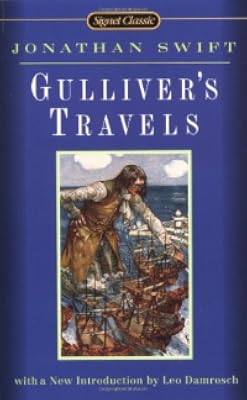






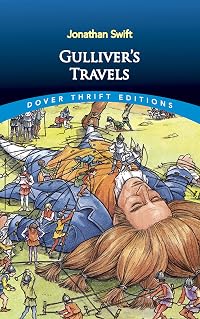




Member Recommendations
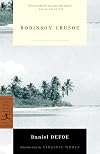


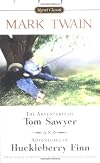
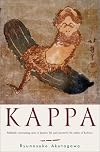
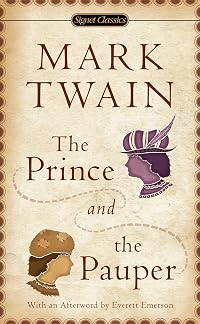
CGlanovsky Visitor to a strange society that subtly satirizes his own.
20


CGlanovsky Faux travelogues of fictitious island cultures detailing the intricacies of their geography, governance, cuisine, art, etc.
11
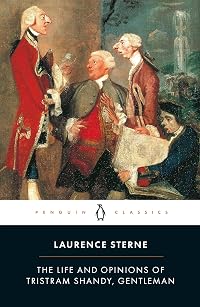
leigonj Kafka had Swift's book in his library and there are definite commonalities between their two writings; I'd be surprised if one had not influenced the other. (Also The Trial).
12

Member Reviews
Quem lê pela primeira vez a versão original de Viagens de Gulliver, tendo como pano de fundo uma vaga lembrança de adaptações infantis, espanta-se ao constatar que tem nas mãos um dos textos mais amargos do cânone ocidental. Como observa George Orwell no prefácio incluído nesta edição, o livro de Jonathan Swift, apesar de todo o seu ressentimento e misantropia, é uma obra deliciosa, que permite vários níveis de leitura. É primeiro um livro de viagens - ou melhor, uma sátira aos livros de viagens, tal como Dom Quixote é, entre outras coisas, uma sátira aos romances de cavalaria; para as crianças, é uma história de aventuras, cheia das criaturas fantásticas e do humor escatológico de que tanto gostam; e é um dos show more marcos iniciais da ficção científica. Entretanto, o que mais fascina o leitor maduro nessa obra publicada pela primeira vez em 1726 é o olhar implacável que seu autor volta sobre o homem, suas instituições, seu apego irracional ao poder e ao ouro, e sua insistência em prolongar a vida mesmo quando esta só proporciona sofrimento. Esta edição de Viagens de Gulliver foi organizada pelo professor Robert DeMaria Jr., também responsável pelo texto de introdução e pelas notas, e conta com imagens preciosas, como reproduções da folha de rosto e do frontispício da primeira edição da obra-prima de Jonathan Swift, além de mapas das diferentes terras citadas no romance, inestimáveis para a leitura. show less
It is remarkable that a book published nearly 300 years ago is still not merely readable but entertaining. Swift's satire of contemporary politics remains both of these. Other than some words which can be understood by context ('hanger' for sword), the language is our language.
His Gulliver is no intellectual but he is not stupid. He comes across as eminently likeable - a bit of a chancer perhaps but with no malice in him whatsoever. His responses are never naive but they are those of a man who wants to see the best in a situation and in people.
He starts off at least without doubts as to his own culture, civilisation and status in life. He defers to his 'betters' out of principle as well as necessity. All he wants to do is earn a pot to show more feed his family back home and to do so through honest labour.
He is a free-booting English adventurer of the old type, a mentality to be crushed in stages by the Victorian home, the welfare state and general wokery. Swift's lack of preciousness about bodily functions is refreshing. Swift criticises his own kind through a good and decent example of it.
Of course, the contemporary political references are now only for antiquarians. The satire, however, is directed at far more than the contingent foibles and failures of early eighteenth century society and politics. It is directed at the human condition itself.
The Grand Academy of Lagado remains, for example, a brutal satire on the political projectors and think tank wonks of today as much as then. I am afraid I recognised the Laputans as direct ancestors of many Futurist acquaintances with their existential fears and confused reasoning.
Swift is above all a humanist. Today's reader will be surprised at his contemporary designation as a High Tory since his analyses of our species and of society lead time and time again to quite radical conclusions more associated with the modern intelligent Left (not that much of that remains).
His 'conservatism' lies only in the recognition that, whatever he may wish humanity to be, humanity is as it is and so these follies and foibles must continue regardless of the ambitions of the 'projectors' - and so it has proved 300 years later. Plus ca change.
We all know the stories of Lilliput (Gulliver as giant) and Brobdingnag (Gulliver as tiny) but the tales of the isles to the east of Japan (including Laputa) and of the land of the Houyhnhms and Yahoos are worth the extra effort. The book becomes sadder as it proceeds and is not for children.
The first two parts are rollicking satires of human and lordly pretension with enough incident, even if bowdlerised (such as Gulliver peeing on a palace fire in Liiliput), to entertain children. The third and fourth begin to show much more of the self-delusion and cruelty of our species.
Gulliver has a form of mental breakdown during his fourth voyage in which his identification with intelligent horses, who behave like model noble Romans who farmed their plots before the Republic tore itself apart, makes it impossible for him to live easily as a human afterwards.
Indeed, his alienation from his own kind (including his family) seems to turn towards psychosis. Set against Christian and classical ideals, he sees us, 150 years before Darwin, as a form of jumped up Hobbesian brute. He yearns, in effect, to become a human horse, to become an 'ideal'.
Thus we see the fate of all highly intelligent good-hearted intellectuals faced with social reality - you either have a moan (and that is what the eminently sane Swift does in this book) or you go mad. Swift allows himself the luxury of a safe and vicarious insanity through Lemuel Gulliver.
This dark side of the book is seldom noted either because our attention is caught by the rollicking fun of the first two parts or we stand back and enjoy the satire without thinking that it is actually directed at our very core, perhaps at our 'original sin' of simply being what we are.
The edition I used cannot easily be found on Goodreads (it is a 1960s Harper Perennial Edition from the US with an excellent short academic introduction and no cuts) but any reasonable modern edition will do. A knowledge of early modern history and culture helps but is not necessary. show less
His Gulliver is no intellectual but he is not stupid. He comes across as eminently likeable - a bit of a chancer perhaps but with no malice in him whatsoever. His responses are never naive but they are those of a man who wants to see the best in a situation and in people.
He starts off at least without doubts as to his own culture, civilisation and status in life. He defers to his 'betters' out of principle as well as necessity. All he wants to do is earn a pot to show more feed his family back home and to do so through honest labour.
He is a free-booting English adventurer of the old type, a mentality to be crushed in stages by the Victorian home, the welfare state and general wokery. Swift's lack of preciousness about bodily functions is refreshing. Swift criticises his own kind through a good and decent example of it.
Of course, the contemporary political references are now only for antiquarians. The satire, however, is directed at far more than the contingent foibles and failures of early eighteenth century society and politics. It is directed at the human condition itself.
The Grand Academy of Lagado remains, for example, a brutal satire on the political projectors and think tank wonks of today as much as then. I am afraid I recognised the Laputans as direct ancestors of many Futurist acquaintances with their existential fears and confused reasoning.
Swift is above all a humanist. Today's reader will be surprised at his contemporary designation as a High Tory since his analyses of our species and of society lead time and time again to quite radical conclusions more associated with the modern intelligent Left (not that much of that remains).
His 'conservatism' lies only in the recognition that, whatever he may wish humanity to be, humanity is as it is and so these follies and foibles must continue regardless of the ambitions of the 'projectors' - and so it has proved 300 years later. Plus ca change.
We all know the stories of Lilliput (Gulliver as giant) and Brobdingnag (Gulliver as tiny) but the tales of the isles to the east of Japan (including Laputa) and of the land of the Houyhnhms and Yahoos are worth the extra effort. The book becomes sadder as it proceeds and is not for children.
The first two parts are rollicking satires of human and lordly pretension with enough incident, even if bowdlerised (such as Gulliver peeing on a palace fire in Liiliput), to entertain children. The third and fourth begin to show much more of the self-delusion and cruelty of our species.
Gulliver has a form of mental breakdown during his fourth voyage in which his identification with intelligent horses, who behave like model noble Romans who farmed their plots before the Republic tore itself apart, makes it impossible for him to live easily as a human afterwards.
Indeed, his alienation from his own kind (including his family) seems to turn towards psychosis. Set against Christian and classical ideals, he sees us, 150 years before Darwin, as a form of jumped up Hobbesian brute. He yearns, in effect, to become a human horse, to become an 'ideal'.
Thus we see the fate of all highly intelligent good-hearted intellectuals faced with social reality - you either have a moan (and that is what the eminently sane Swift does in this book) or you go mad. Swift allows himself the luxury of a safe and vicarious insanity through Lemuel Gulliver.
This dark side of the book is seldom noted either because our attention is caught by the rollicking fun of the first two parts or we stand back and enjoy the satire without thinking that it is actually directed at our very core, perhaps at our 'original sin' of simply being what we are.
The edition I used cannot easily be found on Goodreads (it is a 1960s Harper Perennial Edition from the US with an excellent short academic introduction and no cuts) but any reasonable modern edition will do. A knowledge of early modern history and culture helps but is not necessary. show less
Quem lê pela primeira vez a versão original de Viagens de Gulliver, tendo como pano de fundo uma vaga lembrança de adaptações infantis, espanta-se ao constatar que tem nas mãos um dos textos mais amargos do cânone ocidental. Como observa George Orwell no prefácio incluído nesta edição, o livro de Jonathan Swift, apesar de todo o seu ressentimento e misantropia, é uma obra deliciosa, que permite vários níveis de leitura. É primeiro um livro de viagens - ou melhor, uma sátira aos livros de viagens, tal como Dom Quixote é, entre outras coisas, uma sátira aos romances de cavalaria; para as crianças, é uma história de aventuras, cheia das criaturas fantásticas e do humor escatológico de que tanto gostam; e é um dos show more marcos iniciais da ficção científica. Entretanto, o que mais fascina o leitor maduro nessa obra publicada pela primeira vez em 1726 é o olhar implacável que seu autor volta sobre o homem, suas instituições, seu apego irracional ao poder e ao ouro, e sua insistência em prolongar a vida mesmo quando esta só proporciona sofrimento. Esta edição de Viagens de Gulliver foi organizada pelo professor Robert DeMaria Jr., também responsável pelo texto de introdução e pelas notas, e conta com imagens preciosas, como reproduções da folha de rosto e do frontispício da primeira edição da obra-prima de Jonathan Swift, além de mapas das diferentes terras citadas no romance, inestimáveis para a leitura. show less
Everyone has read Jonathan Swift's Gulliver's Travels, right? Wrong, at least in many, or perhaps most, instances. It's a children's book isn't it? Absolutely wrong! If any book in the English language has been sinned against, it's this one. Swift's caustic satire casting acerbic aspersions on the many ills of mankind has been cleansed, expurgated, whitewashed, and dumbed down into mild adventure stories for children and even into comic books! Gone from them are the sexual and scatological descriptions. Gone are the stringent attacks on human pride, avarice, and greed. Gone are the quite unflattering portraits of lawyers, judges, parliamentarians, sovereigns, social grandees, and purveyors of remedies and cures. Such picture books have show more no more in common with the real Gulliver's Travels than a “Mad Max” movie has with Macbeth (or Hamlet--take your pick).
Suffer me to quote from the Publisher's Preface to Gulliver's Travels in an accurate rendition published by Easton Press in 1976:
“Although Gulliver's Travels has entertained generation after generation, this was not the author's intent. While he was writing it, Dean Swift wrote from Dublin: 'The chief end I propose to myself in all my labours is to vex the world rather than divert it.' During Swift's own century this end was realized and the savage satire remained uppermost in the reader's mind.
“However, as the years rolled by, the satire began to evaporate, and the story to emerge. No edition appeared in America until 1793, when it came out under the title: The Adventures of Captain Gulliver, abridged from the works of the celebrated Dean Swift.
“Thus, Gulliver's Travels has been known in America as a book for children, published in abridged or expurgated versions, and the illustrations made for it are usually illustrations made for the nursery. It was a ridiculous fate for a savage book, for a book about which H. L. Mencken wrote: 'After two hundred years its blistering humors are as fresh as today's witticism. It comes in great gusts, blasts, tornados!'”
Dean of St. Patrick's in Dublin though he was, Jonathan Swift appears to have held humans, with their foibles and schemes and dissembling natures and hypocrisies, in very low regard. Indeed, he esteemed the intelligence and logic of equines well above the brutish nature of humans, or so his character's final sojourn in the land of the Houyhnhnms would suggest.
The real Gulliver's Travels is from start to finish replete with biting satire of most human institutions, and it is marvelously good satire. Any readers who have fallen into the error of misunderstanding what this book is really about owe it to themselves to disabuse themselves of their mistaken interpretation of the book by reading the “adult” version that Swift penned in the early 18th century. It is amazing how little human nature has changed in the intervening years! show less
Suffer me to quote from the Publisher's Preface to Gulliver's Travels in an accurate rendition published by Easton Press in 1976:
“Although Gulliver's Travels has entertained generation after generation, this was not the author's intent. While he was writing it, Dean Swift wrote from Dublin: 'The chief end I propose to myself in all my labours is to vex the world rather than divert it.' During Swift's own century this end was realized and the savage satire remained uppermost in the reader's mind.
“However, as the years rolled by, the satire began to evaporate, and the story to emerge. No edition appeared in America until 1793, when it came out under the title: The Adventures of Captain Gulliver, abridged from the works of the celebrated Dean Swift.
“Thus, Gulliver's Travels has been known in America as a book for children, published in abridged or expurgated versions, and the illustrations made for it are usually illustrations made for the nursery. It was a ridiculous fate for a savage book, for a book about which H. L. Mencken wrote: 'After two hundred years its blistering humors are as fresh as today's witticism. It comes in great gusts, blasts, tornados!'”
Dean of St. Patrick's in Dublin though he was, Jonathan Swift appears to have held humans, with their foibles and schemes and dissembling natures and hypocrisies, in very low regard. Indeed, he esteemed the intelligence and logic of equines well above the brutish nature of humans, or so his character's final sojourn in the land of the Houyhnhnms would suggest.
The real Gulliver's Travels is from start to finish replete with biting satire of most human institutions, and it is marvelously good satire. Any readers who have fallen into the error of misunderstanding what this book is really about owe it to themselves to disabuse themselves of their mistaken interpretation of the book by reading the “adult” version that Swift penned in the early 18th century. It is amazing how little human nature has changed in the intervening years! show less
Most people have at least heard of Gulliver’s Travels and it’s hard not to have a few preconceived notions pop into your head for a book like that. I knew the general idea before I read it, but I was surprised by the specific observations Gulliver shares about each race he visits. A shipwreck strands Gulliver with the Lilliputs and a series of adventures follow.
Originally published as a satire, the book is now read by all ages. He travels all over and meets the strangest people. He makes observations about their ways of life and in doing so often tells more about himself and his prejudices than he means to. Each new group teaches him something about the way he sees the world.
The Lilliputs are a tiny people, so small they can fit show more in his hand. They have to make 100 meals just to feed him. The very next group he discovers are giants and he is now the tiny figure that can fit in their hand. His observations of both of these groups were not always what you would expect. Sometimes he remarks on the texture of their skin. He even makes some hilarious comments about watching one of the giants nurse and being terrified by her enormous breast. The woman who takes care of him in the giants’ land sews him shirts lets him to use items from her dollhouse.
There’s a lot of humor worked into the stories. At one point he gets in a fight with the queen’s dwarf and is dropped into a giant bowl of cream and then stuck into a marrow bone. There are houseflies that constantly plague him because they're the size of birds. He can see when the flies lay eggs in the giants’ food because they look so large to him. Gulliver also discovers the Houyhnhnms, a race of horses that are superior to all the other races he describes.
The thing I loved about it was that it made you look at your own world a little differently. It makes you notice things that you normally take for granted. The whole book is a fascinating exercise in how our situation and surroundings affect the way we see the world. Swift manages to do this in a humorous way, never taking himself too seriously. It broke my heart a little that Gulliver kept leaving his family to travel and then when he finally returns he never quite gets over leaving the Houyhnhnms.
BOTTOM LINE: At times clever, at others dry, this classic gives the reader a lot to think about when they view their own society. It’s a reminder that so much of what we believe is based on what we already know. The more we learn about other cultures, the more we can understand them and appreciate their strengths. show less
Originally published as a satire, the book is now read by all ages. He travels all over and meets the strangest people. He makes observations about their ways of life and in doing so often tells more about himself and his prejudices than he means to. Each new group teaches him something about the way he sees the world.
The Lilliputs are a tiny people, so small they can fit show more in his hand. They have to make 100 meals just to feed him. The very next group he discovers are giants and he is now the tiny figure that can fit in their hand. His observations of both of these groups were not always what you would expect. Sometimes he remarks on the texture of their skin. He even makes some hilarious comments about watching one of the giants nurse and being terrified by her enormous breast. The woman who takes care of him in the giants’ land sews him shirts lets him to use items from her dollhouse.
There’s a lot of humor worked into the stories. At one point he gets in a fight with the queen’s dwarf and is dropped into a giant bowl of cream and then stuck into a marrow bone. There are houseflies that constantly plague him because they're the size of birds. He can see when the flies lay eggs in the giants’ food because they look so large to him. Gulliver also discovers the Houyhnhnms, a race of horses that are superior to all the other races he describes.
The thing I loved about it was that it made you look at your own world a little differently. It makes you notice things that you normally take for granted. The whole book is a fascinating exercise in how our situation and surroundings affect the way we see the world. Swift manages to do this in a humorous way, never taking himself too seriously. It broke my heart a little that Gulliver kept leaving his family to travel and then when he finally returns he never quite gets over leaving the Houyhnhnms.
BOTTOM LINE: At times clever, at others dry, this classic gives the reader a lot to think about when they view their own society. It’s a reminder that so much of what we believe is based on what we already know. The more we learn about other cultures, the more we can understand them and appreciate their strengths. show less
Even on (fifth? sixth?) read, and even with a stronger acquaintance with the sources (hello, Gargantua! sup Lycurgus), the inventiveness never flags. And the satire certainly has its flat-in-2010 moments (mockin' on Walpole and Bolingbroke, like that immortal Simpsons moment when Barney and Wade Boggs get in a fistfight about whether the greatest British prime minister was Pitt the Elder or Lord Palmerston), but overall it surprises you with its Juvenalian saturninity, its baleful eye. These are stories you'll never forget, as useful for an impromptu fairytale as for thinking about the good society in a new way at 17, realizing "hey, the Houyhnhnms aren't the good guys at all . . . ."
No, the reason this loses a half star as I return to show more it in fullblown manhood is that I'm a lot less susceptible to the Augustan smoothness with which Swift invites us to agree with him, a lot less willing to accept the "dark failure" view of mankind as seductive now that I know I won't just forget it as soon as I go outside in the teenage sunshine. I won't condemn Swift's misanthropy on general principle. But I think we have to condemn him on the specifics too. So often he's condemning lawyers and whoremasters and degenerate nobles and all the usual targets, and then he gets around to women, and you'd expect the usual stuff about how they're silly and grasping or whatever, but Swift condemns them for "lewdness", and given the state of patriarchal relations at that time, that is fucking appalling. Or another example: footnote tells me that when he makes fun of "fiddlers" in Book IV, it's far from idle talk--this man, this deacon and thunderbolt moralist refused to come to a man's defense on a rape charge because he was a fiddler. It's "hang 'im! If he's not guilty of this it'll just be something else. Fiddlers."
And it comes across in the satire. How can it not? And it makes me sour. So don't love Jon Swift, but read Gulliver's Travels, the vividest English novel of the 18th c. show less
No, the reason this loses a half star as I return to show more it in fullblown manhood is that I'm a lot less susceptible to the Augustan smoothness with which Swift invites us to agree with him, a lot less willing to accept the "dark failure" view of mankind as seductive now that I know I won't just forget it as soon as I go outside in the teenage sunshine. I won't condemn Swift's misanthropy on general principle. But I think we have to condemn him on the specifics too. So often he's condemning lawyers and whoremasters and degenerate nobles and all the usual targets, and then he gets around to women, and you'd expect the usual stuff about how they're silly and grasping or whatever, but Swift condemns them for "lewdness", and given the state of patriarchal relations at that time, that is fucking appalling. Or another example: footnote tells me that when he makes fun of "fiddlers" in Book IV, it's far from idle talk--this man, this deacon and thunderbolt moralist refused to come to a man's defense on a rape charge because he was a fiddler. It's "hang 'im! If he's not guilty of this it'll just be something else. Fiddlers."
And it comes across in the satire. How can it not? And it makes me sour. So don't love Jon Swift, but read Gulliver's Travels, the vividest English novel of the 18th c. show less
“I cannot but conclude that the Bulk of your Natives, to be the most pernicious Race of little odious Vermin that Nature ever suffered to crawl upon the Surface of the Earth.”
Gulliver’s Travels was published in 1726 by Irish author Jonathan Swift. It is the story of the travels of ship's surgeon, Lemuel Gulliver to various fantastical lands.
Gulliver first travels to Lilliput, a land of tiny people caught up with political rivalries between the High Heels and the Low Heels and religious disputes between the “Big Endians” and the “Small Endians” in reference to where they cut their eggs.
Next he travels to Brobdingnag, a land of giants where he has the reverse experience of being the small and vulnerable one. Thirdly he show more travels to Laputa, a land where the focus is so much on science and experiments that the whole country has fallen into a dysfunctional state. Lastly he lives in the Land of the Houyhnhnms, where he finally realises he is the same as the despised and vulgar Yahoos and begins to idolize his wise horsey overlords.
I began this book feeling that the narrator was an over-intrusive pompous colonialistic ass. Gradually I realised that there were strong elements of satire to the story and there was indeed some self-awareness about the follies and evils of colonialism. Some of the countries he visited were horrified at his descriptions of the bloodthirsty wars of the British and forced Gulliver to reevaluate his own sense of superiority. However, despite the clever political satire, I couldn’t get past my perception of Gulliver being a boring pompous white guy who I didn’t really like. And although I realise you can’t judge an 18th century book by 21st century moral values, I found his sexism, racism and homophobia trying to read. 3 stars for imagination and cleverness. show less
Gulliver’s Travels was published in 1726 by Irish author Jonathan Swift. It is the story of the travels of ship's surgeon, Lemuel Gulliver to various fantastical lands.
Gulliver first travels to Lilliput, a land of tiny people caught up with political rivalries between the High Heels and the Low Heels and religious disputes between the “Big Endians” and the “Small Endians” in reference to where they cut their eggs.
Next he travels to Brobdingnag, a land of giants where he has the reverse experience of being the small and vulnerable one. Thirdly he show more travels to Laputa, a land where the focus is so much on science and experiments that the whole country has fallen into a dysfunctional state. Lastly he lives in the Land of the Houyhnhnms, where he finally realises he is the same as the despised and vulgar Yahoos and begins to idolize his wise horsey overlords.
I began this book feeling that the narrator was an over-intrusive pompous colonialistic ass. Gradually I realised that there were strong elements of satire to the story and there was indeed some self-awareness about the follies and evils of colonialism. Some of the countries he visited were horrified at his descriptions of the bloodthirsty wars of the British and forced Gulliver to reevaluate his own sense of superiority. However, despite the clever political satire, I couldn’t get past my perception of Gulliver being a boring pompous white guy who I didn’t really like. And although I realise you can’t judge an 18th century book by 21st century moral values, I found his sexism, racism and homophobia trying to read. 3 stars for imagination and cleverness. show less
Members
- Recently Added By
Lists

The Guardian's 1000 Novels Everyone Must Read
1,005 works; 550 members

1001 Books You Must Read Before You Die
1,448 works; 1,131 members

The Top Ten: Writers Pick Their Favorite Books
240 works; 31 members

Dishonourable Mentions of 2013
189 works; 63 members

Publisher's Weekly Bestsellers Prior to 1895 in Chronological Order
95 works; 6 members

Western World's Greatest Books - Project Gutenberg
295 works; 15 members

How to Read a Book's Recommended Reading List
309 works; 10 members

The Guardian's 100 Best Novels Written in English
105 works; 13 members

Top 50 Favourite Books
50 works; 2 members

Nonhuman Protagonists
235 works; 34 members

Well-Educated Mind
150 works; 3 members

100 books that changed the world
31 works; 2 members

Overdue Podcast
805 works; 9 members

100
56 works; 1 member

Favorite Reads of 2025
25 works; 1 member
School Made Us Read It
380 works; 196 members

.
396 works; 1 member

.
194 works; 2 members

The 150 Greatest Novels of All Time
150 works; 6 members
The Complete Rory Gilmore Reading List
506 works; 5 members

DigitalDreamDoor top 300
300 works; 4 members

Novels/Poems/Short Stories/Anything Storytelling Related
112 works; 2 members

Mustich's 1000 Books to Read Before You Die: A Life Changing List
1,001 works; 19 members

Recommended Reading : 600 Classics Reviewed, Editors of Salem Press, 2015
634 works; 6 members

The Well-Educated Mind, Susan Wise Bauer, 2016
179 works; 3 members
New Lifetime Reading Plan by Fadiman and Major
225 works; 5 members

My Novel Collection (Publication Order)
2 works; 1 member
Classical Conversations Challenge II Exposition
18 works; 1 member

AP Lit
363 works; 6 members

Before Austen Comes Aesop
318 works; 9 members

Books and authors mentioned by Le Clézio in his Nobel Prize speech
87 works; 3 members

Greatest Books, allegedly
484 works; 9 members
bound
100 works; 1 member
Talk Discussions
Past Discussions
Gulliver's Travels in George Macy devotees (June 2023)
Heritage Press Gulliver's Travels in George Macy devotees (August 2022)
Author Information

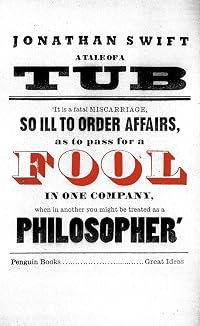
Apparently doomed to an obscure Anglican parsonage in Laracor, Ireland, even after he had written his anonymous masterpiece, A Tale of a Tub (c.1696), Swift turned a political mission to England from the Irish Protestant clergy into an avenue to prominence as the chief propagandist for the Tory government. His exhilaration at achieving importance show more in his forties appears engagingly in his Journal to Stella (1710--13), addressed to Esther Johnson, a young protegee for whom Swift felt more warmth than for anyone else in his long life. At the death of Queen Anne and the fall of the Tories in 1714, Swift became dean of St. Patrick's Cathedral, Dublin. In Ireland, which he considered exile from a life of power and intellectual activity in London, Swift found time to defend his oppressed compatriots, sometimes in such contraband essays as his Drapier's Letters (1724), and sometimes in such short mordant pieces as the famous A Modest Proposal (1729); and there he wrote perhaps the greatest work of his time, Gulliver's Travels (1726). Using his characteristic device of the persona (a developed and sometimes satirized narrator, such as the anonymous hack writer of A Tale of a Tub or Isaac Bickerstaff in Predictions for the Ensuing Year, who exposes an astrologer), Swift created the hero Gulliver, who in the first instance stands for the bluff, decent, average Englishman and in the second, humanity in general. Gulliver is a full and powerful vision of a human being in a world in which violent passions, intellectual pride, and external chaos can degrade him or her---to animalism, in Swift's most horrifying images---but in which humans do have scope to act, guided by the Classical-Christian tradition. Gulliver's Travels has been an immensely successful children's book (although Swift did not care much for children), so widely popular through the world for its imagination, wit, fun, freshness, vigor, and narrative skill that its hero is in many languages a common proper noun. Perhaps as a consequence, its meaning has been the subject of continuing dispute, and its author has been called everything from sentimental to mad. Swift died in Dublin and was buried next to his beloved "Stella." (Bowker Author Biography) show less
Some Editions
Awards and Honors
Distinctions
Notable Lists
Series
Belongs to Publisher Series
Limited Editions Club (S:1.01)
Geração Público (4)
Oud Goud (V)
Penguin English Library, 2012 series (2012-04)
Airmont Classics (15)
Tus libros (16)
Penguin Clothbound Classics (2010)
Riverside Editions (B49)
The World's Classics (20)
Prisma Klassieken (25)
Pocket Books (34)
Dean's Classics (29)
detebe-Klassiker (22590)
Harper Perennial Olive Editions (2018 Olive)
The Pocket Library (PL-51)
insel taschenbuch (0058)
Everyman's Library (60)
Zephyr Books (70)
Perpetua reeks (77)
I Libri dell'Unità [L'Unità] (11-12)
Lanterne (L 379)
Gallimard, Folio (597)
Work Relationships
Is contained in
Grote avonturen drieling. Gullivers reizen / Robinson Crusoe / Michael Strogoff, de koerier van de tsaar. by Henk Cornelissen
Adventure Classics--Ivanhoe, Gullivers Travels, Treasure Island, The Call of the Wild, The Count of Monte Cristo (boxed set) by Walter Scott
Is retold in
Has the (non-series) sequel
Has the adaptation
Is abridged in
Is parodied in
Inspired
Has as a commentary on the text
Has as a student's study guide
Has as a teacher's guide
Common Knowledge
- Canonical title
- Gulliver's Travels
- Original title
- Gulliver's Travels
- Alternate titles*
- Gullivers Reisen. Reisen zu etlichen fernen Völkern der Welt in vier Teilen von Lemuel Gulliver – vormals Schiffsarzt, alsdann Kapitän auf mehreren Schiffen; Gullivers Reisen. Reisen in verschiedene ferne Länder der Welt von Lemuel Gulliver – erst Schiffsarzt, dann Kapitän mehrerer Schiffe; Gulliver’s Reisen in unbekannte Länder
- Original publication date
- 1726
- People/Characters
- Lemuel Gulliver; Reldresal
- Important places
- England, UK; Lilliput; Blefuscu; Brobdingnag; Laputa; Balnibarbi (show all 12); Glubbdubdrib; Luggnagg; Japan; Country of the Houyhnhnms; Mildendo, Lilliput; Utopia, The New World
- Related movies
- Gulliver's Travels (1996 | IMDb); Gulliver's Travels (1939 | IMDb); Gulliver's Travels (1977 | IMDb); Gulliver's Travels (1992 | IMDb); Gulliver's Travels (2010 | IMDb)
- First words
- My father had a small estate in Nottinghamshire; I was the third of five sons.
- Quotations
- And he gave it for his opinion, "that whoever could make two ears of corn, or two blades of grass, to grow upon a spot of ground where only one grew before, would deserve better of mankind, and do more essential service to hi... (show all)s country, than the whole race of politicians put together.”
I said there was a society of men among us, bred up from their youth in the art of proving by words multiplied for the purpose, that white is black, and black is white, according as they are paid. […] It is a maxim among th... (show all)ese lawyers, that whatever hath been done before may legally be done again: and therefore they take special care to record all the decisions formerly made against common justice and the general reason of mankind. These, under the name of precedents, they produce as authorities, to justify the most iniquitous opinions; and the judges never fail of decreeing accordingly. - Last words
- (Click to show. Warning: May contain spoilers.)I dwell the longer upon this subject, from the desire I have to make the society of an English yahoo by any means not insupportable; and therefore I here entreat those who have any tincture of this absurd vice, that they will not presume to come in my sight.
- Publisher's editor*
- Editorial Orbis
- Original language
- English
- Disambiguation notice
- This is the main work for Gulliver's Travels. Please do not combine with any adaptation, abridgement, etc.
*Some information comes from Common Knowledge in other languages. Click "Edit" for more information.
Classifications
Statistics
- Members
- 21,005
- Popularity
- 266
- Reviews
- 191
- Rating
- (3.72)
- Languages
- 38 — Arabic, Bengali, Bosnian, Catalan, Chinese, Cornish, Czech, Danish, Dutch, English, Estonian, Finnish, French, German, Greek, Hindi, Hungarian, Italian, Japanese, Korean, Latvian, Lithuanian, Macedonian, Malay, Norwegian (Bokmål), Norwegian, Polish, Romanian, Russian, Serbian, Croatian, Slovak, Slovenian, Spanish, Swedish, Turkish, Portuguese (Portugal), Portuguese (Brazil)
- Media
- Paper, Audiobook, Ebook
- ISBNs
- 1,372
- UPCs
- 11
- ASINs
- 650