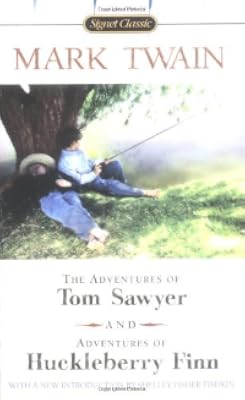
The Adventures of Tom Sawyer / The Adventures of Huckleberry Finn
by Mark Twain 
Tom Sawyer (Collections and Selections — 1-2)
On This Page
Description
Tom Sawyer, an adventurous boy, is as much at home in the respectable world of his Aunt Polly as in the self-reliant and parentless world of his friend Huck Finn. The two enjoy a series of adventures, accidentally witnessing a murder, establishing the innocence of the man wrongly accused, as well as being hunted by Injun Joe, the true murderer.Tags
Recommendations


















Member Recommendations

andyray for those youths today, the missouri of 1860-70 is magic through twain's pen.
05

Member Reviews
Some inexpert thought about Huckleberry Finn:
The principal theme of the novel is freedom. Outwardly, Huck and Jim make their journey to win freedom—Jim from slavery and Huck from “sivilization.” But Twain is interested in something much more romantic and primal than the mere absence of oppression. Huck’s (and Twain’s) real yearning is for a mystical union with nature represented by the Mississippi River. That is why the most magnificent writing from the novel comes during Huck’s reflections on the raft at night, such as these passages from Chapter 19:
“Two or three days and nights went by; I reckon I might say they swum by, they slid along so quiet and smooth and lovely. Here is the way we put in the time. It was a show more monstrous big river down there—sometimes a mile and a half wide…
Sometimes we'd have that whole river all to ourselves for the longest time. Yonder was the banks and the islands, across the water; and maybe a spark—which was a candle in a cabin window—and sometimes on the water you could see a spark or two—on a raft or a scow, you know; and maybe you could hear a fiddle or a song coming over from one of them crafts. It's lovely to live on a raft. We had the sky, up there, all speckled with stars, and we used to lay on our backs and look up at them, and discuss about whether they was made…”
The desire for absolute and total freedom explains the most perplexing question about the raft journey: Why do Huck and Jim continue floating south after they miss the junction with the Ohio River at Cairo? The answer is that by the point the steam boat collides with their raft in Chapter 16, Huck and Jim have tasted too long the kind of freedom represented by the river and have no intention of precariously making their way north only so that Jim might be able to live out his days as a tolerated but despised free negro in a “free state.” Of course Jim and Huck know that to continue heading south is madness—the image of the raft slowly making its way toward the slave plantations of the Mississippi delta lingers in the mind as one of literature’s enduring voyages of doom.
The quest for freedom also explains why nearly all the raft journey takes place at night. The literal explanation, offered by Huck, is the need to avoid other river travelers, who would not believe that Jim was Huck’s slave. The more profound reason is that night, like the river, is a symbol of freedom, nature, and ultimately, extinction. Night provides temporary escape from the ignorance, chicanery, cowardice and mob-fueled violence of the society excoriated by Colonel Sherburn (also Twain’s view) in Chapter 22: “Because you’re brave enough to tar and feather poor friendless cast-out women that come along here, did that make you think you had grit enough to lay your hands on a man?”
Of course in the end Huck and Jim are not doomed. To the regret of many readers, Twain contrives a happy ending, engineered by Tom Sawyer. One of the most disappointing things about the chapters at the Phelps plantation is that Huck, whose greatness of spirit even encompasses compassion for the tarred and feathered king and duke in Chapter 33, must accept a subservient role to Tom, who after all, is a product of the society Jim and Huck have been fleeing. Twain’s final disposition of Huck and Jim gives the novel a very disquieting end. Huck tells the reader of his intention to escape being “sivilized” by heading west (“for the Territory”), but Jim is left behind, deep in slave country, with only $40 in his pocket. Does Twain mean for us to surmise that his chances for making it safely to the free states (forget about his family!) are slim? show less
The principal theme of the novel is freedom. Outwardly, Huck and Jim make their journey to win freedom—Jim from slavery and Huck from “sivilization.” But Twain is interested in something much more romantic and primal than the mere absence of oppression. Huck’s (and Twain’s) real yearning is for a mystical union with nature represented by the Mississippi River. That is why the most magnificent writing from the novel comes during Huck’s reflections on the raft at night, such as these passages from Chapter 19:
“Two or three days and nights went by; I reckon I might say they swum by, they slid along so quiet and smooth and lovely. Here is the way we put in the time. It was a show more monstrous big river down there—sometimes a mile and a half wide…
Sometimes we'd have that whole river all to ourselves for the longest time. Yonder was the banks and the islands, across the water; and maybe a spark—which was a candle in a cabin window—and sometimes on the water you could see a spark or two—on a raft or a scow, you know; and maybe you could hear a fiddle or a song coming over from one of them crafts. It's lovely to live on a raft. We had the sky, up there, all speckled with stars, and we used to lay on our backs and look up at them, and discuss about whether they was made…”
The desire for absolute and total freedom explains the most perplexing question about the raft journey: Why do Huck and Jim continue floating south after they miss the junction with the Ohio River at Cairo? The answer is that by the point the steam boat collides with their raft in Chapter 16, Huck and Jim have tasted too long the kind of freedom represented by the river and have no intention of precariously making their way north only so that Jim might be able to live out his days as a tolerated but despised free negro in a “free state.” Of course Jim and Huck know that to continue heading south is madness—the image of the raft slowly making its way toward the slave plantations of the Mississippi delta lingers in the mind as one of literature’s enduring voyages of doom.
The quest for freedom also explains why nearly all the raft journey takes place at night. The literal explanation, offered by Huck, is the need to avoid other river travelers, who would not believe that Jim was Huck’s slave. The more profound reason is that night, like the river, is a symbol of freedom, nature, and ultimately, extinction. Night provides temporary escape from the ignorance, chicanery, cowardice and mob-fueled violence of the society excoriated by Colonel Sherburn (also Twain’s view) in Chapter 22: “Because you’re brave enough to tar and feather poor friendless cast-out women that come along here, did that make you think you had grit enough to lay your hands on a man?”
Of course in the end Huck and Jim are not doomed. To the regret of many readers, Twain contrives a happy ending, engineered by Tom Sawyer. One of the most disappointing things about the chapters at the Phelps plantation is that Huck, whose greatness of spirit even encompasses compassion for the tarred and feathered king and duke in Chapter 33, must accept a subservient role to Tom, who after all, is a product of the society Jim and Huck have been fleeing. Twain’s final disposition of Huck and Jim gives the novel a very disquieting end. Huck tells the reader of his intention to escape being “sivilized” by heading west (“for the Territory”), but Jim is left behind, deep in slave country, with only $40 in his pocket. Does Twain mean for us to surmise that his chances for making it safely to the free states (forget about his family!) are slim? show less
Tom Sawyer is pure fun, but Huckleberry Finn is the real treasure. Mark Twain's grasp of the various Southern dialects is amazingly true to life, and in Adventures of Huckleberry Finn he satirizes many aspects of that region in the antebellum era, such as superstitions, societal teachings, and family honor. The author underwent a complete transformation in how he viewed blacks between the time he wrote Tom Sawyer and Huck Finn, and it is interesting to see how the character of Tom Sawyer changes from an innocent troublemaker to a mean-spirited, "adventure"-seeking adolescent. I read The Adventures of Tom Sawyer for fun in elementary school, and Adventures of Huckleberry Finn for my high school senior English class, and because of that, show more I recommend that you follow along the story on SparkNotes (or a similar guide) because it may reveal to you some insight into the time period or into Twain's satire that you would not have picked up on your own. show less
As Tom Sawyer might say, I don't have much truck for book banners and censorship. Hearing about attempts to ban or censor "Tom Sawyer" and "Huckleberry Finn" bothers the librarian in me. Then I heard about this controversial edition in which the racial epithets are replaced. It's been decades since I read "Tom Sawyer" and I've never read "Huckleberry" so I decided to see for myself how effective these versions are. And actually, I found this a suitable substitute for those who don't want to deal with the originals. As an adult reader, I discovered and better appreciated Mark Twain's humor and hilarious turn of phrase. The replacement words detracted not at all from the stories or his talent.
Twain created two of the most eduring American characters with these two works - Jim and Huck. Notice I didn't say Tom; when I was a kid, Tom Sawyer was the slickest kid I ever read about. But now that I'm all grown up, you realize Tom Sawyer was and always will be a grade A brat.
It's in Huck though, that salvation lies. Between his adventures with Tom and then Jim we get to see Huck truly mature from a poor white trash bigot into well, a poor white trash boy with a good heart and a buried chest full of money. And Twain skewers everything and everyone in between - school marms, small towns, con men, Shakespeare, lynchings - and you realize, even in this day in age that yes, being American, and living the American dream, and having that show more tolerance for all the people around you is possible. Even if your Pa did seem to inspire the Temptations' "Daddy Was A Rollin' Stone"... show less
It's in Huck though, that salvation lies. Between his adventures with Tom and then Jim we get to see Huck truly mature from a poor white trash bigot into well, a poor white trash boy with a good heart and a buried chest full of money. And Twain skewers everything and everyone in between - school marms, small towns, con men, Shakespeare, lynchings - and you realize, even in this day in age that yes, being American, and living the American dream, and having that show more tolerance for all the people around you is possible. Even if your Pa did seem to inspire the Temptations' "Daddy Was A Rollin' Stone"... show less
Shamefaced about my lack of exposure to the American classics. Had to read this for book club or I probably never would have. So glad I did; hilarious, touching, and in my opinion an ingenious way of presenting the moral dilemmas of the day with regard to slavery. I kind of missed Huck when Tom Sawyer showed up, but I did laugh out loud at Tom. Wonderful.
Audible version. Elijah Wood's reading is simply fantastic. Unfortunately, this story is not as engaging as I remember from childhood. I understand it has a Purpose, but I suspect I'd have given the book up completely before finishing, had I been reading the print version or had it been performed by anyone else.
Tom Sawyer and Huckleberry Finn are two of the most iconic American characters, and this volume contains both of their stories. The first - Tom Sawyer's - is a good, general read, but the second - Huck's - is where Mark Twain really pulls out all his stops. He tackles some of the deepest issues of his America, namely, slavery and abolition, and creates an incredible satiric novel.
Members
- Recently Added By
Lists

The 100 Best Books of All Time by Norwegian Book Club (World Library)
104 works; 21 members

Philip Ward's Lifetime Reading Plan
592 works; 22 members

Books I've Read More Than Once
602 works; 49 members

Great Books Favorites
71 works; 6 members

Carole's List
445 works; 13 members

My list of 100 books to read next
100 works; 4 members

American Lit for Eng 11 Research Project
368 works; 6 members

100 knjiga
100 works; 1 member
Author Information

2,752+ Works 208,778 Members
Mark Twain was born Samuel L. Clemens in Florida, Missouri on November 30, 1835. He worked as a printer, and then became a steamboat pilot. He traveled throughout the West, writing humorous sketches for newspapers. In 1865, he wrote the short story, The Celebrated Jumping Frog of Calaveras County, which was very well received. He then began a show more career as a humorous travel writer and lecturer, publishing The Innocents Abroad in 1869, Roughing It in 1872, and, Gilded Age in 1873, which was co-authored with Charles Dudley Warner. His best-known works are The Adventures of Tom Sawyer, Mississippi Writing: Life on the Mississippi, and The Adventures of Huckleberry Finn. He died of a heart attack on April 21, 1910. (Bowker Author Biography) show less
Mark Twain has a Legacy Library. Legacy libraries are the personal libraries of famous readers, entered by LibraryThing members from the Legacy Libraries group.
Some Editions
Awards and Honors
Series

Belongs to Publisher Series
Work Relationships
Contains
Has the adaptation
Common Knowledge
- Canonical title
- The Adventures of Tom Sawyer / The Adventures of Huckleberry Finn
- Original title
- The Adventures of Tom Sawyer and Huckleberry Finn
- Original publication date
- 1876 (The Adventures of Tom Sawyer) (The Adventures of Tom Sawyer); 1876 (Tom Sawyer) (Tom Sawyer); 1884 (The Adventures of Huckleberry Finn) (The Adventures of Huckleberry Finn); 1884 (Huckleberry Finn) (Huckleberry Finn)
- People/Characters
- Tom Sawyer; Huckleberry Finn; Jim [Huckleberry Finn]; Widow Douglas; Miss Watson; Pap Finn (show all 11); The Duke [Huckleberry Finn] (a/k/a the Duke of Bridgewater); The King [Huckleberry Finn] (a/k/a the Dauphin or Louis XVII); Judge Thatcher; Silas Phelps; Sally Phelps
- Important places
- Mississippi River, USA; St. Petersburg, Missouri, USA; Hannibal, Missouri, USA; Arkansas, USA; Missouri, USA; Illinois, USA (show all 8); Kentucky, USA; USA
- Related movies
- Huck and Tom (1918 | IMDb); The Adventures of Huck Finn (1993 | IMDb); Huckleberry Finn (1920 | IMDb); The Adventures of Huck Finn (2012 | IMDb); Huckleberry Finn (1931 | IMDb); The Adventures of Huckleberry Finn (1939 | IMDb) (show all 22); The Adventures of Huckleberry Finn (1960 | IMDb); The Adventures of Huckleberry Finn (1955 | IMDb); Climax!: The Adventures of Huckleberry Finn (1955 | IMDb); The Adventures of Huckleberry Finn (1984 | IMDb); The United States Steel Hour: The Adventures of Huckleberry Finn (1957 | IMDb); The Adventures of Huckleberry Finn (1981 | IMDb); Huckleberry Finn (1967 | IMDb); Moartea lui Joe Indianul (1968 | IMDb); Les aventures de Tom Sawyer (1968 | IMDb); Aventuras de Huck (1969 | IMDb); Sovsem propashchiy (1972 | IMDb); Huckleberry Finn (1974 | IMDb); Huckleberry Finn (1975 | IMDb); The Adventures of Huckleberry Finn (1982 | IMDb); American Playhouse: Adventures of Huckleberry Finn (1985 | IMDb); Huck and the King of Hearts (1993 | IMDb)
- Epigraph
- Notice: Persons attempting to find a motive in this narrative will be prosecuted; persons attempting to find a moral in it will be banished; persons attempting to find a plot in it will be shot. By Order of the Author per G. ... (show all)G., Chief of Ordnance
- First words
- Tom!
You don't know about me, without you have read a book by the name of The Adventures of Tom Sawyer, but that ain't no matter. - Quotations
- All right, then, I'll go to hell - and tore it up.
- Last words
- (Click to show. Warning: May contain spoilers.)I been there before.
(Click to show. Warning: May contain spoilers.)But I reckon I got to light out for the Territory ahead of the rest, because Aunt Sally she's going to adopt me and sivilize me, and I can't stand it. I been there before. - Blurbers
- Hemingway, Ernest
- Original language*
- English
- Disambiguation notice
- This is an omnibus edition of both The Adventures of Tom Sawyer and Adventures of Huckleberry Finn. It should not be combined with either individual work.
*Some information comes from Common Knowledge in other languages. Click "Edit" for more information.
Classifications
- Genres
- Fiction and Literature, Children's Books, General Fiction
- DDC/MDS
- 813.4 — Literature & rhetoric American literature in English American fiction in English Later 19th Century 1861-1900
- LCC
- PS1306 .A1 — Language and Literature American literature American literature Individual authors 19th century
- BISAC
Statistics
- Members
- 4,154
- Popularity
- 3,685
- Reviews
- 35
- Rating
- (4.05)
- Languages
- 14 — Arabic, Czech, English, Estonian, French, German, Italian, Latvian, Lithuanian, Norwegian (Bokmål), Romanian, Russian, Spanish, Portuguese (Portugal)
- Media
- Paper, Audiobook, Ebook
- ISBNs
- 132
- UPCs
- 2
- ASINs
- 120