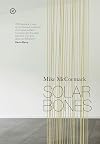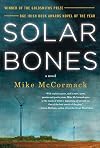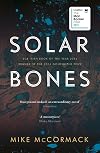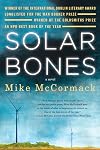
Solar Bones
by Mike McCormack
On This Page
Description
"On All Souls Day, the late Marcus Conway returns home. Solar Bones captures in a single relentless sentence the life and death of this rural Irish engineer, and his place in the globally interconnected 21st century. The book takes in local municipal failures and global financial collapse, the quotidian pleasures of family, ancient history and the latest headlines, the living and the dead. A vital, tender, acerbic, warm, and death-haunted work one of Ireland's most important contemporary show more novelists, Solar Bones builds its own style and language one broken line at a time. The result is visionary accounting of the now"-- show lessTags
Recommendations







Member Reviews
"...and it was part of their whole Christmas thing to leave food and drink on the kitchen table for Santa Claus and Rudolph, something to keep them fed on their big night's work, usually cake or a sandwich and a carrot, and it was my job, before going to bed to eat some of it - or at least to leave teeth marks in it - to show that Santa had indeed sampled our hospitality so that, the following morning, when they had got over the delight of their initial presents they would stand beside the table to examine the remains of the food and the whiskey glass lying sideways on the table because obviously, with a drop taken in so many houses along the way, Santa must have been well slewed by the time he got to our door and it was a wonder at all show more he managed to leave the right presents in the right houses and there was Agnes standing by the table in her pyjamas listening to me saying all this, weighing it up, while Darragh was already surging ahead , examining the carrot and cake but still not saying anything so that I began to wonder if I had slipped up somewhere in my story and given something away that would spoil the whole thing and I was about to open my mouth again but Mairead (his wife) was looking at me from across the table, shaking her head, wearing that expression, both fearful and dismayed, which was telling me without words to
stop now, before you go too far
stop now
so I stopped"
This was really good. I had checked it out from the library in print, not knowing anything about it - it was calling to me from the "new fiction" section. It's written in stream of consciousness, but don't let that scare you as it is perfectly done. No capitals or periods or quotations, but it works just fine because of how they formatted it. I had started reading it and was thinking that it had such a lovely flow to it, an internal rhythm that I thought would be perfect as an audiobook, so I checked, and sure enough it was available on audio. Narrated by Tim Gerard Reynolds, it is so beautifully rendered that it was a pleasure to listen to, and I was sad when it ended. So why not five stars? Well, I though it dragged just a bit in the middle, keeping it from being a perfect read - such a small quibble, really, as the book is only 217 pages. Anyway, highly recommended, and if you do audio at all, go with that format - I listened to it at 1.25x speed, and it was sublime. show less
stop now, before you go too far
stop now
so I stopped"
This was really good. I had checked it out from the library in print, not knowing anything about it - it was calling to me from the "new fiction" section. It's written in stream of consciousness, but don't let that scare you as it is perfectly done. No capitals or periods or quotations, but it works just fine because of how they formatted it. I had started reading it and was thinking that it had such a lovely flow to it, an internal rhythm that I thought would be perfect as an audiobook, so I checked, and sure enough it was available on audio. Narrated by Tim Gerard Reynolds, it is so beautifully rendered that it was a pleasure to listen to, and I was sad when it ended. So why not five stars? Well, I though it dragged just a bit in the middle, keeping it from being a perfect read - such a small quibble, really, as the book is only 217 pages. Anyway, highly recommended, and if you do audio at all, go with that format - I listened to it at 1.25x speed, and it was sublime. show less
"Solar Bones" describes a couple of hours in the life of Marcus Conway, Irish citizen, resident of County Mayo, engineer, public-sector employee, husband, father of two, and completely unique individual, one of the seven million humans who live on this crazy spinning ball of dirt we call the Earth. And you can't say that the author doesn't make these hours count. In two hundred fifty or so pages written in an intensely lyrical stream-of-consciousness style that reminded my admittedly untrained ear of nothing so much as T.S. Eliot's "Ash Wednesday," we learn about -- among many, many other things -- Marcus's marriage, his sometimes difficult relationships with his children, his daughter's burgeoning art career, the enormous respect he show more had for his father, the route he takes to commute to work, his grounded and unfussy devotion to Catholicism, a few of his formative childhood memories, and what a typical workday of his might be like. It's a lot to get through, and I can't blame those who, when they read this, suspect that "Solar Bones" might just be another unfortunate literary exercise of the Joycean kind -- another manic Hibernian episode of verbose self-expression. But Solar Bones sets itself apart by its rigor: Marcus isn't just some of neighborhood character, he's also an engineer. Tension, collapse, and potential disaster are constantly on his mind, and it's no accident that "Solar Bones" is set in the immediate aftermath of the collapse of Ireland's too-good-to-be-true "Celtic Tiger" economic miracle. Marcus is, he tells us, a man who reads the newspaper and listens to radio news bulletins. Marcus may speak often of the affection that he feels for County Mayo, a place where he can trace his ancestry back centuries, but there's more than just sentiment at work here. Still, McCormick ably shows how his character's life is also linked to his town -- and to the wider world -- by extremely concrete economic and social realities. While reading this one, I wondered if the author knew what his audience might have been expecting from an "Irish novel" and deliberately tried to write against type, at least a little. There's more than just discursive, well-written modernist prose and fond, glowy memories of long-ago marital lovemaking going on in "Solar Bones."
Some readers may complain that the prose in this novel seems to have been rendered so exquisitely that the life has been sucked out of it. Others might complain that not much happens in this book. These points are valid enough, but the quality of the writing -- which is conventionally pleasing and designed to throw the reader off-kilter at the same time -- and its careful construction might also be equally difficult to deny. "Solar Bones" succeeds on another fundamentally important level, too: Marcus and his family -- his wife Mairead, his daughter Agnes, and his son Darragh -- all feel like real people rather than literary constructs. I wouldn't call "Solar Bones" conventionally written or plotted, but it's obvious that this doesn't mean that McCormick has forgotten the human element. In other words, his characters come through. I saw a bit of Ian McEwan's preoccupation with systems and technology here, but none of that author's apparent contempt for basic, familiar human stories.
The real question, then, for readers wondering if they should pick this one up is whether they think that -- admirable or not -- McCormack's stylistic trickery and dense, finely worked writing style might make this one not worth the trip. I sympathize: I liked "Solar Bones", in the end, but I can't say that it didn't sometimes test my patience, and I can't really say that I out-and-out enjoyed it. It isn't the sort of thing you can read on a beach or a bus. You might have to make an investment to finish this one. This one is probably going to end up in a second-hand bookshop, but how much does that really mean? I've seen great movies that I know that I'll never watch again. With all the respect I can muster, I can say this: it's clear that McCormick's a genuine talent, and "Solar Bones" checks all of the boxes for what a quality novel should be and do. And that, dear reader, is why it gets four stars from me. show less
Some readers may complain that the prose in this novel seems to have been rendered so exquisitely that the life has been sucked out of it. Others might complain that not much happens in this book. These points are valid enough, but the quality of the writing -- which is conventionally pleasing and designed to throw the reader off-kilter at the same time -- and its careful construction might also be equally difficult to deny. "Solar Bones" succeeds on another fundamentally important level, too: Marcus and his family -- his wife Mairead, his daughter Agnes, and his son Darragh -- all feel like real people rather than literary constructs. I wouldn't call "Solar Bones" conventionally written or plotted, but it's obvious that this doesn't mean that McCormick has forgotten the human element. In other words, his characters come through. I saw a bit of Ian McEwan's preoccupation with systems and technology here, but none of that author's apparent contempt for basic, familiar human stories.
The real question, then, for readers wondering if they should pick this one up is whether they think that -- admirable or not -- McCormack's stylistic trickery and dense, finely worked writing style might make this one not worth the trip. I sympathize: I liked "Solar Bones", in the end, but I can't say that it didn't sometimes test my patience, and I can't really say that I out-and-out enjoyed it. It isn't the sort of thing you can read on a beach or a bus. You might have to make an investment to finish this one. This one is probably going to end up in a second-hand bookshop, but how much does that really mean? I've seen great movies that I know that I'll never watch again. With all the respect I can muster, I can say this: it's clear that McCormick's a genuine talent, and "Solar Bones" checks all of the boxes for what a quality novel should be and do. And that, dear reader, is why it gets four stars from me. show less
There is plenty not to like about SOLAR BONES. It is disorienting, especially the beginning when the narrator, Marcus Conway, sits at his kitchen table reminiscing about his life following his death; the inexplicable idea that the dead can become flesh for one hour every year; the unconventional narrative style that abandons a coherent plot for free-association; and the fact that the novel is just one continuous sentence—that’s right, no periods. With that said, McCormack gives us quite a remarkable reading experience.
Conway is an everyman who remembers a pretty mundane life with many regrets but no ability to change anything—remember he’s dead. He mulls over what he has experienced in his profession as a middle-aged civil show more engineer living in rural County Mayo: the tension between the precision and definability of engineering versus what he perceives as an essentially chaotic world. “What really tormented me was that all this filth and disorder offended my engineer’s sense of structure, everything out of place and alignment.” A childhood memory of a broken down tractor revives his sense that the natural world just teeters on the verge of chaos, “the whole construct humming closer to collapse than I had ever suspected.” Similarly, Marcus recalls visiting a torture museum in Prague where elegant machines were designed just to inflict horrible pain. “The highest technical expressions of their age, the end to which skilled minds had deployed their noble gifts.”
As a man who spent much of his life as a civil engineer concerned “with scale and accuracy, mapping and surveying so that the grid of reason and progress could be laid across the earth, gathering its wildness into towns and villages by way of bridges and roads and water schemes and power lines,” Marcus can’t reconcile a world in disarray and seemingly spinning out of sync. Chaos scientists invoke a concept they call the “butterfly effect” to explain why chaotic systems like the weather can't be predicted more than a few days in advance. It postulates the poetic notion that the flap of a butterfly's wings in Brazil may be capable of setting off a cascade of atmospheric events that could result the formation of a tornado in Texas. Although he never cites the “butterfly effect”, Marcus acutely senses that it was in force during his life.
Family life provided solace to Marcus, although this also had its chaotic moments. He seems to have a settled and fulfilling relationship with Mairead, his schoolteacher wife. Darragh is his wisecracking son, who communicates via Skype as he backpacks in Australia. Agnes, his daughter, is an edgy artist whose debut installation features her own blood. Marcus’ realization that Agnes used her own blood in her debut show brings on a panic attack. Marcus recalls a painful time when Mairead left him but later returned. Chaos intervenes once again when Mairead becomes severely ill from a contaminated water supply. Municipal political corruption, brought on by the Irish building boom, also tests Conway’s ethics.
This remarkable book is timely because it gives the reader a strong sense of how misguided is our sense of control in a very fragile world. Certainly the most compelling argument is our increasing realization that humans may have irreversibly destroyed the planet, resulting in the loss of species and habitable places. In the face of all of this, we can only gaze in wonder and feel as helpless as Marcus Conway does on All Soul’s Eve in County Mayo, Ireland. show less
Conway is an everyman who remembers a pretty mundane life with many regrets but no ability to change anything—remember he’s dead. He mulls over what he has experienced in his profession as a middle-aged civil show more engineer living in rural County Mayo: the tension between the precision and definability of engineering versus what he perceives as an essentially chaotic world. “What really tormented me was that all this filth and disorder offended my engineer’s sense of structure, everything out of place and alignment.” A childhood memory of a broken down tractor revives his sense that the natural world just teeters on the verge of chaos, “the whole construct humming closer to collapse than I had ever suspected.” Similarly, Marcus recalls visiting a torture museum in Prague where elegant machines were designed just to inflict horrible pain. “The highest technical expressions of their age, the end to which skilled minds had deployed their noble gifts.”
As a man who spent much of his life as a civil engineer concerned “with scale and accuracy, mapping and surveying so that the grid of reason and progress could be laid across the earth, gathering its wildness into towns and villages by way of bridges and roads and water schemes and power lines,” Marcus can’t reconcile a world in disarray and seemingly spinning out of sync. Chaos scientists invoke a concept they call the “butterfly effect” to explain why chaotic systems like the weather can't be predicted more than a few days in advance. It postulates the poetic notion that the flap of a butterfly's wings in Brazil may be capable of setting off a cascade of atmospheric events that could result the formation of a tornado in Texas. Although he never cites the “butterfly effect”, Marcus acutely senses that it was in force during his life.
Family life provided solace to Marcus, although this also had its chaotic moments. He seems to have a settled and fulfilling relationship with Mairead, his schoolteacher wife. Darragh is his wisecracking son, who communicates via Skype as he backpacks in Australia. Agnes, his daughter, is an edgy artist whose debut installation features her own blood. Marcus’ realization that Agnes used her own blood in her debut show brings on a panic attack. Marcus recalls a painful time when Mairead left him but later returned. Chaos intervenes once again when Mairead becomes severely ill from a contaminated water supply. Municipal political corruption, brought on by the Irish building boom, also tests Conway’s ethics.
This remarkable book is timely because it gives the reader a strong sense of how misguided is our sense of control in a very fragile world. Certainly the most compelling argument is our increasing realization that humans may have irreversibly destroyed the planet, resulting in the loss of species and habitable places. In the face of all of this, we can only gaze in wonder and feel as helpless as Marcus Conway does on All Soul’s Eve in County Mayo, Ireland. show less
Marcus Conway is a ghost. On All Souls Day, he sits at the dinner table waiting for his family to return, and unspools a stream-of-concious monologue about this life written in a single sentence (this is the second single-sentence novel I've read recently!). The single sentence isn't as apparent in the audiobook - deftly narrated by Timothy Reynolds - but I do notice that he starts phrase with "and" a lot, adding a certain rhythmn to the prose. Marcus talks about his own father's death, his sometimes troubled relationship with his wife and children, and his work as a civic engineer. Local politics also plays a big part of his story, from voting to a politicians thickheaded insistence on building a school that's not structurally sound, show more to even the awful stomach virus that infects his community - including his wife - caused by bad sanitation. Over time, Marcus unravels the details of his own death and comes to terms with his mortality. The thing about this novel is that for all the experimental nature of its narrative, Marcus is a perfectly ordinary person doing ordinary things. McCormack's writing unveils the fascinating stories within the everyday person. show less
This is such a beautiful, rich, and rewarding book. On the surface, SOLAR BONES presents a middle-aged man's reflections on his work and family life. The meditation unfolds one early afternoon in November--the month of All Souls, when ghosts restlessly flit about--while the man is alone in the house he's lived in since he married 25 years ago.
Marcus Conway is an engineer with a deeply metaphysical bent. In due time, the reader learns that his original intentions had been toward the priesthood. Having spent two years at a seminary as a young man before a voice told him to “cop himself on” (smarten up), he is deeply grounded in the humanities: poetry, philosophy, literature. Now, on this November afternoon, he muses about how all show more things tend towards entropy. The energy of the sun makes possible--infuses--all life on this planet, and it seems that part of the work of humans is to impose rhythm and meaning on existence, create structure, give life its "bones". However, all things eventually wind down: they move from order and structure to disorder, dissolution, diffusion--oblivion. This process is working within Marcus himself as he looks back on his life while anxiously awaiting the return of his wife and children who might hold him in their gaze and affirm his existence.
McCormick's work also thoughtfully explores the tension between politics and engineering. This may sound dull, but In McCormick's capable hands, it works--beautifully. Marcus reflects that an engineer, taking the long view, can withhold approval for a building that rests on unstable, unreliable foundations, knowing that it is only a matter of time before that the building will fail or fall--injuring, maiming, or killing the vulnerable. A politician's view, on the other hand, is fuelled by the desire for quick results which will keep him basking in his constituents' approval and propel him to ever higher office and power. Marcus’s working life was characterized by repeated wearing encounters with fractious elected officials eager to throw caution to the wind and present voters with pretty public works projects.
A large section of the book is devoted to Marcus's thoughts on a cryptosporidium water-contamination outbreak that leaves many in the Galway vicinity, including Martin's wife, Mairead, disabled for weeks by diarrhea and vomiting. It is a small matter perhaps, but McCormick refers to this illness as a virus when it is actually infection and inflammation of the gastrointestinal tract by microscopic parasitic organisms called Protozoa. As well, his descriptions of Mairead's bedridden days--the bouts of illness in which bodily fluids pour from one end or the other--run overly long. These seem to be fairly minor quibbles with an otherwise accomplished, impressive piece of stream-of-consciousness writing whose form embodies and serves its themes so well.
For me, SOLAR BONES provided a wonderful, unusual reading experience. I look forward to reading McCormick's other works.
Rating: 4.5 rounded up to 5 show less
Marcus Conway is an engineer with a deeply metaphysical bent. In due time, the reader learns that his original intentions had been toward the priesthood. Having spent two years at a seminary as a young man before a voice told him to “cop himself on” (smarten up), he is deeply grounded in the humanities: poetry, philosophy, literature. Now, on this November afternoon, he muses about how all show more things tend towards entropy. The energy of the sun makes possible--infuses--all life on this planet, and it seems that part of the work of humans is to impose rhythm and meaning on existence, create structure, give life its "bones". However, all things eventually wind down: they move from order and structure to disorder, dissolution, diffusion--oblivion. This process is working within Marcus himself as he looks back on his life while anxiously awaiting the return of his wife and children who might hold him in their gaze and affirm his existence.
McCormick's work also thoughtfully explores the tension between politics and engineering. This may sound dull, but In McCormick's capable hands, it works--beautifully. Marcus reflects that an engineer, taking the long view, can withhold approval for a building that rests on unstable, unreliable foundations, knowing that it is only a matter of time before that the building will fail or fall--injuring, maiming, or killing the vulnerable. A politician's view, on the other hand, is fuelled by the desire for quick results which will keep him basking in his constituents' approval and propel him to ever higher office and power. Marcus’s working life was characterized by repeated wearing encounters with fractious elected officials eager to throw caution to the wind and present voters with pretty public works projects.
A large section of the book is devoted to Marcus's thoughts on a cryptosporidium water-contamination outbreak that leaves many in the Galway vicinity, including Martin's wife, Mairead, disabled for weeks by diarrhea and vomiting. It is a small matter perhaps, but McCormick refers to this illness as a virus when it is actually infection and inflammation of the gastrointestinal tract by microscopic parasitic organisms called Protozoa. As well, his descriptions of Mairead's bedridden days--the bouts of illness in which bodily fluids pour from one end or the other--run overly long. These seem to be fairly minor quibbles with an otherwise accomplished, impressive piece of stream-of-consciousness writing whose form embodies and serves its themes so well.
For me, SOLAR BONES provided a wonderful, unusual reading experience. I look forward to reading McCormick's other works.
Rating: 4.5 rounded up to 5 show less
In a small town in Ireland on All Souls’ Day in 2009, Marcus Conway sits at his kitchen table and reminisces about his life. His thoughts touch on his family, work as a civil engineer, political views, epidemics, and economic conditions. He reflects on his two children, Agnes and Darragh, when they were young and now that they have grown.
It is told in stream-of-consciousness without traditional punctuation. I am not generally a fan of writing that does not provide natural breaks for the reader. However, if you are like me in this regard, I heartily recommend the audio performance by Tim Gerard Reynolds. The prose is poetic and flows beautifully in the narration. There is a reason for the unusual structure, which will eventually show more become apparent. I own a copy of the e-book, so I was able to appreciate the author’s artistic intent. show less
It is told in stream-of-consciousness without traditional punctuation. I am not generally a fan of writing that does not provide natural breaks for the reader. However, if you are like me in this regard, I heartily recommend the audio performance by Tim Gerard Reynolds. The prose is poetic and flows beautifully in the narration. There is a reason for the unusual structure, which will eventually show more become apparent. I own a copy of the e-book, so I was able to appreciate the author’s artistic intent. show less
This book captivated me with its use of the language and its keen observations on life. If you like traditional structure and can’t bear a punctuation mark to be missing, forget it; it’s one long sentence. One long surprisingly readable, poetic, long sentence that somehow manages to convey the intricacies, heartbreaks and humor of life with its look at everything from politics to economics to construction on the smallest of scales. It’s definitely not going to be everyone’s cup of tea, but honestly, I’m going to go out on a limb and say it’s going to win the Man Booker. Given my feelings on Lincoln and the Bardo (love), that’s saying something.
Members
- Recently Added By
Lists

Booker Prize
491 works; 62 members

Man Booker Prize Longlist 2017
13 works; 4 members

2018 Notable Books for Adults
26 works; 4 members

Kirkus Starred Fiction Reviews of Books Published in 2017
412 works; 7 members

To Read
617 works; 7 members

Books Read in 2018
4,360 works; 110 members
Books With Body Parts in the Title
153 works; 9 members

Novels set over the course of a single day (or less)
72 works; 8 members

Dead narrators
50 works; 4 members

To read
61 works; 1 member

LitHub's Best Novels of the Decade 2010-2019
39 works; 1 member
Author Information

7+ Works 890 Members
Mike McCormack is an Irish writer, born in 1965. He is a graduate of the University College Galway in English and Philosophy. His short story collections include Getting It in the Head and Forensic Songs. His novels include Crowe's Requiem, Notes from a Coma, and Solar Bones, which won the 2016 Goldsmiths Prize and the 2018 International Dublin show more Literary Award. (Bowker Author Biography) show less
Some Editions
Awards and Honors
Awards
Distinctions
Notable Lists
Work Relationships
Has the adaptation
Common Knowledge
- Canonical title
- Solar Bones
- Original title
- Solar Bones
- Original publication date
- 2016
- People/Characters
- Marcus Conway
- Important places
- County Mayo, Ireland
- Dedication
- for Maeve
- First words
- the bell
- Last words
- (Click to show. Warning: May contain spoilers.)keep going to fuck
- Blurbers
- Colm Toíbín; Blake Morrison; Lisa McInerney
- Original language
- English
Classifications
Statistics
- Members
- 556
- Popularity
- 53,313
- Reviews
- 25
- Rating
- (3.90)
- Languages
- Dutch, English, French, Spanish
- Media
- Paper, Audiobook, Ebook
- ISBNs
- 24
- ASINs
- 6