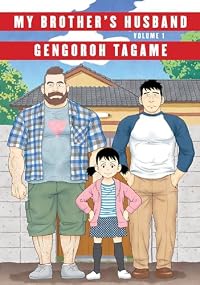
My Brother's Husband, Volume 1 [omnibus]
by Gengoroh Tagame (Author, Illustrator)
My Brother's Husband (Collections and Selections — Issues #1 & 2 [omnibus 1/2])
On This Page
Description
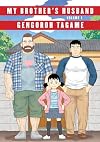
Yaichi is a work-at-home suburban dad in contemporary Tokyo; formerly married to Natsuki, father to their young daughter, Kana. Their lives suddenly change with the arrival at their doorstep of a hulking, affable Canadian named Mike Flanagan, who declares himself the widower of Yaichi's estranged gay twin, Ryoji. Mike is on a quest to explore Ryoji's past, and the family reluctantly but dutifully takes him in. What follows is an unprecedented and heartbreaking look at the state of a largely show more still-closeted Japanese gay culture: how it's been affected by the West, and how the next generation can change the preconceptions about it and prejudices against it. show lessTags
Recommendations



Member Reviews
A manga which explores the reactions of a Japanese father and his daughter to the Canadian husband of his deceased brother. Kana's easy acceptance is contrasted to Yaichi's coming to grips with previously unexamined feelings of discomfort in acknowledging and understanding his brother's homosexuality and relationship with Mike and some outright homophobia. There is less stress on Mike as an individual than Mike as a sort of best case "Guess Who's Coming to Dinner" guest. This manga departs from the style I'm used to in the rendering of the adult men, but otherwise the big eyed simple features of Kana and her mother are more typical.
Yaichi is uncomfortable, to put it mildly, when his twin brother Ryoji's Canadian husband Mike comes to visit a month or so after Ryoji's death. Although he doesn't want to be openly rude, he can't help his knee-jerk homophobic reactions. His young daughter Kana's obvious love of Mike prompts him to try to be more accepting, and he gradually gains more and more food for thought - about his and other Japanese people's reactions to gay people, about the courage it must have taken for his brother to come out to him, and about how he'd react if Kana one day said she was a lesbian.
This was occasionally difficult and uncomfortable reading, from Yaichi's reaction to Mike hugging him to his freakout about Kana's reaction to Mike having a hairy show more chest. Tagame handles all of it head-on, and is just as unflinching in his examination of the aspects of Japanese culture that most Japanese adults take for granted (such as "all people with tattoos are scary"), with Kana, a child, acting as one of the characters who questions why things are the way they are. This is not the most subtle series, but it's not trying to be.
This is one of the few works I've read that's both written by a man and looks at issues gay people face in Japan. I liked the way this series encouraged readers to examine their assumptions - about everybody, not just Mike. There were aspects to Yaichi's own life that weren't like that of a typical Japanese man. For example, both Mike and I assumed thatYaichi's wife was dead and that Yaichi was a widower like him. In reality, she was very much alive - the two of them were just divorced (or separated? I can't remember), with an amicable relationship in which Yaichi was the one primarily caring for Kana.
Some aspects of this felt a little simplistic. It seemed odd how cheerful everyone was, considering Ryoji had just died a month ago. With Yaichi, it was a bit more believable, considering he'd last seen Ryoji maybe a decade or so ago (again, I can't quite remember the details), but even Mike only had a few moments here and there where he was overcome by grief. That said, everyone grieves differently, and I could understand the author wanting to keep things focused on Yaichi and Mike's efforts to connect and understand each other.
Extras:
A few of Tagame's uninked pages from the volume. I love how crisp everything looks.
(Original review posted on A Library Girl's Familiar Diversions.) show less
This was occasionally difficult and uncomfortable reading, from Yaichi's reaction to Mike hugging him to his freakout about Kana's reaction to Mike having a hairy show more chest. Tagame handles all of it head-on, and is just as unflinching in his examination of the aspects of Japanese culture that most Japanese adults take for granted (such as "all people with tattoos are scary"), with Kana, a child, acting as one of the characters who questions why things are the way they are. This is not the most subtle series, but it's not trying to be.
This is one of the few works I've read that's both written by a man and looks at issues gay people face in Japan. I liked the way this series encouraged readers to examine their assumptions - about everybody, not just Mike. There were aspects to Yaichi's own life that weren't like that of a typical Japanese man. For example, both Mike and I assumed that
Some aspects of this felt a little simplistic. It seemed odd how cheerful everyone was, considering Ryoji had just died a month ago. With Yaichi, it was a bit more believable, considering he'd last seen Ryoji maybe a decade or so ago (again, I can't quite remember the details), but even Mike only had a few moments here and there where he was overcome by grief. That said, everyone grieves differently, and I could understand the author wanting to keep things focused on Yaichi and Mike's efforts to connect and understand each other.
Extras:
A few of Tagame's uninked pages from the volume. I love how crisp everything looks.
(Original review posted on A Library Girl's Familiar Diversions.) show less
When Yaichi’s twin brother, Ryoji, passes away, he is forced to confront his past when Ryoji’s widower, Mike, comes to visit. Mike wants to learn about his husband’s life, but comes to understand how little homosexuality is accepted in Japan. Yaichi, through his interactions with Mike and Mike’s growing friendship with Yaichi’s daughter, Kana, begins to understand that maybe he was too harsh and unaccepting of his brother’s life and starts to reshape his views about homosexuality. Dealing strongly with the homophobia and struggle of self-acceptance in Japanese culture, this is still ultimately a story of hope. I’m looking forward to reading the next volume.
I’m not much of a manga reader, I admit I find most of them melodramatic and silly. With My Brother’s Husband, I don’t think I’ve ever encountered a manga that had me feeling so many conflicting emotions. I consider myself to be a pretty progressive thinker and devoted to diversity but this book made me self-reflect on the ways we (often unfairly) make assumptions about people. I’ll give just one vague example that isn’t even related to the main story line: in the book, I made the same assumption that Mike does about Yaichi being a single Dad. When the real family dynamic is revealed, I chastised myself for jumping to conclusions for really no good reason.
For the uninitiated, this can definitely feel like an out-of-the-box show more choice for the TBR pile. The manga format can be hard to read, a basic understanding of Japanese culture and hospitality is necessary for context, and the author’s background as a primarily gay BDSM erotic manga artist might give one pause – but this is so worth a try. show less
For the uninitiated, this can definitely feel like an out-of-the-box show more choice for the TBR pile. The manga format can be hard to read, a basic understanding of Japanese culture and hospitality is necessary for context, and the author’s background as a primarily gay BDSM erotic manga artist might give one pause – but this is so worth a try. show less
Gengoroh Tagame is an extremely influential manga creator known worldwide for his work in sadomasochistic, homoerotic fantasies. More recently, however, he has garnered a significant amount of attention for his series My Brother's Husband, a four-volume manga aimed at general audience which directly addresses homophobia and other forms of discrimination in Japanese culture–one of the first works of its kind created for a prominent, mainstream magazine. My Brother's Husband began serialization in Monthly Action in 2014 and would go on to win a Japan Media Arts Excellence Award in 2015. The series is one of the very few manga which I have made the point of collecting in the original Japanese, but I was absolutely thrilled when it was show more licensed for an English-language release. Translated by Anne Ishii, who has been instrumental in bringing Tagame's work as a whole to English-reading audiences, the first omnibus in Pantheon Books' hardcover edition of My Brother's Husband was published in 2017 and is equivalent to the first two Japanese volumes released in 2015 and 2016.
Yaichi is a single father in Japan raising his young daughter Kana. Following the unexpected death of his estranged twin brother Ryoji, his brother's Canadian husband Mike Flanagan arrives to meet the family and pay his respects. Yaichi's life is suddenly upended–out of touch with Ryoji for years, he had never entirely come to terms with the fact that his younger brother was gay, but with Mike around it becomes something impossible for him to ignore. As for Kana, she is absolutely delighted to discover an uncle who she never knew existed and manages to convince her father to allow Mike to stay in their home while he's in the area. As the days pass, the three of them become closer despite the occasional awkward clash of cultures; Mike's kindhearted, gentle nature combined with Kana's infectious exuberance and curiosity force Yaichi to reflect on his own learned attitudes and preconceived notions regarding homosexuality as well as confront the gulf that formed between him and Ryoji because of them. Through Mike, Yaichi is finally able reconnect with and learn more about his brother and who he was.
Tagame's message of kindness, love, and acceptance in My Brother's Husband is not at all subtle. At times it may come across as obvious or even like preaching to the choir for some readers, but the manga is really intended more for those who, like Yaichi, have casually conformed with and promulgated a culture of discrimination and misinformed stereotypes within society without putting much thought into it than it is for those who have personally experienced the negative effects of that discrimination. Even so, My Brother's Husband still has plenty to offer that will appeal to a wide audience. The series is in turns heartwarming and heartbreaking, an honest and earnest exploration of family and the complex and often complicated relationships that exist between people. It's a beautiful and moving story supported by strong, expressive artwork. Unsurprisingly, considering his artistic background, Tagame particularly excels in the realistic portrayal of adult masculine forms, but Kana's cute character design can be quite effective as well. The backgrounds in the manga are fairly simple, the focus of Tageme's illustrations is definitely on the characters, their facial expressions and body language adeptly conveying their thoughts and feelings, helping to establish the emotional core of the manga.
I unequivocally love the three lead characters and the development of their relationships in My Brother's Husband. One of ways this is frequently accomplished in the manga which I particularly appreciate is through the sharing of meals and food, a natural and important way that people form connections in real life which serves to further cement those that exist in My Brother's Husband. In addition to providing the series' primary point of perspective, Yaichi is also probably the most well-rounded character. He has his flaws, but he is also a devoted and caring father who is willing to challenge his own internalized prejudices, initially for the sake of his daughter but ultimately for himself and the others, like Mike, he has come to care about as well. Seeing Yaichi slowly grow as a person and become more accepting over the course of the first omnibus of My Brother's Husband has been wonderful. Mike, while overall coming across as a less nuanced character, is still a very positive and sympathetic portrayal of a gay man, his incredible patience and understanding adding to what makes him so immensely endearing. And of course there's Kana, too, who can so easily love others despite their differences, her youth and innocence allowing her an amount of freedom and flexibility that's not as easily accessible to adults who have already become set in their ways. I am very much looking forward to the continuation and conclusion of the story of these three in the second omnibus of My Brother's Husband.
Experiments in Manga show less
Yaichi is a single father in Japan raising his young daughter Kana. Following the unexpected death of his estranged twin brother Ryoji, his brother's Canadian husband Mike Flanagan arrives to meet the family and pay his respects. Yaichi's life is suddenly upended–out of touch with Ryoji for years, he had never entirely come to terms with the fact that his younger brother was gay, but with Mike around it becomes something impossible for him to ignore. As for Kana, she is absolutely delighted to discover an uncle who she never knew existed and manages to convince her father to allow Mike to stay in their home while he's in the area. As the days pass, the three of them become closer despite the occasional awkward clash of cultures; Mike's kindhearted, gentle nature combined with Kana's infectious exuberance and curiosity force Yaichi to reflect on his own learned attitudes and preconceived notions regarding homosexuality as well as confront the gulf that formed between him and Ryoji because of them. Through Mike, Yaichi is finally able reconnect with and learn more about his brother and who he was.
Tagame's message of kindness, love, and acceptance in My Brother's Husband is not at all subtle. At times it may come across as obvious or even like preaching to the choir for some readers, but the manga is really intended more for those who, like Yaichi, have casually conformed with and promulgated a culture of discrimination and misinformed stereotypes within society without putting much thought into it than it is for those who have personally experienced the negative effects of that discrimination. Even so, My Brother's Husband still has plenty to offer that will appeal to a wide audience. The series is in turns heartwarming and heartbreaking, an honest and earnest exploration of family and the complex and often complicated relationships that exist between people. It's a beautiful and moving story supported by strong, expressive artwork. Unsurprisingly, considering his artistic background, Tagame particularly excels in the realistic portrayal of adult masculine forms, but Kana's cute character design can be quite effective as well. The backgrounds in the manga are fairly simple, the focus of Tageme's illustrations is definitely on the characters, their facial expressions and body language adeptly conveying their thoughts and feelings, helping to establish the emotional core of the manga.
I unequivocally love the three lead characters and the development of their relationships in My Brother's Husband. One of ways this is frequently accomplished in the manga which I particularly appreciate is through the sharing of meals and food, a natural and important way that people form connections in real life which serves to further cement those that exist in My Brother's Husband. In addition to providing the series' primary point of perspective, Yaichi is also probably the most well-rounded character. He has his flaws, but he is also a devoted and caring father who is willing to challenge his own internalized prejudices, initially for the sake of his daughter but ultimately for himself and the others, like Mike, he has come to care about as well. Seeing Yaichi slowly grow as a person and become more accepting over the course of the first omnibus of My Brother's Husband has been wonderful. Mike, while overall coming across as a less nuanced character, is still a very positive and sympathetic portrayal of a gay man, his incredible patience and understanding adding to what makes him so immensely endearing. And of course there's Kana, too, who can so easily love others despite their differences, her youth and innocence allowing her an amount of freedom and flexibility that's not as easily accessible to adults who have already become set in their ways. I am very much looking forward to the continuation and conclusion of the story of these three in the second omnibus of My Brother's Husband.
Experiments in Manga show less
At least in my admittedly limited experience, there's a surfeit of queer literature that is heavy or deep in emotional and political scope. My Brother's Husband, instead, focuses on the small things, the everyday interactions that come with being gay in a heteronormative world. I think it's particular interesting that at least in volume 1, we're mostly seeing Yaichi's perspective; Mike is a less developed character. It's not common that we get the internal monologues and worries and decisions and conflicts from the family member who is beginning to deal with and process having a gay brother-in-law. Tagame's writing and art does brilliantly in making these thoughts both poignant and heartwarming. It also succeeds in injecting some show more comedy, which made reading Kana's reactions in particular thoroughly enjoyable. In the end, I take the volume as a reminder not to catastrophise about these small interactions; that opening up can hurt but reaps its rewards. show less
4 Stars
I’m not an expert in manga by any means, but I can see how this story has hopefully made some strides in breaking some barriers towards acceptance, not only in Japan but everywhere.
Yaichi is confronted with his dead brother Ryoji’s truth in the form of Ryoji’s big Canadian widower Mike, who shows up hoping to go down memory lane and connect with Ryoji’s family whom he’s never met. Though Yaichi never rejected his twin, he wasn’t as accepting either and his natural inclination to ignore or avoid is brought down as he learns and slowly changes his preconceived notions and bigotry through his daughter Kana’s innocence and unwavering acceptance.
The manga’s simplicity points out issues plainly, hitting the mark with show more precision, both painful and poignant. show less
I’m not an expert in manga by any means, but I can see how this story has hopefully made some strides in breaking some barriers towards acceptance, not only in Japan but everywhere.
Yaichi is confronted with his dead brother Ryoji’s truth in the form of Ryoji’s big Canadian widower Mike, who shows up hoping to go down memory lane and connect with Ryoji’s family whom he’s never met. Though Yaichi never rejected his twin, he wasn’t as accepting either and his natural inclination to ignore or avoid is brought down as he learns and slowly changes his preconceived notions and bigotry through his daughter Kana’s innocence and unwavering acceptance.
The manga’s simplicity points out issues plainly, hitting the mark with show more precision, both painful and poignant. show less
Members
- Recently Added By
Lists

Childhood: Books for or about children in different cultures around the wor
345 works; 18 members

Manga, Manhua, and Manhwa Read in 2022
44 works; 2 members
Author Information

Some Editions
Awards and Honors
Series

Belongs to Publisher Series
Work Relationships
Common Knowledge
- Canonical title
- My Brother's Husband, Volume 1 [omnibus]
- Original title
- 弟の夫 (Otōto no Otto) (Otōto no Otto)
- Original publication date
- 2015
- People/Characters
- Yaichi Origuchi; Mike Flanagan; Kana Origuchi
- Important places
- Tokyo, Japan
- First words
- Both the parents?
- Last words
- (Click to show. Warning: May contain spoilers.)Kana?
- Blurbers
- Bechdel, Alison; Cooper, Anderson; Ware, Clara
- Original language
- Japanese
- Disambiguation notice
- Omnibus (352 pages) collecting issues 1 and 2 of the original 4-volume manga series.
The single manga were not published in English; English translations were released only as omnibuses.
Classifications
- Genres
- LGBTQ+, Graphic Novels & Comics, Teen
- DDC/MDS
- 741.5 — Arts & recreation Drawing & decorative arts Drawing and drawings Comic books, graphic novels, fotonovelas, cartoons, caricatures, comic strips
- LCC
- PN6790 .J33 .T255613 — Language and Literature Literature (General) Literature (General) Collections of general literature Comic books, strips, etc.
- BISAC
Statistics
- Members
- 585
- Popularity
- 49,940
- Reviews
- 33
- Rating
- (4.36)
- Languages
- English
- Media
- Paper, Ebook
- ISBNs
- 4
- ASINs
- 2