On This Page
Description
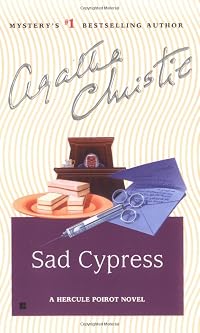
Beautiful young Elinor Carlisle stood serenely in the dock, accused of the murder of Mary Gerrard, her rival in love. The evidence was damning: only Elinor had the motive, the opportunity and the means to administer the fatal poison. Yet, inside the hostile courtroom, only one man still presumed Elinor was innocent until proven guilty: Hercule Poirot was all that stood between Elinor and the gallows.Tags
Recommendations














Member Reviews
Isn't it Romantic?
Apart from the novels she wrote under the pen name Mary Westmacott, Agatha Christie's 1940 mystery Sad Cypress may just be her most romantic book. It's the most unapologetically love-gushy of the 27 Christie mysteries I've read so far (which amounts to about one-third of her canon).
Being the prim and proper product of the Victorian era that she was, Agatha usually kept her romantic subplots bound tighter than a laced-up corset. Yes, there was often a love interest in her mysteries, but she did her best to keep the hearts-and-roses stuff suppressed until the last chapter. Agatha once said, "I myself always found the love interest a terrible bore in detective stories. Love, I felt, belong to romantic stories. To force a show more love motif into what should be a scientific process went much against the grain."
That may be true in most cases, but Sad Cypress finds the Grand Dame of Mysteries chafing against the grain throughout the book.
Not that the romance trumps the mystery. Not by a long-shot. Those who are looking for murder, deceit and intrigue will find it in spades here in Sad Cypress. The plot revolves around an elderly dowager, Mrs. Welman who, contrary to her name, is not in the pink of health and suffers two strokes in the course of the book's early chapters.
When they get an anonymous letter warning them that a girl in the household is "sucking up" to the widowed invalid and might prevent their chances of an inheritance, niece Elinor Carlisle and nephew Roddy Welman make a quick trip to the woman's estate. They have plans for the old lady's money and it involves their eventual marriage. You see, Elinor and Roddy are literally kissing cousins, having maintained a cool, detached love affair for quite some time. They're lovers, but their feelings for each other run deep under a cool surface.
As always when she saw Roddy, Elinor was conscious of a slightly giddy feeling, a throb of sudden pleasure, a feeling that it was incumbent upon her to be very matter-of-fact and unemotional. Because it was so very obvious that Roddy, although he loved her, didn't feel about her the way she felt about him. The first sight of him did something to her, twisted her heart round so that it almost hurt. Absurd that a man—an ordinary, yes, a perfectly ordinary young man—should be able to do that to one! That the mere look of him should set the world spinning, that his voice should make you want—just a little—to cry…Love surely should be a pleasurable emotion—not something that hurt you by its intensity…
This passage comes from Chapter One. Normally, Agatha would save something like this for Chapter Twenty-Eight—if, indeed, she included such heart-throbbing, light-headed language at all. This is the stuff of Norah Lofts or Barbara Cartland, not Agatha Christie. The mere presence of passages like that stands in sharp contrast to Hercule Poirot, who enters the scene after two of the characters have died (at the risk of spoiling your enjoyment of Sad Cypress, I won't reveal the victims).
Romantic complications ensue after Elinor and Roddy arrive at Mrs. Welman's estate. We already know that Roddy is clinically detached in how he views their relationship:
Elinor, he thought judicially, was really quite perfect. Nothing about her ever jarred or offended. She was delightful to look at, witty to talk to—altogether the most charming of companions.
But then Mary comes into view.
She is the young girl who is allegedly "sucking up" to old Mrs. Welman. Mary is the lodgekeeper's daughter and has gotten quite close to the ailing woman and, yes, there is the chance she could be written into the will.
After receiving the anonymous letter and rushing to Mrs. Welman's bedside, Roddy is out wandering through the woods, thinking about the pleasant way in which Elinor never jars nor offends, when…suddenly…she appears:
A girl came through the trees toward him—a girl with pale, gleaming hair and a rose-flushed skin.
He thought, "How beautiful—how unutterably beautiful."
Something gripped him; he stood quite still, as though frozen into immobility. The world, he felt, was spinning, was topsy-turvy, was suddenly and impossibly and gloriously crazy!
And so, Agatha sets up a deliciously tense love triangle which eventually proves to be central to the novel's mystery plot. Here, she integrates and intertwines love and murder as she rarely has before.
I notice that I've given scant mention to Monsieur Hercule Poirot. He's part of the love story, too. He's in love with himself—and supremely confident in his abilities to sort out all the pieces of the puzzle. Never fear—everything is easy to Hercule Poirot. This comes from the mouth of the Belgian himself. He will find the killer and the true lovers will eventually find each other by the close of the book. show less
Apart from the novels she wrote under the pen name Mary Westmacott, Agatha Christie's 1940 mystery Sad Cypress may just be her most romantic book. It's the most unapologetically love-gushy of the 27 Christie mysteries I've read so far (which amounts to about one-third of her canon).
Being the prim and proper product of the Victorian era that she was, Agatha usually kept her romantic subplots bound tighter than a laced-up corset. Yes, there was often a love interest in her mysteries, but she did her best to keep the hearts-and-roses stuff suppressed until the last chapter. Agatha once said, "I myself always found the love interest a terrible bore in detective stories. Love, I felt, belong to romantic stories. To force a show more love motif into what should be a scientific process went much against the grain."
That may be true in most cases, but Sad Cypress finds the Grand Dame of Mysteries chafing against the grain throughout the book.
Not that the romance trumps the mystery. Not by a long-shot. Those who are looking for murder, deceit and intrigue will find it in spades here in Sad Cypress. The plot revolves around an elderly dowager, Mrs. Welman who, contrary to her name, is not in the pink of health and suffers two strokes in the course of the book's early chapters.
When they get an anonymous letter warning them that a girl in the household is "sucking up" to the widowed invalid and might prevent their chances of an inheritance, niece Elinor Carlisle and nephew Roddy Welman make a quick trip to the woman's estate. They have plans for the old lady's money and it involves their eventual marriage. You see, Elinor and Roddy are literally kissing cousins, having maintained a cool, detached love affair for quite some time. They're lovers, but their feelings for each other run deep under a cool surface.
As always when she saw Roddy, Elinor was conscious of a slightly giddy feeling, a throb of sudden pleasure, a feeling that it was incumbent upon her to be very matter-of-fact and unemotional. Because it was so very obvious that Roddy, although he loved her, didn't feel about her the way she felt about him. The first sight of him did something to her, twisted her heart round so that it almost hurt. Absurd that a man—an ordinary, yes, a perfectly ordinary young man—should be able to do that to one! That the mere look of him should set the world spinning, that his voice should make you want—just a little—to cry…Love surely should be a pleasurable emotion—not something that hurt you by its intensity…
This passage comes from Chapter One. Normally, Agatha would save something like this for Chapter Twenty-Eight—if, indeed, she included such heart-throbbing, light-headed language at all. This is the stuff of Norah Lofts or Barbara Cartland, not Agatha Christie. The mere presence of passages like that stands in sharp contrast to Hercule Poirot, who enters the scene after two of the characters have died (at the risk of spoiling your enjoyment of Sad Cypress, I won't reveal the victims).
Romantic complications ensue after Elinor and Roddy arrive at Mrs. Welman's estate. We already know that Roddy is clinically detached in how he views their relationship:
Elinor, he thought judicially, was really quite perfect. Nothing about her ever jarred or offended. She was delightful to look at, witty to talk to—altogether the most charming of companions.
But then Mary comes into view.
She is the young girl who is allegedly "sucking up" to old Mrs. Welman. Mary is the lodgekeeper's daughter and has gotten quite close to the ailing woman and, yes, there is the chance she could be written into the will.
After receiving the anonymous letter and rushing to Mrs. Welman's bedside, Roddy is out wandering through the woods, thinking about the pleasant way in which Elinor never jars nor offends, when…suddenly…she appears:
A girl came through the trees toward him—a girl with pale, gleaming hair and a rose-flushed skin.
He thought, "How beautiful—how unutterably beautiful."
Something gripped him; he stood quite still, as though frozen into immobility. The world, he felt, was spinning, was topsy-turvy, was suddenly and impossibly and gloriously crazy!
And so, Agatha sets up a deliciously tense love triangle which eventually proves to be central to the novel's mystery plot. Here, she integrates and intertwines love and murder as she rarely has before.
I notice that I've given scant mention to Monsieur Hercule Poirot. He's part of the love story, too. He's in love with himself—and supremely confident in his abilities to sort out all the pieces of the puzzle. Never fear—everything is easy to Hercule Poirot. This comes from the mouth of the Belgian himself. He will find the killer and the true lovers will eventually find each other by the close of the book. show less
First sentence: "Elinor Katharine Carlisle. You stand charged upon this indictment with the murder of Mary Gerrard upon the 27th of July last. Are you guilty or not guilty?"
Premise/plot: Harriet Vane had Lord Peter Wimsey, and Elinor Katharine Carlisle has Peter Lord. Though her hero is not an amateur detective, but a country doctor. Still, Peter Lord, who fell in love with Elinor at first sight, has the wisdom to seek the best of the best to clear her name: Hercule Poirot. He wants Poirot to find evidence that will acquit her of murder. Is love blinding him? Is the woman he loves guilty of murder? It seems that she had opportunity to kill her aunt (supposedly out of greed) and Mary (supposedly out of jealousy). But Lord and Poirot show more doubt the supposed motives. They see other possibilities.
My thoughts: I loved this one. I just LOVED it. I loved the characterization! I loved the story! While Peter Lord is no Lord Peter, I did enjoy him very much! I was quite surprised by how pleased I was that Elinor had someone on her side. Not that Elinor was completely lovable. She was flawed--very flawed. But still. By the end, I was seeing her through Peter Lord's eyes, I was seeing her with love.
"One does not practice detection with a textbook! One uses one's natural intelligence." (196)
"One must understand with the cells of one's brain before one uses one's eyes."(196)
"One always likes to know exactly what lies have been told one."
"Did Welman tell you a lie?"
"Definitely."
"Who else has lied to you?"
"Everybody. I think: Nurse O'Brien romantically; Nurse Hopkins stubbornly; Mrs. Bishop venomously; You yourself--"
"Good God!" Peter Lord interrupted him unceremoniously. "You don't think I've lied to you, do you?"
"Not yet," Poirot admitted.
Dr. Lord sank back in his chair. He said, "You're a disbelieving sort of fellow, Poirot." (198)
ETA: I first read this one in 2011. So it has been quite a while. I haven't reread many Christie novels. So it's always tricky for me to match plot points and characters with titles. I don't always even remember if it's Miss Marple or Hercule Poirot. I read this one for the 1940 Book Club. As soon as I realized it was THIS MYSTERY, I was so excited. I remembered loving these characters! show less
Premise/plot: Harriet Vane had Lord Peter Wimsey, and Elinor Katharine Carlisle has Peter Lord. Though her hero is not an amateur detective, but a country doctor. Still, Peter Lord, who fell in love with Elinor at first sight, has the wisdom to seek the best of the best to clear her name: Hercule Poirot. He wants Poirot to find evidence that will acquit her of murder. Is love blinding him? Is the woman he loves guilty of murder? It seems that she had opportunity to kill her aunt (supposedly out of greed) and Mary (supposedly out of jealousy). But Lord and Poirot show more doubt the supposed motives. They see other possibilities.
My thoughts: I loved this one. I just LOVED it. I loved the characterization! I loved the story! While Peter Lord is no Lord Peter, I did enjoy him very much! I was quite surprised by how pleased I was that Elinor had someone on her side. Not that Elinor was completely lovable. She was flawed--very flawed. But still. By the end, I was seeing her through Peter Lord's eyes, I was seeing her with love.
"One does not practice detection with a textbook! One uses one's natural intelligence." (196)
"One must understand with the cells of one's brain before one uses one's eyes."(196)
"One always likes to know exactly what lies have been told one."
"Did Welman tell you a lie?"
"Definitely."
"Who else has lied to you?"
"Everybody. I think: Nurse O'Brien romantically; Nurse Hopkins stubbornly; Mrs. Bishop venomously; You yourself--"
"Good God!" Peter Lord interrupted him unceremoniously. "You don't think I've lied to you, do you?"
"Not yet," Poirot admitted.
Dr. Lord sank back in his chair. He said, "You're a disbelieving sort of fellow, Poirot." (198)
ETA: I first read this one in 2011. So it has been quite a while. I haven't reread many Christie novels. So it's always tricky for me to match plot points and characters with titles. I don't always even remember if it's Miss Marple or Hercule Poirot. I read this one for the 1940 Book Club. As soon as I realized it was THIS MYSTERY, I was so excited. I remembered loving these characters! show less
“That, M. Poirot, is confidential. I cannot tell you without authorization from my client.” Poirot said: “Then I shall have to interview your client!” Mr. Seddon said with a cold smile: “That, I fear, will not be easy.” Poirot rose and made a gesture. “Everything,” he said, “is easy to Hercule Poirot.”
Christie, Agatha. Sad Cypress: Hercule Poirot Investigates (Hercule Poirot series Book 21) (pp. 178-179). HarperCollins. Kindle Edition.
Hercule Poirot is begged to take on the case of Elinor Carlisle - a woman who is being charged with the murder of Mary Gerrard - the woman her fiance took one look at and fell in love with - and the crime Elinor seems to have no desire to prove herself innocent of.
I enjoyed this one. show more The case was really interesting and had me invested in finding out the truth of the matter. Plus I really enjoyed the way it was structured with the three parts. I had my own little theories and I was pretty much wrong on all accounts. I did guess Mary was likely Aunt Laura's daughter from her secret love affair. But I didn't remotely guess the identity of the killer. Omg?! The nurse!? Is really Mary Gerrard's aunt!!! Christie stumps me every time. Or at least so much of the time it's actually a little sad.
I liked Elinor a lot and I felt sorry for her - her feelings for Roderick were brutal. Roderick was okay - except I was annoyed on Elinor's behalf. I mean he never professed great passionate feelings for Elinor, but his sudden falling for Mary was irritating. Especially since he had proposed. It wasn't like Elinor chased after him, begging him to have her - he chose her. And then it was all over. I totally got why Elinor made the decision she did. I wouldn't have wanted to marry him either. And after that I was glad no will meant he got no money.
I liked Peter Lord, although I had my doubts about him too. I thought he might've been the killer. My favourite part was this though;
“If it hadn’t been for you—she would have been convicted.”
Hercule Poirot said quickly: “No, it is you, my friend, she has to thank for her life.”
“I? I didn’t do anything. I tried—” He broke off.
Hercule Poirot smiled a little. “Mais oui, you tried very hard, did you not? You were impatient because I did not seem to you to be getting anywhere. And you were afraid, too, that she might, after all, be guilty. And so, with great impertinence, you also told me the lies! But, mon cher, you were not very clever about it. In future I advise you to stick to the measles and the whooping cough and leave crime detection alone.”
Peter Lord blushed. He said: “Did you know—all the time?”
Poirot said severely: “You lead me by the hand to a clearing in the shrubs, and you assist me to find a German matchbox that you have just put there! C’est l’enfantillage!”
Peter Lord winced.
Christie, Agatha. Sad Cypress: Hercule Poirot Investigates (Hercule Poirot series Book 21) (pp. 279-280). HarperCollins. Kindle Edition.
Lmfao. I loved this. Poor Peter, trying so hard to get Elinor off and in the meantime just amusing Hercule Poirot.
And of course I always love Poirot when he gets on his high horse about his reputation.
I am in good hands. Mr. Seddon has been most kind. I am to have a very famous counsel.”
Poirot said: “He is not so famous as I am!”
Elinor Carlisle said with a touch of weariness: “He has a great reputation.”
“Yes, for defending criminals. I have a great reputation—for demonstrating innocence.”
Christie, Agatha. Sad Cypress: Hercule Poirot Investigates (Hercule Poirot series Book 21) (p. 195). HarperCollins. Kindle Edition.
A solid mystery with interesting characters and a fascinating investigation into the innocence of Elinor Carlisle. 4.5 stars, rounded to 5 stars. show less
Christie, Agatha. Sad Cypress: Hercule Poirot Investigates (Hercule Poirot series Book 21) (pp. 178-179). HarperCollins. Kindle Edition.
Hercule Poirot is begged to take on the case of Elinor Carlisle - a woman who is being charged with the murder of Mary Gerrard - the woman her fiance took one look at and fell in love with - and the crime Elinor seems to have no desire to prove herself innocent of.
I enjoyed this one. show more The case was really interesting and had me invested in finding out the truth of the matter. Plus I really enjoyed the way it was structured with the three parts. I had my own little theories and I was pretty much wrong on all accounts.
I liked Elinor a lot and I felt sorry for her - her feelings for Roderick were brutal. Roderick was okay - except I was annoyed on Elinor's behalf. I mean he never professed great passionate feelings for Elinor, but his sudden falling for Mary was irritating.
I liked Peter Lord, although I had my doubts about him too.
“If it hadn’t been for you—she would have been convicted.”
Hercule Poirot said quickly: “No, it is you, my friend, she has to thank for her life.”
“I? I didn’t do anything. I tried—” He broke off.
Hercule Poirot smiled a little. “Mais oui, you tried very hard, did you not? You were impatient because I did not seem to you to be getting anywhere. And you were afraid, too, that she might, after all, be guilty. And so, with great impertinence, you also told me the lies! But, mon cher, you were not very clever about it. In future I advise you to stick to the measles and the whooping cough and leave crime detection alone.”
Peter Lord blushed. He said: “Did you know—all the time?”
Poirot said severely: “You lead me by the hand to a clearing in the shrubs, and you assist me to find a German matchbox that you have just put there! C’est l’enfantillage!”
Peter Lord winced.
Christie, Agatha. Sad Cypress: Hercule Poirot Investigates (Hercule Poirot series Book 21) (pp. 279-280). HarperCollins. Kindle Edition.
Lmfao. I loved this. Poor Peter, trying so hard to get Elinor off and in the meantime just amusing Hercule Poirot.
And of course I always love Poirot when he gets on his high horse about his reputation.
I am in good hands. Mr. Seddon has been most kind. I am to have a very famous counsel.”
Poirot said: “He is not so famous as I am!”
Elinor Carlisle said with a touch of weariness: “He has a great reputation.”
“Yes, for defending criminals. I have a great reputation—for demonstrating innocence.”
Christie, Agatha. Sad Cypress: Hercule Poirot Investigates (Hercule Poirot series Book 21) (p. 195). HarperCollins. Kindle Edition.
A solid mystery with interesting characters and a fascinating investigation into the innocence of Elinor Carlisle. 4.5 stars, rounded to 5 stars. show less
Another great Poirot read with everything hanging on a scrap of paper and seemingly meaningless lie. A heroine falsely accused but apathetic because she has condemned herself morally. Clever and tragic.
Further thoughts on a later reread: - interesting that it was published ten years exactly after Dorothy Sayer's "Strong Poison", there are quite a few plot parallels, a resigned prisoner against whom there's a watertight case, a man who's fallen in love with the prisoner and who is determined to get her off, an unsuspected motive regarding inheritances, and a similar manner of poisoning involving a shared meal (won't say more as it will be a spoiler).
Further thoughts on a later reread: - interesting that it was published ten years exactly after Dorothy Sayer's "Strong Poison", there are quite a few plot parallels, a resigned prisoner against whom there's a watertight case, a man who's fallen in love with the prisoner and who is determined to get her off, an unsuspected motive regarding inheritances, and a similar manner of poisoning involving a shared meal (won't say more as it will be a spoiler).
Watching Christie experiment with form is always a delight and having this novel open with the murder trial of one of the characters and then backtracking to the whodunnit of it all makes for a compelling read. Spending the whole of the novel determining whether the character on trial actually did it is a nice change and added some variety to my ongoing delve into all the Poirot novels.
I have only ever read a couple of Christie novels - although I used to watch the Poirot series with David Suchet and Miss Marple with Joan Hickson - and thought that the Read Christie 2023 challenge would be a good way to discover some more of her work. The 'official' choice for January is Sad Cypress, a Poirot murder mystery with good reviews, so I took the plunge.
Now, I know that Agatha Christie wrote detective novels, obviously, but I didn't expect her characters - or the ones in this book, at least - to be paper thin clichés! I couldn't find an ounce of sympathy or interest for 'good girl' Mary, the victim, or stoic Elinor, the accused. And the writing has not aged well, either - Christie was certainly a fan of dragging the humble show more 'said' down with adverbs and then repeating herself to get the point across. For the first few chapters, before Poirot makes an appearance, I thought I was reading one of Christie's early novels because the phrasing was so clumsy.
I agree. It’s the only civilized thing to do. You put animals out of their pain. I suppose you don’t do it with human beings simply because, human nature being what it is, people would get shoved off for their money by their fond relations—perhaps when they weren’t really bad at all.’
The mystery, however, was very well done, which I suppose is the point! I thought more was going to be made of the euthanasia angle, which would have been interesting, but instead there's a rather Victorian case of 'natural' children and inheritance fraud (make sure to write a will, kids!) I picked up on the love child almost straight away but didn't identify the killer (apparently the least likely suspect in Christie's stories is usually whodunit).
On a tangent, the characters brought to mind a negative version of Jane Austen's Emma, with Elinor as Emma, Roddy as Mr Knightley (apologies, Mr K) and insipid Mary as a mash-up of Jane Fairfax and Harriet Smith. I think my imagination needed a distraction to get through the 'dear old' middle class wartime narrative!
A quick, fairly painless read, possibly not worth £3.99 on Kindle. Onto the next Christie mystery! show less
Now, I know that Agatha Christie wrote detective novels, obviously, but I didn't expect her characters - or the ones in this book, at least - to be paper thin clichés! I couldn't find an ounce of sympathy or interest for 'good girl' Mary, the victim, or stoic Elinor, the accused. And the writing has not aged well, either - Christie was certainly a fan of dragging the humble show more 'said' down with adverbs and then repeating herself to get the point across. For the first few chapters, before Poirot makes an appearance, I thought I was reading one of Christie's early novels because the phrasing was so clumsy.
I agree. It’s the only civilized thing to do. You put animals out of their pain. I suppose you don’t do it with human beings simply because, human nature being what it is, people would get shoved off for their money by their fond relations—perhaps when they weren’t really bad at all.’
The mystery, however, was very well done, which I suppose is the point! I thought more was going to be made of the euthanasia angle, which would have been interesting, but instead there's a rather Victorian case of 'natural' children and inheritance fraud (make sure to write a will, kids!) I picked up on the love child almost straight away but didn't identify the killer (apparently the least likely suspect in Christie's stories is usually whodunit).
On a tangent, the characters brought to mind a negative version of Jane Austen's Emma, with Elinor as Emma, Roddy as Mr Knightley (apologies, Mr K) and insipid Mary as a mash-up of Jane Fairfax and Harriet Smith. I think my imagination needed a distraction to get through the 'dear old' middle class wartime narrative!
A quick, fairly painless read, possibly not worth £3.99 on Kindle. Onto the next Christie mystery! show less
Agatha Christie se está convirtiendo junto con Jane Austen en mi lugar seguro, como siempre encontrarme con sus intrigas, con Poirot haciendo sus pesquisas, siempre es una delicia.
Después de mis últimas lecturas realmente necesitaba descansar mi mente y este libro me ha caído como anillo al dedo.
Esta es la primera vez que adivino quien es el asesino desde el primer momento, por primera vez fue demasiado obvio para mí, eso no le ha quitado ni un milímetro de diversión a mi lectura, para nada.
Amo a esta mujer, me he puesto la meta de leerme todos sus libros y aunque voy muy despacio, en algún momento lo lograré
Después de mis últimas lecturas realmente necesitaba descansar mi mente y este libro me ha caído como anillo al dedo.
Esta es la primera vez que adivino quien es el asesino desde el primer momento, por primera vez fue demasiado obvio para mí, eso no le ha quitado ni un milímetro de diversión a mi lectura, para nada.
Amo a esta mujer, me he puesto la meta de leerme todos sus libros y aunque voy muy despacio, en algún momento lo lograré
Members
- Recently Added By
Published Reviews
I had a lot of eyerolls at the romance. I often do, there’s something so cringy about Poirot generalizing about all these young girls and their emotions. Some of the dated gender attitudes, and British ideas about continental views, simply did not age well. Then again, I don’t really go for insta-love in modern romance novels either, so some of it’s just me.
Still, I think this is a good show more mystery because I spent the whole book trying to figure out how anyone could have committed the crime. This is the opposite of some of the Christie inheritance mysteries with so many possible suspects running around. Here, I felt like no one else had any motive or any opportunity! Actually, I wasn’t even sure that Elinor had motive and opportunity, she didn’t seem terribly into Rodney and it would be incredibly risky to poison food she was also eating. Plus, the whole investigation feels extra tense because Elinor has already been accused.
In general, the wild explanation of how the murder happened and then the convoluted explanation of why win out over the eye-rolling romantic plot. show less
Still, I think this is a good show more mystery because I spent the whole book trying to figure out how anyone could have committed the crime. This is the opposite of some of the Christie inheritance mysteries with so many possible suspects running around. Here, I felt like no one else had any motive or any opportunity! Actually, I wasn’t even sure that Elinor had motive and opportunity, she didn’t seem terribly into Rodney and it would be incredibly risky to poison food she was also eating. Plus, the whole investigation feels extra tense because Elinor has already been accused.
In general, the wild explanation of how the murder happened and then the convoluted explanation of why win out over the eye-rolling romantic plot. show less
added by TheFictionAddiction
Lists

British Mystery
469 works; 14 members

Crime and Mysteries to Read
746 works; 31 members

Agatha Christie Poirot
43 works; 2 members

Female Author
1,234 works; 67 members

Books About Murder
313 works; 7 members

Favorite Books from the 1940s
38 works; 3 members

Detective Stories
343 works; 5 members

Shakespeare Quote Titles
112 works; 12 members

Alphabetical Books
211 works; 3 members

Books Read in 2020
4,379 works; 124 members

Books Read in 2023
5,547 works; 145 members

Books Read in 2024
4,623 works; 126 members

TBR
77 works; 1 member

Agatha Christie Chronology
93 works; 1 member
Author Information

One of the most successful and beloved writer of mystery stories, Agatha Mary Clarissa Christie was born in 1890 in Torquay, County Devon, England. She wrote her first novel, The Mysterious Affair at Styles, in 1920, launching a literary career that spanned decades. In her lifetime, she authored 79 crime novels and a short story collection, 19 show more plays, and six novels written under the name of Mary Westmacott. Her books have sold over a billion copies in the English language with another billion in 44 foreign languages. Some of her most famous titles include Murder on the Orient Express, Mystery of the Blue Train, And Then There Were None, 13 at Dinner and The Sittaford Mystery. Noted for clever and surprising twists of plot, many of Christie's mysteries feature two unconventional fictional detectives named Hercule Poirot and Miss Jane Marple. Poirot, in particular, plays the hero of many of her works, including the classic, The Murder of Roger Ackroyd (1926), and Curtain (1975), one of her last works in which the famed detective dies. Over the years, her travels took her to the Middle East where she met noted English archaeologist Sir Max Mallowan. They married in 1930. Christie accompanied Mallowan on annual expeditions to Iraq and Syria, which served as material for Murder in Mesopotamia (1930), Death on the Nile (1937), and Appointment with Death (1938). Christie's credits also include the plays, The Mousetrap and Witness for the Prosecution (1953; film 1957). Christie received the New York Drama Critics' Circle Award for 1954-1955 for Witness. She was also named Dame Commander of the Order of the British Empire in 1971. Christie died in 1976. (Bowker Author Biography) show less
Some Editions
Series

Belongs to Publisher Series
Work Relationships
Is contained in
Agatha Christie's Detectives: Five Complete Novels (The Murder At The Vicarage, Dead Man's Folly, Sad Cypress, Towards Zero, N or M?) by Agatha Christie
Agatha Christie Crime Collection: Appointment with Death, Crooked House, Sad Cypress. by Agatha Christie
Common Knowledge
- Canonical title
- Sad Cypress
- Original title
- Sad Cypress
- Original publication date
- 1940-03-01
- People/Characters
- Hercule Poirot; Elinor Carlisle; Roderick Welman; Mary Gerrard; Dr. Peter Lord; Laura Welman (show all 16); Nurse Jessie Hopkins; Nurse O'Brien; Horlick; Mrs Bishop; Mrs Slattery; Ted Bigland; Mr Seddon; Sir Edwin Bulmer; Sir Samuel Attenbury; Mr Gerrard
- Important places
- Maidensford, England, UK; London, England, UK
- Related movies
- Agatha Christie's Poirot: Sad Cypress (2003 | IMDb)
- Epigraph
- Come away, come away, death,
And in sad cypress let me be laid;
Fly away, fly away, breath;
I am slain by a fair cruel maid.
My shroud of white, stuck all with yew,
O prepare it!
My part of death, no one so ... (show all)true
Did share it.
—Shakespeare - Dedication
- To Peter and Peggy McLeod
- First words
- "Elinor Katharine Carlisle."
- Last words
- (Click to show. Warning: May contain spoilers.)"... With you, she can be happy."
- Original language
- English UK
Classifications
Statistics
- Members
- 4,033
- Popularity
- 3,864
- Reviews
- 90
- Rating
- (3.68)
- Languages
- 28 — Catalan, Czech, Danish, Dutch, English, Estonian, Finnish, French, Georgian, German, Greek, Hungarian, Indonesian, Italian, Japanese, Lithuanian, Norwegian (Bokmål), Norwegian, Polish, Portuguese, Romanian, Russian, Serbian, Sinhalese, Slovenian, Spanish, Swedish, Turkish
- Media
- Paper, Audiobook, Ebook
- ISBNs
- 148
- UPCs
- 5
- ASINs
- 89