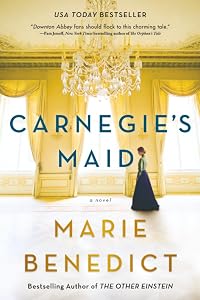
Carnegie's Maid
by Marie Benedict
On This Page
Description
Clara Kelley is not who they think she is. She's not the experienced Irish maid who was hired to work in one of Pittsburgh's grandest households. She's a poor farmer's daughter with nowhere to go and nothing in her pockets. But the other woman with the same name has vanished, and pretending to be her just might get Clara some money to send back home. If she can keep up the ruse, that is. Serving as a lady's maid in the household of Andrew Carnegie requires skills she doesn't have, answering show more to an icy mistress who rules her sons and her domain with an iron fist. What Clara does have is a resolve as strong as the steel Pittsburgh is becoming famous for, coupled with an uncanny understanding of business, and Andrew begins to rely on her. But Clara can't let her guard down, not even when Andrew becomes something more than an employer. Revealing her past might ruin her future -- and her family's.--Provided by Publisher. show lessTags
Recommendations














































Member Reviews
3.5 stars
Clara Kelly has come to the US from Ireland. When she gets off the boat, she is mistaken for another Clara Kelly and ends up in a much better place than she otherwise would have been – as a lady’s maid to Mrs. Carnegie (yes, Andrew Carnegie’s mother). She quickly learns what she needs to know to make her way and falls for Mrs. Carnegie’s oldest son, Andrew. Clara, though a farmer’s daughter in Ireland, was well-read, thanks to her father, and is smart. She and Andrew have some good conversations, including business conversations and fall for each other, though Clara, especially, tries to fight her feelings.
I liked this. I listened to the audio and had no problem following what was going on. In the author’s note at show more the end, we learn that Clara was, of course, a fictional character, as the author wanted to imagine what might have changed him from the business tycoon he was to the philanthropist he became (paying for libraries and museums that anyone could enjoy), regardless of monetary wealth or social class. show less
Clara Kelly has come to the US from Ireland. When she gets off the boat, she is mistaken for another Clara Kelly and ends up in a much better place than she otherwise would have been – as a lady’s maid to Mrs. Carnegie (yes, Andrew Carnegie’s mother). She quickly learns what she needs to know to make her way and falls for Mrs. Carnegie’s oldest son, Andrew. Clara, though a farmer’s daughter in Ireland, was well-read, thanks to her father, and is smart. She and Andrew have some good conversations, including business conversations and fall for each other, though Clara, especially, tries to fight her feelings.
I liked this. I listened to the audio and had no problem following what was going on. In the author’s note at show more the end, we learn that Clara was, of course, a fictional character, as the author wanted to imagine what might have changed him from the business tycoon he was to the philanthropist he became (paying for libraries and museums that anyone could enjoy), regardless of monetary wealth or social class. show less
Marie Benedict is a descendant of Irish immigrants who came to America seeking a better life. Her ancestors made their living as domestic servants, factory laborers, and coal miners, but they hoped that their children would do better financially, socially, and professionally. "Carnegie's Maid" is the fictional tale of Clara Kelley, a nineteen-year-old woman whose destitute family lives in Ireland and relies on the money she sends home to survive. In 1863, thanks to an improbable mix-up, she lands a coveted position as a lady's maid to Margaret, Andrew Carnegie's mother. Clara is relieved to have this job, and prays that the secret she is keeping from her employer is never revealed.
A predictable but implausible romance blossoms between show more Andrew Carnegie and Clara. It turns out that Clara is educated, intelligent, and has keen business sense. As Clara and Andrew secretly get to know one another, they discuss literature, human rights, mergers, and ideas for new ventures. Inevitably, their attraction to one another grows. The author paints a diverting picture of everyday life in a privileged household during the late 1800s. In addition, Benedict touches on such themes as the evils of slavery; the chasm between rich and poor; discrimination against Catholics; and the suffering of penniless immigrants arriving in a new land with few prospects.
Sharp-eyed Clara does not miss a trick. Although she is falling in love with Andrew, she discerns a streak of ruthlessness in this man from Scotland. He worked his way up to become fabulously wealthy, thanks to fierce determination, shady practices, and financial savvy. He and his mother are shrewd and self-serving, but Clara prevails on Andrew to remember his roots and use his wealth to help the indigent and those who, like him, arrived from Europe hoping to prosper someday. The book poses a question that is still timely: Do affluent people have a responsibility to help the underprivileged, or should the poor be expected to climb out of poverty without assistance? Although this is a conventional tale of haves and have-nots, Clara is so likeable, smart, and goodhearted that readers will grow to care about her. Enjoy "Carnegie's Maid" for its setting, period detail, fine descriptive writing, and history lesson about Irish immigration and the era of the Robber Barons. show less
A predictable but implausible romance blossoms between show more Andrew Carnegie and Clara. It turns out that Clara is educated, intelligent, and has keen business sense. As Clara and Andrew secretly get to know one another, they discuss literature, human rights, mergers, and ideas for new ventures. Inevitably, their attraction to one another grows. The author paints a diverting picture of everyday life in a privileged household during the late 1800s. In addition, Benedict touches on such themes as the evils of slavery; the chasm between rich and poor; discrimination against Catholics; and the suffering of penniless immigrants arriving in a new land with few prospects.
Sharp-eyed Clara does not miss a trick. Although she is falling in love with Andrew, she discerns a streak of ruthlessness in this man from Scotland. He worked his way up to become fabulously wealthy, thanks to fierce determination, shady practices, and financial savvy. He and his mother are shrewd and self-serving, but Clara prevails on Andrew to remember his roots and use his wealth to help the indigent and those who, like him, arrived from Europe hoping to prosper someday. The book poses a question that is still timely: Do affluent people have a responsibility to help the underprivileged, or should the poor be expected to climb out of poverty without assistance? Although this is a conventional tale of haves and have-nots, Clara is so likeable, smart, and goodhearted that readers will grow to care about her. Enjoy "Carnegie's Maid" for its setting, period detail, fine descriptive writing, and history lesson about Irish immigration and the era of the Robber Barons. show less
If someone is rich, especially rich beyond all imagining, those of us who live on a budget often have many ideas about how they should spend their money. We condemn them for what we view as frivolous or extravagant spending, especially if it is noteworthy enough to be reported on publicly, and often pair that condemnation with a belief that that money could have been better spent on charity. Underlying that assumption is a value judgement that the wealthy person may or may not have earned. Some wealthy people give a lot to the charities of their choice. Some give little to nothing. Some give right from the moment they earn their first penny, while others amass a fortune before they start to give. Andrew Carnegie was one of the latter show more type. Known for his intelligence and sometimes ruthless business practices, he was fabulously wealthy before he started using his fortune philanthropically and no one knows what inspired his sudden generosity. In Marie Benedict's historical fiction novel Carnegie's Maid, Benedict has imagined the catalyst for this beneficence on Carnegie's part to be his love for the invented person of Irish immigrant and lady's maid Clara Kelley.
Clara Kelley was sent to the US by her family in search of a job that would allow her to send money home to them, money that might help them save the family farm. She lands in Philadelphia and hopes to make her way to Pittsburgh, where she has family and will look for a job, when she impossibly hears a driver calling her name. He's actually calling for another Clara Kelley, who our Clara Kelley realizes quickly must have died on the boat over and so, without thinking, she assumes the dead woman's identity, lucking into a ride to Pittsburgh and a job as a lady's maid to Andrew Carnegie's mother, a job the farmer's daughter could never have hoped for in the regular scheme of things. As a lady's maid, she is immersed in the opulent house and furnishings, living amidst wealth unimagined. But when she visits her own family near the factories, she sees an entirely different side of the city, the struggle for survival, the grinding poverty unnoticed and unacknowledged by those in the upper echelons of society, the echelons the immigrant Carnegies are so interested in joining. She is bothered by the obvious disparity and the myriad social injustices but she cannot say anything, dependent as her family back in Ireland is on the money she sends home so she keeps her head down, learning her role as lady's maid, keeping track of Carnegie's vast holdings in an effort to understand how he gained his wealth, and using the library in the house to continue the education her quick brain demands. As she encounters Andrew Carnegie more and more often, he cannot miss her intelligence and a proper romance blooms. Will Clara allow her feelings for Carnegie to jeopardize her position and the support her family needs? Or will her loyalty to her family and the impossibility of the class differences win out?
The novel opens with Carnegie drafting a document detailing his goals for using his wealth for the benefit of others rather than for himself as a way to honor the love and beliefs of his Clara before moving back in time to the story of Clara arriving in the US and going to work for the Carnegies. The entire plot here is predicated on something incredibly improbable: not only was there a dead woman with the heroine's same name who was headed to the same city Clara needs to go to but despite Clara's upbringing on a small farm with a mother who was once a lowly scullery maid, she's convincing enough to pretend to be a competent lady's maid until she learns how to actually perform her duties, so the story takes a pretty big suspension of disbelief from the reader right from the get go. Clara also has a pretty immediate and unlikely understanding of certain legal business matters that she shouldn't have, no matter how smart she is. In spite of these coincidences and anomalies, it is interesting to see this lady's maid from the bottom of society spar with Andrew Carnegie, titan of industry, and their conversations serve to draw a fuller picture of his contradictory character. The strong emphasis on libraries and the advantage of having access to books for learning, the way Carnegie himself rose above his working class origins, was definitely interesting. There weren't many characters in the novel, and certainly few that were more than simply mentioned briefly, allowing the focus beyond Clara to be on Andrew Carnegie and his social climbing mother but also likely being historically accurate since lady's maids inhabited a lonely rung in the household structure. Carnegie was an intriguing character here; surprisingly Clara was less so, perhaps because she was rather less believable. Over all, this novel of ideas, a guess at the origin of Carnegie's philanthropy, was a fast, easy, and generally enjoyable read. show less
Clara Kelley was sent to the US by her family in search of a job that would allow her to send money home to them, money that might help them save the family farm. She lands in Philadelphia and hopes to make her way to Pittsburgh, where she has family and will look for a job, when she impossibly hears a driver calling her name. He's actually calling for another Clara Kelley, who our Clara Kelley realizes quickly must have died on the boat over and so, without thinking, she assumes the dead woman's identity, lucking into a ride to Pittsburgh and a job as a lady's maid to Andrew Carnegie's mother, a job the farmer's daughter could never have hoped for in the regular scheme of things. As a lady's maid, she is immersed in the opulent house and furnishings, living amidst wealth unimagined. But when she visits her own family near the factories, she sees an entirely different side of the city, the struggle for survival, the grinding poverty unnoticed and unacknowledged by those in the upper echelons of society, the echelons the immigrant Carnegies are so interested in joining. She is bothered by the obvious disparity and the myriad social injustices but she cannot say anything, dependent as her family back in Ireland is on the money she sends home so she keeps her head down, learning her role as lady's maid, keeping track of Carnegie's vast holdings in an effort to understand how he gained his wealth, and using the library in the house to continue the education her quick brain demands. As she encounters Andrew Carnegie more and more often, he cannot miss her intelligence and a proper romance blooms. Will Clara allow her feelings for Carnegie to jeopardize her position and the support her family needs? Or will her loyalty to her family and the impossibility of the class differences win out?
The novel opens with Carnegie drafting a document detailing his goals for using his wealth for the benefit of others rather than for himself as a way to honor the love and beliefs of his Clara before moving back in time to the story of Clara arriving in the US and going to work for the Carnegies. The entire plot here is predicated on something incredibly improbable: not only was there a dead woman with the heroine's same name who was headed to the same city Clara needs to go to but despite Clara's upbringing on a small farm with a mother who was once a lowly scullery maid, she's convincing enough to pretend to be a competent lady's maid until she learns how to actually perform her duties, so the story takes a pretty big suspension of disbelief from the reader right from the get go. Clara also has a pretty immediate and unlikely understanding of certain legal business matters that she shouldn't have, no matter how smart she is. In spite of these coincidences and anomalies, it is interesting to see this lady's maid from the bottom of society spar with Andrew Carnegie, titan of industry, and their conversations serve to draw a fuller picture of his contradictory character. The strong emphasis on libraries and the advantage of having access to books for learning, the way Carnegie himself rose above his working class origins, was definitely interesting. There weren't many characters in the novel, and certainly few that were more than simply mentioned briefly, allowing the focus beyond Clara to be on Andrew Carnegie and his social climbing mother but also likely being historically accurate since lady's maids inhabited a lonely rung in the household structure. Carnegie was an intriguing character here; surprisingly Clara was less so, perhaps because she was rather less believable. Over all, this novel of ideas, a guess at the origin of Carnegie's philanthropy, was a fast, easy, and generally enjoyable read. show less
After reading The Other Einstein I knew Marie Benedict had a particular passion for writing about historical figures with a female perspective, that didn't and doesn't revolve around who they're sleeping with. So when I saw Carnegie's Maid was up for grabs, I grabbed it. While written about a true historical figure, it is told from the perspective of Clara, and fictional Clara's are always sweet and soft spoken, yet Marie's Clara is somehow the voice for all Irish immigrants in this novel. She's somehow the catalyst for Andrew's free libraries, and quite honestly I got Beauty and the Beast vibes a few times. Ms. Benedict delivers a second well researched novel, giving us an insight on the Irish immigrant experience in America at the show more time, while also giving us a realistic view. There is a love story in this novel, but it doesn't feel forced and it isn't the sole focus. Clara is a passionate character, and it is hard to distill the legacy of the Carnegie's and not see the compassion and philanthropy shown by Andrew. I cannot wait to read what she writes next. show less
Why did Andrew Carnegie, arguably the most cutthroat robber baron ever — which is saying something — turn philanthropist? That’s the question Benedict tries to answer in this engaging, if half-fulfilled, novel.
Her catalyst is Clara Kelley, who leaves Galway for New York in November 1863, on a mission that feels desperate. Her once-prosperous farm family faces poverty, if not destitution, because of her father’s political activity. Clara, healthy, vigorous, and intelligent, is the daughter chosen to cross the Atlantic, find gainful employment, and send money home.
Well versed in horror stories about conmen who fleece new immigrants, Clara makes an instinctive decision on arrival. A man in livery asks her whether she’s Clara show more Kelley, to which she naturally says yes. But it’s quickly apparent that she’s not the young woman he’s expecting. Nevertheless, she plays the part to the hilt—-who’s fleecing whom?--and he helps her into his carriage, which will bring them to Pittsburgh.
During the ride, Clara gleans that she’s to be ladies’ maid to a Mrs. Carnegie, a notion that both excites and terrifies her, because she has no idea what a lady's maid does or who her new employer is, aside from having a wealthy son. I like this part of the novel best, for Clara must suss out what people want to hear before they even ask, an exercise fraught with tension and, sometimes, humor.
But our heroine has two aces up her puffy sleeves. First, her betters talk about her as though she weren’t there — a servant’s lot — and from the information gained, she infers ways to keep one step ahead of exposure. Secondly, Clara senses that Mrs. Carnegie asks so many questions about how her former employers dressed, took tea, or buffed their nails not to uncover her maid's falsehoods, but because she’s unsure of herself. She has money, of course, and a son who’s like a god to her, but no name or social standing, and that scares her. She needs to know How Things Are Done, without giving herself away. In other words, she's more like her maid than she knows.
Clara can’t ever breathe a syllable of her discovery, yet the knowledge gives her courage and the means with which to flatter. And when she has the rare luxury to breathe, she’s free to observe that her made-of-iron mistress manufactures and sells that product, and her escritoire holds business papers instead of invitations or calling cards. That opens a world for Clara — a woman can enter business and compete with men — a feminist touch I like, and which Benedict wisely refrains from overplaying.
Despite such an ingenious premise and engaging protagonist, though, several obstacles hold the story back. First is Pointless Prologue No. 1728, in which Andrew pens an unsent letter to Clara bemoaning her departure, expressing his love, and promising to devote his fortune to charitable causes. A version of this letter apparently exists, which prompts the central historical question — why did he write it? — but sabotages the plot.
Narrative questions do remain, but I think they pale beside the larger issues, not least whose story this is, the male industrialist’s or that of the fictive woman who influences him. I find Clara’s predicament compelling enough at the outset without a Famous Person waiting in the wings.
Also, rather than evoke Clara’s conflicts through physical detail, such as memories of her home and family, she asks rhetorical questions of herself, often the same ones. So many authors settle for that, and some readers might say that’s the difference between commercial and literary fiction.
I disagree. A confident storyteller in any genre realizes that a three-sentence digression that offers a window on inner life connects with the reader and creates tension. It’s also subtler and more effective than three rhetorical questions in a row.
Carnegie’s Maid does draw some lovely parallels. Carnegie and Clara realize that they’re both immigrants, yet the distance between them is enormous. I wish Clara had gone a little further, recognizing that her lie is no worse than those he tells in his business, and that unlike him, she hasn’t hurt anybody.
Her pretense, in fact, is precisely the sort of boldness that can decide success or failure, especially for a poor immigrant, and it’s certainly what has built the Carnegie empire. She can never say so, but I wanted her to think it.
Benedict also juxtaposes Clara’s family situation with that of Mr. Ford, the household chef and former slave, and her only ally among the servants. I like this very much, but again, I would have liked it even better had Clara imagined slavery or how her friend must have suffered.
Likewise, I would have welcomed a passage or two in which she wonders what she would do if she had riches, or what it might feel like to be sexually touched, an issue that arises because of Andrew’s attraction for her. We’re told only that no one in Galway wanted to marry her, but surely, she felt some sexual pull, sometime. I’d have expected her to measure that fantasy against Andrew’s physical reality and to struggle with that.
Consequently, Carnegie’s Maid feels restrained, in a way, because of risks not taken. It’s a decent novel but could have been much more. show less
Her catalyst is Clara Kelley, who leaves Galway for New York in November 1863, on a mission that feels desperate. Her once-prosperous farm family faces poverty, if not destitution, because of her father’s political activity. Clara, healthy, vigorous, and intelligent, is the daughter chosen to cross the Atlantic, find gainful employment, and send money home.
Well versed in horror stories about conmen who fleece new immigrants, Clara makes an instinctive decision on arrival. A man in livery asks her whether she’s Clara show more Kelley, to which she naturally says yes. But it’s quickly apparent that she’s not the young woman he’s expecting. Nevertheless, she plays the part to the hilt—-who’s fleecing whom?--and he helps her into his carriage, which will bring them to Pittsburgh.
During the ride, Clara gleans that she’s to be ladies’ maid to a Mrs. Carnegie, a notion that both excites and terrifies her, because she has no idea what a lady's maid does or who her new employer is, aside from having a wealthy son. I like this part of the novel best, for Clara must suss out what people want to hear before they even ask, an exercise fraught with tension and, sometimes, humor.
But our heroine has two aces up her puffy sleeves. First, her betters talk about her as though she weren’t there — a servant’s lot — and from the information gained, she infers ways to keep one step ahead of exposure. Secondly, Clara senses that Mrs. Carnegie asks so many questions about how her former employers dressed, took tea, or buffed their nails not to uncover her maid's falsehoods, but because she’s unsure of herself. She has money, of course, and a son who’s like a god to her, but no name or social standing, and that scares her. She needs to know How Things Are Done, without giving herself away. In other words, she's more like her maid than she knows.
Clara can’t ever breathe a syllable of her discovery, yet the knowledge gives her courage and the means with which to flatter. And when she has the rare luxury to breathe, she’s free to observe that her made-of-iron mistress manufactures and sells that product, and her escritoire holds business papers instead of invitations or calling cards. That opens a world for Clara — a woman can enter business and compete with men — a feminist touch I like, and which Benedict wisely refrains from overplaying.
Despite such an ingenious premise and engaging protagonist, though, several obstacles hold the story back. First is Pointless Prologue No. 1728, in which Andrew pens an unsent letter to Clara bemoaning her departure, expressing his love, and promising to devote his fortune to charitable causes. A version of this letter apparently exists, which prompts the central historical question — why did he write it? — but sabotages the plot.
Narrative questions do remain, but I think they pale beside the larger issues, not least whose story this is, the male industrialist’s or that of the fictive woman who influences him. I find Clara’s predicament compelling enough at the outset without a Famous Person waiting in the wings.
Also, rather than evoke Clara’s conflicts through physical detail, such as memories of her home and family, she asks rhetorical questions of herself, often the same ones. So many authors settle for that, and some readers might say that’s the difference between commercial and literary fiction.
I disagree. A confident storyteller in any genre realizes that a three-sentence digression that offers a window on inner life connects with the reader and creates tension. It’s also subtler and more effective than three rhetorical questions in a row.
Carnegie’s Maid does draw some lovely parallels. Carnegie and Clara realize that they’re both immigrants, yet the distance between them is enormous. I wish Clara had gone a little further, recognizing that her lie is no worse than those he tells in his business, and that unlike him, she hasn’t hurt anybody.
Her pretense, in fact, is precisely the sort of boldness that can decide success or failure, especially for a poor immigrant, and it’s certainly what has built the Carnegie empire. She can never say so, but I wanted her to think it.
Benedict also juxtaposes Clara’s family situation with that of Mr. Ford, the household chef and former slave, and her only ally among the servants. I like this very much, but again, I would have liked it even better had Clara imagined slavery or how her friend must have suffered.
Likewise, I would have welcomed a passage or two in which she wonders what she would do if she had riches, or what it might feel like to be sexually touched, an issue that arises because of Andrew’s attraction for her. We’re told only that no one in Galway wanted to marry her, but surely, she felt some sexual pull, sometime. I’d have expected her to measure that fantasy against Andrew’s physical reality and to struggle with that.
Consequently, Carnegie’s Maid feels restrained, in a way, because of risks not taken. It’s a decent novel but could have been much more. show less
Famine threatens the livelihood of Irish men and women, forcing them to seek better, yet unknown opportunities abroad in America. It was not uncommon to see a young girl on her own, sometimes the family’s only hope for income, and starting a better life. Clara is just such a girl; coming from a family of 5, her mother and father deemed her the best fit to starting life in America on her own. Clara’s older sister, Eliza, is set to be married, and her younger sister is, well, too young.
Clara seems to be at terms with her change in life. She does what’s best for herself on the voyage over to America; keeps to herself, avoids those who are sick; so that she may have the best opportunity for a job. Clara is settled on having either to show more work for a mill, or a seamstress- when your family owns a farm, there’s not much to choose from when it comes to work, seeing as she wasn’t trained for anything. Clara’s father, however, saw to it that his 3 daughters would be taught as men; reading, having an opinion, etc. It is because of her father that Clara developed her sharp wit, that puts her at an advantage to stand out.
Surviving the voyage across the sea was a feat upon itself, arriving in Philadelphia, Clara’s biggest concern is quarantine. If one person on the boat is deemed unhealthy, then the entire boat is at risk; setting back the hopes and dreams of finding a job and earning a living. And of course human beings are still separated according to class, like prize chattel going to the slaughter. Our Clara is lower class, not that that seems to bother her one bit. The only promise Clara has at this point is a second cousin already residing in Pittsburgh Pennsylvania- scraping what little money she has together, her plan is to make it to her family and find what little work is available.
By some luck, a Clara Kelley from a “higher class” is missing- and readers are left to guess that the name Clara Kelley is very popular across the seas. Clara hesitantly comes forward ( I mean it is her name and all) to see what exactly they are looking for. It turns out the other Clara was promised for “high end” maid work; judging how unkempt our Clara is from her trip overseas, the valet is questioning if she is who she says. Without any options of proving her validity, the valet whisks her and two other girls off in a carriage.
Ironically Clara is taken to Pittsburgh to start a trial employ with Mrs. Carnegie. Quite a difference in scenery for an Irish farm girl.
Mrs. Carnegie is a tough mistress to work for. She likes things the way she expects them to be preformed, and if you deter from that expectation you are dismissed from service. Clara professed she was a quick learner- picking up on her mistress’ mannerisms, she becomes the ideal lady’s maid. Mrs. Carnegie also takes a liking to Clara, and it is in the private moments between the two of them that she softens, and asks Clara her opinion on societal trends.
As Clara gains confidence in her stolen role, she is reminded of everything she left behind. Receiving letters from home paints a sad picture of what life on the farm has become. She is further reminded of what her life could have been by visiting her relatives. Seeing how destitute a life working in the mill is, Clara bolsters her resolve to do whatever she could to restore her family’s farm. Taking the train home, she breaks down. Missing her family, keeping up her assumed appearance, she sobs in front of complete strangers. That is when her mistress’ son, Andrew Carnegie talks to her.
Stemmed by Carnegie’s generosity of bridging the servant-master gap, Clara starts observing his business practices, and the two secretly exchange business deals to further the Carnegie name. How far can a lady’s maid succeed in business?
Here we are again, with a book breaking the stereotypes of history classes. All throughout high school we are inundated with men: presidents, inventors, business proposals. Reading these historical fiction books however, gives me hope that ideally, women are the backbone of everything these men did. Goading them on in lucrative business proposals, pushing for presidency because they had a good heart, making friends in that inner most circle to gain a vantage point. What if, most (I’m giving men the benefit of the doubt here) men’s brilliant ideas, stemmed from a simple pillow talk with their wife?
In a time where women were more for tea parties, and social events, it’s encouraging to think that woman were just as forward thinking as we are today. It angers me to know that in the past people like me, who are openly opinionated, and not full of decorum, would be looked down upon because I couldn’t keep a comment to myself. Granted, that comment would be dripping with cynicism, but that’s who I am. And I know for a fact I wouldn’t last long in that time period.
Just like in “The Other Einstein”, it feels that for far too long men have been running with ideas stemmed from women and reaping the benefits. All the while women have been scraping nothing but bottom, trying to carve out a place for themselves. I love hearing untold stories of women, even if they are historical fiction.
Again, Marie Benedict knocks it out of the park with “Carnegie’s Maid”. I earnestly hope that he continues her work with untold stories of great women hidden in the monstrous shadows of men. show less
Clara seems to be at terms with her change in life. She does what’s best for herself on the voyage over to America; keeps to herself, avoids those who are sick; so that she may have the best opportunity for a job. Clara is settled on having either to show more work for a mill, or a seamstress- when your family owns a farm, there’s not much to choose from when it comes to work, seeing as she wasn’t trained for anything. Clara’s father, however, saw to it that his 3 daughters would be taught as men; reading, having an opinion, etc. It is because of her father that Clara developed her sharp wit, that puts her at an advantage to stand out.
Surviving the voyage across the sea was a feat upon itself, arriving in Philadelphia, Clara’s biggest concern is quarantine. If one person on the boat is deemed unhealthy, then the entire boat is at risk; setting back the hopes and dreams of finding a job and earning a living. And of course human beings are still separated according to class, like prize chattel going to the slaughter. Our Clara is lower class, not that that seems to bother her one bit. The only promise Clara has at this point is a second cousin already residing in Pittsburgh Pennsylvania- scraping what little money she has together, her plan is to make it to her family and find what little work is available.
By some luck, a Clara Kelley from a “higher class” is missing- and readers are left to guess that the name Clara Kelley is very popular across the seas. Clara hesitantly comes forward ( I mean it is her name and all) to see what exactly they are looking for. It turns out the other Clara was promised for “high end” maid work; judging how unkempt our Clara is from her trip overseas, the valet is questioning if she is who she says. Without any options of proving her validity, the valet whisks her and two other girls off in a carriage.
Ironically Clara is taken to Pittsburgh to start a trial employ with Mrs. Carnegie. Quite a difference in scenery for an Irish farm girl.
Mrs. Carnegie is a tough mistress to work for. She likes things the way she expects them to be preformed, and if you deter from that expectation you are dismissed from service. Clara professed she was a quick learner- picking up on her mistress’ mannerisms, she becomes the ideal lady’s maid. Mrs. Carnegie also takes a liking to Clara, and it is in the private moments between the two of them that she softens, and asks Clara her opinion on societal trends.
As Clara gains confidence in her stolen role, she is reminded of everything she left behind. Receiving letters from home paints a sad picture of what life on the farm has become. She is further reminded of what her life could have been by visiting her relatives. Seeing how destitute a life working in the mill is, Clara bolsters her resolve to do whatever she could to restore her family’s farm. Taking the train home, she breaks down. Missing her family, keeping up her assumed appearance, she sobs in front of complete strangers. That is when her mistress’ son, Andrew Carnegie talks to her.
Stemmed by Carnegie’s generosity of bridging the servant-master gap, Clara starts observing his business practices, and the two secretly exchange business deals to further the Carnegie name. How far can a lady’s maid succeed in business?
Here we are again, with a book breaking the stereotypes of history classes. All throughout high school we are inundated with men: presidents, inventors, business proposals. Reading these historical fiction books however, gives me hope that ideally, women are the backbone of everything these men did. Goading them on in lucrative business proposals, pushing for presidency because they had a good heart, making friends in that inner most circle to gain a vantage point. What if, most (I’m giving men the benefit of the doubt here) men’s brilliant ideas, stemmed from a simple pillow talk with their wife?
In a time where women were more for tea parties, and social events, it’s encouraging to think that woman were just as forward thinking as we are today. It angers me to know that in the past people like me, who are openly opinionated, and not full of decorum, would be looked down upon because I couldn’t keep a comment to myself. Granted, that comment would be dripping with cynicism, but that’s who I am. And I know for a fact I wouldn’t last long in that time period.
Just like in “The Other Einstein”, it feels that for far too long men have been running with ideas stemmed from women and reaping the benefits. All the while women have been scraping nothing but bottom, trying to carve out a place for themselves. I love hearing untold stories of women, even if they are historical fiction.
Again, Marie Benedict knocks it out of the park with “Carnegie’s Maid”. I earnestly hope that he continues her work with untold stories of great women hidden in the monstrous shadows of men. show less
When a case of mistaken identity leads Irish immigrant Clara Kelley to take a position as a lady's maid in the Carnegie household, she finds herself falling in love with the bachelor son of her employer -- none other than the famous businessman and philanthropist Andrew Carnegie.
I find that I have problems with historical fiction that takes actual historical figures and makes up parts of their lives. It's strange: something like Hamilton is okay with me, though certainly Lin-Manuel Miranda took plenty of liberties with the historical facts there. And something like the Bloody Jack series is okay with me, because Jacky's encounters with actual historical figures are meant to be over-the-top, and Jacky herself is fictional. But this book show more irked me a bit. In addition to my issues with the historical shenanigans, I also thought that the writing was poor. The author did a lot of that trick where she shoehorns her research into the text, so that characters are telling each other things they already know in order to impart knowledge to the reader. I also thought it highly unlikely that Clara would be able to fake it 'till she made it as a lady's maid, having had no training. I mean, I'm pretty sure I couldn't accomplish the duties of an 1860's lady's maid if I were suddenly thrown back in time, and it's not like Clara's scullery maid mother could have trained her for the job. I grant that she found a book in the family library that helped her, but she seemed to be doing okay even before then, and I just don't buy it.
That's not to say that the book wasn't enjoyable -- I did make it through the whole thing -- but I probably won't seek out other books by this author. I read this for book club, and I think most of us were pretty ambivalent on it. show less
I find that I have problems with historical fiction that takes actual historical figures and makes up parts of their lives. It's strange: something like Hamilton is okay with me, though certainly Lin-Manuel Miranda took plenty of liberties with the historical facts there. And something like the Bloody Jack series is okay with me, because Jacky's encounters with actual historical figures are meant to be over-the-top, and Jacky herself is fictional. But this book show more irked me a bit. In addition to my issues with the historical shenanigans, I also thought that the writing was poor. The author did a lot of that trick where she shoehorns her research into the text, so that characters are telling each other things they already know in order to impart knowledge to the reader. I also thought it highly unlikely that Clara would be able to fake it 'till she made it as a lady's maid, having had no training. I mean, I'm pretty sure I couldn't accomplish the duties of an 1860's lady's maid if I were suddenly thrown back in time, and it's not like Clara's scullery maid mother could have trained her for the job. I grant that she found a book in the family library that helped her, but she seemed to be doing okay even before then, and I just don't buy it.
That's not to say that the book wasn't enjoyable -- I did make it through the whole thing -- but I probably won't seek out other books by this author. I read this for book club, and I think most of us were pretty ambivalent on it. show less
Members
- Recently Added By
Lists

Literary Pittsburgh
45 works; 1 member

el
1,139 works; 1 member
Author Information

25+ Works 14,454 Members
Marie Benedict is a well established lawyer at two of the country's premier law firms. She graduated magna cum laude from Boston College with a focus on Art History and History. She is also a cum laude graduate of Boston University School of Law. Marie had a passion for unearthing the hidden historical stories of women. She followed this passion show more and began her writing career. Her first historical novel was "The Other Einstein", which recounts the story of Albert Einstein's first wife, a physicist, and the role she may have played in his theories.The other novels in this series include Carnegie's Maid, and The Only Woman in the Room. She also writes historical novels as Heather Terrell. Those titles include: The Chrysalis, The Map Thief, and Brigid of Kildare. (Bowker Author Biography) show less
Some Editions
Awards and Honors
Awards
Work Relationships
Is contained in
Common Knowledge
- Canonical title
- Carnegie's Maid
- Original publication date
- 2018
- People/Characters
- Clara Kelley; Andrew Carnegie; Margaret Carnegie
- Important places
- Pittsburgh, Pennsylvania, USA
- First words
- The gentle melody of a Christmas song lifted into the air of his study from the street below.
- Last words
- (Click to show. Warning: May contain spoilers.)I laughed again. "I did, little Maeve. I did. In fact, I knew him well. When I lived in Pittsburgh, long ago. I was his maid."
- Blurbers
- Pam Jenoff; Erika Robuck; Sarah McCoy
Classifications
Statistics
- Members
- 1,212
- Popularity
- 20,470
- Reviews
- 76
- Rating
- (3.61)
- Languages
- English, Hungarian
- Media
- Paper, Audiobook, Ebook
- ISBNs
- 13
- UPCs
- 2
- ASINs
- 2