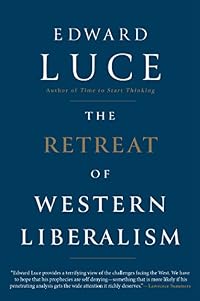
The Retreat of Western Liberalism
by Edward Luce
On This Page
Description
In his widely acclaimed book Time to Start Thinking, Financial Times chief US columnist and commentator Edward Luce charted the course of America's relative decline, proving to be a prescient voice on our current social and political turmoil. In The Retreat of Western Liberalism, Luce makes a larger statement about the weakening of western hegemony and the crisis of liberal democracy--of which Donald Trump and his European counterparts are not the cause, but a terrifying symptom. Luce argues show more that we are on a menacing trajectory brought about by ignorance of what it took to build the West, arrogance towards society's economic losers, and complacency about our system's durability--attitudes that have been emerging since the fall of the Berlin Wall. We cannot move forward without a clear diagnosis of what has gone wrong. Unless the West can rekindle an economy that produces gains for the majority of its people, its political liberties may be doomed. The West's faith in history teaches us to take democracy for granted. Reality tells us something troublingly different. Combining on-the-ground reporting with intelligent synthesis of the literature and economic analysis, Luce offers a detailed projection of the consequences of the Trump administration, the rise of European populism, and a forward-thinking analysis of what those who believe in enlightenment values must do to defend them from the multiple onslaughts they face in the coming years. -- Publisher description show lessTags
Recommendations










Member Reviews
Reading this book was either ill-timed on my part or just in time depending on how you look at it. It was written during Trump’s presidency and now that we are in the midst of another Trump candidacy for president, it is both out-of-date and potentially prescient.
The premise of the book is that in the last fifty years or so, liberal democracy has been waning. This has been due to a variety of factors. First is the rise of the global economy that coincides with the decline of the middle class in Western countries. Second is the increasingly dysfunctional political scene that takes democracy for granted. Third is the declining power of the West and the loss of faith in their own systems. Lastly the author discusses the backlash of show more communities towards institutions and the general malaise regarding societal decline.
This was interesting for both historical content and present-day insights. I very much appreciated the conciseness. I closed the book feeling both more informed and deeply disturbed. show less
The premise of the book is that in the last fifty years or so, liberal democracy has been waning. This has been due to a variety of factors. First is the rise of the global economy that coincides with the decline of the middle class in Western countries. Second is the increasingly dysfunctional political scene that takes democracy for granted. Third is the declining power of the West and the loss of faith in their own systems. Lastly the author discusses the backlash of show more communities towards institutions and the general malaise regarding societal decline.
This was interesting for both historical content and present-day insights. I very much appreciated the conciseness. I closed the book feeling both more informed and deeply disturbed. show less
Pay no attention to the one and two star reviews...those are from rightwing trolls that probably didn't actually read the book, or if they did, Luce's text sailed way over their heads. Lucidly assembled, well-researched, well-composed, Luce writes as the journalist he is, though at times percolates a little too academic. Published in 2017, Luce while doing well to capture the contemporary conditions and lay out his thesis, unfortunately used a great many at-the-time current names that he could have no way of knowing just one year later have already been dismissed, fired, or left of their own accord from the debacle that the 2016 US elections results created.
Luce divides his book into four parts that he calls
- Fusion ... about the show more integration of the global economy and the impact to Western economies
- Reaction ... about the degeneration of Western politics
- Fallout ... about the decline of US, and Western leadership/dominance
- Half Life ... about what can be done
In Fusion, Luce rightly identifies, and explains his position, China's ascendancy to the top player in the global economy. He rightly identifies Trump as an accelerant in that. And the US, income disparity is a huge factor in the decline, tied to the trap that those on the wrong side are enmeshed. He quotes Richard Florida: "In the US your ZIP code is increasingly your destiny." A consequence of the global decline seems to be the "experts" missing the mark repeatedly. Luce says "Every January, the Davos [World Economic Forum] gathering sounds a little more bemused about what is happening in the world outside." He says that Davos "specialises in projecting the future from a recent past that took it by surprise." My notes on that were:
As Luce examines the Reaction leading to the decline, he looks at the impacts of the fall of the Soviet Union, the fallout (not his later section) of the Al Queda attacks.
For Fallout, Luce opens with a "plausible" (his term) scenario about a near future war with China. He's actually correct that it is plausible, and that T is the cause, but he names all the players from State to Defense to political advisors to even the Federal Reserve Chair. The only US players still there are T and Jeff Sessions! I submit that Luce would have thought it inconceivable that the nine other named aren't in their positions anymore! And to pile on, Luce says in commenting on Xi Jinping's term expiration in 2022,
I didn't make any notes for the Half Life section. I don't think he had much to offer in the way of what can be done. And in the pace of the technological world today, nothing would work anyway.
So...good, sobering recount of what's happening, some good thoughts on how we got here and what the consequences are, but no tangible help to recover. Worth the read. show less
Luce divides his book into four parts that he calls
- Fusion ... about the show more integration of the global economy and the impact to Western economies
- Reaction ... about the degeneration of Western politics
- Fallout ... about the decline of US, and Western leadership/dominance
- Half Life ... about what can be done
In Fusion, Luce rightly identifies, and explains his position, China's ascendancy to the top player in the global economy. He rightly identifies Trump as an accelerant in that. And the US, income disparity is a huge factor in the decline, tied to the trap that those on the wrong side are enmeshed. He quotes Richard Florida: "In the US your ZIP code is increasingly your destiny." A consequence of the global decline seems to be the "experts" missing the mark repeatedly. Luce says "Every January, the Davos [World Economic Forum] gathering sounds a little more bemused about what is happening in the world outside." He says that Davos "specialises in projecting the future from a recent past that took it by surprise." My notes on that were:
This is too common a condition in the western world. Short-sight extrapolated irresponsibly, and with implied authority and yet without rigor, only to be replaced by the next most recent crisis. At the mercy of the winds instead of exercising strategic initiative...{sigh}.He further observes, "For every risk, Davos offers an identikit fix. Most of its Latinate prose sounds innocuous. But the lexicon betrays a worldview that is inherently wary of public opinion. Democracy is never a cure." Calling out Davos: "One potential solution could be to make better use of technology in the process of government – not only to deliver services in a faster, more transparent, inclusive and consumer-oriented way, but also to establish a 'digital public square' with more direct communication between leaders and people." My response to that is be mindful of the lessons told in Democracy Hacked. He closes out the Fusion section with
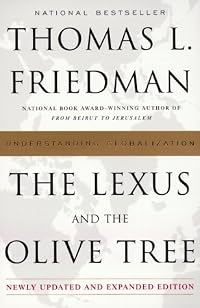
When you put on the Golden Straitjacket, ‘your economy grows and your politics shrinks’. [Thomas] Friedman possesses an uncanny knack for catching the spirit of the age with revealing insights. But he should have dropped the word golden. Straitjackets are for lunatics. We can hardly complain if our democracies have begun to lose their minds.I thought that an interesting adulation with backhanded disparity. Friedman may once have been insightful and influential, but with soundbites only, and nothing of substance. Bad writing sells books because bestsellers rarely get read, and more rarely are understood, and even more rarely have critical thinking properly applied. Friedman's bloviating tends to buffalo many, prompting an image in my head of the pseudo intellectuals pontificating on the merits of Bukowski or Foster Wallace, or Mark Rothko.
As Luce examines the Reaction leading to the decline, he looks at the impacts of the fall of the Soviet Union, the fallout (not his later section) of the Al Queda attacks.
It is hard to overstate the damage the Iraq War did to America's global soft power - and to the credibility of the West's democratic mission. Operation Enduring Freedom, which began after 9/11, was followed by Operation Iraqi Freedom. Both were rashly named. It is one thing to go to war in the name of liberty; quite another to be clueless about it. Even without the doublespeak of the ‘war on terror’, it is highly questionable whether democracy can be installed from the barrel of a gun."That last bit was rather well put.
From America’s post-9/11 blunders to Donald Trump’s election, the twenty-first century has been generous to autocrats everywhere. It is tempting to believe these were historic accidents that will iron themselves out in due course. The human, social and technological forces favouring democracy will ultimately prove far stronger than the ‘shit happens’ school of history. It is a train of thought we should avoid. Bertolt Brecht, the great German playwright, famously said: ‘Would it not be easier / In that case for the government / To dissolve the people / And elect another?’ In a strange way that is what Putin does by manipulating and remaking Russian public opinion to suit his purposes. Messing with people’s heads is also Trump’s specialty.Spot on, that specialty. Here's a sobering observation:
In America, the share of voters describing themselves as independent has been creeping up for years.15 This is no measure of Socratic equidistance. For the most part, independent is a fancy word for apathetic.While there are plenty of end notes, I did flag a few that did not have cites, and to me, that changes the color of the relation of possible facts to pronouncement and opinion. In talking about Trump's pagentry, Luce relates a story about Trump's foray in to the world of professional "wrestling", eventually leading to Linda McMahon getting a cushy appointment. He discusses Chris Hedges's book Empire of Illusion, about WWE, but then
Hedges was writing in 2009. Since then, WWE’s popularity has been overtaken by the Ultimate Fighting Championship, which attracts tens of millions of viewers and earns its biggest stars tens of millions of dollars. Unlike wrestling, the UFC is not scripted. The contestants fight it out in a large octagonal steel cage. They really do aim to hurt each other.I have observed publicly that UFC is a descent into barbarism. It is a symptom of the retreat of civilization. Gladiatorial pugilistic violence as spectator sport was big 2,000 years ago in Rome. That it resurges today is pitiful. As noted above, Luce could not have dreamed up the chaotic mindnumbing daily trials of the 2017-current as of this writing US executive branch. He says in one passage "Putin, who is the only world leader Trump admires[...]". Enter Kim Jong Un and some love letters. Now, as he tried to outline the historically normal powers would keep the executive in check, here is a shot far wide of the mark...it may have made sense when he was writing the book but...If I were a budding Mark Felt [Woodward and Bernstein's "Deep Throat"], I would leak my material to John McCain, the ornery senator from Arizona, or his fellow Arizonian Jeff Flake, or Lindsey Graham, the Republican from South Carolina. There are few who revile Trump more than the Republican hawks.Right on McCain, obviously before his passing; wrong on the spineless Flake; and so wrong on the politically bi-polar Graham as to be embarrassingly wrong. Luce must be thinking "I can't put out a new edition...everything has changed!" But the real crying shame is this:
Finally, there is the judiciary, America's third branch of government. There is nothing to stop a US president from ignoring the courts.Ahem...{whispers aside}...now he has Kavanaugh.
For Fallout, Luce opens with a "plausible" (his term) scenario about a near future war with China. He's actually correct that it is plausible, and that T is the cause, but he names all the players from State to Defense to political advisors to even the Federal Reserve Chair. The only US players still there are T and Jeff Sessions! I submit that Luce would have thought it inconceivable that the nine other named aren't in their positions anymore! And to pile on, Luce says in commenting on Xi Jinping's term expiration in 2022,
It would be a disaster if Xi broke with Chinese precedent and prolonged his hold on power.Well...if "for life" means anything to "prolong"... Luce has to be reeling everyday something new comes along to shatter his backup data! The thesis is still sound...just the reasoning that got him there is no longer valid. But the chaos is. He says himself "This book does not dare offer precise forecasts. But it is safe to say that if Germany fails to lead Europe, the European Union will fall apart." Yeah. forecasts are so far off...but to be fair, how could anyone not assume that T wouldn't have even a shred of respect for the office or the country?
I didn't make any notes for the Half Life section. I don't think he had much to offer in the way of what can be done. And in the pace of the technological world today, nothing would work anyway.
So...good, sobering recount of what's happening, some good thoughts on how we got here and what the consequences are, but no tangible help to recover. Worth the read. show less
I was quite disappointed with the first part of this book. It seemed liked the author couldn't live up to his lofty title at all - he just jumps from one topic to the next and cites lots of statistics without giving much thought to what it all means. Fortunately he finds the right focus in the second chapter when he begins to discuss the motivations behind populist politics both from the perspective of political elites and that of working class people.
In the middle part of the book the author lays out a hypothetical scenario for how the US might tumble into war with China in the year 2020. This seemed like an unnecessary diversion. Maybe it's an attempt to go down in history as the true prognosticator who predicted this war (if it would show more happen), but it serves no other useful purpose as far as I can see.
The author then moves away from guesswork towards the end of the book as he again returns to his political diagnosis. In the concluding chapter he makes a good point when he says that writing off half the population as ignorant buffoons will not advance the cause of liberalism. The polarization of society is a serious problem for democracy on both ends of the scale: between ultra-liberals and median liberals, and between anti-liberals and median liberals. show less
In the middle part of the book the author lays out a hypothetical scenario for how the US might tumble into war with China in the year 2020. This seemed like an unnecessary diversion. Maybe it's an attempt to go down in history as the true prognosticator who predicted this war (if it would show more happen), but it serves no other useful purpose as far as I can see.
The author then moves away from guesswork towards the end of the book as he again returns to his political diagnosis. In the concluding chapter he makes a good point when he says that writing off half the population as ignorant buffoons will not advance the cause of liberalism. The polarization of society is a serious problem for democracy on both ends of the scale: between ultra-liberals and median liberals, and between anti-liberals and median liberals. show less
Sadly, a missed opportunity. The author’s central premise is of great importance, but seriously marred by his presentation which is unfortunately casual.
The book is very timely, but was clearly written too fast and borders at times on incoherence, revealing all too obviously the author’s metier.
It’s all too glib, too superficial, and calls desperately for active editing. The acknowledgements section identifies two editors but I suspect that that is wishful thinking and that the individuals concerned were rather research assistants.
There are a few good things nestling among the garbage. The author's treatment of the rise of democracy (pp. 115-117) is good, but the closely following put-down of the European Union (pp. 118-119) is show more naïve populist nonsense.
Unsourced, unsupported allegations abound, as do strawmen.
Eventually after completing about two-thirds the book I gave up; the sh*t was an insult to my intelligence. show less
The book is very timely, but was clearly written too fast and borders at times on incoherence, revealing all too obviously the author’s metier.
It’s all too glib, too superficial, and calls desperately for active editing. The acknowledgements section identifies two editors but I suspect that that is wishful thinking and that the individuals concerned were rather research assistants.
There are a few good things nestling among the garbage. The author's treatment of the rise of democracy (pp. 115-117) is good, but the closely following put-down of the European Union (pp. 118-119) is show more naïve populist nonsense.
Unsourced, unsupported allegations abound, as do strawmen.
Eventually after completing about two-thirds the book I gave up; the sh*t was an insult to my intelligence. show less
The Retreat of Western Liberalism (2017) is more of a long essay. The page count is over 200 but probably due to font or margins, it's really about a 125-150 page book. It makes a good case that what we're seeing with Trump and elsewhere is part of a bigger trend and there is probably worse to come. Nothing new there but insightful.
The author is a seasoned journalist who has spent years each in 3 countries outside of his native UK, and he has absorbed knowledge from them. This book is startlingly insightful and very useful in understanding what is happening the US right now, as well as what is happening overall in many areas of the world affected by what has occurred in the US over the past decade.
Not exactly sure what I learned from this book, or how it might have changed me, but I liked it. Basically a centrist rant about the current social situation, but well-written and brief.
Members
- Recently Added By
Author Information

5 Works 1,315 Members
Awards and Honors
Distinctions
Common Knowledge
- Original publication date
- 2017
Classifications
- Genres
- Politics and Government, Nonfiction, General Nonfiction, History
- DDC/MDS
- 320.5109182 — Society, Government, and Culture Political science Types of Government Political ideologies Liberalism Biography And History
- LCC
- JC574 .L84 — Political Science Political theory Political theory. The state. Theories of the state Purpose, functions, and relations of the state
- BISAC
Statistics
- Members
- 375
- Popularity
- 83,206
- Reviews
- 10
- Rating
- (3.76)
- Languages
- English, Italian, Portuguese (Portugal)
- Media
- Paper, Audiobook, Ebook
- ISBNs
- 14
- ASINs
- 4