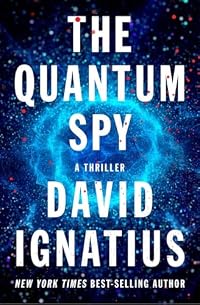
The Quantum Spy: A Thriller
by David Ignatius
On This Page
Description
A hyper-fast quantum computer is the digital equivalent of a nuclear bomb: whoever possesses one will be able to shred any encryption in existence, effectively owning the digital world. The question is: Who will build it first, the United States or China? The latest of David Ignatius's timely, sharp-eyed espionage novels follows CIA agent Harris Chang into a quantum research lab compromised by a suspected Chinese informant. The breach provokes a mole hunt that is obsessive, destructive, show more and--above all--uncertain: Do the leaks expose real secrets, or are they false trails meant to deceive the Chinese? Chang soon finds that there is a thin line between loyalty and betrayal, as the investigation leads him down a rabbit hole as dangerous as it is deep. Grounded in the real-world global charge toward technological dominance, The Quantum Spy presents a sophisticated game of cat-and-mouse wired to an exhilarating cyber thriller. show lessTags
Recommendations
























Member Reviews
In "The Quantum Spy" (QS) Acknowledgements, author David Ignatius writes: "This novel explores how the U. S. Government oversees technology." Oversees? In the first chapters, a small, West Coast high tech firm is visited by a government contact, ostensibly to review the progress of the government funded startup. After the review, the CEO is advised by Mr. Green that it is time to "go black" - time to stop all public announcements of their advances, time to step-up security, link more closely with government overseers, etc. The CEO/Founder balks, proclaiming the benefits of a world-wide sharing of scientific advances, the independence that scientists.....The intelligence agent states his case, and the CEO begrudgingly concedes.
So, what's show more the big deal about quantum computers (yawn)? From QS: "...it would take a classical computer more than ten million years to factor a fifty-digit number, whereas it would take less than a second on a quantum computer...All (existing) codes could be decrypted and read." The reader will learn a bit more about quantum computers - they exist only on paper, and efforts have been underway to develop the hardware for years - and that's all you need to know on the subject. Naturally there is a spy vs. spy race.
And there's so much more in this great spy novel. Yes, there's a mole in a U.S. agency. A high level one, with a relative associated with the agency. There is also a high level Chinese spy caught by the Americans with his fingers in the till and some other naughty places; the Chinese want revenge. The plot moves nicely along at a delicious pace, and the story hops from Europe to Canada to Mexico and even to my hometown! And there is a grand big showdown with a nice twisty but not all-together unexpected finale. Where? That turns out to be the critical, unanswered question - how can the agency cover their asset if the meeting location is unknown? Will quantum technology help?
Wait, there's still more. David Ignatius is a serious writer, a journalist for the Washington Post, an author of nine other excellent novels, and a frequent contributor to Morning Joe (he's the adult in the group, the big picture guy). Ignatius also offers us an introspective look at Harris Chang, a U.S. Intelligence Officer. Ignatius makes a strong argument in the Acknowledgement that this story is pure fiction and little is real. But the rather depressing inner workings and relationships in the U S Agency as described here seem to be too close to our enemy counterparts. U S Agents must be focused on their self-protection not only in the field but in the office as well. There is also a theme of how American citizens of a different skin color and foreign roots assimilate and are viewed by others. This comes up many times, hitting us with a not so gentle reminder of how difficult we make life for some of our fellow citizens. Not just in certain regions of our country but in one of our more respected intelligence agencies. Harris Chang: "But I began to see that to my American colleagues, I will always be Chinese. That is the first thing they see. The color of my skin." show less
So, what's show more the big deal about quantum computers (yawn)? From QS: "...it would take a classical computer more than ten million years to factor a fifty-digit number, whereas it would take less than a second on a quantum computer...All (existing) codes could be decrypted and read." The reader will learn a bit more about quantum computers - they exist only on paper, and efforts have been underway to develop the hardware for years - and that's all you need to know on the subject. Naturally there is a spy vs. spy race.
And there's so much more in this great spy novel. Yes, there's a mole in a U.S. agency. A high level one, with a relative associated with the agency. There is also a high level Chinese spy caught by the Americans with his fingers in the till and some other naughty places; the Chinese want revenge. The plot moves nicely along at a delicious pace, and the story hops from Europe to Canada to Mexico and even to my hometown! And there is a grand big showdown with a nice twisty but not all-together unexpected finale. Where? That turns out to be the critical, unanswered question - how can the agency cover their asset if the meeting location is unknown? Will quantum technology help?
Wait, there's still more. David Ignatius is a serious writer, a journalist for the Washington Post, an author of nine other excellent novels, and a frequent contributor to Morning Joe (he's the adult in the group, the big picture guy). Ignatius also offers us an introspective look at Harris Chang, a U.S. Intelligence Officer. Ignatius makes a strong argument in the Acknowledgement that this story is pure fiction and little is real. But the rather depressing inner workings and relationships in the U S Agency as described here seem to be too close to our enemy counterparts. U S Agents must be focused on their self-protection not only in the field but in the office as well. There is also a theme of how American citizens of a different skin color and foreign roots assimilate and are viewed by others. This comes up many times, hitting us with a not so gentle reminder of how difficult we make life for some of our fellow citizens. Not just in certain regions of our country but in one of our more respected intelligence agencies. Harris Chang: "But I began to see that to my American colleagues, I will always be Chinese. That is the first thing they see. The color of my skin." show less
A new author for me. I found the story very plausible but highly technical and involved. The action was minimal but the tension was intense. For a bit of a "Luddite" the immersion into quantum computing was almost overwhelming. I honestly can't say I understand in any better after reading the book - but then again it is not meant to be an instruction manual.
I am used to seeing David Ignatius on TV as a reporter but who knew that he also was a mystery writer. This is a great spy story - a new secret technology, the CIA, NSA and Chinese Intellegence. Before the end everyone seems to be the traitor but even when you know who it is you wonder if everything will work out.
I listened to this book on audio and the narrator added to the story.
I listened to this book on audio and the narrator added to the story.
With many twists and turns, this is a spy novel updated to consider the race for the next leap in computer technology. Harris Chang, CIA operative, is the focal character, but we get inside the heads of many spies, American and Chinese. In good thriller tradition, the author keeps us guessing who the good guys really are, and when our suspicions are confirmed we still aren't really sure how the technology race will play out. The quantum theory is a bit daunting for the uninitiated, but can be somewhat set aside for those who are disinterested in that aspect of the plot. Chang's identification as a Chinese American is a most interesting theme.
I eagerly awaited the release of David Ignatius' latest, 'The Quantum Spy', and I now feel my eagerness was wasted. Ignatius, who has penned some of my favorite spy novels and is well-regarded for not only his writing chops but also his deep knowledge of foreign affairs and the CIA, has delivered a poorly planned thriller with a transparent plot and laughably poor dialogue. Don't get me wrong, there are a few good sections and the whole thing is readable (especially if you pretend that it's by a generic thriller writer instead of Ignatius), but he set a high bar for himself that isn't reached by this effort.
The plot involves Quantum Computing, the next 'big thing' and a source of extreme competition between the US and Chinese. The show more Americans are making progress, but a 'mole' in the CIA is providing intel to the Chinese, and the CIA pulls out all stops to discover who it is. A young ex-armed forces American of Chinese descent is engaged to help, and he finds himself being recruited by the Chinese. The Americans think they've determined the identity of the mole (through a rather haphazard process) but rapidly change directions (a silly move done with virtually no thorough analysis I could see) when more information comes to light. In the meantime, internecine warfare among the Chinese agencies continues to put pressure on their side for results. The end is pretty predictable.
Guess I'll look forward to his next, which will hopefully be a bounce-back to previous form. show less
The plot involves Quantum Computing, the next 'big thing' and a source of extreme competition between the US and Chinese. The show more Americans are making progress, but a 'mole' in the CIA is providing intel to the Chinese, and the CIA pulls out all stops to discover who it is. A young ex-armed forces American of Chinese descent is engaged to help, and he finds himself being recruited by the Chinese. The Americans think they've determined the identity of the mole (through a rather haphazard process) but rapidly change directions (a silly move done with virtually no thorough analysis I could see) when more information comes to light. In the meantime, internecine warfare among the Chinese agencies continues to put pressure on their side for results. The end is pretty predictable.
Guess I'll look forward to his next, which will hopefully be a bounce-back to previous form. show less
This book is supposed to be a thriller about quantum computing technology and intelligence agents in the US and China, but the characters were not compelling enough to care about them and their fate. Perhaps the Harris Chang character, a Chinese American CIA agent, is an exception, but this was not enough to carry the book for me. I never read David Ignatius fiction before, and I probably will not read it again. More disappointing, because I really admire David Ignatius as a columnist.
Although fiction, the book is well researched on the available details on quantum computing, and presents a plausible scenario whereby the US and China engage in secret competition over dominance in that area. So, a fun read.
Members
- Recently Added By
Author Information

19 Works 3,202 Members
David Ignatius was born in Cambridge, Massachusetts on May 26, 1950. He received a B.A. from Harvard University in 1963 and a diploma in economics from Kings College, Cambridge, England, in 1975. He has worked as a reporter for the Wall Street Journal, the New York Times Magazine, and the Washington Post, where he is an associate editor. In 1985, show more he received the Edward Weintal Prize for diplomatic reporting from the Institute for the Study of Diplomacy. He is the author of several novels including Agents of Innocence, Siro, The Bank of Fear, A Firing Offense, Body of Lies, The Increment, and The Director. (Bowker Author Biography) show less
Some Editions
Common Knowledge
- Original publication date
- 2017
- People/Characters
- Harris Chang; John Vandel; Minister Li Zian
Classifications
Statistics
- Members
- 273
- Popularity
- 117,780
- Reviews
- 11
- Rating
- (3.63)
- Languages
- Czech, English, German
- Media
- Paper, Audiobook, Ebook
- ISBNs
- 18
- ASINs
- 3