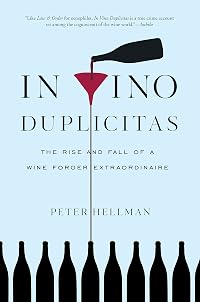
In Vino Duplicitas: The Rise and Fall of a Wine Forger Extraordinaire
by Peter Hellman
On This Page
Description
Nobody can know them all, certainly not Rudy Kurniawan, who never set eyes on Burgundy. In the end, it was his imprecise knowledge of a particular domaine's history that tripped him up. It happened amid extreme merriment, one spring evening, in New York. The mistakes that he made, minuscule and highly arcane, upended his life. Also upended would be the practices and pleasures of seekers after rare old wine.Tags
Recommendations









Member Reviews
3.5 stars.
This book was a quick and engaging read and unlike a lot of other reviewers, I quite liked how the various chapter sections would ping pong between moments of the main timeline, intercut as well by historical background that filled in info on the various characters and the wines themselves.
However, the book ended up leaving me unsatisfied for two main reasons. The first is there really are no characters one can attach themselves to, which reduces a reader’s connection to the book. Beyond the wine forger, this book is filled with narcissists, sociopaths, and various people who championed themselves as special for little reason other than their access to both expensive wine, and the money necessary to purchase it. Even the show more main winemaker whose family label is repeatedly forged, and is written to appear as a moral center of the book, ends up having a falling out with his siblings and leaving their winery.
The second is there is no real resolution as to why the main character became a wine forger to begin with. There are possibilities brought up in an addendum after the last chapter, but no definitive confirmation, as the author is unable to get an interview with the main subject or anyone in his family. One of the main reasons I read books involving true crime is to find out the psychology and motivation behind the criminal—to get answers as to what makes a person behave in such ways. In the end, this book teases reasons why, but leaves solid conclusions unfulfilled, which was quite disappointing, and left my reaction when the book was finished more negative than what I felt when I was reading much of it. show less
This book was a quick and engaging read and unlike a lot of other reviewers, I quite liked how the various chapter sections would ping pong between moments of the main timeline, intercut as well by historical background that filled in info on the various characters and the wines themselves.
However, the book ended up leaving me unsatisfied for two main reasons. The first is there really are no characters one can attach themselves to, which reduces a reader’s connection to the book. Beyond the wine forger, this book is filled with narcissists, sociopaths, and various people who championed themselves as special for little reason other than their access to both expensive wine, and the money necessary to purchase it. Even the show more main winemaker whose family label is repeatedly forged, and is written to appear as a moral center of the book, ends up having a falling out with his siblings and leaving their winery.
The second is there is no real resolution as to why the main character became a wine forger to begin with. There are possibilities brought up in an addendum after the last chapter, but no definitive confirmation, as the author is unable to get an interview with the main subject or anyone in his family. One of the main reasons I read books involving true crime is to find out the psychology and motivation behind the criminal—to get answers as to what makes a person behave in such ways. In the end, this book teases reasons why, but leaves solid conclusions unfulfilled, which was quite disappointing, and left my reaction when the book was finished more negative than what I felt when I was reading much of it. show less
If you've seen "Sour Grapes" - and if you haven't, you should - much of this will be familiar. But still, its a detailed narrative of Rudy Kurniawan (his assumed, rather than real name, but the one by which he is best known) and his assault on the very high end of the wine market, flooding it with forgeries. Its not hard to have some sympathy for him; after all most of the dupees were spending tens even hundreds of thousands of dollars on bottles and cases of rare wine. If they can't tell the difference between the real and the fake, more fool them no? Its not quite a victimless crime, but surely caveat emptor? Its hard to generate sympathy for Bill Koch for example
A couple of questions remain though, which In Vino Duplicitas, show more entertaining as it is doesn't quite to the bottom of. Firstly, and probably most importantly, where did the money come from? How does a student and refugee go from part time employment at the golf pro shop, to charging hundreds of thousands of dollars a day at Hermes and trading millions of dollars of wine in just a couple of years? Secondly, to what extent were the wine auction houses complicit? Maybe the wine was dubious, but it boosted sales and sale prices and that's good for everyone. And thirdly, did Kurniawan start off as a fraudster, or did he simply work out that the so called wine afficianados really couldn't tell the difference between the good stuff and plonk, and couldn't resist the chance to pot such slow moving targets
A great yarn, but not the end of the story show less
A couple of questions remain though, which In Vino Duplicitas, show more entertaining as it is doesn't quite to the bottom of. Firstly, and probably most importantly, where did the money come from? How does a student and refugee go from part time employment at the golf pro shop, to charging hundreds of thousands of dollars a day at Hermes and trading millions of dollars of wine in just a couple of years? Secondly, to what extent were the wine auction houses complicit? Maybe the wine was dubious, but it boosted sales and sale prices and that's good for everyone. And thirdly, did Kurniawan start off as a fraudster, or did he simply work out that the so called wine afficianados really couldn't tell the difference between the good stuff and plonk, and couldn't resist the chance to pot such slow moving targets
A great yarn, but not the end of the story show less
For most of us, the world of rare and and expensive wines is very foreign indeed. It's hard to wrap one's head around the fact that there are bottles of wine in existence that are valued at more than a brand new vehicle and that people actually purchase and drink these wines. This is an interesting account of the story of con man Rudy Kurniawan, who forged a tremendous amount of these wines and was eventually caught. Definitely a different kind of true crime story and an interesting read.
**I received an advanced reader’s copy from the publisher through NetGalley in exchange for an honest review**
Hellman chronicles the story of Rudy Kurniawan, a young wine connoisseur whose practices and wine dealings/transactions may not be one hundred percent reliable. A journalist with articles found in Wine Spectator, Hellman interviews a cast of characters who interacted with Kurniawan. Along the way, Hellman takes readers on a history lesson of rare wines.
Parts of Hellman’s nonfiction narrative were fascinating – details from interviews and trials, as well as remarks made by people who knew Kurniawan. At other times, the narrative was slow. The writing style has a journalistic flair; not a criticism, but a style that took show more some time to follow. This is also a very current topic in the wine world, with litigations and repercussions still being felt among collectors and auction houses. I was unfamiliar with the case prior to this book, so it was very insightful. I cannot attest to any additional information covered in this book that had been covered in news articles or other accounts of events that took place.
Overall, it was an interesting introductory look at a man who really made the wine world think about provenance and authenticity, as well as the basic principles of truth and justice. show less
Hellman chronicles the story of Rudy Kurniawan, a young wine connoisseur whose practices and wine dealings/transactions may not be one hundred percent reliable. A journalist with articles found in Wine Spectator, Hellman interviews a cast of characters who interacted with Kurniawan. Along the way, Hellman takes readers on a history lesson of rare wines.
Parts of Hellman’s nonfiction narrative were fascinating – details from interviews and trials, as well as remarks made by people who knew Kurniawan. At other times, the narrative was slow. The writing style has a journalistic flair; not a criticism, but a style that took show more some time to follow. This is also a very current topic in the wine world, with litigations and repercussions still being felt among collectors and auction houses. I was unfamiliar with the case prior to this book, so it was very insightful. I cannot attest to any additional information covered in this book that had been covered in news articles or other accounts of events that took place.
Overall, it was an interesting introductory look at a man who really made the wine world think about provenance and authenticity, as well as the basic principles of truth and justice. show less
Goodreads just ate my review, so here's the short version.
This could have been really good—the crime and the characters are interesting—but Hellman didn't really explore the events of the characters in enough depth and his prose was flat. There were several paragraphs and passages that were repeated almost verbatim in different chapters, as if the author was attempting to "pad out" his manuscript. Save your time and wait for a better book on these events. Or just go back and read the multitude of magazine articles already written about this fraud.
This could have been really good—the crime and the characters are interesting—but Hellman didn't really explore the events of the characters in enough depth and his prose was flat. There were several paragraphs and passages that were repeated almost verbatim in different chapters, as if the author was attempting to "pad out" his manuscript. Save your time and wait for a better book on these events. Or just go back and read the multitude of magazine articles already written about this fraud.
read 2023
Full review to come!
Members
- Recently Added By
Author Information
9+ Works 369 Members
Peter Hellman is an award-winning journalist and author. He was a features writer for New York magazine and today contributes to the New York Times, the Wall Street Journal, and other publications
Awards and Honors
Awards
Distinctions
Classifications
- Genres
- Nonfiction, General Nonfiction, Food & Cooking, Biography & Memoir, Politics and Government
- DDC/MDS
- 364.16 — Society, government, & culture Social problems and social services Crime Criminal offenses Crimes of property
- LCC
- HV6692 .K87 .H45 — Social sciences Social pathology. Social and public welfare. Criminology Social pathology. Social and public welfare. Criminology Crimes and offenses
- BISAC
Statistics
- Members
- 70
- Popularity
- 430,922
- Reviews
- 7
- Rating
- (3.25)
- Languages
- English
- Media
- Paper, Audiobook, Ebook
- ISBNs
- 7
- ASINs
- 3