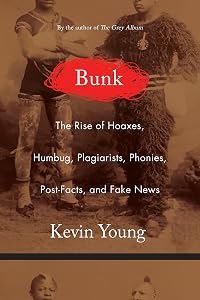
Bunk: The Rise of Hoaxes, Humbug, Plagiarists, Phonies, Post-Facts, and Fake News
by Kevin Young
On This Page
Description
"Award-winning poet and critic Kevin Young traces the history of the hoax as a peculiarly American phenomenon--the legacy of P.T. Barnum's 'humbug' culminating with the currency of Donald J. Trump's 'fake news'. Disturbingly, Young finds that fakery is woven from stereotype and suspicion, with race being the most insidious American hoax of all. He chronicles how Barnum came to fame by displaying figures like Joice Heth, a black woman whom he pretended was the 161-year-old nursemaid to George show more Washington, and 'What Is It?', an African American man Barnum professed was a newly discovered missing link in evolution. Bunk then turns to the hoaxing of history and the ways that forgers, plagiarists, and journalistic fakers invent backstories and falsehoods to sell us lies about themselves and about the world in our own time, from pretend Native Americans like Nasdijj to the deadly imposture of Clark Rockefeller, from the made-up memoirs of James Frey to the identity theft of Rachel Dolezal. This brilliant and timely work asks what it means to live in a post-factual world of 'truthiness' where everything is up for interpretation and everyone is subject to a pervasive cynicism that damages our ideas of reality, fact, and art."--Dust jacket flap. show lessTags
Recommendations


Member Recommendations
Member Reviews
Kevin Young is the poetry editor of the New Yorker, and if you didn't already know that, you'd guess immediately from the style--the book reads like a 500 page New Yorker article, or perhaps collection of articles. The title fairly accurately summarizes the contents, which dip into the lengthy history of America's (and to some extent the world's) complicated relationship with the notion of truth, from P.T. Barnum to "fake news."He's particularly interested in the role of race--from how the black body became an object for public display, stripping them of their humanity, and how our views on race have shaped and enabled hucksters' ability to defraud the public.
Young's background is in literary criticism, and his analysis skews somewhat show more towards that, rather than to a strictly historical accounting. It's a fascinating read, but not necessarily a purely pleasurable one. show less
Young's background is in literary criticism, and his analysis skews somewhat show more towards that, rather than to a strictly historical accounting. It's a fascinating read, but not necessarily a purely pleasurable one. show less
A fascinating and timely book that functions simultaenously as an entertaining history of American hoaxes, an academic examination of the meaning of hoaxes and plagiarism, and a personal account of how the narratives that drive them have affected the author and black Americans in general. In a sense, "Bunk" is entertaining for the same reason that Lawrence Wright's "Going Clear" is: the stories of American "humbugs" from P.T. Barnum to Donald Trump are astonishingly, endlessly strange and entertaining. And most of these stories are complex and bizarre enough to be worth revisiting in full: one comes off amazed at how complicated some hoaxes can be (they almost always involve more than one person) and how easy it can be to get people to show more fall for a likely story. But the author's also very good at highlighting what connects these stories through the years. The book functions as sort of a history of the development of the American hoax and how it's changed: while old-time carnival owners sought to amaze their audiences, modern hoaxers tend to want to horrify them. He digs into the political implications of hoaxes, which is something most people who write on scandal don't, as most reporting doesn't tend to go too far beyond psychological speculation about the person who perpetrated the hoax. He's got a very good eye -- and a deep understanding -- of the various ironies and contradictions that most hoaxes involve.
Young's other focus is race, and he argues that race is usually an essential component of American hoaxes. Honestly, it's sometimes difficult to tell whether Young wanted to write a book about the history of race in America or about notable American deceptions. While this gives the book a welcome personal tone -- as young tells us that he personally has experienced many of the strange situations in which both hoaxers and their marks have found themselves in -- some of this book's readers may feel that he's stretching his arguments a bit too thin and perhaps losing his focus. The book also loses some points for being a bit too long, and not as tightly organized as it could have been. Even so, even while providing an entertaining history of notable frauds, the author never loses sight of the damage that these frauds do. He argues that they not only hurt the people that are fooled, and the artists whose work is lifted, they also do injury to the truth and to our ability to relate to each other honestly. At a time when a lot of people seem to take it for granted that we live in a "post-truth" era where facts simply don't matter, this is an important reminder that ferreting out pernicious falsehoods is still a worthwhile endeavor. Recommended as a survival guide for our times. show less
Young's other focus is race, and he argues that race is usually an essential component of American hoaxes. Honestly, it's sometimes difficult to tell whether Young wanted to write a book about the history of race in America or about notable American deceptions. While this gives the book a welcome personal tone -- as young tells us that he personally has experienced many of the strange situations in which both hoaxers and their marks have found themselves in -- some of this book's readers may feel that he's stretching his arguments a bit too thin and perhaps losing his focus. The book also loses some points for being a bit too long, and not as tightly organized as it could have been. Even so, even while providing an entertaining history of notable frauds, the author never loses sight of the damage that these frauds do. He argues that they not only hurt the people that are fooled, and the artists whose work is lifted, they also do injury to the truth and to our ability to relate to each other honestly. At a time when a lot of people seem to take it for granted that we live in a "post-truth" era where facts simply don't matter, this is an important reminder that ferreting out pernicious falsehoods is still a worthwhile endeavor. Recommended as a survival guide for our times. show less
As much as I hate the implications of this book, I loved the book itself. Young has brought me face to face with the racism that is part of the air we breathe in America, just as it most likely is everywhere. His book is filled with fascinating historical examples of "untruths" that some of us manage to perpetrate on others. His research is impeccable.
Perhaps because he is a poet, I sometimes had to strain to catch the connections he was making. Sometimes I found them difficult to follow. I don't think racism itself is usually the overt intent of people who commit these acts. Sometimes these people are psychopaths who are merely out to game the system; sometimes they are mentally ill. But the fact remains, their "bunk" could not show more succeed if the wider society were not racist.
He made me think and see things in a different way. I will be more conscious of my own reactions and thoughts due to this book. That is no small accomplishment for a writer to achieve. show less
Perhaps because he is a poet, I sometimes had to strain to catch the connections he was making. Sometimes I found them difficult to follow. I don't think racism itself is usually the overt intent of people who commit these acts. Sometimes these people are psychopaths who are merely out to game the system; sometimes they are mentally ill. But the fact remains, their "bunk" could not show more succeed if the wider society were not racist.
He made me think and see things in a different way. I will be more conscious of my own reactions and thoughts due to this book. That is no small accomplishment for a writer to achieve. show less
This book was very long, and it took me a very long time to finish. It definitely had interesting parts and ideas, but it was also extremely tedious. The author is most certainly knowledgeable and a gifted writer, but he likes to hear his own voice a bit too much. He could use much more editing. I would have preferred to read a 50-page essay on the topic and would have gotten just as much information. Plus, I could have avoided the word salad that ended up allowing the otherwise interesting thesis to get lost.
The ideas of how race, racism, and other cultural themes intertwine with hoaxes, liars, plagiarism, forgery, and more is provocative. He dives deeply into many instances historically and how culture has played a role in who, when, show more how, and why people choose to hoax or fake or bend the truth. The problem I experienced was that he dove so deeply and neglected to give the reader an oxygen tank. I was left drowning in all of the text. While he did make me chuckle at his word play occasionally, it mainly felt like he was writing for himself rather than trying to reach out and take the journey together. show less
The ideas of how race, racism, and other cultural themes intertwine with hoaxes, liars, plagiarism, forgery, and more is provocative. He dives deeply into many instances historically and how culture has played a role in who, when, show more how, and why people choose to hoax or fake or bend the truth. The problem I experienced was that he dove so deeply and neglected to give the reader an oxygen tank. I was left drowning in all of the text. While he did make me chuckle at his word play occasionally, it mainly felt like he was writing for himself rather than trying to reach out and take the journey together. show less
An interesting book that I'm not sure earned its full page count (500+ in the print edition, I read an ebook from the library). The overall thesis is that hoaxes and fake news are built on an otherized foundation, usually racial but sometimes religious or other minority culture. The idea is that we're more willing to be fooled by "weird stuff" from cultures we consider "weird" to begin with—a fine assertion, and one I think is probably even true—but I was expecting this book more to be about the people who perpetrate hoaxes, not the, idk, sociology of hoaxes.
Bunk by Kevin Young is a fascinating account of how people enjoy fooling and being fooled by others. I really found this to be interesting and pretty well done. Apparently, the biggest impetus to hoaxing is race and racism. This is a connection that I would not have made. The author enjoys saying that the hoax reveals the hoaxer. I have heard of things like blackface and the whitewashing of history, but I never figured that a lot of those ideas came from hoaxing and humbug.
The author does have some habits that I find annoying, but these are just nitpicking to be honest. For example, sometimes the author will have a sentence or statement that seems perfectly fine, but he punctuates this sentence with something in parentheses that seems show more to take away from it somehow.
A lot of the book covers Circus Freaks, people that are supposedly from Africa but were actually born in Ohio or Chicago, Sideshow Acts like the Bearded Lady, authors that faked their body of work that I had never heard of, and so on. The book casts a relatively wide net with what it calls a hoax. You even get famous ones like the Piltdown Man or the Cardiff Giant, both of which are things I am somewhat familiar with. Meanwhile, you also get people like JT LeRoy, an amalgamation of several people created to sell books or something. It even covers situations where ladies had Hysteria, a general term for “being a woman” I guess.
This book is pretty exhaustive in what it covers. While it obviously covers the hoax, it also covers how the hoaxed people react to finding out. Sometimes people merely reacted with bemusement and other times people were insulted enough to file a lawsuit.
The book is very well done, and I probably wouldn’t have even picked it up from the Library if it weren’t for the blurb on the front. The idea of revealing a hoax or a bit of deception seems like something that a lot of people like to do. show less
The author does have some habits that I find annoying, but these are just nitpicking to be honest. For example, sometimes the author will have a sentence or statement that seems perfectly fine, but he punctuates this sentence with something in parentheses that seems show more to take away from it somehow.
A lot of the book covers Circus Freaks, people that are supposedly from Africa but were actually born in Ohio or Chicago, Sideshow Acts like the Bearded Lady, authors that faked their body of work that I had never heard of, and so on. The book casts a relatively wide net with what it calls a hoax. You even get famous ones like the Piltdown Man or the Cardiff Giant, both of which are things I am somewhat familiar with. Meanwhile, you also get people like JT LeRoy, an amalgamation of several people created to sell books or something. It even covers situations where ladies had Hysteria, a general term for “being a woman” I guess.
This book is pretty exhaustive in what it covers. While it obviously covers the hoax, it also covers how the hoaxed people react to finding out. Sometimes people merely reacted with bemusement and other times people were insulted enough to file a lawsuit.
The book is very well done, and I probably wouldn’t have even picked it up from the Library if it weren’t for the blurb on the front. The idea of revealing a hoax or a bit of deception seems like something that a lot of people like to do. show less
Loved this book, it's amazing what people believed, and I suppose in 100 years readers will be saying the same about our era of online hoaxes. The old hoaxes were more fun to read about, I guess since I'm tired of living thru the Trump hoax the new stuff just want as appealing to read about.
Members
- Recently Added By
Lists

Must-Read Books by Black Authors
114 works; 92 members
Author Information

28+ Works 2,377 Members
Kevin Young is the author of a previous book of nonfiction, The Grey Album: On the Blackness of Blackness, which won the PEN Open Book Award, was recognized as a New York Times Notable Book, and named a finalist for the National Book Critics Circle Award for criticism. He is the author of eleven books of poetry, including Brown and Blue Laws: show more Selected Uncollected Poems 1995-2015. Young is the director of the Schomburg Center for Research in Black Culture and poetry editor for the New Yorker. show less
Awards and Honors
Awards
Distinctions
Notable Lists
Common Knowledge
Classifications
Statistics
- Members
- 418
- Popularity
- 73,947
- Reviews
- 11
- Rating
- (3.43)
- Languages
- English
- Media
- Paper, Audiobook, Ebook
- ISBNs
- 9
- ASINs
- 2