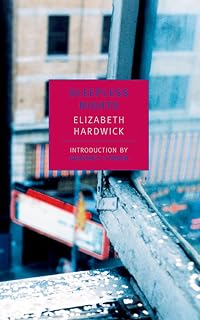
Sleepless Nights
by Elizabeth Hardwick
On This Page
Description
In Sleepless Nights a woman looks back on her life - the parade of people, the shifting background of place - and assembles a scrapbook of memories, reflections, portraits, letters, wishes, and dreams. An inspired fusion of fact and invention, this beautifully realized, hard-bitten, lyrical book is not only Elizabeth Hardwick's finest fiction but one of the outstanding contributions to American literature of the last fifty years.Tags
Recommendations







Member Reviews
Maybe I’m just old school, but when I think of what a novel should be there is a standard list of things I look for: a narrative based on fictional events, a well-defined plot with action and resolution, fully conceived characters, identifiable central themes, etc. However, when I also think about some of the best and most imaginative books I’ve read over the years—like Italo Calvino’s If On a Winter’s Night a Traveler or David Mitchell’s Cloud Atlas—I realize that many were missing at least some of those elements. And so it is with Sleepless Nights, Elizabeth Hardwick’s ostensibly autobiographical tale that seems to be a cross between a post-modern fictional account, a personal history and memoir, and a pastiche of show more prose poetry.
An elderly woman named Elizabeth (not coincidentally the author’s name) living in a nursing home looks back at the events and relationships that shaped her life (many of which are, not coincidentally, similar to events in the author’s life) in a decidedly haphazard and non-linear way. She was once married, although memories of her husband are surprisingly few in number among the detailed, if fragmentary, sketches she offers of the people from her past. Instead, we learn of her interactions with a diverse group that includes her parents, platonic friends, occasional lovers, housemaids, spinster neighbors, and even the singer Billie Holiday.
The reader quickly realizes that, regardless of how it is labeled, Sleepless Nights is not a book defined by its plot. Rather, it is all about the tapestry of beautiful words and images that Hardwick uses while constructing a compelling portrait of a thoughtful person who has engaged fully with life. By the end of this slim but densely packed volume, we have gained considerable insight into the main character—who the author claimed in a separate interview to be less about herself than we might think—while also realizing that there is so much of her past that she has not shared. This book helped me to rethink the limits of what good fiction can be and I am certainly glad for that experience. show less
An elderly woman named Elizabeth (not coincidentally the author’s name) living in a nursing home looks back at the events and relationships that shaped her life (many of which are, not coincidentally, similar to events in the author’s life) in a decidedly haphazard and non-linear way. She was once married, although memories of her husband are surprisingly few in number among the detailed, if fragmentary, sketches she offers of the people from her past. Instead, we learn of her interactions with a diverse group that includes her parents, platonic friends, occasional lovers, housemaids, spinster neighbors, and even the singer Billie Holiday.
The reader quickly realizes that, regardless of how it is labeled, Sleepless Nights is not a book defined by its plot. Rather, it is all about the tapestry of beautiful words and images that Hardwick uses while constructing a compelling portrait of a thoughtful person who has engaged fully with life. By the end of this slim but densely packed volume, we have gained considerable insight into the main character—who the author claimed in a separate interview to be less about herself than we might think—while also realizing that there is so much of her past that she has not shared. This book helped me to rethink the limits of what good fiction can be and I am certainly glad for that experience. show less
In this semi auto-biographical memoir, Hardwick recounts the varied people she met in her life, largely in New York. In the main, she talks in a passive voice, as if some anthropologist discovering the hidden, strange, vivid characters around her. But this isn't entirely true. Many of her interactions are with men, where she appears more like prey than an equal, and woman-as-victim is a running them in this book, as if this is simply how things are. What's clear by the end, though, is that, despite the passive voice, she is deeply touched, often wounded, by the many relationships she has, but tries hard to suppress these feelings.
There are metafictional touches here, where she makes it clear she's generating a semi-fictional world out show more of reality. There are also some incredibly detailed characters here, especially Billie Holiday, which is the highlight of the book. The lack of apparent structure, the flitting between one topic and another is a reflection of the writer's meandering mind, but also a reflection of the energetic chaos of the city where the book is largely based.
This is clearly a literary work, for people who are very well read - many of the allusions were lost on me, which I found a touch frustrating. Nevertheless, there's no denying the poetic style and her ability to capture a mood and people from her life in ways that seem to belie the suggestion that this is some fictional recreation. show less
There are metafictional touches here, where she makes it clear she's generating a semi-fictional world out show more of reality. There are also some incredibly detailed characters here, especially Billie Holiday, which is the highlight of the book. The lack of apparent structure, the flitting between one topic and another is a reflection of the writer's meandering mind, but also a reflection of the energetic chaos of the city where the book is largely based.
This is clearly a literary work, for people who are very well read - many of the allusions were lost on me, which I found a touch frustrating. Nevertheless, there's no denying the poetic style and her ability to capture a mood and people from her life in ways that seem to belie the suggestion that this is some fictional recreation. show less
Seemingly random and yet interconnected view of characters, situations, destinies, relationships, passions and drabness. Life as it truly is - unsorted and always filtered through our very own views and opinions. There is nothing larger than life here, the scale is dis-comfortably real and right and we feel this and subsequently do not feel quite safe. Still we carry on reading, fascinated by Elizabeth Hardwick's wonderful, painfully beautiful writing. This is a kind of book one returns to; it is like a window upon human existence, a scrapbook of samples which show the usual and the unusual next to each other, and therefore somehow made equally important.
Incredibly beautiful words that flow and captivate imagination and interest. I truly enjoyed reading this series of delightful essays with an exquisite almost magical take on ordinary people and scenes. A joy for the senses of a reader!
I found this little novel in a charity shop while on holiday, I hadn’t heard of it – although I seem to remember reading Elizabeth Hardwick’s novel The Ghostly Lover many years ago (which I’m pretty sure was not as Mills and Boons as it might sound). It has turned out to be a rather delicious little find. There are books where nothing much happens – and somehow it is still immensely satisfying – in this book not only does nothing much happen – there is no plot at all, and yet from the moment I started reading I was blown away by the style, the wise and wonderful writing – and the images it leaves behind.
Sleepless Nights is an unusual book to describe, and difficult to do justice to. Although categorised as fiction, show more there is nothing novel like about it. Instead Sleepless Nights reads like a random series of memories, wonderings and stories. Our narrator is Elizabeth, an old woman in a nursing home, looking back over her life and loves. The structure of this book – though it is fairly formless – is such that reading it becomes like delving into the hidden recesses of someone’s mind, the sometimes unconnected letter extracts, wonderings and reminiscences that come unbidden in the quiet of the night.
"If only one knew what to remember or pretend to remember. Make a decision and what you want from the lost things will present itself. You can take it down like a can from a shelf. Perhaps."
From Kentucky, to Boston, New York, graduate school at Columbia, Vermont, Montreal and Europe, Elizabeth’s memories and stories of the past offer a tantalising glimpse of a life, for no work of fiction has ever felt so autobiographical.
Elizabeth Hardwick’s astonishingly good prose beautifully captures the spirit of New York – 1940’s jazz clubs and the fabulous Billie Holiday.
“And there she often was – the “bizarre deity,” Billie Holiday.
Real people: nothing like your mother and father, nothing like those friends from long ago now living in the family house alone, with the silver and the pictures, a few new lamps and a new roof – set up at last, preparing to die.
At night in the cold winter moonlight, around 1943, the city pageantry was of a benign sort. Adolescents were sleeping and the threat was only in the landscape, aesthetic. Dirty slush in the gutters, a lost black overshoe, a pair of white panties, perhaps thrown from a car. Murderous dissipation went with the music, inseparable, skin and bone. And always her luminous self-destruction. “
Elizabeth’s stories of friends and lovers, of people her parents knew of college days and the changing face of New York city, is like taking a detailed look at someone’s photograph album and private diaries. Disjointed, poignant meanderings of a life, dreams politics and music all play a part.
Elizabeth comes across as a woman I want to spend time with, curled up on brightly patterned scatter cushions in a New York apartment building - listening again to the stories of Billie Holiday, communists and cleaning ladies, to an accompaniment of subway trains and jazz. show less
Sleepless Nights is an unusual book to describe, and difficult to do justice to. Although categorised as fiction, show more there is nothing novel like about it. Instead Sleepless Nights reads like a random series of memories, wonderings and stories. Our narrator is Elizabeth, an old woman in a nursing home, looking back over her life and loves. The structure of this book – though it is fairly formless – is such that reading it becomes like delving into the hidden recesses of someone’s mind, the sometimes unconnected letter extracts, wonderings and reminiscences that come unbidden in the quiet of the night.
"If only one knew what to remember or pretend to remember. Make a decision and what you want from the lost things will present itself. You can take it down like a can from a shelf. Perhaps."
From Kentucky, to Boston, New York, graduate school at Columbia, Vermont, Montreal and Europe, Elizabeth’s memories and stories of the past offer a tantalising glimpse of a life, for no work of fiction has ever felt so autobiographical.
Elizabeth Hardwick’s astonishingly good prose beautifully captures the spirit of New York – 1940’s jazz clubs and the fabulous Billie Holiday.
“And there she often was – the “bizarre deity,” Billie Holiday.
Real people: nothing like your mother and father, nothing like those friends from long ago now living in the family house alone, with the silver and the pictures, a few new lamps and a new roof – set up at last, preparing to die.
At night in the cold winter moonlight, around 1943, the city pageantry was of a benign sort. Adolescents were sleeping and the threat was only in the landscape, aesthetic. Dirty slush in the gutters, a lost black overshoe, a pair of white panties, perhaps thrown from a car. Murderous dissipation went with the music, inseparable, skin and bone. And always her luminous self-destruction. “
Elizabeth’s stories of friends and lovers, of people her parents knew of college days and the changing face of New York city, is like taking a detailed look at someone’s photograph album and private diaries. Disjointed, poignant meanderings of a life, dreams politics and music all play a part.
Elizabeth comes across as a woman I want to spend time with, curled up on brightly patterned scatter cushions in a New York apartment building - listening again to the stories of Billie Holiday, communists and cleaning ladies, to an accompaniment of subway trains and jazz. show less
[...] Sleepless Nights feels as if someone had written the most vivid and witty of diaries for several decades, then ripped out all the pages and tossed them into the air. The reader wanders into this experiment in Dada with Hardwick, picking up a moment here, an encounter there, trying to make meaning out of seemingly random conjunctions. And how, after all, does one make meaning out of a life?
[A much longer review can be found at http://sycoraxpine.blogspot.com/2007/07/sleepless-nights.html ]
[A much longer review can be found at http://sycoraxpine.blogspot.com/2007/07/sleepless-nights.html ]
Novella, memoir, a series of only vaguely related sketches of people and places the author has dreamed of or known? Categorizing this slim volume is nearly impossible but that hardly matters when the prose in question is as beautiful and evocative as Hardwick's. There's very little "narrative" here and nothing that can be called a plot; readers looking for a "story" are bound to be confused or disappointed, but accepted on its own terms this little book is full of more honesty, poetry, joy, pain and hard-won wisdom than many larger, more structured works. One of the loveliest books I've read in a long, long time.
Members
- Recently Added By
Published Reviews
ThingScore 75
added by recursiveansatz
Lists

50 Books by Women Authors
50 works; 10 members

TML 200 Best Books 1950-1999
202 works; 10 members

2016 UpROOTed
11 works; 1 member

Mustich's 1000 Books to Read Before You Die: A Life Changing List
1,001 works; 19 members

The Modern Library (The Two Hundred Best Novels....
202 works; 1 member
Author Information

24+ Works 2,829 Members
Elizabeth Hardwick was born on July 27, 1916, in Lexington, Kentucky. Hardwick earned her undergraduate and graduate degrees from the University of Kentucky, then she enrolled at Columbia University for additional study. Formerly an adjunct associate professor of English at Barnard College in New York, Hardwick has spent most of her adult life show more writing novels and essays. Hardwick's first novel, The Ghostly Lover, a story about a Kentucky family, was published in 1945. Since then, Hardwick has also written the novels The Simple Truth and Sleepless Nights. Her books of essays include A View of My Own, Sight-Readings: American Fiction, and Seduction and Betrayal: Women and Literature. Once nominated for the National Book Award, Seduction and Betrayal focuses on American writers, especially women writers, including Edith Wharton, Gertrude Stein, Katherine Anne Porter, among others. The founder and advisory editor of the New York Review of Books, Hardwick's works have appeared in periodicals such as The New Yorker, The London Times Literary Supplement, and Harper's. She died at the age of 91 on December 2, 2007. (Bowker Author Biography) show less
Some Editions
Awards and Honors
Awards
Distinctions
Series
Belongs to Publisher Series
Work Relationships
Is abridged in
Common Knowledge
- Canonical title
- Sleepless Nights
- Original title
- Sleepless Nights
- Original publication date
- 1979
- Dedication
- To my daughter Harriet,
and
to my friend, Mary McCarthy - First words
- It is June. This is what I have decided to do with my life just now.
- Last words
- (Click to show. Warning: May contain spoilers.)Thus, I am always on the phone, always writing letters, always waking up to address myself to B. and D. and C. - those whom I dare not ring up until morning and yet must talk to throughout the night.
- Publisher's editor*
- Nijgh& Van Ditmar
- Blurbers
- Didion, Joan; Roth, Philip; Sontag, Susan; Manning, Olivia; McCarthy, Mary
- Original language*
- Engels
*Some information comes from Common Knowledge in other languages. Click "Edit" for more information.
Classifications
Statistics
- Members
- 1,037
- Popularity
- 24,949
- Reviews
- 25
- Rating
- (3.70)
- Languages
- 8 — Catalan, Danish, Dutch, English, French, German, Portuguese, Spanish
- Media
- Paper, Audiobook, Ebook
- ISBNs
- 22
- ASINs
- 9