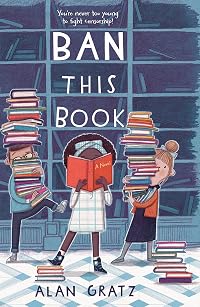
Ban This Book
by Alan Gratz
On This Page
Description
A fourth grader fights back when From the Mixed-Up Files of Mrs. Basil E. Frankweiler by E. L. Konigsburg is challenged by a well-meaning parent and taken off the shelves of her school library. Amy Anne is shy and soft-spoken, but don't mess with her when it comes to her favorite book in the whole world. Amy Anne and her lieutenants wage a battle for the books as they start a secret banned books locker library, make up ridiculous reasons to ban every single book in the library to make a show more point, and take a stand against censorship. show lessTags
Recommendations



Member Reviews
Ashy fourth-grader leads the revolt when censors decimate her North Carolina school’s library.
In a tale that is dominated but not overwhelmed by its agenda, Gratz takes Amy Anne, a young black bibliophile, from the devastating discovery that her beloved From the Mixed-up Files of Mrs. Basil E. Frankweiler has been removed from the library at the behest of Mrs. Spencer, a despised classmate’s mom, to a qualified defense of intellectual freedom at a school board meeting: “Nobody has the right to tell you what books you can and can’t read except your parents.” Meanwhile, as more books vanish, Amy Anne sets up a secret lending library of banned titles in her locker—a ploy that eventually gets her briefly suspended by the same show more unsympathetic principal who fires the school’s doctorate-holding white librarian for defiantly inviting Dav Pilkey in for an author visit. Characters frequently serve as mouthpieces for either side, sometimes deadly serious and other times tongue-in-cheek (“I don’t know about you guys, but ever since I read Wait Till Helen Comes, I’ve been thinking about worshipping Satan”). Indeed, Amy Anne’s narrative is positively laced with real titles that have been banned or challenged and further enticing teasers for them.
Contrived at some points, polemic at others, but a stout defense of the right to read. (discussion guide) (Fiction. 9-11)
-Kirkus Review show less
In a tale that is dominated but not overwhelmed by its agenda, Gratz takes Amy Anne, a young black bibliophile, from the devastating discovery that her beloved From the Mixed-up Files of Mrs. Basil E. Frankweiler has been removed from the library at the behest of Mrs. Spencer, a despised classmate’s mom, to a qualified defense of intellectual freedom at a school board meeting: “Nobody has the right to tell you what books you can and can’t read except your parents.” Meanwhile, as more books vanish, Amy Anne sets up a secret lending library of banned titles in her locker—a ploy that eventually gets her briefly suspended by the same show more unsympathetic principal who fires the school’s doctorate-holding white librarian for defiantly inviting Dav Pilkey in for an author visit. Characters frequently serve as mouthpieces for either side, sometimes deadly serious and other times tongue-in-cheek (“I don’t know about you guys, but ever since I read Wait Till Helen Comes, I’ve been thinking about worshipping Satan”). Indeed, Amy Anne’s narrative is positively laced with real titles that have been banned or challenged and further enticing teasers for them.
Contrived at some points, polemic at others, but a stout defense of the right to read. (discussion guide) (Fiction. 9-11)
-Kirkus Review show less
This is a fantastic read for older elementary to middle school aged children. As an adult, I highly enjoyed reading this book as well. Alan Gratz walks us through the trials and tribulations of students working to counteract the book banning process happening in their school library. When they create their own library, providing access to the banned literature, many students become interested in reading and the activism around their fight. These students ultimately end up speaking up to the school board, showing children the importance of standing up for what you believe in, and providing free, uncensored access to literature in a public setting. This book connects to topics such as challenged/banned literature in real life, activism, show more youth social engagement and community building. This book is a great tool for discussions in the classroom around social-justice movements in the local community. This book is inclusive, showing a young black girl as the main character, with a family that engages in their own dynamic journey to better support her and her friends in their mission. One quote that really spoke to me in this book was: “Every person should be free to read whatever they want, whenever they want, and not have to explain to anyone else why we like it, or why we think it’s valuable” (Alan Gratz). show less
Ban This Book is a great story for quiet, shy kids. Amy Anne is a fourth grader who likes to read but who rarely tells people what she is feeling. Her favorite book is From the Mixed-up Files of Mrs. Basil E. Frankweiler. One day when she is in the library to check it out again, she finds that it is missing from the shelf. The librarian tells Amy Anne that a parent asked that it be removed from circulation because it is unsuitable for kids. After more books are removed from circulation, Amy Anne starts a lending library from her locker.
The book makes a stand against censorship. As Amy Anne says, "Nobody has the right to tell you what books you can and can't read except your parents." All of the books mentioned in the novel have been show more challenged in real life. The novel examines a variety of ways in which books influence kids at certain times in their lives, and argues that while all books are not suitable for kids at all ages, they should remain available. Even Amy Anne doesn't like or isn't interested in all of the books that were pulled from the shelves, but she champions other kids' rights to read them.
The novel shows how kids with little in common can come together and make a difference. In the process, they may find unlikely friends. Amy Anne, who starts the novel unable to stand and speak, finds her voice and makes a difference. She just had to find her passion. This is a great novel for young readers. show less
The book makes a stand against censorship. As Amy Anne says, "Nobody has the right to tell you what books you can and can't read except your parents." All of the books mentioned in the novel have been show more challenged in real life. The novel examines a variety of ways in which books influence kids at certain times in their lives, and argues that while all books are not suitable for kids at all ages, they should remain available. Even Amy Anne doesn't like or isn't interested in all of the books that were pulled from the shelves, but she champions other kids' rights to read them.
The novel shows how kids with little in common can come together and make a difference. In the process, they may find unlikely friends. Amy Anne, who starts the novel unable to stand and speak, finds her voice and makes a difference. She just had to find her passion. This is a great novel for young readers. show less
 This review was written for LibraryThing Early Reviewers.
I loved this story of a 4th-grader fighting for the freedom to read. G recently told me she wants to be an activist so I've found her a couple of books featuring kids fighting against injustice. Plus she is very interested in reading anything that has been banned. Since I discovered this one she's less likely to read it, but I love a book about books AND featuring a librarian. This definitely felt like a kid-appropriate version of Lula Dean's Little Library of Banned Books (and one day when she's older maybe she'll read about that little library).
Amy Anne can be a little frustrating at times because she won't speak up, but when she finally allows herself to be honest at the end *chef's kiss*, yes, AA, TELL THEM, don't continue to LET show more THEM! The voice of one adult should never govern what happens in an entire school system, but so many school boards are allowing that today -- some do-gooder who doesn't even read is often the instigator it seems and they've gathered a bunch of their friends who also haven't read a book (and probably don't even have a kid in that district).
For adults, another good one to check out: That Librarian: The Fight Against Book Banning in America. show less
Amy Anne can be a little frustrating at times because she won't speak up, but when she finally allows herself to be honest at the end *chef's kiss*, yes, AA, TELL THEM, don't continue to LET show more THEM! The voice of one adult should never govern what happens in an entire school system, but so many school boards are allowing that today -- some do-gooder who doesn't even read is often the instigator it seems and they've gathered a bunch of their friends who also haven't read a book (and probably don't even have a kid in that district).
For adults, another good one to check out: That Librarian: The Fight Against Book Banning in America. show less
This originally appeared at The Irresponsible Reader.
---
WHAT'S BAN THIS BOOK ABOUT?
Amy Anne is a big reader—to those who don't know her that well, that's all they know about her. She spends a lot of time every day in her school library—they appear to have set certain rules because of her (there's a limit to how often she can check out certain books in a row). One day she goes to check out her favorite book, From the Mixed-Up Files of Mrs. Basil E. Frankweiler, yet again, but it's not there. Not because someone checked it out, but because one mother of another fourth-grader has got the school board to remove it—and a few others—from the library.
Now, it's been a few decades since I read From the Mixed-Up Files of Mrs. Basil E. show more Frankweiler, but I don't remember it really being the kind of book that ends up on banned lists. But maybe I'm naive—is this really a challenged book? I can understand why some groups want other books removed from required reading lists, etc.--I almost never agree, but I can see where someone might get the idea.
Also, I should note that this really does seem to be set in/around 2017 from some of the other titles, even if the book that sets the whole thing off is from 1968.
Amy Anne is livid, she's confused, she's bewildered—why would someone do this? She sets out to go to the next school board meeting, gets her parents to rearrange their schedule to get her there, writes up a statement, and then...is far too timid to read it, leaving the school librarian, Mrs. Jones, as the only opposition. (I'm less than impressed with her father's reaction to this, but I understand it)
Amy Anne is mad at herself, mad at the school board, mad at that mother—and sets out to read every book on the list (although she changes her mind when she sees that one of them is a non-fiction work about s-e-x). A friend has access to one of the books, and she spends her savings on a couple of others. Apparently, Public Libraries aren't an option? Her friends want to read those, and soon most of that challenged list is circulating in her social circle. Then the same mother gets another batch of books pulled—and Amy adds more to her list.
Eventually, she's running a small, independent—and covert—lending library from her locker. Naturally, that can only last so long, or the book would be missing some conflict...and well, enough said about that.
THE ROLE OF PARENTS
The presence and role of parents in MG novels (YA novels, too) is tricky—especially when it comes to the protagonists doing things that aren't approved of—for good or ill. Do you write the parents off somehow, do you make them incredibly authoritarian so that part of what the protagonists are rebelling against is that authority, do you get them to buy into/cheer on the activities? Those are, by and large, the options that authors seem to have to choose from. Few do what Gratz accomplished—you make them human, with regular strengths and flaws, supportive, but exercising actual authority in responsible ways.
The other aspect of parental authority in this book revolves around the reading material of the students. Amy Anne and Mrs. Jones are constantly repeating that parents should decide if their kids should read something for recreation. But the decision of one parent shouldn't dictate what other kids can read. That's an important distinction—and one this parent can get behind.
THAT REMINDS ME
Actually, Mrs. Jones and the kids support the idea that the librarian/school board/administration can choose to pull a book from circulation or not even let it start in the first place—but there's a process. It shouldn't just be one/a few parents demanding a book be removed—there needs to be consideration, deliberation, and thought involved. And then a book can be pulled—one at a time, after a process.
Gratz and his characters never call for an "all books are appropriate" approach, they just want it to be a careful process with input from various parties. I think that's important to remember (and practice).
HOW ABOUT THE NARRATION?
Bahni Turpin rocked this narration. I totally believed I was listening to a 4th grader recount the events of her life. She did a good job with the supporting characters, too—but she shined when she was giving us things from Amy Anne's perspective. She captured the frustration of someone who was always fighting against her impulses to say what she wanted to say rather than what she thought was the right thing to say, or didn't feel brave enough to do the right thing publicly. Yes, that's clear in the text, but Turpin delivers it so that you don't just know that's what Amy Anne's going through—you feel it and you believe it.
There's a joy to Amy Anne and a sadness to her, and Turpin delivered the goods on both aspects.
I ADMIT TO A LITTLE CONFUSION
Early on, Amy Anne rationalizes that it's not the school lending them—these books haven't been banned from the premises, it's just that the school can't provide them. A lot of the books in her library are privately owned, I don't see why she gets in trouble for having and circulating them.
There are other, clear legal infractions involved—and I agree with the administration for coming down on her for that. But the rest? That feels a little wrong, and Amy Anne's parents should have fought that.
SO, WHAT DID I THINK ABOUT BAN THIS BOOK?
Beyond the message about banning books, this book is a celebration of what books can do—how they can inspire as well as entertain, comfort those who need it, rattle the perspective when necessary—to affect the reader in ways they can't fully articulate or understand. All of that and more. The core of this book comes from the love Amy Anne has for some books, and that love grows to more as soon as she's exposed to it.
I loved that—as well as the message about not allowing the conscience of one parent dictate to them all. The solution that Amy Anne and her friends come up with for the final encounter with the school board was pretty clever, and I really liked the way that Gratz set up and resolved the major hurdle to their plan.
Yes, it's a little simple. Yes, the solution is a little pat and easy. Yes, the whole thing comes across like an after-school special (or whatever the contemporary equivalent is—I'd say a Disney Channel movie, but I guess that's not a thing. A made-for-Disney+ movie?). But it's not trying to be careful and nuanced, it's a story directed at 8-11 year-olds (my guess), trying to inspire them in a certain direction as well as entertain. I got a very strong Lemonade Mouth-feel from this (the movie, not the book—I never got around to reading that), I realize that's a reference that only works for readers/parents of a certain age, but I don't know anything more contemporary.
It's a celebration of freedom, of literature, of learning from your mistakes and sticking up for what you believe (even if you do it poorly at first). It's about finding the courage to do the right thing, even when not expedient.
I'm guessing it was the apparent upsurge in School Book Bans that led my library to getting this audiobook, and I'm glad they did. It's something that people should be reading about/thinking about/talking about. Hopefully, this book kicks off some of that in our area.
I really enjoyed this and figure most book lovers will, too. show less
---
WHAT'S BAN THIS BOOK ABOUT?
Amy Anne is a big reader—to those who don't know her that well, that's all they know about her. She spends a lot of time every day in her school library—they appear to have set certain rules because of her (there's a limit to how often she can check out certain books in a row). One day she goes to check out her favorite book, From the Mixed-Up Files of Mrs. Basil E. Frankweiler, yet again, but it's not there. Not because someone checked it out, but because one mother of another fourth-grader has got the school board to remove it—and a few others—from the library.
Now, it's been a few decades since I read From the Mixed-Up Files of Mrs. Basil E. show more Frankweiler, but I don't remember it really being the kind of book that ends up on banned lists. But maybe I'm naive—is this really a challenged book? I can understand why some groups want other books removed from required reading lists, etc.--I almost never agree, but I can see where someone might get the idea.
Also, I should note that this really does seem to be set in/around 2017 from some of the other titles, even if the book that sets the whole thing off is from 1968.
Amy Anne is livid, she's confused, she's bewildered—why would someone do this? She sets out to go to the next school board meeting, gets her parents to rearrange their schedule to get her there, writes up a statement, and then...is far too timid to read it, leaving the school librarian, Mrs. Jones, as the only opposition. (I'm less than impressed with her father's reaction to this, but I understand it)
Amy Anne is mad at herself, mad at the school board, mad at that mother—and sets out to read every book on the list (although she changes her mind when she sees that one of them is a non-fiction work about s-e-x). A friend has access to one of the books, and she spends her savings on a couple of others. Apparently, Public Libraries aren't an option? Her friends want to read those, and soon most of that challenged list is circulating in her social circle. Then the same mother gets another batch of books pulled—and Amy adds more to her list.
Eventually, she's running a small, independent—and covert—lending library from her locker. Naturally, that can only last so long, or the book would be missing some conflict...and well, enough said about that.
THE ROLE OF PARENTS
The presence and role of parents in MG novels (YA novels, too) is tricky—especially when it comes to the protagonists doing things that aren't approved of—for good or ill. Do you write the parents off somehow, do you make them incredibly authoritarian so that part of what the protagonists are rebelling against is that authority, do you get them to buy into/cheer on the activities? Those are, by and large, the options that authors seem to have to choose from. Few do what Gratz accomplished—you make them human, with regular strengths and flaws, supportive, but exercising actual authority in responsible ways.
The other aspect of parental authority in this book revolves around the reading material of the students. Amy Anne and Mrs. Jones are constantly repeating that parents should decide if their kids should read something for recreation. But the decision of one parent shouldn't dictate what other kids can read. That's an important distinction—and one this parent can get behind.
THAT REMINDS ME
Actually, Mrs. Jones and the kids support the idea that the librarian/school board/administration can choose to pull a book from circulation or not even let it start in the first place—but there's a process. It shouldn't just be one/a few parents demanding a book be removed—there needs to be consideration, deliberation, and thought involved. And then a book can be pulled—one at a time, after a process.
Gratz and his characters never call for an "all books are appropriate" approach, they just want it to be a careful process with input from various parties. I think that's important to remember (and practice).
HOW ABOUT THE NARRATION?
Bahni Turpin rocked this narration. I totally believed I was listening to a 4th grader recount the events of her life. She did a good job with the supporting characters, too—but she shined when she was giving us things from Amy Anne's perspective. She captured the frustration of someone who was always fighting against her impulses to say what she wanted to say rather than what she thought was the right thing to say, or didn't feel brave enough to do the right thing publicly. Yes, that's clear in the text, but Turpin delivers it so that you don't just know that's what Amy Anne's going through—you feel it and you believe it.
There's a joy to Amy Anne and a sadness to her, and Turpin delivered the goods on both aspects.
I ADMIT TO A LITTLE CONFUSION
Early on, Amy Anne rationalizes that it's not the school lending them—these books haven't been banned from the premises, it's just that the school can't provide them. A lot of the books in her library are privately owned, I don't see why she gets in trouble for having and circulating them.
There are other, clear legal infractions involved—and I agree with the administration for coming down on her for that. But the rest? That feels a little wrong, and Amy Anne's parents should have fought that.
SO, WHAT DID I THINK ABOUT BAN THIS BOOK?
Beyond the message about banning books, this book is a celebration of what books can do—how they can inspire as well as entertain, comfort those who need it, rattle the perspective when necessary—to affect the reader in ways they can't fully articulate or understand. All of that and more. The core of this book comes from the love Amy Anne has for some books, and that love grows to more as soon as she's exposed to it.
I loved that—as well as the message about not allowing the conscience of one parent dictate to them all. The solution that Amy Anne and her friends come up with for the final encounter with the school board was pretty clever, and I really liked the way that Gratz set up and resolved the major hurdle to their plan.
Yes, it's a little simple. Yes, the solution is a little pat and easy. Yes, the whole thing comes across like an after-school special (or whatever the contemporary equivalent is—I'd say a Disney Channel movie, but I guess that's not a thing. A made-for-Disney+ movie?). But it's not trying to be careful and nuanced, it's a story directed at 8-11 year-olds (my guess), trying to inspire them in a certain direction as well as entertain. I got a very strong Lemonade Mouth-feel from this (the movie, not the book—I never got around to reading that), I realize that's a reference that only works for readers/parents of a certain age, but I don't know anything more contemporary.
It's a celebration of freedom, of literature, of learning from your mistakes and sticking up for what you believe (even if you do it poorly at first). It's about finding the courage to do the right thing, even when not expedient.
I'm guessing it was the apparent upsurge in School Book Bans that led my library to getting this audiobook, and I'm glad they did. It's something that people should be reading about/thinking about/talking about. Hopefully, this book kicks off some of that in our area.
I really enjoyed this and figure most book lovers will, too. show less
Fourth-grader Amy Anne Ollinger is stunned when she tries to check out her favorite book from the library, only to find it missing. Someone else must have checked it out after she returned it yesterday. So, she askes Mrs Jones, the school librarian, if she can put a hold on that title. That’s when she learns that the book has been removed because another student’s parent complained it was “inappropriate.” And this is just the beginning. The mother has a list of books she wants removed from the school library’s shelves. Amy Anne, together with her friends Rebecca and Danny, decide to form the BBLL – Banned Books Locker Library. They get a copy of every book on the list and put in in Amy Anne’s locker, loaning them out to show more all the kids at school.
I loved Amy Anne. I loved how she starts out a quiet, shy girl who virtually never voices her concerns out loud, but who takes action to right a wrong. I like how she ultimately gathers her courage and marshals all her friends in the school – even those she didn’t previously know she had – to help bring the issue to a head and formulate a satisfying conclusion. After all, “for all the amazing things that books can do, they can’t make you into a bad person.” Brava, Amy Anne!
Perfect read to celebrate Banned Books Week! show less
I loved Amy Anne. I loved how she starts out a quiet, shy girl who virtually never voices her concerns out loud, but who takes action to right a wrong. I like how she ultimately gathers her courage and marshals all her friends in the school – even those she didn’t previously know she had – to help bring the issue to a head and formulate a satisfying conclusion. After all, “for all the amazing things that books can do, they can’t make you into a bad person.” Brava, Amy Anne!
Perfect read to celebrate Banned Books Week! show less
This is a great story for all of us reading nerds -- girl goes to school to check out her absolutely favorite book again and it's been taken off the shelves because a parent was concerned. It's a little didactic, I have to say, a little preachy here and there. But I don't mind that because I wholeheartedly agree with the message, and I love love love the empowerment that happens here. Amy Anne goes from a girl who can't speak her mind to one who's passionate for a cause. The boundaries about how to determine bad behavior from thoughtful protest are well drawn, and the whole thing is at a good level for 4-5th graders. Nicely done. Also love that AA is a girl of color with an interesting family and some really good friends.
Members
- Recently Added By
Lists

Build Your Library Level 3
30 works; 1 member
Author Information

45+ Works 14,959 Members

Alan M. Gratz is a LibraryThing Author, an author who lists their personal library on LibraryThing.
Awards and Honors
Awards
Common Knowledge
- Canonical title
- Ban This Book
- Original publication date
- 2017
- People/Characters
- Amy Anne Ollinger; Rebecca Zimmerman; Mrs. Jones; Dav Pilkey; Sarah Spencer; Trey McBride (show all 8); Angelina Ollinger; Alexis Ollinger
- Important places
- Shelbourne Elementary School
- First words
- It all started the day my favorite book went missing from the library.
- Last words
- (Click to show. Warning: May contain spoilers.)So I did.
Classifications
- Genres
- Kids, Tween, Fiction and Literature, Children's Books
- DDC/MDS
- 813.54 — Literature & rhetoric American literature in English American fiction in English 1900-1999 1945-1999
- LCC
- PZ7 .G77224 .B — Language and Literature Fiction and juvenile belles lettres Fiction and juvenile belles lettres Juvenile belles lettres
- BISAC
Statistics
- Members
- 1,286
- Popularity
- 18,951
- Reviews
- 53
- Rating
- (4.30)
- Languages
- Catalan, English, German, Spanish
- Media
- Paper, Audiobook, Ebook
- ISBNs
- 22
- ASINs
- 2
