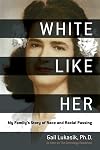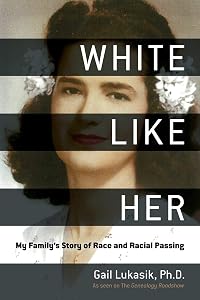
White Like Her
by Gail Lukasik 
On This Page
Description
In the historical context of the Jim Crow South, Gail explores her mother's decision to pass, how she hid her secret even from her own husband, and the price she paid for choosing whiteness. Haunted by her mother's fear and shame, Gail embarks on a quest to uncover her mother's racial lineage, tracing her family back to eighteenth-century colonial Louisiana. In coming to terms with her decision to publicly out her mother, Gail changed how she looks at race and heritage.With a foreword show more written by Kenyatta Berry, host of PBS's Genealogy Roadshow, this unique and fascinating story of coming to terms with oneself breaks down barriers. show lessTags
Recommendations






Member Recommendations
Member Reviews
"We all think we know who we are. We all believe what our parents tell us about our families. Sometimes what they don’t tell us is the real story."
On its surface, White Like Her is one woman’s dogged journey* to learn about her family’s history. What sets it apart is that Gail Lukasik’s journey is predicated on sifting through the secrecy that shrouded much of her mother’s life, ultimately disrupting the narrative of Lukasik and her family’s whiteness. You see, Alvera Frederic passed as white for most of her adult life, but spent her formative years in a black family. Born in New Orleans, she straddled the line of “blackness,” until she reinvented herself in Ohio, marrying a white man and starting a family, while leaving show more her own behind.
Much of this book follows, step by step, Lukasik’s uncovering of her mother’s true racial identity, pieced together as a result of a census record and an appearance on PBS’ Genealogy Roadshow. What I like most about this book is that it serves as a primer, of sorts, for those unfamiliar with key tools of the genealogy trade. From census records to military enlistments to church baptismal lists, Lukasik leaves no resource unexamined. It’s a great roadmap for those venturing into their own family tree for the first time, an experience that can be surprisingly daunting.
There is, of course, Lukasik’s processing of new facets of her identity. She makes mention, a few times, of her DNA’s breakdown that she is 7-9% African. However, she honestly acknowledges that she was raised to be a white woman, with all the trappings of it, including racism. I think this begs a great question of how much black does it take for one to put on the veil of blackness and with what implications. She also grapples a great deal with why her mother could seemingly turn her back on her family to ensconce herself in whiteness. Neither is an easy question to answer, but it is certainly interesting to see a white woman process that in a way that feels authentic and seeks to understand.
White Like Her was an interesting read, perhaps more so because I took for granted my own understanding of race as a social construct and how it has played out over centuries in America. I was 8 or 9 when Alex Haley’s Queen was released, and I vividly remember the scene in which Halle Berry’s Queen was outed as being black. While I didn’t pick up on the concept of passing, I was well aware of the colorism and its ability to create opportunities for those able to take advantage of their fairer-toned skin. White LIke Her starts a few steps back, and provides context for some key ideas that led to Alvera’s decision to pass for white. Lukasik, in painstaking detail, explores the common practices of slave owners’ rape of enslaved women, plaçage relationships between “colored’ or mulatto women and white men who were legally forbidden from marrying them, and how these led to a caste system in New Orleans (and elsewhere).
Part of what made White Like Me hit so close to home was its dogged pursuit of the truth in a dubiously presented history. As someone who has experienced the ups, downs, and around in tracing my ancestry, I felt Lukasik was a kindred spirit, of sorts. The high of verifying a long-lost ancestor, coupled with the disappointment of not being able to confirm another, is both part exhilarating and part infuriating, especially when tied to the sorts of unspoken half-truths that are wont to be passed among family members. Lukasik had a great deal of assistance at her disposal, but that didn’t entirely sidestep common roadblocks in seeking information about people who’ve been dead anywhere between 20 to 200 years. In this way, I found myself incredibly invested in her success and triangulating data about her family members in order to find her truth.
Lukasik, an author herself, weaves a compelling exploration of race in America, and the implications for those whose lived experience is adjacent to, but wholly apart from blackness. Admittedly, her whiteness was a key part of why I was interested in reading this book, and it felt like a genuinely reflective response to a situation that would leave most people jarred. I think this is valuable to any genealogist (novice to pro) and those interested in intersections of race, gender, and economics from slavery to now.
*Anyone who tells you genealogy isn’t a journey replete with long, sleepless nights and tears of both elation and frustration is a bold-faced liar and you don’t need that kind of negativity in your life. show less
On its surface, White Like Her is one woman’s dogged journey* to learn about her family’s history. What sets it apart is that Gail Lukasik’s journey is predicated on sifting through the secrecy that shrouded much of her mother’s life, ultimately disrupting the narrative of Lukasik and her family’s whiteness. You see, Alvera Frederic passed as white for most of her adult life, but spent her formative years in a black family. Born in New Orleans, she straddled the line of “blackness,” until she reinvented herself in Ohio, marrying a white man and starting a family, while leaving show more her own behind.
Much of this book follows, step by step, Lukasik’s uncovering of her mother’s true racial identity, pieced together as a result of a census record and an appearance on PBS’ Genealogy Roadshow. What I like most about this book is that it serves as a primer, of sorts, for those unfamiliar with key tools of the genealogy trade. From census records to military enlistments to church baptismal lists, Lukasik leaves no resource unexamined. It’s a great roadmap for those venturing into their own family tree for the first time, an experience that can be surprisingly daunting.
There is, of course, Lukasik’s processing of new facets of her identity. She makes mention, a few times, of her DNA’s breakdown that she is 7-9% African. However, she honestly acknowledges that she was raised to be a white woman, with all the trappings of it, including racism. I think this begs a great question of how much black does it take for one to put on the veil of blackness and with what implications. She also grapples a great deal with why her mother could seemingly turn her back on her family to ensconce herself in whiteness. Neither is an easy question to answer, but it is certainly interesting to see a white woman process that in a way that feels authentic and seeks to understand.
White Like Her was an interesting read, perhaps more so because I took for granted my own understanding of race as a social construct and how it has played out over centuries in America. I was 8 or 9 when Alex Haley’s Queen was released, and I vividly remember the scene in which Halle Berry’s Queen was outed as being black. While I didn’t pick up on the concept of passing, I was well aware of the colorism and its ability to create opportunities for those able to take advantage of their fairer-toned skin. White LIke Her starts a few steps back, and provides context for some key ideas that led to Alvera’s decision to pass for white. Lukasik, in painstaking detail, explores the common practices of slave owners’ rape of enslaved women, plaçage relationships between “colored’ or mulatto women and white men who were legally forbidden from marrying them, and how these led to a caste system in New Orleans (and elsewhere).
Part of what made White Like Me hit so close to home was its dogged pursuit of the truth in a dubiously presented history. As someone who has experienced the ups, downs, and around in tracing my ancestry, I felt Lukasik was a kindred spirit, of sorts. The high of verifying a long-lost ancestor, coupled with the disappointment of not being able to confirm another, is both part exhilarating and part infuriating, especially when tied to the sorts of unspoken half-truths that are wont to be passed among family members. Lukasik had a great deal of assistance at her disposal, but that didn’t entirely sidestep common roadblocks in seeking information about people who’ve been dead anywhere between 20 to 200 years. In this way, I found myself incredibly invested in her success and triangulating data about her family members in order to find her truth.
Lukasik, an author herself, weaves a compelling exploration of race in America, and the implications for those whose lived experience is adjacent to, but wholly apart from blackness. Admittedly, her whiteness was a key part of why I was interested in reading this book, and it felt like a genuinely reflective response to a situation that would leave most people jarred. I think this is valuable to any genealogist (novice to pro) and those interested in intersections of race, gender, and economics from slavery to now.
*Anyone who tells you genealogy isn’t a journey replete with long, sleepless nights and tears of both elation and frustration is a bold-faced liar and you don’t need that kind of negativity in your life. show less
With the boom in readily accessible home genetic testing kits, this story is a must-read. Author Gail Lukasik discovers a hidden family link, later confirming it with extensive genealogical research and a genetic test. Her mother passed for white as a young woman, leaving behind an extended family in New Orleans that chose to remain on the other side of the color line. Lukasik is also a fiction mystery author, and tells her real-life mystery story with skill, revealing her search bit by bit. With compassion, she delves into the historical milieu and racial oppression her mother faced that drove her to make a decision readers today might otherwise not find sympathetic. Interspersed with her family’s story and the research is show more Lukasik’s appearance on the Genealogy Roadshow television program. Whether your own genetic test has revealed a surprise, or you are just curious about the historical phenomenon of racial passing, this story is fascinating. show less
When the author was an adult, she discovered that her mother was a mixed race woman who had cut herself off from her family in the 1940's to pass as a white woman, and becomes obsessed with discovering her black heritage. Helped mightily by the PBS television show, Genealogy Road Show, she begins to trace her mother's lineage back to 18th Century colonial Louisiana.
Her story, fairly common in this country, not only describes the rich and diverse heritage of most Americans, but also the insidious burden of slavery and racism on our county's psyche.
Her story, fairly common in this country, not only describes the rich and diverse heritage of most Americans, but also the insidious burden of slavery and racism on our county's psyche.
I originally saw Gail's story on the show Genealogy Roadshow which I love. As someone who works on her own genealogy, I can relate to Gail's search. I found the story of her mother's passing as white to be extremely brave and heartbreaking at the same time.
Gail tells the story of how she discovered her mother's secret and how she broached the topic with her. Once her mother confirmed the truth, she made Gail swear that she wouldn't tell anyone until she was gone. Gail kept her promise to her mother for the next 17 years.
This story details not only Gail's family history but the history of racism and how long it has been a plague on our society. Learning of the caste system that took place in early New Orleans history was extremely show more interesting. I loved how Gail's book ended with meeting family and seeing her mother in their face. This was definitely an eye-opening read and I am so glad I read it. show less
Gail tells the story of how she discovered her mother's secret and how she broached the topic with her. Once her mother confirmed the truth, she made Gail swear that she wouldn't tell anyone until she was gone. Gail kept her promise to her mother for the next 17 years.
This story details not only Gail's family history but the history of racism and how long it has been a plague on our society. Learning of the caste system that took place in early New Orleans history was extremely show more interesting. I loved how Gail's book ended with meeting family and seeing her mother in their face. This was definitely an eye-opening read and I am so glad I read it. show less
Privileged white woman Gail Lukasik grew up knowing little about her olive skinned mother's family or past. In researching her family history with the help of the producers of cable TV's Genealogy Roadshow, she makes a startling discovery: her mother had been designated as "colored" at birth and left her family behind to move north and pass for white. Lukasik wrestles with the implications of this decision and its impact on her mother's life. She traces her ancestors back to their original enslavement in the 18th century, and gets to know their modern-day black descendants.
Genealogical research results are of the most interest to the people involved; to everyone else they just seem obsessive. I also found the writing style repetitive show more and bland. Still, this book offers an interesting perspective on a little-discussed American phenomenon. show less
Genealogical research results are of the most interest to the people involved; to everyone else they just seem obsessive. I also found the writing style repetitive show more and bland. Still, this book offers an interesting perspective on a little-discussed American phenomenon. show less
The book deals with the absorbing topic of the author seeking information about cross-racial family relationships hidden from her. It's all the more compelling because the author is white and only in adulthood found out that her mother "passed" for white and concealed almost all of her relatives from her immediate family. I found the book interesting - Gale Lukaskik, the author devoted a good amount of attention to considering her mother's motivations and actions, which was my main interest. However, a great deal of the book went into detail about her mother's family genealogy. I found this a bit abstract -- Lukasik explained the research that was done to find far back relatives and the inferences she and others helping her had to make. show more I finished reading the book even though it covered a lot of ground I hadn't expected it to. show less
Gail Lukasik is a mystery author. As an adult, she sent away for her mother’s birth certificate from New Orleans, only to see “(col.)” after her mother’s name. “Col”? Coloured? What!? This began a genealogical search (after her mother refused to talk about it), with help from the tv show “Genelalogical Roadshow” for her ancestry (much of the searching, and the tv show came after her mother died). Her mother did, indeed, abandon her family in New Orleans so that she could move north and pass for white.
There were some interesting stories in her family’s background, but it was hard to keep track of all the people. And not all the stories were as interesting as others. Doing the tv show also helped reunite her with family show more she never knew she had, which was interesting. show less
There were some interesting stories in her family’s background, but it was hard to keep track of all the people. And not all the stories were as interesting as others. Doing the tv show also helped reunite her with family show more she never knew she had, which was interesting. show less
Members
- Recently Added By
Lists

Books Read in 2026
1,912 works; 66 members

Mothers and Daughters
114 works; 11 members

Genealogy
11 works; 1 member
Author Information

7+ Works 227 Members
Gail Lukasik is a LibraryThing Author, an author who lists their personal library on LibraryThing.
Some Editions
Common Knowledge
- Canonical title
- White Like Her
- Original publication date
- 2017
- People/Characters
- Alvera Frederic Kalina; Gail Lukasik; Azemar Frederic; Camille Kilbourne; Laura Baker; Leon Frederic, Sr. (show all 22); Harold J. Kalina; Aunt Alma; Uncle Fred; Jerry Lukasik; Christopher Lukasik; Stephanie Frederic; Felicite Dauphin; Marta; Azemar Frederic Jr; Kenyatta D. Berry; Ula Moret; Versie Jeffries; Paris L. Gill Smith; Paula Danners; Jeanne Thomas; Philomene Lanabere
- Important places
- New Orleans, Louisiana, USA; Cleveland, Ohio, USA; Libertyville, Illinois, USA; Chicago, Illinois, USA; Saint Louis, Missouri, USA; Iberville Parish, Louisiana, USA (show all 7); California, USA
- Epigraph
- Be the fingerprint on the window,
the breath behind the curtain,
the shadow that lingers after the light leaves. - Dedication
- For my mother, Alvera Frederic Kalina, whose courage lit the way.
Thank you, mom, for your bravery and sacrifice. - First words
- Wild with anticipation, I hurry up the steps of the St. Louis Central Public Library, oblivious to the blistering heat and humidity.
- Last words
- (Click to show. Warning: May contain spoilers.)Preparing me to be the daughter she wanted me to be: secret keeper and storyteller.
Classifications
- Genres
- Anthropology, Nonfiction, Biography & Memoir, General Nonfiction, History
- DDC/MDS
- 305.800973 — Society, government, & culture Social sciences, sociology & anthropology Social group - Age, Gender, Ethnicity Ethnic and national groups standard subdivisions / Ethnic and national groups with ethnic origins from more than one continent, of European descent standard subdivisions Biography And History North America United States
- LCC
- E185.625 .L85 — History of the United States United States
- BISAC
Statistics
- Members
- 130
- Popularity
- 251,158
- Reviews
- 8
- Rating
- (3.43)
- Languages
- English
- Media
- Paper, Audiobook, Ebook
- ISBNs
- 11
- ASINs
- 2