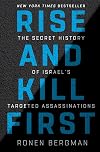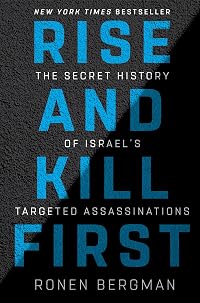
Rise and Kill First: The Secret History of Israel's Targeted Assassinations
by Ronen Bergman
On This Page
Description
"The Talmud says: "If someone comes to kill you, rise up and kill him first." This instinct to take every measure, even the most aggressive, to defend the Jewish people is hardwired into Israel's DNA. From the very beginning of its statehood in 1948, protecting the nation from harm has been the responsibility of its intelligence community and armed services, and there is one weapon in their vast arsenal that they have relied upon to thwart the most serious threats. Targeted assassinations show more have been used countless times, on enemies large and small, sometimes in response to attacks against the Israeli people and sometimes preemptively. Journalist and military analyst Ronen Bergman offers an inside account of the targeted killing programs: their successes, their failures, and the moral and political price exacted on the men and women who approved and carried out the missions. Bergman has gained the rare cooperation of many current and former members of the Israeli government, including Prime Ministers Shimon Peres, Ehud Barak, Ariel Sharon, and Benjamin Netanyahu, as well as high-level figures in the country's military and intelligence services: the IDF (Israel Defense Forces), the Mossad (the world's most feared intelligence agency), Caesarea (a "Mossad within the Mossad" that carries out attacks on the highest-value targets), and the Shin Bet (an internal security service that implemented the largest targeted assassination campaign ever, in order to stop what had once appeared to be unstoppable: suicide terrorism). Bergman traces, from statehood to the present, the gripping events and thorny ethical questions underlying Israel's targeted killing campaign, which has shaped the Israeli nation, the Middle East, and the entire world." -- show lessTags
Recommendations



































Member Recommendations


The Palestine Laboratory: How Israel Exports the Technology of Occupation Around the World by Antony Loewenstein
LamontCranston The Palestine Laboratory frequently cites Bergmans book, articles, and interviews him.
LamontCranston To find out what happened to the Palestinians that this work initially glosses over.

Member Reviews
If you want to know whether or not Yasser Arafat was assassinated, don’t read this book. As Ronen Bergman writes, because of Israel’s policy of censorship, “If I knew the answer to the question of what killed Yasser Arafat, I wouldn’t be able to write it here in this book, or even be able to write that I know the answer.”
What Bergman is permitted to reveal, though, is extraordinary: not just that he was allowed to publish an exposé of Israel’s legendarily secretive intelligence services, but that he so thoroughly undercuts their aura of invincibility. As an Israeli investigative journalist, Bergman draws back the curtain on Israel’s long struggle in the shadows for survival — a struggle that has misfired as often as show more not.
Bergman suggests in his prologue that those who cooperated with his investigation were motivated by that most basic of human desires: to talk about the things they’ve done, and to explain their side of the story. This motivation is doubtless all the stronger in a nation torn between its alignment with the liberal democracies of the West and the zeal of its regional enemies to kill it.
I found the result highly readable and even-handed, but depressing. Starting from the violent birth of modern Israel, the mind numbs as corpses pile up through decades of car bombings, poisonings, missile strikes, and sniper kills in response to suicide bombers, abductions and murders, rocket attacks, and programs to develop weapons of mass destruction.
Certainly Bergman does not let his countrymen off easy. He doesn’t minimize the suffering of Palestinian, Lebanese, and Arab civilians caught in the crossfire of history. At times, the depths of Israel’s suffering pushed its leaders to commit or permit what can only be described as war crimes.
And yet it’s equally clear that on balance, Israel’s leaders have usually operated within rules of engagement meant to minimize or avoid civilian casualties, sometimes to the detriment of Israelis. Only the most relentlessly ignorant or ideological critic could compare Israel disfavorably to an assortment of foes who deliberately target and murder as many civilians as they can.
This book left me with a profound sense of sadness, but it’s a useful lens through which to view the cycles of retribution that consume the headlines. Critics from right and left might find it too bleeding-heart or too lenient, respectively. One thing is certain: it’s difficult to foresee an end to the bloodshed, and it’s easy to foresee that mutual forgiveness and reconciliation will prove as elusive as the human threats Israel has spent its existence hunting down and killing. show less
What Bergman is permitted to reveal, though, is extraordinary: not just that he was allowed to publish an exposé of Israel’s legendarily secretive intelligence services, but that he so thoroughly undercuts their aura of invincibility. As an Israeli investigative journalist, Bergman draws back the curtain on Israel’s long struggle in the shadows for survival — a struggle that has misfired as often as show more not.
Bergman suggests in his prologue that those who cooperated with his investigation were motivated by that most basic of human desires: to talk about the things they’ve done, and to explain their side of the story. This motivation is doubtless all the stronger in a nation torn between its alignment with the liberal democracies of the West and the zeal of its regional enemies to kill it.
I found the result highly readable and even-handed, but depressing. Starting from the violent birth of modern Israel, the mind numbs as corpses pile up through decades of car bombings, poisonings, missile strikes, and sniper kills in response to suicide bombers, abductions and murders, rocket attacks, and programs to develop weapons of mass destruction.
Certainly Bergman does not let his countrymen off easy. He doesn’t minimize the suffering of Palestinian, Lebanese, and Arab civilians caught in the crossfire of history. At times, the depths of Israel’s suffering pushed its leaders to commit or permit what can only be described as war crimes.
And yet it’s equally clear that on balance, Israel’s leaders have usually operated within rules of engagement meant to minimize or avoid civilian casualties, sometimes to the detriment of Israelis. Only the most relentlessly ignorant or ideological critic could compare Israel disfavorably to an assortment of foes who deliberately target and murder as many civilians as they can.
This book left me with a profound sense of sadness, but it’s a useful lens through which to view the cycles of retribution that consume the headlines. Critics from right and left might find it too bleeding-heart or too lenient, respectively. One thing is certain: it’s difficult to foresee an end to the bloodshed, and it’s easy to foresee that mutual forgiveness and reconciliation will prove as elusive as the human threats Israel has spent its existence hunting down and killing. show less
Readers looking for the greatest hits of an agency staffed exclusively by super-spies are likely to come away from this one disappointed. Well, maybe just a little disappointed. There are parts of this book that James Bond fans will certainly appreciate. Bergman has a real feel for narrative tension: his accounts of the Mossad's most impressive successes and its most embarrassing failures are taut and compulsively readable: he never lets the reader forget how the tiniest details can mean the difference between a mission's success or failure. He portrays the Mossad as an institution that often knows how to play the long game: many accounts of these assassinations involve individuals who'd been on the Mossad's list for years, sometimes show more decades. There's also a lot here about the Mossad's recruiting process and renowned operational precision, which sometimes lives up to its reputation and sometimes, well, doesn't. I don't know enough about either the intelligence community or Israeli history to know what elements in "Rise and Kill First" qualify as revelations, but this one contains more than enough information about the theory and practice of spycraft to keep even the most dedicated reader of spy thrillers satisfied.
"Rise and Kill First" also has a consistent institutional focus. Bergman never forgets to contextualize the Mossad, patiently explaining how the Mossad has cooperated and occasionally competed with other Israeli security organizations such as Shin Bet. It might surprise some readers to know that the Mossad hasn't always been in the vanguard of Israel's intelligence community: much of its reputation can be traced directly to the efforts of Meir Dagan. At the same time, it's also a story of transformation: Bergman tells us how the Mossad's various successes and failures contributed to its current values and operating practices. Should. the Mossad draw upon Jewish foreign nationals in neutral countries? What constitutes an acceptable loss, or an acceptable amount of -- as the United States puts it -- collateral damage? Unfortunately, in this sense, the Mossad serves as a troubling analogy for our entire age. There's quite a lot here about how the Mossad struggled with the morality of the assassinations they carried out: we hear from lawyers, judges, rabbis, and the agents who participated in these operations themselves. I was surprised that many of these assassinations required a real-time go-ahead from the current Israeli prime minister: more than one assassination attempt has had to be postponed because the person in charge was asleep. As time goes on and Israel's relationship with the Palestinians worsens, tactics and both sides become increasingly brutal and moral questions tend to fall by the wayside. The increasingly technological nature of modern warfare serves mostly to obviate most of these moral issues. Israel actually pioneered many aspects of drone warfare, but by the end of the book, the assassinations seem less like special operations and more like an assembly line. Of course, it has to be mentioned that even Dayan realized at some point what Americans have recently learned in Iraq: without a workable political solution, there's only so much that even the best intelligence operation can accomplish. That still isn't in sight, of course. To paraphrase one of the book's own chapter, titles, "Rise and Kill First" is, in many respects, a story of remarkable tactical success and inevitable strategic failure. Recommend. show less
"Rise and Kill First" also has a consistent institutional focus. Bergman never forgets to contextualize the Mossad, patiently explaining how the Mossad has cooperated and occasionally competed with other Israeli security organizations such as Shin Bet. It might surprise some readers to know that the Mossad hasn't always been in the vanguard of Israel's intelligence community: much of its reputation can be traced directly to the efforts of Meir Dagan. At the same time, it's also a story of transformation: Bergman tells us how the Mossad's various successes and failures contributed to its current values and operating practices. Should. the Mossad draw upon Jewish foreign nationals in neutral countries? What constitutes an acceptable loss, or an acceptable amount of -- as the United States puts it -- collateral damage? Unfortunately, in this sense, the Mossad serves as a troubling analogy for our entire age. There's quite a lot here about how the Mossad struggled with the morality of the assassinations they carried out: we hear from lawyers, judges, rabbis, and the agents who participated in these operations themselves. I was surprised that many of these assassinations required a real-time go-ahead from the current Israeli prime minister: more than one assassination attempt has had to be postponed because the person in charge was asleep. As time goes on and Israel's relationship with the Palestinians worsens, tactics and both sides become increasingly brutal and moral questions tend to fall by the wayside. The increasingly technological nature of modern warfare serves mostly to obviate most of these moral issues. Israel actually pioneered many aspects of drone warfare, but by the end of the book, the assassinations seem less like special operations and more like an assembly line. Of course, it has to be mentioned that even Dayan realized at some point what Americans have recently learned in Iraq: without a workable political solution, there's only so much that even the best intelligence operation can accomplish. That still isn't in sight, of course. To paraphrase one of the book's own chapter, titles, "Rise and Kill First" is, in many respects, a story of remarkable tactical success and inevitable strategic failure. Recommend. show less
One of the surprises in this book was the number of times Israel's intelligence community (the Mossad, Shin Bet, et al) completely botched a job. Going into the book I had unconsciously imagined that Israeli spies and commandos were complete masters of the field, and my pre-conceived image was only brought into my conscious mind as the book began tearing it to shreds. I don't know if it was more fun reading about the failures or the successes; either way I was fascinated.
Rise and Kill First is an astounding history of secret assassinations, and how turning to murder as an instrument of statecraft corrodes governments. Anyone who's passed Political Science 101 knows that states are founded on the use of violence. Israel's bloody constitutional moment is closer than most. Even prior to the War of Independence in 1949, Irgun carried out a guerrilla war of assassination against British and Arab officials in the Mandate of Palestine. The Jewish Brigade had a sideline in occupied Europe bringing SS officers to justice. Even as newborn Israel celebrated liberal human rights, and a constitution that banned the death penalty, it's security services, Mossad, Shin Bet, and AMAN, wrote a very different shadow show more constitution. Anyone with Jewish blood on their hands would die, and to paraphrase the Talmud, "If a man comes to kill you, rise and kill him first."
Bergman traces a complicated history of professionalizing state-sponsored murder. At first Israel used letter bombs, but this method was random and easy to foil. Human assassination teams were more precise, but the Lillehammer affair, where an innocent man was killed in Norway, was just one of the problems. Human agents could also be exposed, arrested or assassinated in retribution, and close command in foreign countries was impossible.
As Israel faced threats from Egyptian scientists, the radical terrorists of Black September, and later Hamas and Hezbollah, the security services innovated. Israel prefigured the American War on Terror tactics of 'unlawful combatants', assassination via drone aircraft, and high-tech warrooms that collated intelligence to present senior officials with real time "go/no-go" choices on assassinations.
However, for all the investment, it seems like the targeted assassinations were unable to prevent the First and Second Intifada or substantially degrade the suicide bomber recruitment pipeline. Strategic weapons programs in Egypt, Syria, Iraq, and Iran were more vulnerable to 'key man' attacks. But I think it's fair to say that the use of assassination has hardened world opinion against Israel as much as the occupation and building of settlements in Palestinian territory, and the longterm running of assassinations has eroded respect for law and life. An eye for an eye leaves everyone blind. show less
Bergman traces a complicated history of professionalizing state-sponsored murder. At first Israel used letter bombs, but this method was random and easy to foil. Human assassination teams were more precise, but the Lillehammer affair, where an innocent man was killed in Norway, was just one of the problems. Human agents could also be exposed, arrested or assassinated in retribution, and close command in foreign countries was impossible.
As Israel faced threats from Egyptian scientists, the radical terrorists of Black September, and later Hamas and Hezbollah, the security services innovated. Israel prefigured the American War on Terror tactics of 'unlawful combatants', assassination via drone aircraft, and high-tech warrooms that collated intelligence to present senior officials with real time "go/no-go" choices on assassinations.
However, for all the investment, it seems like the targeted assassinations were unable to prevent the First and Second Intifada or substantially degrade the suicide bomber recruitment pipeline. Strategic weapons programs in Egypt, Syria, Iraq, and Iran were more vulnerable to 'key man' attacks. But I think it's fair to say that the use of assassination has hardened world opinion against Israel as much as the occupation and building of settlements in Palestinian territory, and the longterm running of assassinations has eroded respect for law and life. An eye for an eye leaves everyone blind. show less
Astounding, overwhelming non-fiction book about the Israeli secret services, and specifically their history of assassination. It is absolutely packed with detail and data — so many stories of various operations, by all sides, successful and not. Bergman keeps his tone mostly factual and non partisan — although revealing so much of Israel's secrets automatically puts him at odds with her institutions. He treads a fine line between sympathy and condemnation, again, for both sides — recognising the deep-rooted causes of the conflicts. He is absolutely excoriating, though, about Ariel Sharon, and his efforts to undermine any peaceful initiatives, and hence perpetuate a tragic and vastly damaging and deadly conflict (Benjamin Netanyahu show more does not fare too well either). In the end, it is a deeply sad book — and makes one want to cry for the missed opportunities, and all the casually slaughtered innocents. show less
This book has remarkable research about the tactical success of Israeli intelligence agencies, the tragic strategic failures of the Israeli government, and the clearest arguments I have ever read for compromise on the Palestinian territories.
No matter the ingenious methods Mossad used to corral Israel’s enemies abroad, there was always another enemy lurking.
This isn’t just the story about Israel’s fabled spy service. It’s about the triumvirate of intelligence services: AMAN, the military intelligence directorate, Shin Bet, its domestic security agency, and Mossad, the agency keeping tabs on Israel’s enemies abroad.
And unlike the divisions between US intelligence and operations arms, in Israel the intelligence divisions are show more often tasked with covert campaigns, such as the targeted assassinations discussed in this book.
In the scope of this book, we learn the agencies undertook about 1,000 targeted killings, a period where the US secretly attempted about 350 targeted killings with its own drone force, Delta Force, and SEAL teams.
Journalist Ronen Bergman has been given access to some very senior players in the Israeli intelligence community including Mossad spymaster Meir Dagan who died only in March, 2016, and spent his last breaths condemning Benjamin Netanyahu’s government.
While no single act of terror on Jews in the 20th century motivated these killings, it’s pretty clear that the attack on athletes at the 1972 Olympic Games in Munich was something that motivated Dagan.
We learn what the intelligence agencies and the Israeli Defence Force (IDF) did well and where they fell far short. We learn how in recent years they adapted new technologies so well that with their drone force it is almost like shooting fish in a barrel.
The discussion of drone coverage, mobile electronic surveillance, and wiretapping opens questions about privacy in the State of Israel itself, of how far the security services will go to monitor its Arab and other citizens.
We learn that Shin Bet was very slow to recognize the rising power of Hamas, and the coalition between Syria, Iran, and Hamas which has delivered hundreds of millions in military supplies and expertise to the terrorist cells.
And we learn that Syria came very close to secretly completing a nuclear arms program before Israeli jets put an end to it.
Not only is the book well researched and written, it is expertly edited as well. While this book is about a terribly serious subject, it does allow room for the gallows humour of trained killers. show less
No matter the ingenious methods Mossad used to corral Israel’s enemies abroad, there was always another enemy lurking.
This isn’t just the story about Israel’s fabled spy service. It’s about the triumvirate of intelligence services: AMAN, the military intelligence directorate, Shin Bet, its domestic security agency, and Mossad, the agency keeping tabs on Israel’s enemies abroad.
And unlike the divisions between US intelligence and operations arms, in Israel the intelligence divisions are show more often tasked with covert campaigns, such as the targeted assassinations discussed in this book.
In the scope of this book, we learn the agencies undertook about 1,000 targeted killings, a period where the US secretly attempted about 350 targeted killings with its own drone force, Delta Force, and SEAL teams.
Journalist Ronen Bergman has been given access to some very senior players in the Israeli intelligence community including Mossad spymaster Meir Dagan who died only in March, 2016, and spent his last breaths condemning Benjamin Netanyahu’s government.
While no single act of terror on Jews in the 20th century motivated these killings, it’s pretty clear that the attack on athletes at the 1972 Olympic Games in Munich was something that motivated Dagan.
We learn what the intelligence agencies and the Israeli Defence Force (IDF) did well and where they fell far short. We learn how in recent years they adapted new technologies so well that with their drone force it is almost like shooting fish in a barrel.
The discussion of drone coverage, mobile electronic surveillance, and wiretapping opens questions about privacy in the State of Israel itself, of how far the security services will go to monitor its Arab and other citizens.
We learn that Shin Bet was very slow to recognize the rising power of Hamas, and the coalition between Syria, Iran, and Hamas which has delivered hundreds of millions in military supplies and expertise to the terrorist cells.
And we learn that Syria came very close to secretly completing a nuclear arms program before Israeli jets put an end to it.
Not only is the book well researched and written, it is expertly edited as well. While this book is about a terribly serious subject, it does allow room for the gallows humour of trained killers. show less
I've needed to sit on reviewing this book for a while, knowing that no matter what I write, several folks will take my assessment of it as biased. So, let's start with what the book says it's about in its title: "The Secret History of Israel's Targeted Assassinations. Yes, the book is about that. It is also about what the people targeted for assassinations did to Israelis that Israel felt justified the assassinations. Well, at least most of the person's targeted for assassination did things against Israelis. And, of course, there are the people who weren't actually targeted and hadn't done anything but be near those targeted, who were also killed or wounded. Collateral damage, I think is the term is. But, really, the book is about two show more sets of peoples who hate each other with a deep passion. It is also about the belief that if you fear someone may do harm to you, then "rise and kill first." Surely, having someone state openly and clearly that you need to wiped off the face of the earth, then you may believe you have good reason to rise first, but, at some point, if you assume everyone associated with that stated enemy is out to kill you, then you just end up killing a whole bunch of people. Thousands. Tens of thousands. There is no end in sight. The idea of two separate nations or a shared state are laughable in the context of this book. What the book does not cover is how this whole perpetual motion machine got started. There are other very good books on that. This book is very good at explaining how that machine never stops running. It's a sustainably captivating read, assuming all the hatred doesn't get in the way for you. show less
Members
- Recently Added By
Lists

TLS 6010
39 works; 1 member

Books Referenced by Khalidi's The Hundred Years' War on Palestine
181 works; 1 member
Author Information

18 Works 828 Members
Some Editions
Awards and Honors
Awards
Distinctions
The Guardian Book of the Day (2018-07-22)
Common Knowledge
- Original title
- Rise and Kill First: The Secret History of Israel's Targeted Assassinations
- Original publication date
- 2018
- Important places
- Israel
- Important events
- Assassination of Folke Bernadotte; 1948 Palestinian Exodus; 1948 Arab-Israel War; Trial of Adolf Eichmann (1960); Six-Day War (1967); Lillehammer affair (show all 12); Yom Kippur War (1973); Operation Entebbe (1976); Operation Litani (1978); Lebanon War (1982); First Palestinian Intifada (1987 | 1993); Second Palestinian Intifada
- Epigraph
- If someone comes to kill you,
rise up and kill him first.
THE BABYLON TALMUD, TRACTATE SANHEDRIN.
PORTION 72, VERSE 1 - Dedication
- TO YANA
who appeared
at exactly the right moment - First words
- Meir Dagan, chief of the Israeli Mossad, legendary spy and assassin, walked into the room, leaning on his cane.
- Quotations
- Let us not today cast blame on the murderers. Who are we to argue against their potent hatred for us? For eight years they have been sitting in the refugee camps in Gaza, and before their eyes we have been turning the land an... (show all)d villages in which they and their forefathers lived into our own inheritance... We are the generation of settlement, and without steel helmets and the maw of the cannon we will not be able to plant a tree or build a home. Our children will not live if we do not dig shelters, and without barbed wire fences and machine guns we will not be able to pave roads or drill for water. Millions of Jews, annihilated because they had no country, gaze at us from the dust of Jewish history and command us to settle and raise up a land for our people.
- Blurbers
- Baer, Robert; Weiner, Tim; Bird, Kai; Pardo, Tamir; Barak, Ehud
Classifications
- Genres
- History, Nonfiction, General Nonfiction, Politics and Government
- DDC/MDS
- 327.125694 — Society, government, & culture Political science International Relations: Spies Foreign policy and specific topics in international relations Espionage and subversion Asia
- LCC
- HV6295 .I75 .B47 — Social sciences Social pathology. Social and public welfare. Criminology Social pathology. Social and public welfare. Criminology Crimes and offenses
- BISAC
Statistics
- Members
- 674
- Popularity
- 42,619
- Reviews
- 30
- Rating
- (4.35)
- Languages
- 6 — Dutch, English, French, German, Polish, Portuguese
- Media
- Paper, Audiobook, Ebook
- ISBNs
- 17
- ASINs
- 5