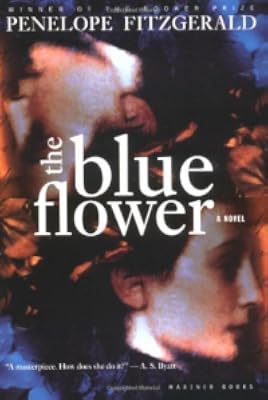
The Blue Flower
by Penelope Fitzgerald
On This Page
Description
The Blue Flower is set in the age of Goethe, in the small towns and great universities of late eighteenth-century Germany. It tells the true story of Friedrich von Hardenberg, a passionate, impetuous student of philosophy who will later gain fame as the romantic poet Novalis. Fritz seeks his father's permission to wed his "heart's heart," his "spirit's guide"--A plain, simple child named Sophie von Kuhn. It is an attachment that shocks his family and friends. Their brilliant young Fritz, show more betrothed to a twelve-year-old dullard? How can this be? The irrationality of love, the transfiguration of the commonplace, the clarity of purpose that comes with knowing one's own fate-these are the themes of this beguiling novel, themes treated with a mix of wit, grace, and mischievous humor. show lessTags
Recommendations












Member Recommendations

Member Reviews
The historical-fiction probably flew over my head but there's a couple of scenes which struck me. In a novel that's supposedly about this man's all-consuming passion and obsession for a young girl, Fitzgerald takes time to show us glimpses of people - women, in particular - whose lives are filled with a simmering dissatisfaction that's overshadowed, even neglected, by Novalis. Their disappointments seem banal when juxtaposed alongside Novalis' poetic sensibilities and intellectual pursuits, but that's precisely the point. The tragedies of everyday life are mostly unheard and unspoken of.
Having read and enjoyed Penelope Fitzgerald's The bookshop I remembered that I once owned her Blue Flower although I'd not read it. So on to the Internet and a new copy - foolishly I wanted the cover as above. Anyway it added to the pleasure. The Blue Flower tells a story from the early life of the German poet Novalis. I could tell you the plot, insubstantial as it is, but that was not where the pleasure lay. This is one of those novels where the fun is in the brilliant way that she inhabits her characters and brings them alive in a way that draws you in and makes you so familiar with them they are real (as in this case they were, but you know what I mean). It is quite a skill and when you put a book like that down it is like the end of show more a great symphony. You feel some sort of echo lingering after it. There aren't many books in that league. Anyway I'm now reading (2016) a non-fiction piece she wrote on her father Edward Knox and his three brothers. I actually became aware of this when I saw it footnoted in Iain Murray's biography of J C Ryle. show less
Fitzgerald’s best work, I can’t believe the Booker Prize shortlisted her other, lesser books and didn’t recognize this one. It is a masterpiece of restraint and timing. Some background in German Romanticism really brings out the story but I think it could be enjoyed without knowing the backdrop. There’s a reason this book is lauded by literary greats: it’s the very opposite of some banal story that spoon-feeds its audience and raises no questions. Chapter 20, The Nature of Desire, presents an incredibly tight reveal of the human heart.
The story focuses on the polymath poet Novalis (Fritz in the novel) who died young and lost his teenage betrothed when she was a mere 15 years old. This historical novel is finely researched: show more the 18th century Germanic land is wonderfully brought forth in all its contradictions. Fitzgerald is among the best writers at allowing the reader to form their own opinions and benefit from the subtext, and she finds a way to portray widely disparate truths as both being true at the same time. The reader can feel both outrage and sympathy for the main character. It is the funniest and the grimmest of her novels.
The blue flower, Blaue Blume, permeated the German Romanticist movement and continued as a symbol throughout literature since then. A transcendent longing, an unknowable desire for spiritual homecoming, love and desire: it is the perfect symbol for this magical look at how quixotic and unnerving our choices can appear to others. show less
The story focuses on the polymath poet Novalis (Fritz in the novel) who died young and lost his teenage betrothed when she was a mere 15 years old. This historical novel is finely researched: show more the 18th century Germanic land is wonderfully brought forth in all its contradictions. Fitzgerald is among the best writers at allowing the reader to form their own opinions and benefit from the subtext, and she finds a way to portray widely disparate truths as both being true at the same time. The reader can feel both outrage and sympathy for the main character. It is the funniest and the grimmest of her novels.
The blue flower, Blaue Blume, permeated the German Romanticist movement and continued as a symbol throughout literature since then. A transcendent longing, an unknowable desire for spiritual homecoming, love and desire: it is the perfect symbol for this magical look at how quixotic and unnerving our choices can appear to others. show less
This was an odd one, but I liked it. The novel is ostensibly a fictionalization of the life of Friedrich von Hardenberg, the romantic poet who wrote under the pseudonym Novalis. But it's more a tragicomedy of manners, painting a fascinating little portrait of the 18th-century German aristocratic intelligentsia—Goethe makes a cameo—with a really delightfully arch tone. You just can't beat period snark, and Fitzgerald pulls it off coupled with plenty of sympathy for her characters—many of whom are hapless, doomed, or both. What there is of plot kind of knuckles under to the very precise details of the day and the language... it reminded me a bit of Sylvia Townsend Warner's The Corner That Held Them in that regard. Anyway, a strange show more little book but a fun one. show less
36. The Blue Flower by Penelope Fitzgerald
Introduction: Candia McWilliam (2013); Preface:: Hermione Lee (2013)
OPD: 1995
format: 292-page paperback from 2013
acquired: May 1 read: Jun 1-5 time reading: 9:00, 1.9 mpp
rating: 5
genre/style: historical fiction theme: Booker
locations: Jena, Germany and surrounding area, 1790’s
about the author: 1916 –2000: A Booker Prize-winning novelist, poet, essayist and biographer from Lincoln, England. She was the daughter of Edmund Knox, later an editor of Punch, and Christina, née Hicks, daughter of Edward Hicks, Bishop of Lincoln, and one of the first women students at Oxford. She was a niece of the theologian and crime writer Ronald Knox, the cryptographer Dillwyn Knox, the Bible scholar Wilfred show more Knox, and the novelist and biographer Winifred Peck.
A novel about Novalis, a German romantic poet who died young around the year 1800. This is a book I hadn't heard of until it came in Booker posts on Facebook. One judge from every year, 1969 through 2022, was quoted. (I don't recall the source article.) Three separate judges expressed surprise/disappointment that [The Blue Flower] was overlooked in 1995. It didn't make the short list. It did win the National Critics Circle Award, an American award that first opened up to non-American novels that year. Anyway, I was curious, and it helped lead to a group read in the Booker Facebook group. And, well, it's about time I read something from Penelope Fitzgerald.
So the novel. It's quite wonderful. Historical fiction, a model for Hilary Mantel, who was an admirer for Fitzgerald. We're in the German romantic movement, with Goethe and other famous German authors, many of whom clustered in Jena, a sort of bohemian university town. This is not easy world to capture. Fitzgerald does it with the lightest touch, and, to play on the title, it blooms. (or it did for me.)
She did some things I can pick up on. She somehow conveys a massive amount of much information in a very condensed a fashion... and yet keeps her reader. You don't notice as you're reading how much accumulates so fast. And it's brief. Characters get two-word descriptions and that sticks. She also created an atmosphere. She doesn't go too far. She leaves things unexplained, and in doings so, she opens the windows to the reader’s imagination. Our minds fill in, and then keep going. In a way, each chapter, there are 55 of them, is a thought piece, an inspirational idea left for reader reflection. She also ties everything together. For what it’s worth, I think every single character introduced is revisited at some point. And, lastly, she's also charmingly humorous in many ways. Her characters are lovable.
So, we get a finger on this mind of this young inspired German poet, his odd love-life, his family, the world of Jenna, and really of 1790's Germany. We are filled with detail, and filled with ideas to pursue, and left without conclusion. Nothing goes too deep, except maybe the reader. Reader, pursue on your own.
I finished this feeling a bit muted. My next books felt wordy, and slow. In the opening scene in [The Blue Flower] it's washday, and blankets and clothes are blowing in the wind. Their owners, appropriately left as ghosts, missing. The free blowing linens left as an image we can apply in our mind to our thoughts... unlike the actual blue flower, which I never could understand.
Not every reader liked the book. But, if you like Mantel's Thomas Cromwell, I highly recommend Fitzgerald's Novalis.
2024
https://www.librarything.com/topic/360386#8558450 show less
Introduction: Candia McWilliam (2013); Preface:: Hermione Lee (2013)
OPD: 1995
format: 292-page paperback from 2013
acquired: May 1 read: Jun 1-5 time reading: 9:00, 1.9 mpp
rating: 5
genre/style: historical fiction theme: Booker
locations: Jena, Germany and surrounding area, 1790’s
about the author: 1916 –2000: A Booker Prize-winning novelist, poet, essayist and biographer from Lincoln, England. She was the daughter of Edmund Knox, later an editor of Punch, and Christina, née Hicks, daughter of Edward Hicks, Bishop of Lincoln, and one of the first women students at Oxford. She was a niece of the theologian and crime writer Ronald Knox, the cryptographer Dillwyn Knox, the Bible scholar Wilfred show more Knox, and the novelist and biographer Winifred Peck.
A novel about Novalis, a German romantic poet who died young around the year 1800. This is a book I hadn't heard of until it came in Booker posts on Facebook. One judge from every year, 1969 through 2022, was quoted. (I don't recall the source article.) Three separate judges expressed surprise/disappointment that [The Blue Flower] was overlooked in 1995. It didn't make the short list. It did win the National Critics Circle Award, an American award that first opened up to non-American novels that year. Anyway, I was curious, and it helped lead to a group read in the Booker Facebook group. And, well, it's about time I read something from Penelope Fitzgerald.
So the novel. It's quite wonderful. Historical fiction, a model for Hilary Mantel, who was an admirer for Fitzgerald. We're in the German romantic movement, with Goethe and other famous German authors, many of whom clustered in Jena, a sort of bohemian university town. This is not easy world to capture. Fitzgerald does it with the lightest touch, and, to play on the title, it blooms. (or it did for me.)
She did some things I can pick up on. She somehow conveys a massive amount of much information in a very condensed a fashion... and yet keeps her reader. You don't notice as you're reading how much accumulates so fast. And it's brief. Characters get two-word descriptions and that sticks. She also created an atmosphere. She doesn't go too far. She leaves things unexplained, and in doings so, she opens the windows to the reader’s imagination. Our minds fill in, and then keep going. In a way, each chapter, there are 55 of them, is a thought piece, an inspirational idea left for reader reflection. She also ties everything together. For what it’s worth, I think every single character introduced is revisited at some point. And, lastly, she's also charmingly humorous in many ways. Her characters are lovable.
So, we get a finger on this mind of this young inspired German poet, his odd love-life, his family, the world of Jenna, and really of 1790's Germany. We are filled with detail, and filled with ideas to pursue, and left without conclusion. Nothing goes too deep, except maybe the reader. Reader, pursue on your own.
I finished this feeling a bit muted. My next books felt wordy, and slow. In the opening scene in [The Blue Flower] it's washday, and blankets and clothes are blowing in the wind. Their owners, appropriately left as ghosts, missing. The free blowing linens left as an image we can apply in our mind to our thoughts... unlike the actual blue flower, which I never could understand.
Not every reader liked the book. But, if you like Mantel's Thomas Cromwell, I highly recommend Fitzgerald's Novalis.
2024
https://www.librarything.com/topic/360386#8558450 show less
The thing about Heinrich von Ofterdingen that probably grates most on a modern reader is the way it treats the poet's Great Love. Poor Mathilde only has about three lines in the whole book (when she blushingly agrees to teach him the guitar, marry him, etc.). The irony here is that this probably reflects very closely Novalis's own Great Tragic Love, for the unfortunate teenager Sophie von Kühn. He met her during a visit to her family when she was 12 and he in his early twenties, they became engaged on her thirteenth birthday, and she died a couple of years later, before they could marry. Penelope Fitzgerald takes this incident as the hook for her historical novel about Novalis, The Blue Flower. Significantly, we never see him as show more anything other than a charming but rather selfish young man who is training to be a mining official, whilst Sophie is just a dim and slightly puzzled little girl. Fitzgerald puts the focus on the busy social life around them: their various siblings (as usual Fitzgerald handles the eccentric child-characters brilliantly), the frustrated intelligent young women who are rather hoping that Friedrich might notice them, their parents, teachers and doctors.
The book has its irritating aspects - for instance, I didn't like the slightly clumsy Germanisms she puts in to disguise the fact that we're reading the book in English ("the Bernhard"), but on the whole it's an amusing, moderately thought-provoking palate-cleanser when you've been exposed to the worst aspects of Romanticism. And it's not quite a satire: there's a strong element of explaining where the Romantics were coming from, trying to give us a feel for what it might have been like to live in a time when science had made all questions ask able but - at least for practical everyday purposes like healthcare - hadn't yet answered very many of them. show less
The book has its irritating aspects - for instance, I didn't like the slightly clumsy Germanisms she puts in to disguise the fact that we're reading the book in English ("the Bernhard"), but on the whole it's an amusing, moderately thought-provoking palate-cleanser when you've been exposed to the worst aspects of Romanticism. And it's not quite a satire: there's a strong element of explaining where the Romantics were coming from, trying to give us a feel for what it might have been like to live in a time when science had made all questions ask able but - at least for practical everyday purposes like healthcare - hadn't yet answered very many of them. show less
If ever there is a book to persevere with, to have patience with, and to go back and re-read again, it is ‘The Blue Flower’ by Penelope Fitzgerald. When I bought it, I didn’t realize it was the last novel by the Booker prize winner; published five years before her death in 2000 aged 83. For someone about to read it, it can seem a trifle intimidating. Set in 18th century Germany, Fitzgerald tells her imagining of the teenage story of real German poet and philosopher Fritz von Hardenberg, later called Novalis. He is a young man so self-contained, so absorbed in his thoughts, that I wondered where the drama would arise. But it does, because he falls in love.
‘The Blue Flower’ is a short novel, 223 pages. The chapters are concise show more [mostly only two or three pages each] and this encouraged me to ‘just read another’ and so, gradually, almost without realizing, I fell into the story. Fitzgerald recreates this particular time in German history with a delicacy that, despite the language and sometimes confusing names, makes the people become real.
It is 1794 and Fritz, an idealistic and passionate student of philosophy and writer of poems, stays with some family friends and meets their youngest daughter, Sophie von Kühn. Love is instant for Fritz and, despite a little bemusement on the part of Sophie, and astonishment by his siblings and friends, he proves himself constant.
It is the sort of novel that, when you are reading it you ‘get’ it but afterwards, when trying to describe it to someone else, you struggle to grasp it. I still do not really understand the meaning of the blue flower. But although the deeper meaning may elude me, there are passages I love. Particularly the opening chapter when a guest arrives at the Hardenberg house in Kloster Gasse; it is washday, the annual occasion for washing personal and household linen, and his arrival effects an introduction to the household. This starts a juxtaposition which runs throughout the novel, of the ordinary everyday mundanity of life alongside Fritz’s poetic sensibilities. He calls twelve-year old Sophie his Philosophy, his guardian spirit. Knowing he must wait for her, he trains as an official in the salt mines and Fitzgerald treats us to some of the practicalities and science of this industry.
This is not a lazy read. Be prepared to invest something into it yourself. Fitzgerald does not put it all onto the page, she expects the reader to think, to research, to work it out, as she did when writing. If each book is the visible bit of an iceberg above the waterline, with the research submerged, ‘The Blue Flower’ is the snowball on top of the iceberg.
Read more of my book reviews at http://www.sandradanby.com/book-reviews-a-z/ show less
‘The Blue Flower’ is a short novel, 223 pages. The chapters are concise show more [mostly only two or three pages each] and this encouraged me to ‘just read another’ and so, gradually, almost without realizing, I fell into the story. Fitzgerald recreates this particular time in German history with a delicacy that, despite the language and sometimes confusing names, makes the people become real.
It is 1794 and Fritz, an idealistic and passionate student of philosophy and writer of poems, stays with some family friends and meets their youngest daughter, Sophie von Kühn. Love is instant for Fritz and, despite a little bemusement on the part of Sophie, and astonishment by his siblings and friends, he proves himself constant.
It is the sort of novel that, when you are reading it you ‘get’ it but afterwards, when trying to describe it to someone else, you struggle to grasp it. I still do not really understand the meaning of the blue flower. But although the deeper meaning may elude me, there are passages I love. Particularly the opening chapter when a guest arrives at the Hardenberg house in Kloster Gasse; it is washday, the annual occasion for washing personal and household linen, and his arrival effects an introduction to the household. This starts a juxtaposition which runs throughout the novel, of the ordinary everyday mundanity of life alongside Fritz’s poetic sensibilities. He calls twelve-year old Sophie his Philosophy, his guardian spirit. Knowing he must wait for her, he trains as an official in the salt mines and Fitzgerald treats us to some of the practicalities and science of this industry.
This is not a lazy read. Be prepared to invest something into it yourself. Fitzgerald does not put it all onto the page, she expects the reader to think, to research, to work it out, as she did when writing. If each book is the visible bit of an iceberg above the waterline, with the research submerged, ‘The Blue Flower’ is the snowball on top of the iceberg.
Read more of my book reviews at http://www.sandradanby.com/book-reviews-a-z/ show less
Members
- Recently Added By
Published Reviews
ThingScore 83
Was aber an anderen Romanen von Fitzgerald als Understatement, Verdichtung und subtile Psychologisierung gelobt wird, verkehrt sich hier ins Gegenteil: die Figuren scheinen trotz immer wieder behaupteter körperlicher und seelischer Schmerzen kaum leidensfähig, der Leser wird mit diffusen Anspielungen auf zentrale Themen der Romantik (Bergbau, Krankheit) allein gelassen. Woher das "gewisse show more unaussprechbare Gefühl von Unsterblichkeit" rührt, das Novalis beim Anblick der über zwei Jahre dahinsiechenden Sophie empfindet, bleibt unklar. So hinterläßt der Roman einen ebenso zwiespältigen Eindruck wie Sophies begrenzte Schreibkünste: "tausent Krüße an alles mit einanter" - charmant, aber doch eher unverständlich. show less
added by Indy133
Penelope Fitzgerald's writing is rife with odd, almost impossible contradictions: She is a minimalist who celebrates an abundance of details, a miniaturist who can unravel the mysteries of human character with five words of dialogue. In the closely observed realm of her slim, 1995 novel titled The Blue Flower, readers are plunged so suddenly, intimately and irrevocably into the physical and show more intellectual world of 18th-century Germany – which produced, among others, Goethe and Hegel – the 21st century becomes merely a faintly remembered acquaintance.....Sensual feast that it is, however, this book brings the reader back again and again to the growing, transmogrifying child – the blue flower – at its heart.... show less
added by vancouverdeb
Penelope Fitzgerald uses fiction to examine an 18th-century German poet and his doomed love for a 12-year-old ...It is hard to know where to begin to praise the book. First off, I can think of no better introduction to the Romantic era: its intellectual exaltation, its political ferment, its brilliant amateur self-scrutiny, its propensity for intense friendships and sibling relationships, its show more uncertain morals, its rumors and reputations and meetings, its innocence and its refusal of limits. Also, ''The Blue Flower'' is a wholly convincing account of that very difficult subject, genius. show less
added by vancouverdeb
Lists

The Guardian's 1000 Novels Everyone Must Read
1,005 works; 551 members

Female Author
1,234 works; 67 members

Lives of the Poets (and Philosophers)
110 works; 5 members

50 Books by Women Authors
50 works; 10 members

TML 200 Best Books 1950-1999
202 works; 10 members

A Novel Cure
742 works; 23 members

Authors from England
147 works; 4 members

A Good Read (Radio 4)
287 works; 1 member

Books Read in 2016
4,666 works; 199 members

Read This Next
120 works; 3 members

A Rainbow of Books: Colors in the Title
570 works; 24 members

Books Read in 2019
4,052 works; 110 members

Totally Biased List of Tookie’s Favorite Books: Short Perfect Novels
13 works; 1 member

The Modern Library (The Two Hundred Best Novels....
202 works; 1 member
Author Information

24+ Works 12,102 Members
In 1997 Penelope Fitzgerald's novel The Blue Flower was named one of the New York Times Book Review's eleven Best Books of the Year. Winner of the 1979 Booker Prize for Offshore, Fitzgerald was also short-listed for the Booker for The Bookshop. The Beginning of Spring, and The Gate of Angels. Penelope Fitzgerald lives in England. (Bowker Author show more Biography) Penelope Fitzgerald, one of England's most-celebrated contemporary writers, is the author of "The Blue Flower," which won the National Book Critics Circle Award. Winner of the 1979 Booker Prize for "Offshore," she was also shortlisted for the Booker for "The Bookshop," "The Beginning of Spring," & "The Gate of Angels." She lives in London. (Bowker Author Biography) Admired by many as one of the leading English novelists of her day, Penelope Fitzgerald (1916-2000) wrote some twelve books of fiction and nonfiction over the course of her writing career; which began at the age of sixty. She won the National Book Critics Circle Award for "The Blue Flower" and the Booker Prize for "Offshore". She died on April 28, 2000, at the age of eighty-three. (Bowker Author Biography) show less
Some Editions
Awards and Honors
Awards
Distinctions
Notable Lists
Series
Belongs to Publisher Series
Work Relationships
Common Knowledge
- Canonical title
- The Blue Flower
- Original title
- The Blue Flower
- Original publication date
- 1995
- People/Characters
- Novalis; Johann Wolfgang von Goethe; Sophie von Kuhn; Fritz von Hardenberg; Karoline Just; Bernhard von Hardenberg (show all 9); Erasmus von Hardenberg; Rahel Just; Leutnant Wilhelm Mandelsloh
- Important places
- Leipzig, Saxony, Germany; Jena, Thuringia, Germany; Grüningen, Zurich, Switzerland
- Epigraph
- 'Novels arise out of the shortcomings of history.'
F. von Hardenberg, later Novalis, Fragments und Studien, 1799 - 1800 - First words
- Jacob Dietmahler was not such a fool that he could not see that they had arrived at his friend's house on the washday.
- Last words
- (Click to show. Warning: May contain spoilers.)'Best of brothers - '
- Blurbers
- Wilson, A.N.; Lessing, Doris; Byatt, A. S.; Brookner, Anita; Glendinning, Victoria; Kermode, Frank (show all 18); Dibdin, Michael; Annan, Gabriele; Hughes-Hallett, Lucy; Hensher, Philip; Annan, Noel; Thwaite, Anthony; Ratcliffe, Michael; Leland, Mary; Smith, Ali; Johnson, Daniel; McLaurin, David; Mannes-Abbott, Guy
- Original language
- English
Classifications
Statistics
- Members
- 2,158
- Popularity
- 9,451
- Reviews
- 62
- Rating
- (3.58)
- Languages
- 8 — Dutch, English, Estonian, French, German, Italian, Spanish, Portuguese (Portugal)
- Media
- Paper, Audiobook, Ebook
- ISBNs
- 39
- UPCs
- 2
- ASINs
- 16