On This Page
Description
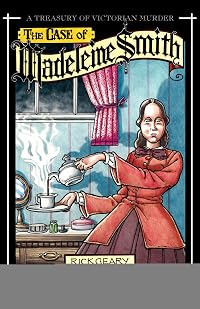
A scandalous secret affair in 19th Scotland between an upper class woman and a gentleman of lower standing ends in his murder by poison...Tags
Recommendations


















Member Reviews
The Case of Madeleine Smith is a case I'd already read about in two of the books from Mr. Geary's bibliography: Crimes of Passion and Victorian Murderesses. As I recall, those books concentrated mainly on the romance, the poisoning, and the trial. This book is divided into several parts: Death by Poison, Madeleine and Emile, A Forbidden Romance, An Attachment Severed, The Trial of Madeleine Smith, and The Rest of Her Life.
The first five parts are a very good introduction to the case, but it was the last part that really fascinated me. I hadn't known she'd reverted to her childhood nickname of 'Lena'. She and her brother Jack moved to London, where she married her art teacher (yes, he knew who she was), and became a leading hostess in show more London's artistic and intellectual circles. She was also a Socialist. Some of their friends knew who she had been (loved George Bernard Shaw's comment).
Madeleine had two children by her first husband and they both grew up to be radicals. Her first husband died in 1910. The widow moved to her son's place in New York city during World War I. Her second husband was more than 10 years younger than she was. (I also loved the way she treated some movie guys who tried to blackmail her into getting involved in a film they were making of her life.)
She actually lived through most of the Roaring Twenties, which I did not expect. I'm glad I added this book to my collection. show less
The first five parts are a very good introduction to the case, but it was the last part that really fascinated me. I hadn't known she'd reverted to her childhood nickname of 'Lena'. She and her brother Jack moved to London, where she married her art teacher (yes, he knew who she was), and became a leading hostess in show more London's artistic and intellectual circles. She was also a Socialist. Some of their friends knew who she had been (loved George Bernard Shaw's comment).
Madeleine had two children by her first husband and they both grew up to be radicals. Her first husband died in 1910. The widow moved to her son's place in New York city during World War I. Her second husband was more than 10 years younger than she was. (I also loved the way she treated some movie guys who tried to blackmail her into getting involved in a film they were making of her life.)
She actually lived through most of the Roaring Twenties, which I did not expect. I'm glad I added this book to my collection. show less
I'm a big fan of Rick Geary's "Treasury of Victorian Murder" series, and this latest volume concerning Madeleine Smith is one of the stronger titles yet.
It goes without saying that Geary is a visual stylist of the first order, and his instantly-recognizable pen work features the sort of confident attack that only the top artists in the field (Chris Ware, Jim Woodring, Jaime Hernandez, etc) routinely display. Geary's greatest strengths as a graphic artist are all brought to the fore in The Case of Madeleine Smith, and the grace and fluidity of his line is a genuine visual treat.
But in the end, what makes this volume so rewarding is Geary's ability to navigate the turbulent waters of Victorian morality and manners in the service of a show more good old-fashioned murder story, made all the more fascinating by the intricate dance of social custom and expectation that makes a murder so tawdry and inconvenient. At heart, this is a story of social disgrace and the strange nuances that only the Victorians could bring to that scenario. Geary manages to capture all the odd complexities of his shameful situation, and the rewards for the reader are many. show less
It goes without saying that Geary is a visual stylist of the first order, and his instantly-recognizable pen work features the sort of confident attack that only the top artists in the field (Chris Ware, Jim Woodring, Jaime Hernandez, etc) routinely display. Geary's greatest strengths as a graphic artist are all brought to the fore in The Case of Madeleine Smith, and the grace and fluidity of his line is a genuine visual treat.
But in the end, what makes this volume so rewarding is Geary's ability to navigate the turbulent waters of Victorian morality and manners in the service of a show more good old-fashioned murder story, made all the more fascinating by the intricate dance of social custom and expectation that makes a murder so tawdry and inconvenient. At heart, this is a story of social disgrace and the strange nuances that only the Victorians could bring to that scenario. Geary manages to capture all the odd complexities of his shameful situation, and the rewards for the reader are many. show less
Madeleine Smith became notorious in 1850s Scotland when she stood trial for murdering her lover, Emile L’Anglier. The two had been corresponding and meeting in secret for nearly two years at the time of L’Anglier’s death. However, there were signs that Smith was tiring of the affair and planned to marry another man. Geary’s graphic novel succinctly presents the facts of the case, the details of the affair leading up to L’Anglier’s death, the trial and verdict, and Smith’s life after the trial. The illustrations and the text work well together. Some of the lurid details are mentioned in the text, but the drawings are tasteful.
This is a graphic novel about an historic crime. Geary has written a series of them. Reading about crime in this genre is a great way to find out about crimes that happened and the consequences or lack there of that resulted. The books are a quick read and don't get bogged down by descriptions of the people or places (they are there in the pictures).
The graphic novel format lends itself very well to depicting the dress and customs of the people as well as the circumstances of the crime. There are even maps provided so that the reader can picture where the various important locales are in relation to each other. Instead of reading a written account of the murder, the reader is presented with words and pictures and it is the pictures as show more much as the words that show the story as it unfolds. show less
The graphic novel format lends itself very well to depicting the dress and customs of the people as well as the circumstances of the crime. There are even maps provided so that the reader can picture where the various important locales are in relation to each other. Instead of reading a written account of the murder, the reader is presented with words and pictures and it is the pictures as show more much as the words that show the story as it unfolds. show less
Rick Geary, it seems, has put together quite a number of these True Crime/ Unsolved Murder books. The stories, fascinating already, are very much helped by the static/ graven images which make up the art. Obviously researched in detail, this is another example of a quality book by NBM Publishing. I will indeed be ordering more from them!
Madeleine Smith is secretly dating a man of lesser means and doesn't want to disappoint her family by continuing the relationship.
I find this series, A Treasury of Victorian Murder, to be fascinating. Geary has a way of succinctly describing the events and depicting them with his drawings that keep me engrossed. With my natural curiosity towards true crime books, these are a fantastic way to learn about and see the time period. (4.25/5)
Originally posted on: Thoughts of Joy
I find this series, A Treasury of Victorian Murder, to be fascinating. Geary has a way of succinctly describing the events and depicting them with his drawings that keep me engrossed. With my natural curiosity towards true crime books, these are a fantastic way to learn about and see the time period. (4.25/5)
Originally posted on: Thoughts of Joy
A very interesting murder case. I really do wonder whether she committed it or not.
Members
- Recently Added By
Author Information

87+ Works 3,014 Members
Awards and Honors
Notable Lists
Series

Work Relationships
Is contained in
Common Knowledge
- Canonical title
- The Case of Madeleine Smith
- Original publication date
- 2006
- People/Characters
- Madeleine "Lena" Smith (gentlewoman, middle name Hamilton, eldest child); Emile L'Anglier (clerk, son of a successful seed merchant & nurseryman); James Smith (architect, father of Madeline & 4 others); Elizabeth Hamilton Smith (James' wife, mother of his children); Elizabeth 'Bessie' Smith (Madeleine's younger sister); John 'Jack Smith (Madeleine's younger brother) (show all 35); Janet Smith (Madeleine's younger sister); James Smith, Jr. (Madeleine's younger brother, the youngest child); Mrs. Alice Gorton (owner, Gorton's Academy for Young Ladies, Madeleine's finishing school); MIss Mary Perry (older lady, Emile's confidante); Robert Baird (introduced Madeleine and Emile at his request); Christina Haggart (Smith housemaid who carried the letters between Madeleine and Emile); Mrs. Ann Jenkins (Emile's landlady); William 'Billy' Minnoch (well-to-do merchant | courting Madeleine); William Murray (the Smiths' young page); Amadee Thau (Emile's friend and fellow lodger); Dr. Thomson (summoned to attend Emile 22 Feb 1857); Miss Mary Jane Buchanan (Madeleine's friend since Gorton's Academy); Mrs. Towers (Miss Perry's sister); Mr. Towers (Miss Perry's brother-in-law); Dr. James Steven of Stafford Place (called to attend Emile 23 Mar 1857); William Stevenson (Emilie's supervisor at Huggins Seed Warehouse); James Hart (procurator fiscal); Auguste de Mean (French Consulate, Emile's friend); Dr. Frederick Penny (Prof. of Chemistry, Andersonian Univ., discovered arsenic in Emilie's stomach); Lord Ivory (one of the three-judge panel at Madeleine's trial); Lord Hope (Lord Justice Clerk, one of the three-judge panel at Madeleine's trial); Lord Handyside (one of the three judge panel at Madeleine's trial); Lord Advocate James Moncrieff (presenting the case for the crown); John Inglis (Dean of Faculty, Madeleine's defense); George Wardle (William Morris' draftsman & business manager, Madeleine/Lena's art teacher & 1st husband); George Bernard Shaw (fellow Socialist League member, says he took coffee from Lena Wardle w/no ill effect); Thomas 'Tom' Wardle (Madeleine's son by George, well-known radical); Mary 'Kitten' Wardle (Madeleine's eldest by George, free love advocate who smoked in public); William A. Sheehy (widowed Madeleine 'Lena' Wardle's 2nd husband)
- Important places
- Glasgow, Scotland, UK; Smith residence on India Street until 1857, Glasgow, Scotland, UK; Gorton's Academy for Young Ladies, London, England, UK; Isle of Jersey, England, UK; Miss Mary Perry's house on Renfrew Street, Glasgow, Scotland, UK; Rowelyn, near Row, 20 miles up the River Clyde from Glasgow, Scotland, UK (Smith summer residence) (show all 21); Rooming House, 11 Franklin Place, Glasgow, Scotland, UK; large residence, Blytheswood Square, Glasgow (the Smiths & Minnoch on different floors); Murdoch Bros. Apothecary, Sauchiehall Street, Glasgow, Scotland, UK; Currie's Apothecary, Sauchiehall Street, Glasgow, Scotland, UK; Bridge of Allan, spa town, Scotland, UK; Edinburgh, Scotland, UK; High Court of the Justiciary, Edinburgh, Scotland, UK; Jack and Madeleine Smith's flat on Sloane Street, London, England, UK; the Wardle home in the parish of Bloomsbury. West End of London, England, UK; Thomas Wardle's house, Staffordshire, England, UK (lent to sister-in-law Lena); New York, New York, USA; the Sheehy house on Eighth Avenue, New York, New York, USA; Madelein 'Lena' Smith Wardle Sheehy's last residence, 4298 Park Avenue, New York, New York, USA; Emile L'Angeier's grave, Ramshorn Churchyard, Glasgow, Scotland, UK; Lena Sheehy's grave, Mount Hope Cemetery, Hastings-on-Hudson, New York, USA
- First words
- [All capital letters in the original] Monday 23 March 1857 At 2:30 am, Mrs. Ann Jenkins is awakened by a furious pounding at the front door of her lodging house.
- Quotations
- [As Lena Wardle, Madeleine creates a controversy -- quotation is in all capital letters in the original]
She is credited with doing away with the table-cloth at her dinners, and using place mats on the bare wood. Since ... (show all)the fashion (and the morality) of the day demands that the legs even of furniture be concealed, this causes no end of scandal and excitement. - Last words
- (Click to show. Warning: May contain spoilers.)[All capital letters in the original] Lena Sheehy rests beneath a simple marker at Mount Hope Cemetery, Hastings-on-Hudson, New York.
Classifications
- Genres
- Graphic Novels & Comics, Teen
- DDC/MDS
- 364.15230941443 — Society, government, & culture Social problems and social services Crime Criminal offenses Offenses against the person Homicide Murder History, geographic treatment, biography Europe British Isles
- LCC
- HV6555 .G72 .S36 — Social sciences Social pathology. Social and public welfare. Criminology Social pathology. Social and public welfare. Criminology Crimes and offenses
- BISAC
Statistics
- Members
- 119
- Popularity
- 273,690
- Reviews
- 11
- Rating
- (3.81)
- Languages
- English
- Media
- Paper
- ISBNs
- 2