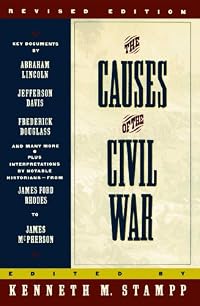
The Causes of the Civil War
by Kenneth Stampp
On This Page
Description
Presents debate on the issues and events leading up to the American Civil War.Tags
Recommendations





















Member Reviews
This book has been hanging around my library for a long time. It is a book of readings that I am sure was used for a lot of college classes. The readings are grouped under seven topics listed as possible causes of the war. After reading through the book my conclusion is that slavery and the maintaining of white supremacy were really the causes of the war. Slavery was the economic engine that made the South run after the invention of the cotton gin and also a social system justified by the belief in white supremacy. I think white supremacy was necessary to racial chattel slavery as a way to justify treating other human beings the way slaves were treated. It also gave the non-slaveholder a reason to support the system. No matter how poor show more and ignorant you were if you were white you were better than the African-American slaves. That gave the majority of the Southerners who didn't own slaves a very good reason to fight in the Civil War.
The articles vary from one-half of a page to five pages going from primary sources up to the time the book was written in 1959. They provide a very interesting look at the way attitudes to the Civil War changed over time. For example in an article from 1860 Alexander Stephens, the Vice-President of the Confederacy, makes it clear that slavery was the cause of the war. In an article he wrote in 1868 he has joined the supporters of the "Lost Cause" theory and says that the war was all about state-rights. One author writing in 1923 analyzed the effects of the subtropical climate on Anglo-Saxons and came up with the idea of "Tropic Nordics". They came from the Deep South and developed a towering race pride and an inclination to ride over racial groups considered to be inferior. All of the inmates are not in the asylum.
The articles I found most interesting focused on the cultural differences between the North and South. They reminded me of [The Mind of the Master Class] a fascinating book on Southern intellectual history I read some years ago. All of the articles point to the fact that there were real differences between the North and South and the Civil War was in some ways an inevitable conflict. The book sets out a wide variety of points of view and lends some credence to the idea that the Civil War isn't really over yet. I enjoyed reading it and would recommend it to anyone who has an interest in American history. show less
The articles vary from one-half of a page to five pages going from primary sources up to the time the book was written in 1959. They provide a very interesting look at the way attitudes to the Civil War changed over time. For example in an article from 1860 Alexander Stephens, the Vice-President of the Confederacy, makes it clear that slavery was the cause of the war. In an article he wrote in 1868 he has joined the supporters of the "Lost Cause" theory and says that the war was all about state-rights. One author writing in 1923 analyzed the effects of the subtropical climate on Anglo-Saxons and came up with the idea of "Tropic Nordics". They came from the Deep South and developed a towering race pride and an inclination to ride over racial groups considered to be inferior. All of the inmates are not in the asylum.
The articles I found most interesting focused on the cultural differences between the North and South. They reminded me of [The Mind of the Master Class] a fascinating book on Southern intellectual history I read some years ago. All of the articles point to the fact that there were real differences between the North and South and the Civil War was in some ways an inevitable conflict. The book sets out a wide variety of points of view and lends some credence to the idea that the Civil War isn't really over yet. I enjoyed reading it and would recommend it to anyone who has an interest in American history. show less
Ratings
Members
- Recently Added By
Author Information

14+ Works 2,118 Members
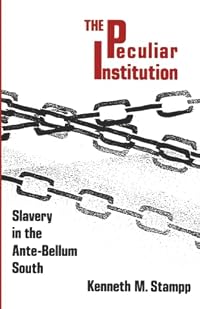
A native of Milwaukee, Kenneth Stampp received his Ph.D. from the University of Wisconsin in 1941 and then taught at the University of Arkansas and the University of Maryland. In 1945 he joined the faculty at the University of California at Berkeley, where he is currently Morrison Professor Emeritus of American History. Stampp has served as show more Harmsworth Professor at Oxford, Commonwealth Lecturer at the University of London, Fulbright Professor at the University of Munich, and visiting professor at Harvard University and Colgate University and Williams College. A past president of the Organization of American Historians, in 1993 he received the Lincoln Prize from the Lincoln and Soldiers Institute of Gettysburg College. Stampp touched off a revolution in the study of slavery with the publication of The Peculiar Institution (1956), which vigorously refutes the long-prevailing Dunning-Phillips interpretation and demolishes a host of myths about the master-slave relationship. His further works on the sectional conflict and its causes established him as a leading authority on that subject as well. (Bowker Author Biography) show less
Common Knowledge
- Canonical title
- The Causes of the Civil War
- Original publication date
- 1959
- Important places
- USA
- Important events
- American Civil War (1861 | 1865)
- Original language
- English
Classifications
- Genres
- History, Nonfiction, General Nonfiction
- DDC/MDS
- 973.711 — History & geography History of North America United States Civil War Era (1857-1865) James Buchanan (1857-1861) Causes
- LCC
- E458 .S8 — History of the United States United States Civil War period, 1861-1865 Lincoln's administrations, 1861-April 15, 1865
- BISAC
Statistics
- Members
- 369
- Popularity
- 84,439
- Reviews
- 1
- Rating
- (3.86)
- Languages
- English
- Media
- Paper
- ISBNs
- 6
- ASINs
- 17