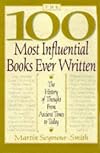
The 100 Most Influential Books Ever Written
by Martin Seymour-Smith
On This Page
Description
"What are the one hundred most influential books ever written? Those works that have radically altered the course of civilization, whether they have embodied the religions practiced by millions (the Bible, the Koran), achieved the pinnacle of artistic expression (The Iliad and The Odyssey, Shakespeare's First Folio), pointed the way to scientific discovery of enormous consequence (Darwin's On the Origin of Species by Means of Natural Selection, Einstein's Relativity), changed the perception show more of mankind about his very nature (Freud' s Interpretation of Dreams, Skinner's Beyond Freedom and Dignity), or forever altered the global political landscape (Plato's Republic, Machiavelli's Prince)." "For each of the one hundred entries (listed in chronological order) he provides historical background and an overview of the text, little-known facts about the author and the creation of the work, a lively discussion of the factors that warrant the book's inclusion among the one hundred most influential books, and detailed analysis of the effects of the work on our lives today."--BOOK JACKET.Title Summary field provided by Blackwell North America, Inc. All Rights Reserved show lessTags
Recommendations













Member Reviews
Stimulating, but questionable scholarship. I always grow suspicious of an author when their treatment of the Scriptures is filled with factual errors. Why should I trust their judgment of Plutarch, when they get the fundamental facts of Scripture wrong? We are all free to have an opinion, but skewing the text is another issue. I cannot say I dislike chocolate when what I am tasting is actually cheese. Seymour-Smith is a literary butter-fly.
However, I did enjoy his lancing of that boil known as Richard Dawkins. it is interesting to see one atheist go after another. There is clearly some history there, as S-S speaks of him a number of times in a very personal way.
However, I did enjoy his lancing of that boil known as Richard Dawkins. it is interesting to see one atheist go after another. There is clearly some history there, as S-S speaks of him a number of times in a very personal way.
"What has been called religion has always been an uneasy mixture of reverence for God and politics."
(p 11)
This author also believes that Jesus was a gnostic. (p. 12) "Gnosticism is a collection of religious ideas and systems which originated in the late 1st century CE among Jewish and early Christian sects." (Wikipedia) Wow, how strange can you get.
The author comes across as very educated in literature with his densely packed references to works unfamiliar to most of us. However, since he does not believe in the divinity of Jesus Christ, it was enough that I read hardly any of his text. Even before that there was something keeping me from reading in it very much.
(p 11)
This author also believes that Jesus was a gnostic. (p. 12) "Gnosticism is a collection of religious ideas and systems which originated in the late 1st century CE among Jewish and early Christian sects." (Wikipedia) Wow, how strange can you get.
The author comes across as very educated in literature with his densely packed references to works unfamiliar to most of us. However, since he does not believe in the divinity of Jesus Christ, it was enough that I read hardly any of his text. Even before that there was something keeping me from reading in it very much.
Dentre os 100 livros, tracei ou arrisquei-me digamos numa terça parte. Assim os classificaria, em termos de gosto pessoal:
(1) as peças de Shakespeare
(2) O Processo de Kafka
(3) Cibernética, de Wiener
(4) O Novo Testamento
(5) O Velho Testamento
(6) alguns cantos da Commedia de Dante
(7) 1984, de Orwell
(8) Candide, de Voltaire
(9) Rabelais
(10) Schopenhauer
(11) Hume
(12) Berkeley
(14) Pascal
(15) uma versão compactada do Quixote
(16) Descartes
(17) I Ching
Não gostei de - possivelmente por não entender - Wittgenstein, Erasmo, Aristoteles, Kant, Hegel, Kirkegaard, Nietzsche, Spinoza. Não gostei nada do Ser e o Nada de Sartre - m uito embora haja lido outras dúzias de livros de Sartre e me considere um sartriano - Mao Dzedong e Maquiavel. Não show more fui adiante em Guerra e Paz, Eneida, Epopeia Homerica, Montaigne. Detestei o Corão e Beauvoir. show less
(1) as peças de Shakespeare
(2) O Processo de Kafka
(3) Cibernética, de Wiener
(4) O Novo Testamento
(5) O Velho Testamento
(6) alguns cantos da Commedia de Dante
(7) 1984, de Orwell
(8) Candide, de Voltaire
(9) Rabelais
(10) Schopenhauer
(11) Hume
(12) Berkeley
(14) Pascal
(15) uma versão compactada do Quixote
(16) Descartes
(17) I Ching
Não gostei de - possivelmente por não entender - Wittgenstein, Erasmo, Aristoteles, Kant, Hegel, Kirkegaard, Nietzsche, Spinoza. Não gostei nada do Ser e o Nada de Sartre - m uito embora haja lido outras dúzias de livros de Sartre e me considere um sartriano - Mao Dzedong e Maquiavel. Não show more fui adiante em Guerra e Paz, Eneida, Epopeia Homerica, Montaigne. Detestei o Corão e Beauvoir. show less
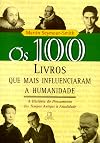
Em "Os 100 Livros Mais Influentes da História: A História do Pensamento dos Tempos Antigos à Atualidade", o inglês Martin Seymour-Smith, pesquisador de história e cultura em geral, com ênfase em literatura, compilou o que ele considera como os 100 livros mais importantes da História, a partir de uma extensa pesquisa sobre os mais significativos escritores, filósofos e cientistas.
A obra apresenta, de forma concisa, não apenas os livros e os autores considerados relevantes, mas também elabora um consistente painel com relação aos períodos históricos das publicações.
Destacam-se, entre os títulos mais conhecidos, a publicação milenar "I Ching"; o Velho e o Novo Testamentos; o Corão; "A Ilíada" e "A Odisseia", de Homero; show more "A Divina Comédia", de Dante; "O Príncipe", de Maquiavel; "Dom Quixote", de Miguel de Cervantes ; "Guerra e Paz", de León Tolstói; "Relatividade", de Einstein; e muito outros. show less
A obra apresenta, de forma concisa, não apenas os livros e os autores considerados relevantes, mas também elabora um consistente painel com relação aos períodos históricos das publicações.
Destacam-se, entre os títulos mais conhecidos, a publicação milenar "I Ching"; o Velho e o Novo Testamentos; o Corão; "A Ilíada" e "A Odisseia", de Homero; show more "A Divina Comédia", de Dante; "O Príncipe", de Maquiavel; "Dom Quixote", de Miguel de Cervantes ; "Guerra e Paz", de León Tolstói; "Relatividade", de Einstein; e muito outros. show less
Jan 21, 2013Portuguese (Brazil)
Ratings
Members
- Recently Added By
Author Information

42+ Works 1,125 Members
Common Knowledge
- Canonical title
- The 100 Most Influential Books Ever Written
- Original publication date
- 1998
- First words
- This book does not provide a list of the one hundred most famous, or the most exciting, or even the "best," books. (Introduction)
The I Ching (pronounced "Yee Jing," and usually translated as Book of Changes) is almost as old, or even as old, as China itself. - Last words
- (Click to show. Warning: May contain spoilers.)His career above all exemplifies the fact that—because willfully selective—partial solutions to problems are worse than no solution at all.
Classifications
- Genres
- Nonfiction, Literature Studies and Criticism, History, Philosophy, Religion & Spirituality
- DDC/MDS
- 028.9 — Computer science, information & general works Library & information sciences Reading and use of other information media Character of reading in libraries
- LCC
- Z1003 .S495 — Bibliography, Library Science and Information Resources General bibliography Biography of bibliographers
- BISAC
Statistics
- Members
- 376
- Popularity
- 83,712
- Reviews
- 4
- Rating
- (2.86)
- Languages
- Czech, English, Polish, Portuguese
- Media
- Paper
- ISBNs
- 7