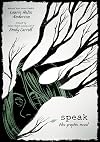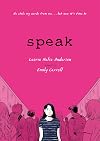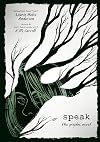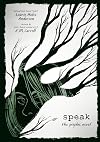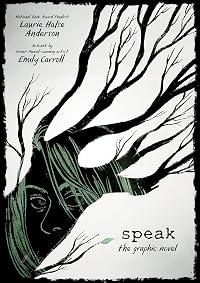
Speak: The Graphic Novel
by Laurie Halse Anderson  , Emily Carroll (Illustrator)
On This Page
Description
"Speak up for yourself--we want to know what you have to say." From the first moment of her freshman year at Merryweather High, Melinda knows this is a big fat lie, part of the nonsense of high school. She is friendless--an outcast--because she busted an end-of-summer party by calling the cops, so now nobody will talk to her, let alone listen to her.Tags
Recommendations



Member Recommendations
Member Reviews
Anderson’s timeless and important tale of high-school sexual assault and its aftermath undergoes a masterful graphic novel transformation.
Melinda, a nascent freshman, is raped at a party shortly before the beginning of school. In an attempt to report the crime, Melinda calls 911, and the party is shut down. When the semester begins, Melinda has become a pariah who spends her days silent. In addition to internalizing the emotional aspects of the assault, Melinda is relentlessly bullied by her peers and often runs into her attacker—a popular senior—who delights in terrorizing her. Although Anderson’s novel came out nearly 20 years ago, this raw adaptation feels current, even with contemporary teenage technological minutiae show more conspicuously absent. Melinda relies upon art to work as a vulnerary; this visual adaptation takes readers outside Melinda’s head and sits them alongside her, seeing what she sees and feeling the importance and power of her desire to create art and express herself. Carroll’s stark black-and-white illustrations are exquisitely rendered, capturing the mood through a perfectly calibrated lens. With the rise of women finding their voices and speaking out about sexual assault in the media, this reworking of the enduring 1999 classic should be on everyone’s radar.
Powerful, necessary, and essential. (Graphic novel. 13-adult)
-Kirkus Review show less
Melinda, a nascent freshman, is raped at a party shortly before the beginning of school. In an attempt to report the crime, Melinda calls 911, and the party is shut down. When the semester begins, Melinda has become a pariah who spends her days silent. In addition to internalizing the emotional aspects of the assault, Melinda is relentlessly bullied by her peers and often runs into her attacker—a popular senior—who delights in terrorizing her. Although Anderson’s novel came out nearly 20 years ago, this raw adaptation feels current, even with contemporary teenage technological minutiae show more conspicuously absent. Melinda relies upon art to work as a vulnerary; this visual adaptation takes readers outside Melinda’s head and sits them alongside her, seeing what she sees and feeling the importance and power of her desire to create art and express herself. Carroll’s stark black-and-white illustrations are exquisitely rendered, capturing the mood through a perfectly calibrated lens. With the rise of women finding their voices and speaking out about sexual assault in the media, this reworking of the enduring 1999 classic should be on everyone’s radar.
Powerful, necessary, and essential. (Graphic novel. 13-adult)
-Kirkus Review show less
Trigger warning: Rape
I don’t know what to say. I loved “Speak” when I read it back in 2015. I felt for Melinda and wanted to hug her throughout the story and loved how Anderson takes a long road to showing us what happened to Melinda and how her life became unraveled before her freshman year of high school. The graphic novel does a great job with showing us Melinda in the present day and her memories of her friends and of a party that changed everything via the illustrations by Emily Carroll. The illustrations add so much to this story and I am glad that I read “Speak” first and then this graphic novel next. I already knew the story that Anderson was going to tell. Seeing it via another medium made it even more show more powerful.
“Speak: The Graphic Novel” follows the main character, Melinda. Melinda is starting her freshman year in high school and the novel quickly shows how alone she feels. She is unable to speak and as we follow her through four quarters at Merryweather High School we find out what led Melinda to lose her voice and how in the end she gets it back.
Melinda has so much pain in her and I am blown away again by the fact that her parents were this clueless. The only person that seems to be aware of Melinda is her art teacher, Mr. Freeman and a classmate of her David Petrakis. The character of Heather was self-absorbed and I cracked up at the scene we had in the novel (with Melinda telling Heather no) was done again in this with Heather’s face not processing being told no.
The writing was so good. I think that doing this novel with illustrations was actually brilliant. Considering that Melinda finds her voice again via her art and art class in school I thought it was great to see.
The graphics just made me want to go and buy this book in hardcover though.
The graphic novel shows us Melinda’s room, her secret hiding place at school, and her art classes. Everything feels tight and slightly claustrophobic.
The ending really resonates and I can’t believe this book is already 20 years old. The themes in this book made it in my mind a true classic that I can see people reading for years. show less
I don’t know what to say. I loved “Speak” when I read it back in 2015. I felt for Melinda and wanted to hug her throughout the story and loved how Anderson takes a long road to showing us what happened to Melinda and how her life became unraveled before her freshman year of high school. The graphic novel does a great job with showing us Melinda in the present day and her memories of her friends and of a party that changed everything via the illustrations by Emily Carroll. The illustrations add so much to this story and I am glad that I read “Speak” first and then this graphic novel next. I already knew the story that Anderson was going to tell. Seeing it via another medium made it even more show more powerful.
“Speak: The Graphic Novel” follows the main character, Melinda. Melinda is starting her freshman year in high school and the novel quickly shows how alone she feels. She is unable to speak and as we follow her through four quarters at Merryweather High School we find out what led Melinda to lose her voice and how in the end she gets it back.
Melinda has so much pain in her and I am blown away again by the fact that her parents were this clueless. The only person that seems to be aware of Melinda is her art teacher, Mr. Freeman and a classmate of her David Petrakis. The character of Heather was self-absorbed and I cracked up at the scene we had in the novel (with Melinda telling Heather no) was done again in this with Heather’s face not processing being told no.
The writing was so good. I think that doing this novel with illustrations was actually brilliant. Considering that Melinda finds her voice again via her art and art class in school I thought it was great to see.
The graphics just made me want to go and buy this book in hardcover though.
The graphic novel shows us Melinda’s room, her secret hiding place at school, and her art classes. Everything feels tight and slightly claustrophobic.
The ending really resonates and I can’t believe this book is already 20 years old. The themes in this book made it in my mind a true classic that I can see people reading for years. show less
It's easier to get out of the building without any hassles if I stay after and take the late bus home.
Evidently Speak has a significant cultural profile from the popular reception of the original novel and the film adaptation. Each was unfamiliar to me, I came to this graphic novel version by way of an interest in illustrator Emily Carroll.
Not having read Anderson's original memoir, it's unclear how much was altered, left out, or new material added. The illustrations work effectively even with Carroll's recognisable style and expression. It never felt to me like Carroll's story, and Anderson's Author's Note clarified the project is intended as adaptation. I likely won't read the novel nor seek out the film: this version worked well for show more me.
Appropriately, the story doesn't deliver dramatic catharsis. It ends on triumph, of a sort, but not concentrated, not climactic, certainly not gleeful. While the support of others is crucial to Melinda's eventual growth, there isn't a heroic intervention -- and even Melinda's own efforts to help Rachel require they be joined with her friend's own efforts, a recapitulation in miniature of the larger story. The end leaves me wanting more, also appropriate for a story that said so much about how Melinda's story had been interrupted, stunted, stopped: and now, has a chance once again to become something else. show less
Evidently Speak has a significant cultural profile from the popular reception of the original novel and the film adaptation. Each was unfamiliar to me, I came to this graphic novel version by way of an interest in illustrator Emily Carroll.
Not having read Anderson's original memoir, it's unclear how much was altered, left out, or new material added. The illustrations work effectively even with Carroll's recognisable style and expression. It never felt to me like Carroll's story, and Anderson's Author's Note clarified the project is intended as adaptation. I likely won't read the novel nor seek out the film: this version worked well for show more me.
Appropriately, the story doesn't deliver dramatic catharsis. It ends on triumph, of a sort, but not concentrated, not climactic, certainly not gleeful. While the support of others is crucial to Melinda's eventual growth, there isn't a heroic intervention -- and even Melinda's own efforts to help Rachel require they be joined with her friend's own efforts, a recapitulation in miniature of the larger story. The end leaves me wanting more, also appropriate for a story that said so much about how Melinda's story had been interrupted, stunted, stopped: and now, has a chance once again to become something else. show less
After last summer's disastrous party, Melinda starts off high school with no friends and a deep depression. But what exactly happened at that party is something Melinda won't talk about to anyone -- even herself.
This graphic novel is based on the YA book of the same name that was published 20 years ago. There are a few updates in the text to acknowledge changes in technology or pop culture, but this is more or less the same tale. As with the original novel, Melinda's account of her sexual assault and its aftermath are moving and, unfortunately, a story that many teens *need* to hear. Melinda's voice is also fantastic -- she is snarky and sharp when observing social customs that she finds ridiculous, but she can also be inspired by show more others and feel a range of emotions.
At first, the graphic format didn't do a lot for me, especially in the early pages when Melinda's story seems to be one of simply fitting in at school. But as we delve further into her story, the artwork really takes off. There is of course the work from Melinda's art class, but Carroll's illustrations also get at Melinda's myriad of feelings that run the gamut of anger, shame, guilt, loneliness, etc.
All in all, this is a title I would highly recommend for teens -- and adults, too. show less
This graphic novel is based on the YA book of the same name that was published 20 years ago. There are a few updates in the text to acknowledge changes in technology or pop culture, but this is more or less the same tale. As with the original novel, Melinda's account of her sexual assault and its aftermath are moving and, unfortunately, a story that many teens *need* to hear. Melinda's voice is also fantastic -- she is snarky and sharp when observing social customs that she finds ridiculous, but she can also be inspired by show more others and feel a range of emotions.
At first, the graphic format didn't do a lot for me, especially in the early pages when Melinda's story seems to be one of simply fitting in at school. But as we delve further into her story, the artwork really takes off. There is of course the work from Melinda's art class, but Carroll's illustrations also get at Melinda's myriad of feelings that run the gamut of anger, shame, guilt, loneliness, etc.
All in all, this is a title I would highly recommend for teens -- and adults, too. show less
I read Speak many years ago; I remembered only that Melinda was raped at a party, shunned, didn't speak, and chewed on her lips. But reading this graphic novel version brought back all the details: her former best friend Rachel, her new sort-of friend Heather, her art class, her hideaway in the janitor's closet, the constant menace of IT (Andy Evans).
Quotes
Art follows lunch like dream follows nightmare.
It's getting harder to talk.
My throat is always sore, my lips raw, like I have some kind of spastic laryngitis.
I know I'm messed up.
I want to confess everything
hand over the guilt and mistake and anger to SOMEONE ELSE.
The whole point of not talking about it, of silencing the memory, is to make it go away.
It won't.
Confused, screwed up, show more but still here.
A small, clean seed-of-me is waking up.
Sometimes I think high school is one long hazing activity.
If you're tough enough to survive this, they'll let you become an adult.
I hope it's worth it. show less
Quotes
Art follows lunch like dream follows nightmare.
It's getting harder to talk.
My throat is always sore, my lips raw, like I have some kind of spastic laryngitis.
I know I'm messed up.
I want to confess everything
hand over the guilt and mistake and anger to SOMEONE ELSE.
The whole point of not talking about it, of silencing the memory, is to make it go away.
It won't.
Confused, screwed up, show more but still here.
A small, clean seed-of-me is waking up.
Sometimes I think high school is one long hazing activity.
If you're tough enough to survive this, they'll let you become an adult.
I hope it's worth it. show less
Hauntingly beautiful and poetic- this graphic novel version of novel author Laurie Anderson is one of my favorites. Never did I imagine that such a creative way can be used to manipulate the colors black and white. Feelings is all that the readers can sense when reading this book. From grief, shame, embarrassment to fear- there is such power behind the imagery that follows the life of Melinda after a sexual assault that resulted in her being ostracized and targeted as the girl who "ruined" a party. Not being able to speak about the incident- readers can feel just how much Melinda is drowning and suffocating at having to keep the pain inside. The illustrations are backed by the anxious fears plaguing Melinda. When Melinda is finally able show more to voice herself and scream "No" when a second attempt is made against her, it was like an earthshattering relief that control and the ability to fight back was finally granted. I cannot recommend this graphic novel enough to anyone struggling to find a voice. show less
Wow. This was stunning, in regards to both the story and the artwork. This is the first time I've read "Speak" in any form, but am definitely going to be picking up the novel to read it again. Mel's story is written so well in Anderson's writing and captured perfectly in Carroll's haunting style. The sense of being a rabbit with shortened breath was just felt so deeply within "Speak" that it was impossible to not feel what Mel was feeling and be get completely caught up in her life. This book is outstanding. // Content warnings: rape, self-harm, physical abuse, severe anxiety & depression,
Members
- Recently Added By
Lists

Graphic Novels
94 works; 6 members

Amazon best fictional genre picks monthly for 2018
418 works; 9 members

Bibliotherapy: Family and Personal Social Issues
174 works; 5 members

Relationships: Boys & Girls
112 works; 1 member

Schools...high school to college
65 works; 2 members

Books for 2020 Book Club
53 works; 3 members

Graphic Novels Adapted from Other Books
206 works; 1 member

Florida's Book Bans and Challenges
311 works; 4 members

Youth: Abuse, Grief, & Loss
51 works; 1 member

Books Read in 2023
5,638 works; 147 members
Author Information

57+ Works 51,941 Members
Laurie Halse Anderson was born in Potsdam, New York on October 23, 1961. She received a B.S.L.L. in Languages and Linguistics from Georgetown University in 1984. Before becoming a full-time author, she worked as a freelance reporter. Her first book, Ndito Runs, was published in 1996. She has written numerous books for children including Turkey show more Pox, No Time for Mother's Day, Fever 1793, Speak, Catalyst, Independent Dames: What You Never Knew about the Women and Girls of the American Revolution, Chains and The Impossible Knife of Memory. She also created the Wild at Heart series, which was originally published by American Girl but is now called the Vet Volunteers series and is published by Penguin Books for Young Readers. Anderson has been nominated and won multiple honorary awards for her literary work. For the masterpiece Speak, Anderson won the Printz Honor Book Award, a National Book Award nomination, Golden Kite award, the Edgar Allan Poe Award, and the Los Angeles Times Book Prize. Her book Fever 1793 won the American Library Association Best Book for Young Adults selection and the Junior Library Guild selection. In 2008, Chains was selected for the National Book Award Finalist and in 2009 was awarded for its Historical Fiction the Scott O'Dell Award. (Bowker Author Biography) show less
Laurie Halse Anderson is a LibraryThing Author, an author who lists their personal library on LibraryThing.

Awards and Honors
Awards
Distinctions
Notable Lists
Work Relationships
Is an adaptation of
Common Knowledge
- Canonical title
- Speak: The Graphic Novel
- Original title
- Speak: The Graphic Novel
- Original publication date
- 2018-02-06
- People/Characters
- Melinda Sordino
- Important places
- Syracuse, New York, USA
- Related movies
- Speak (2004)
- Dedication
- To everyone seeking their voice and reaching for their power.
- First words
- It is my first morning of high school.
- Last words
- (Click to show. Warning: May contain spoilers.)Let me tell you about it.
- Publisher's editor
- Peskin, Joy
- Original language
- English
Classifications
- Genres
- Graphic Novels & Comics, Teen
- DDC/MDS
- 741.5 — Arts & recreation Drawing & decorative arts Drawing Comic books, graphic novels, fotonovelas, cartoons, caricatures, comic strips
- LCC
- PZ7.7 .A47 .S — Language and Literature Fiction and juvenile belles lettres Fiction and juvenile belles lettres Juvenile belles lettres
- BISAC
Statistics
- Members
- 789
- Popularity
- 35,396
- Reviews
- 45
- Rating
- (4.46)
- Languages
- English, French, Italian, Spanish
- Media
- Paper, Ebook
- ISBNs
- 9
- ASINs
- 1