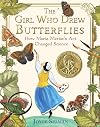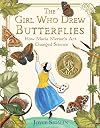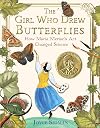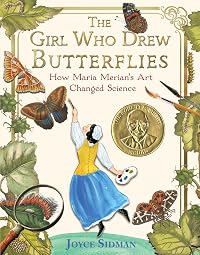
The Girl Who Drew Butterflies: How Maria Merian's Art Changed Science
by Joyce Sidman
On This Page
Description
"Newbery-Honor winning author Joyce Sidman explores the extraordinary life and scientific discoveries of Maria Merian, who discovered the truth about metamorphosis and documented the science behind the mystery in this visual biography that features many original paintings by Maria herself."--Tags
Recommendations







Member Reviews
Oh my. Sidman does it again. What a talent. Gorgeous book illustrations and designs. engaging text, powerful biography, rich and accurate technology and science, fascinating history, end-matter, and a poem. In a way I love the poem the most, how we read one verse at the beginning of each chapter, and how it's about a butterfly but is also a metaphor for a life of anyone, especially for Maria.
I'm just blown away by all the different things we learned. The processes of engraving and printing. The sugarcane and slavery of Surinam. The community of the Labadists. The development of science from its roots w/ Aristotle, through superstition, through catalogs of extensive but casual observations, to the beginnings of actual focused careful show more observation and experimentation. Such a joy to read & view, and such a satisfying learning experience.
This book is a must-buy for every library that serves children and a must-read for every family. Families that homeschool should buy it, because rereads will be enriching. And I'm pretty sure this is a book that will be worth handing down to the next generation, too. show less
I'm just blown away by all the different things we learned. The processes of engraving and printing. The sugarcane and slavery of Surinam. The community of the Labadists. The development of science from its roots w/ Aristotle, through superstition, through catalogs of extensive but casual observations, to the beginnings of actual focused careful show more observation and experimentation. Such a joy to read & view, and such a satisfying learning experience.
This book is a must-buy for every library that serves children and a must-read for every family. Families that homeschool should buy it, because rereads will be enriching. And I'm pretty sure this is a book that will be worth handing down to the next generation, too. show less
There’s been a recent resurgence of interest in Maria Merian and her life and studies well repay that interest. Sidman combines her interest in poetry, the natural world, nonfiction, and butterflies to create a unique and satisfying biography of Merian that explores her life, time period, and the science of the creatures she studied.
The book begins with a glossary of butterfly terms, including the words Merian used. It is illustrated with historic engravings, original maps, photographs, and Maria Merian’s own art. It includes a narrative introduction and a final chapter putting Merian’s life into context. Plentiful back matter includes a timeline, sources, bibliography, author’s note, and index. The book is beautifully made and show more arranged, bringing the artistic fervor of Merian’s own accessible science books to the reader.
The bulk of the text is arranged like a butterfly’s life cycle. It begins with the egg, hatching, and the first instar (stage of a caterpillar’s life) which detail Maria’s youth until her marriage. She was born into an engraver’s family and, when her father died, her mother remarried a painter. Her interest in butterflies and other insects never waned and neither did her love of art. But she was also a dutiful daughter, helping in her fathers’ business, learning household duties, and all of the things a young woman of the 1600s would have learned. By the sixth chapter, she is eighteen and marrying. Eventually she separated from her husband and took her daughters to live in a religious community. Later they officially divorced and he remarried. She then moved on to Amsterdam, which offered her the opportunity to support her daughters and continue her pursuit of art and science. At the age of 52, when she would have been considered elderly, she traveled with her younger daughter Hannah to the Dutch colony of Surinam, there she expanded her research into the insects, amphibians, and plants of the colony, returning only when she became ill. She died at the age of sixty-nine, leaving behind an exquisite legacy of beautifully illustrated books detailing the life and habitats of her beloved caterpillars and butterflies, as well as a volume on Surinam which modern scientists believe to be the only record of a number of extinct species.
Sidman uses her skill with words to weave together not only the facts and story of Merian’s life but also the wider context of the world in the 1600s, pausing to consider the horrific slave and sugar trade in Surinam, the role of religion in Maria Merian’s world, and the numerous scientific facts about caterpillars and butterflies. Many quotes from Merian’s own work are included, as well as illustrations from her books.
Verdict: While a biography of a medieval woman fascinated by caterpillars may not seem like a popular choice, Sidman’s skill in writing and excellent mix of science, story, and history, not to mention the beautiful layout of the book, will make this a popular choice for readers with only a minimal amount of booktalking needed. Highly recommended.
ISBN: 9780544717138; Published 2018 by Houghton Mifflin Harcourt; Borrowed from another library in the consortium; Purchased for the library show less
The book begins with a glossary of butterfly terms, including the words Merian used. It is illustrated with historic engravings, original maps, photographs, and Maria Merian’s own art. It includes a narrative introduction and a final chapter putting Merian’s life into context. Plentiful back matter includes a timeline, sources, bibliography, author’s note, and index. The book is beautifully made and show more arranged, bringing the artistic fervor of Merian’s own accessible science books to the reader.
The bulk of the text is arranged like a butterfly’s life cycle. It begins with the egg, hatching, and the first instar (stage of a caterpillar’s life) which detail Maria’s youth until her marriage. She was born into an engraver’s family and, when her father died, her mother remarried a painter. Her interest in butterflies and other insects never waned and neither did her love of art. But she was also a dutiful daughter, helping in her fathers’ business, learning household duties, and all of the things a young woman of the 1600s would have learned. By the sixth chapter, she is eighteen and marrying. Eventually she separated from her husband and took her daughters to live in a religious community. Later they officially divorced and he remarried. She then moved on to Amsterdam, which offered her the opportunity to support her daughters and continue her pursuit of art and science. At the age of 52, when she would have been considered elderly, she traveled with her younger daughter Hannah to the Dutch colony of Surinam, there she expanded her research into the insects, amphibians, and plants of the colony, returning only when she became ill. She died at the age of sixty-nine, leaving behind an exquisite legacy of beautifully illustrated books detailing the life and habitats of her beloved caterpillars and butterflies, as well as a volume on Surinam which modern scientists believe to be the only record of a number of extinct species.
Sidman uses her skill with words to weave together not only the facts and story of Merian’s life but also the wider context of the world in the 1600s, pausing to consider the horrific slave and sugar trade in Surinam, the role of religion in Maria Merian’s world, and the numerous scientific facts about caterpillars and butterflies. Many quotes from Merian’s own work are included, as well as illustrations from her books.
Verdict: While a biography of a medieval woman fascinated by caterpillars may not seem like a popular choice, Sidman’s skill in writing and excellent mix of science, story, and history, not to mention the beautiful layout of the book, will make this a popular choice for readers with only a minimal amount of booktalking needed. Highly recommended.
ISBN: 9780544717138; Published 2018 by Houghton Mifflin Harcourt; Borrowed from another library in the consortium; Purchased for the library show less
After reading Jeannine Atkins's Finding Wonders: Three Girls Who Changed Science, I was intrigued by the accomplishments of Maria Merian. I was thrilled to see that Joyce Sidman was writing an entire book on her. The result is a combination of art, science, and poetry—my favorite things. It's well researched, readable, and interesting. Joyce includes her own photographs as well as original illustrations from Maria. Each chapter begins with a poem, aptly titled "Egg" and "Hatching" and "Molting" and such. (The entire book was wonderful, but those poems and photos are my favorite parts of the story.) In an age when the contributions of women were neither accepted nor recognized for their importance, Maria perseveres and leaves as her show more legacy much about the true order of insects, destroying long-held myths as she documents their origins. The glossary, author's note, timeline, quote sources, and bibliography make this a must for every classroom and library, K to 12.
"Patience is a beneficial little herb." ~Maria Merian show less
"Patience is a beneficial little herb." ~Maria Merian show less
What an amazing book! I learned so much about things that I never really much had an interest in……….bugs, caterpillars, and butterflies. Of course, I like butterflies. Who doesn’t? But to say I’m interested in entomology would be a stretch. But that is what is so great about this book. You don’t have to be interested in entomology to learn what a wonderful woman in history Maria Merian was.
I stumbled across this book in my library as I was cutting through the juvenile section to go to another section. I only saw the spine of the book which caught my eye. As you can see from my main photo at the top the hardcover is designed to look like a brown leather book with gold embossing. There is an actual dust jacket to the book that show more is beautiful as well but I didn’t know that until I looked it up on bookshop.org to put the link above. My library had removed the dust jacket. I’m definitely ordering the book to add to my collection of kids books.
One of the most fascinating gems of this book to me is the fact that she was such a pioneer in natural history/science and science artistry. Women during her time were not supposed to have professions. She also traveled from her native Germany where she was born in the mid-1600s to Suriname (South America). If you are familiar with naturalists in history then you would be interested to know that Mark Catesby and John James Audobon were inspired by her.
Although this book is categorized for grades 5-7 and ages 10-12 years it is definitely a book that an adult can read as it is in no way too juvenile. I had never heard of her before so the entire book was fascinating. But the most beautiful thing to me is the actual artistry of the book and its graphic design. From the photography taken by the author to the fonts used to the historical insets and Maria’s watercolor images placed throughout the book, it is stunning from cover to cover. Well crafted and well written it makes me want to learn more about Maria! show less
I stumbled across this book in my library as I was cutting through the juvenile section to go to another section. I only saw the spine of the book which caught my eye. As you can see from my main photo at the top the hardcover is designed to look like a brown leather book with gold embossing. There is an actual dust jacket to the book that show more is beautiful as well but I didn’t know that until I looked it up on bookshop.org to put the link above. My library had removed the dust jacket. I’m definitely ordering the book to add to my collection of kids books.
One of the most fascinating gems of this book to me is the fact that she was such a pioneer in natural history/science and science artistry. Women during her time were not supposed to have professions. She also traveled from her native Germany where she was born in the mid-1600s to Suriname (South America). If you are familiar with naturalists in history then you would be interested to know that Mark Catesby and John James Audobon were inspired by her.
Although this book is categorized for grades 5-7 and ages 10-12 years it is definitely a book that an adult can read as it is in no way too juvenile. I had never heard of her before so the entire book was fascinating. But the most beautiful thing to me is the actual artistry of the book and its graphic design. From the photography taken by the author to the fonts used to the historical insets and Maria’s watercolor images placed throughout the book, it is stunning from cover to cover. Well crafted and well written it makes me want to learn more about Maria! show less
As Newbery Honor-winning author Joyce Sidman explains, Maria Merian, born in 1647, loved to draw bugs from the time she was a young girl. But just drawing them wasn’t enough; she wanted to understand them as well:
“With no formal training or university education, Maria Merian took on the role of artist, adventurer, and scientist in seventeenth-century Europe - a time when women were rarely allowed responsibilities outside the home, and unusual interests led to accusations of witchcraft.”
But as Sidman notes:
“Her intrepid fieldwork and careful observation helped uncover the truth about metamorphosis and changed the course of science forever."
This beautiful book about Maria and her accomplishments begins with an insect glossary - show more such a great idea to put a glossary in the front! It is helpful to know at the outset, for example, the differences between moths and butterflies.
The illustrations in this book are lovely. Some are drawings and paintings (many of which are reproductions of those made by Maria Merian herself), and some are stylized excerpts from Maria’s writings, but there are also many contemporary color photographs.
There are informational pictures with captions as well, like one demonstrating the parts of a copper engraver’s workshop, similar to that owned by Maria's father.
When Maria's father died, her mother eventually remarried, this time to a different type of artist. Jacob Marrel specialized in still lifes, and Maria was happy to help him. The author reports:
“Her stepfather prized insects as models and sent Maria outside to capture them.”
At the time, most people believed insects came from “spontaneous generation.” This was Aristotle’s theory and no one questioned it.
Marrel taught Maria how to draw and paint, and soon she was so skillful that she was helping produce pictures for sale. But her curiosity over the nature of caterpillars, moths, and butterflies only intensified, and she began to do her own experiments to find out where they came from and how they developed.
Women in Maria’s time could not attend a university. They could not neglect their “duties” as a female in favor of intellectual pursuits. They also had a “duty” to marry (and indeed, that particular duty was necessary for financial reasons as well as societal ones). In time Maria married one of her stepfather’s apprentices. But in spite of having and raising children and doing housekeeping, she continued to paint and even published a book in 1675 featuring pictures of her flowers.
In 1679 she published a second book, this one including not only plants but images of specific caterpillars showing the preference of plant associated with each one.
Maria found it increasingly difficult to balance all the parts of her life. In 1685, she left her husband, took her daughters and widowed mother, and went to join a religious commune in the northern Netherlands, where her half brother already lived. After six years, finding the restrictions of the community too limiting, she took her daughters to Amsterdam. Because the Netherlands [outside of religious communes] had more progressive laws for women, Maria could open her own business there. She became successful, but her curiosity hadn’t abated. Now she wanted to know more than just about European species of insects. In 1699, Maria and her younger daughter left for Surinam. [Suriname, a small country on the northeastern coast of South America, was formerly known as Surinam when became a Dutch colony beginning in 1667.]
The author writes:
“Maria delighted in the diversity of insects in Surinam and carefully painted them all, from stinging caterpillars to tarantulas.”
But the climate made her ill, and after just short of two years, she and her daughter returned to Amsterdam. In 1705, she published a book with her findings, The Metamorphosis of the Insects of Surinam.
The book was widely praised and even acknowledged by the Royal Society of London, the famed scientific society which would not admit women to its membership for another 250 years.
But Maria never really recovered from the tropical illness she contracted in Surinam and died at the age of sixty-nine in 1715.
The author writes:
“On the very day of her death, an agent of Tsar Peter the Great bought a collection of almost three hundred of her original watercolors to help found Russia’s first art museum.”
Moreover, the famous scientist Carl Linnaeus relied heavily on Maria’s discoveries for his own work.
But many men were offended by her presumption to conduct science, and insisted she had to have had help from a man. Moreover, they said, she was only self-taught, and therefore not a real “scientist.”
Today’s scientists, Sidman points out, “have rediscovered and acknowledged her work for what it is: amazingly beautiful, accurate portrayals of insect metamorphoses and ecosystems.”
The book concludes with an Author’s Note, a Timeline, and a Selected Bibliography. Recommended age range is Age 10 - 12 years.
Evaluation: This book is replete with historical side notes as well as gorgeous photographs and paintings of plants and insects. Even aside from the inspirational story of Maria Merian, the book has a great deal to recommend it in the categories of history, science, and art.
Note: Awards include the 2019 Sibert Medal Informational Book Award from the Association for Library Service to Children, and New York Public Library Top 10 Best Books of 2018. show less
“With no formal training or university education, Maria Merian took on the role of artist, adventurer, and scientist in seventeenth-century Europe - a time when women were rarely allowed responsibilities outside the home, and unusual interests led to accusations of witchcraft.”
But as Sidman notes:
“Her intrepid fieldwork and careful observation helped uncover the truth about metamorphosis and changed the course of science forever."
This beautiful book about Maria and her accomplishments begins with an insect glossary - show more such a great idea to put a glossary in the front! It is helpful to know at the outset, for example, the differences between moths and butterflies.
The illustrations in this book are lovely. Some are drawings and paintings (many of which are reproductions of those made by Maria Merian herself), and some are stylized excerpts from Maria’s writings, but there are also many contemporary color photographs.
There are informational pictures with captions as well, like one demonstrating the parts of a copper engraver’s workshop, similar to that owned by Maria's father.
When Maria's father died, her mother eventually remarried, this time to a different type of artist. Jacob Marrel specialized in still lifes, and Maria was happy to help him. The author reports:
“Her stepfather prized insects as models and sent Maria outside to capture them.”
At the time, most people believed insects came from “spontaneous generation.” This was Aristotle’s theory and no one questioned it.
Marrel taught Maria how to draw and paint, and soon she was so skillful that she was helping produce pictures for sale. But her curiosity over the nature of caterpillars, moths, and butterflies only intensified, and she began to do her own experiments to find out where they came from and how they developed.
Women in Maria’s time could not attend a university. They could not neglect their “duties” as a female in favor of intellectual pursuits. They also had a “duty” to marry (and indeed, that particular duty was necessary for financial reasons as well as societal ones). In time Maria married one of her stepfather’s apprentices. But in spite of having and raising children and doing housekeeping, she continued to paint and even published a book in 1675 featuring pictures of her flowers.
In 1679 she published a second book, this one including not only plants but images of specific caterpillars showing the preference of plant associated with each one.
Maria found it increasingly difficult to balance all the parts of her life. In 1685, she left her husband, took her daughters and widowed mother, and went to join a religious commune in the northern Netherlands, where her half brother already lived. After six years, finding the restrictions of the community too limiting, she took her daughters to Amsterdam. Because the Netherlands [outside of religious communes] had more progressive laws for women, Maria could open her own business there. She became successful, but her curiosity hadn’t abated. Now she wanted to know more than just about European species of insects. In 1699, Maria and her younger daughter left for Surinam. [Suriname, a small country on the northeastern coast of South America, was formerly known as Surinam when became a Dutch colony beginning in 1667.]
The author writes:
“Maria delighted in the diversity of insects in Surinam and carefully painted them all, from stinging caterpillars to tarantulas.”
But the climate made her ill, and after just short of two years, she and her daughter returned to Amsterdam. In 1705, she published a book with her findings, The Metamorphosis of the Insects of Surinam.
The book was widely praised and even acknowledged by the Royal Society of London, the famed scientific society which would not admit women to its membership for another 250 years.
But Maria never really recovered from the tropical illness she contracted in Surinam and died at the age of sixty-nine in 1715.
The author writes:
“On the very day of her death, an agent of Tsar Peter the Great bought a collection of almost three hundred of her original watercolors to help found Russia’s first art museum.”
Moreover, the famous scientist Carl Linnaeus relied heavily on Maria’s discoveries for his own work.
But many men were offended by her presumption to conduct science, and insisted she had to have had help from a man. Moreover, they said, she was only self-taught, and therefore not a real “scientist.”
Today’s scientists, Sidman points out, “have rediscovered and acknowledged her work for what it is: amazingly beautiful, accurate portrayals of insect metamorphoses and ecosystems.”
The book concludes with an Author’s Note, a Timeline, and a Selected Bibliography. Recommended age range is Age 10 - 12 years.
Evaluation: This book is replete with historical side notes as well as gorgeous photographs and paintings of plants and insects. Even aside from the inspirational story of Maria Merian, the book has a great deal to recommend it in the categories of history, science, and art.
Note: Awards include the 2019 Sibert Medal Informational Book Award from the Association for Library Service to Children, and New York Public Library Top 10 Best Books of 2018. show less
In the late 1600’s, when people believed that insects spontaneously arose from dead things, dew, dung, or mud, there lived a girl named Maria Merian who knew better. She studied insects, especially moths and butterflies during a time when women were supposed to forgo study, especially that of insects, in favor of caring for a family and home, exclusively. Still Maria could not quench her thirst for the mystery of God’s smallest creatures, the insects. She studied and drew insect, especially the moths and butterflies in their various stages of growth and metamorphosis during their lives.
This book follows her life and parallels it with the growth and metamorphosis of the butterfly. For example, as the author discusses the eggs of show more insects, he talks of Maria’s early life. When he discusses hatching of the insect egg, he discusses Maria grown up, out in the world, marrying.
This small volume is filled with her colorful drawings and her moving and expressive writings that describe her fascination and love of those tiny beings she studied.
This is a wonderful book, not only about Maria Merian, but also about the time she lived in and the beliefs shared by its people.
I was given a free copy of this book in exchange for an unbiased review. show less
This book follows her life and parallels it with the growth and metamorphosis of the butterfly. For example, as the author discusses the eggs of show more insects, he talks of Maria’s early life. When he discusses hatching of the insect egg, he discusses Maria grown up, out in the world, marrying.
This small volume is filled with her colorful drawings and her moving and expressive writings that describe her fascination and love of those tiny beings she studied.
This is a wonderful book, not only about Maria Merian, but also about the time she lived in and the beliefs shared by its people.
I was given a free copy of this book in exchange for an unbiased review. show less
In the 17th century a young woman pursues her interest in insects, especially moths and butterflies, with a special concentration on their metamorphosis. This is an interesting story, told in a plain and somewhat remote style, with repeated choruses of what women couldn't do then.
Other than the last, there is not the least reason for exciting the ire of those who call for book bans. A woman did amazing work in a time when general society strongly discouraged much of what she did.
Other than the last, there is not the least reason for exciting the ire of those who call for book bans. A woman did amazing work in a time when general society strongly discouraged much of what she did.
Members
- Recently Added By
Lists

BBA Potential: Junior Readers
32 works; 1 member

Biographies or Memoirs
36 works; 1 member

Nature
7 works; 1 member

Art
18 works; 1 member

Science
13 works; 1 member

4th Grade Books
312 works; 5 members

Youth: Zoology
128 works; 1 member

SYES Library Wishlist
1,080 works; 4 members

Books Read in 2024
4,623 works; 126 members

Newbery Adjacent
747 works; 3 members

Precious People
119 works; 1 member

Robert F. Sibert Informational Book Medal
102 works; 1 member

Top Five Books of 2025
954 works; 303 members
Author Information

23+ Works 5,626 Members
Poet and author Joyce Sidman was born in Hartford, Connecticut on June 4, 1956. She received a B.A. in German from Wesleyan University and earned her teacher's certificate in 1983. Sidman teaches poetry and is a columnist for the St. Paul Pioneer Press. She has published several children's books, including Red Sings from Treetops, and she won the show more New Women's Voices award for Like the Air. (Bowker Author Biography) show less
Some Editions
Awards and Honors
Awards
Distinctions
Notable Lists
Common Knowledge
- Original publication date
- 2018-02-20
- People/Characters
- Maria Sybilla Merian
- Important places
- Germany; Netherlands; Suriname (also Surinam)
- Dedication
- For Jim:
i carry your heart with me
(i carry it in my heart) - First words
- A girl kneels in her garden. ("The Girl in the Garden")
April 2, 1647 Frankfurt, Germany
Maria Sybilla Merian was born on a bright spring day into a family of printers and engravers. - Last words
- (Click to show. Warning: May contain spoilers.)She saw nature as an ever-transforming web of connections -- and change our view of it forever.
- Publisher's editor
- Rider, Ann
- Blurbers
- Heiligman, Deborah
Classifications
Statistics
- Members
- 529
- Popularity
- 56,544
- Reviews
- 26
- Rating
- (4.39)
- Languages
- English, Spanish
- Media
- Paper, Audiobook, Ebook
- ISBNs
- 10
- ASINs
- 3