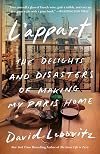
L'Appart: The Delights and Disasters of Making My Paris Home
by David Lebovitz
On This Page
Description
"A chef buys an apartment in Paris and endures the headaches and excitement of renovating his own corner of paradise in the City of Light"-- "Bestselling author and world-renowned chef David Lebovitz continues to mine the rich subject of his evolving ex-pat life in Paris, using his perplexing experiences in apartment renovation as a launching point for stories about French culture, food, and what it means to revamp one's life. Includes dozens of new recipes. When David Lebovitz began the show more project of updating his apartment in his adopted home city, he never imagined he would encounter so much inexplicable red tape while contending with the famously inconsistent European work ethic and hours. Lebovitz maintains his distinctive sense of humor with the help of his partner Romain, peppering this renovation story with recipes from his Paris kitchen. In the midst of it all, he reveals the adventure that accompanies carving out a place for yourself in a foreign country--under baffling conditions--while never losing sight of the magic that inspired him to move to the City of Light many years ago, and to truly make his home there"-- show lessTags
Recommendations










































Member Reviews
If you are secretly (or not so secretly) fascinated by the sight of car wrecks (where no one is injured, of course), you might really like this book.
That's not why I bought it, or course; I thought I'd be reading a breezy memoir about moving to Paris and buying a fabulous, though a tad run down, old apartment and the joys of renovating it. I imagined living vicariously through the author as he haunted the flea markets and found fabulous old doors, lamps, hardware, crockery, etc. Sure, the title says "disasters", too, but they're probably the run of the mill disasters everyone faces when building/renovating, right? Someone painted the kitchen the color meant for the baths, or switched the hot and cold taps.
Not even close. In fact, show more looking at the title, I'm not at all sure where the "delights" come into play. Maybe book 2? Because I gotta tell you, after reading this, I have a lot more sympathy for people who burn the house down for the insurance money. I also have a new appreciation for just how much worse Australian real estate could be. I've always tried to be positive or, at least tactful, about my current home country, but I've never held back on how bent I believe their real estate industry is, particularly Melbourne's (I'm not wrong either: Victoria has been cited numerous times for fraudulent real estate practices; not that it slows anybody down). But boy howdy, Paris makes it clear Aussies are in the minor leagues.
But the buying dramas (did you know you need a medical examination to get a home loan?) were just the amuse bouche; the real nightmare, the one you can't stop reading because it's like a train that just keeps on wrecking itself, a metal snowball gaining mass and spreading destruction, is the renovations. There. are. no. words.
This is where I stop to give a heartfelt thanks to my Daddy, an electrical engineer, and for the grace of god that I was born curious. Foreign country or not (and you can't discount how big a difference that makes - even if the foreign country speaks your language), I'm fortunate that I know enough about electricity, plumbing, and (very) basic building construction to suspect when something isn't right, or safe. Lebovitz was not so blessed and neither was his partner, although he was at least Parisian, and so was able to bridge the language - and sometimes the cultural - gaps, as well as throw well timed fits of temper. But even so, what happens, what they end up with... nope. Still no words. I cannot imagine what I'd have done in his shoes, but it probably would have been neither legal or sane.
It ends well enough, but, though he doesn't give any real figures, one has to assume he had a shit ton of money somewhere because by my rough reckoning, that renovation cost him more than 3 times the original budget.
Throughout this nightmare, he does paint a vivid and gorgeous picture of Paris markets and food, both of which, from what I read here, are better experienced as a tourist. And most of the chapters end with a recipe; some easy, and some for the experienced baker. At some point in the future I'll be giving his Swedish meatball recipe a shot.
And Swedish meatballs leads me to this final thought: there is nothing on this earth that would ever compel me to stand in line for 4 1/2 freaking hours in Ikea. Nothing. Not if the kitchen cabinets were made of solid mahogany and gilded in solid gold. Omg...4.5 hours in Ikea... show less
That's not why I bought it, or course; I thought I'd be reading a breezy memoir about moving to Paris and buying a fabulous, though a tad run down, old apartment and the joys of renovating it. I imagined living vicariously through the author as he haunted the flea markets and found fabulous old doors, lamps, hardware, crockery, etc. Sure, the title says "disasters", too, but they're probably the run of the mill disasters everyone faces when building/renovating, right? Someone painted the kitchen the color meant for the baths, or switched the hot and cold taps.
Not even close. In fact, show more looking at the title, I'm not at all sure where the "delights" come into play. Maybe book 2? Because I gotta tell you, after reading this, I have a lot more sympathy for people who burn the house down for the insurance money. I also have a new appreciation for just how much worse Australian real estate could be. I've always tried to be positive or, at least tactful, about my current home country, but I've never held back on how bent I believe their real estate industry is, particularly Melbourne's (I'm not wrong either: Victoria has been cited numerous times for fraudulent real estate practices; not that it slows anybody down). But boy howdy, Paris makes it clear Aussies are in the minor leagues.
But the buying dramas (did you know you need a medical examination to get a home loan?) were just the amuse bouche; the real nightmare, the one you can't stop reading because it's like a train that just keeps on wrecking itself, a metal snowball gaining mass and spreading destruction, is the renovations. There. are. no. words.
This is where I stop to give a heartfelt thanks to my Daddy, an electrical engineer, and for the grace of god that I was born curious. Foreign country or not (and you can't discount how big a difference that makes - even if the foreign country speaks your language), I'm fortunate that I know enough about electricity, plumbing, and (very) basic building construction to suspect when something isn't right, or safe. Lebovitz was not so blessed and neither was his partner, although he was at least Parisian, and so was able to bridge the language - and sometimes the cultural - gaps, as well as throw well timed fits of temper. But even so, what happens, what they end up with... nope. Still no words. I cannot imagine what I'd have done in his shoes, but it probably would have been neither legal or sane.
It ends well enough, but, though he doesn't give any real figures, one has to assume he had a shit ton of money somewhere because by my rough reckoning, that renovation cost him more than 3 times the original budget.
Throughout this nightmare, he does paint a vivid and gorgeous picture of Paris markets and food, both of which, from what I read here, are better experienced as a tourist. And most of the chapters end with a recipe; some easy, and some for the experienced baker. At some point in the future I'll be giving his Swedish meatball recipe a shot.
And Swedish meatballs leads me to this final thought: there is nothing on this earth that would ever compel me to stand in line for 4 1/2 freaking hours in Ikea. Nothing. Not if the kitchen cabinets were made of solid mahogany and gilded in solid gold. Omg...4.5 hours in Ikea... show less
David Lebovitz, I love you! Otherwise I would never have slogged through your book about buying and renovating a home in Paris. We all have had nightmares with contractors, this is not good reading material. You need something juicy, not painful details of being ripped off, that has happened to me and I don't like thinking about it. Somehow I cared about Lebovitz enough to finish the book. I am such a fan, the man taught me how to bake and it's something I pride myself on. Thank you David but next time you try a memoir, make sure something interesting happens. Happy your place turned out well. Keep writing -- cookbooks!
Lebovitz is an American chef and cookbook author who moved to Paris to advance his career. I have read his previous books, and he is a talented and engaging author. This particular book is about his search for, purchase of, and renovation of a home in Paris. And what a great story it is!
I found myself surprised at the difficulty in even locating a property for sale in Paris (House Hunters International makes it look so easy and fun on TV!). Upon finally finding the property, the author experienced the infamous Paris bureaucracy in the purchase of it. And then, just when you think it should all be smooth sailing, the real trouble begins in the renovation stage!
I cannot believe what Lebovitz went through. His stamina and perseverance are show more amazing. I am sure that I would have gave up many times, escaping back to the safety of the United States. Kudos to him for his overcoming of all the obstacles thrown at him.
I found the book to be fascinating, and could not put it down. I literally devoured it in two evenings. The author is very engaging, writes extremely well, and manages to keep the reader "pulling for" him. I highly recommend this book, even if it does lay to rest my "House Hunters International" fantasy of moving to France! show less
I found myself surprised at the difficulty in even locating a property for sale in Paris (House Hunters International makes it look so easy and fun on TV!). Upon finally finding the property, the author experienced the infamous Paris bureaucracy in the purchase of it. And then, just when you think it should all be smooth sailing, the real trouble begins in the renovation stage!
I cannot believe what Lebovitz went through. His stamina and perseverance are show more amazing. I am sure that I would have gave up many times, escaping back to the safety of the United States. Kudos to him for his overcoming of all the obstacles thrown at him.
I found the book to be fascinating, and could not put it down. I literally devoured it in two evenings. The author is very engaging, writes extremely well, and manages to keep the reader "pulling for" him. I highly recommend this book, even if it does lay to rest my "House Hunters International" fantasy of moving to France! show less
I used to read his blog and found the book just as enjoyable. Tales about French bureaucracy, apartment hunting, plumbing troubles, etc. It was funny, but I'll admit that it helps to have some knowledge of French to appreciate the jokes. There are about 2 dozen recipes, which is why I used to follow him and partly why I bought the book.
I recently hired a gardener to do some yard work. I was supposed to get 40 hours of work for a little over $1,100. I knew I was in trouble when the first question he asked when he came here to work was when he pointed at something growing in the yard and asked“Is that a weed or a plant.”
It went downhill from there: Compared to what David Lebovitz went through when he bought an apartment in Paris, I should be very grateful that I got away so easily.
A native of San Franciso, Lebovitz moved to Paris because he loved cooking, especially French cooking, and loved the country. Everything went well for the first decade. Then he decided he to buy an apartment. The first obstacle he faced was having to get a physical examination before the show more bank would lend him any money. It wanted to ensure that he would be healthy enough to repay it.
Finding an apartment was not easy. Many are not listed. Real estate agents show only those that they have listed. There are no arrangements to show the properties from other companies. While he eventually did find a suitable place, the process for buying it was quite complicated and then he learned it needed a lot of remodeling before he could move in. Imagine having to wait four hours before talking to a staff member at an Ikea store. His biggest mistake was acting like an American. By the end of the ordeal, he had learned a bit more about working under the French “rules.”
Levovitz writes cookbooks. Not surprisingly, much of the book deals with French food. There are twenty five recipes (with very complete direction) mixed in with his story. Often, the recipes tie into what is happening in the purchasing and renovation process. They range from breads and pastries to soups and main dishes to desserts. They are a welcome addition to a story that could have stood by itself. Kind of like the frosting on a cake. I think I gained five pounds just reading them! I was surprised that he didn’t mention using microwave ovens, especially for such things as melting chocolate.
He compares putting together a real estate deal with making cookies. Things “may crumble when extra things are tossed into the mix. But you should be able to push them all back together. To avoid that with your cookies, it helps to squeeze the balls of dough together with notaire-like authority to get everything to stay in place.”
As the book progressed, I became as frustrated as he did with all the obstacles he faced trying to find, buy, and refurbish his apartment. I kept wondering why he didn’t fire the contractor and start again with someone new. Unsure how to handle the situations as an expat made a lot of difference.
There are a lot of French words in the book. He translates many but not all of them.
Tidbits:
When he worked in the San Francisco Bay area, he found the residents were as interested in food as were the French. One favorite was “dewy goat cheeses which, in the 80s, people... thought were tofu.”
Leftover croissants are stuffed and baked again to create a new treat.
“Mais oui, monsieur!” she responded, with enthusiasm the French usually reserve for when they get close to meal time.”
“Most people are quick to invoke the rules, but those rules don’t necessarily apply to them. Thus, skirting the rules is a national pastime.”
“The French get locked into how things should be rather than seeing how they could be. That strategy is great for preserving the grandeur of the past, but hasn’t been as successful for envisioning anything beyond it.”
“Americans go into situations expecting things to go well. When they don’t we have meltdowns. The French go into situations expecting things not to go in their favor, so they’re prepared when they don’t.”
All the forms that people have to keep, e.g., to prove you purchased something, must be archived and saved in a binder. Mitt Romney was a missionary in France for several years so his comment about ‘binders of women’ made sense.”
My favorite description, one I don’t think I’ll ever forget is when he wanted a clothes dryer “so my towels wouldn’t make me feel like I was drying myself with a piece of matzoh after a shower.” I thought of the difference between when starting with the rough matzoh and ending with a soggy, crumbling mess.
I read a uncorrected proof of this book. show less
It went downhill from there: Compared to what David Lebovitz went through when he bought an apartment in Paris, I should be very grateful that I got away so easily.
A native of San Franciso, Lebovitz moved to Paris because he loved cooking, especially French cooking, and loved the country. Everything went well for the first decade. Then he decided he to buy an apartment. The first obstacle he faced was having to get a physical examination before the show more bank would lend him any money. It wanted to ensure that he would be healthy enough to repay it.
Finding an apartment was not easy. Many are not listed. Real estate agents show only those that they have listed. There are no arrangements to show the properties from other companies. While he eventually did find a suitable place, the process for buying it was quite complicated and then he learned it needed a lot of remodeling before he could move in. Imagine having to wait four hours before talking to a staff member at an Ikea store. His biggest mistake was acting like an American. By the end of the ordeal, he had learned a bit more about working under the French “rules.”
Levovitz writes cookbooks. Not surprisingly, much of the book deals with French food. There are twenty five recipes (with very complete direction) mixed in with his story. Often, the recipes tie into what is happening in the purchasing and renovation process. They range from breads and pastries to soups and main dishes to desserts. They are a welcome addition to a story that could have stood by itself. Kind of like the frosting on a cake. I think I gained five pounds just reading them! I was surprised that he didn’t mention using microwave ovens, especially for such things as melting chocolate.
He compares putting together a real estate deal with making cookies. Things “may crumble when extra things are tossed into the mix. But you should be able to push them all back together. To avoid that with your cookies, it helps to squeeze the balls of dough together with notaire-like authority to get everything to stay in place.”
As the book progressed, I became as frustrated as he did with all the obstacles he faced trying to find, buy, and refurbish his apartment. I kept wondering why he didn’t fire the contractor and start again with someone new. Unsure how to handle the situations as an expat made a lot of difference.
There are a lot of French words in the book. He translates many but not all of them.
Tidbits:
When he worked in the San Francisco Bay area, he found the residents were as interested in food as were the French. One favorite was “dewy goat cheeses which, in the 80s, people... thought were tofu.”
Leftover croissants are stuffed and baked again to create a new treat.
“Mais oui, monsieur!” she responded, with enthusiasm the French usually reserve for when they get close to meal time.”
“Most people are quick to invoke the rules, but those rules don’t necessarily apply to them. Thus, skirting the rules is a national pastime.”
“The French get locked into how things should be rather than seeing how they could be. That strategy is great for preserving the grandeur of the past, but hasn’t been as successful for envisioning anything beyond it.”
“Americans go into situations expecting things to go well. When they don’t we have meltdowns. The French go into situations expecting things not to go in their favor, so they’re prepared when they don’t.”
All the forms that people have to keep, e.g., to prove you purchased something, must be archived and saved in a binder. Mitt Romney was a missionary in France for several years so his comment about ‘binders of women’ made sense.”
My favorite description, one I don’t think I’ll ever forget is when he wanted a clothes dryer “so my towels wouldn’t make me feel like I was drying myself with a piece of matzoh after a shower.” I thought of the difference between when starting with the rough matzoh and ending with a soggy, crumbling mess.
I read a uncorrected proof of this book. show less
L'appart is a charming and witty account of a Paris renovation by a chef, blogger, and lover of most things French, with the possible exceptions of real estate agents and contractors. Loving most things French, as he did, he decided to pull up stakes in the U.S. And move to the city of lights. After renting an apartment for years, he finally decided it was time to strike out on his own. Of course, this was all easier said than done. After spending nearly a year in the search for the right abode, he finally found a place he wanted to call home. But then came the challenge of renovation. What he had expected to take two months or so, turned into a marathon ordeal. And, “ordeal” is the key word here. Personally, I cannot imagine how show more anyone could cope with such a cauchemar but, Mr. Lebovitz managed to come out the other end in one piece.
Just in case perils of renovation get you down while reading this account, don't fret because the author has provided numerous tasty recipes that will cheer you up no end. My personal favorite was the Lemon Yogurt Cake. And if after reading this book you still feel inclined to dive into your own French renovation, I'd like to wish you Bon Courage; you will most likely need it.
Thanks to Crown Publishing for allowing me to read this book in exchange for an honest review.
More reviews at: www.susannesbooklist.blogspot.com show less
Just in case perils of renovation get you down while reading this account, don't fret because the author has provided numerous tasty recipes that will cheer you up no end. My personal favorite was the Lemon Yogurt Cake. And if after reading this book you still feel inclined to dive into your own French renovation, I'd like to wish you Bon Courage; you will most likely need it.
Thanks to Crown Publishing for allowing me to read this book in exchange for an honest review.
More reviews at: www.susannesbooklist.blogspot.com show less
Famous French chef, David Lebowitz, our author, had lived in France for some time. He finally makes the decision to invest in his own condo in Paris, the city he loves so much. He finds a place that has possibilities, and so he decides that renovations are in order. He will have his dream kitchen. He will have lots of light. Boy, was her wrong! Buying property and hiring renovations in France is much different than it is in the United States, where David had always lived. His nightmare was only beginning.
This well-written account of David’s experiences with buying and renovating his own Paris home will have you cringing with horror and laughing, too. I really enjoyed this one!
This well-written account of David’s experiences with buying and renovating his own Paris home will have you cringing with horror and laughing, too. I really enjoyed this one!
Members
- Recently Added By
Author Information

13+ Works 3,410 Members
David Lebovitz is a pastry chef, author, and blogger. Trained as a pastry chef in France and Belgium, he worked at Chez Panisse in Berkeley, California for twelve years. He is the author of several books including Room for Dessert, Ripe for Dessert, Ready for Dessert: My Best Recipes, The Great Book of Chocolate, The Perfect Scoop, The Sweet Life show more in Paris, and My Paris Kitchen: Recipes and Stories. (Bowker Author Biography) show less
Awards and Honors
Distinctions
Common Knowledge
- Canonical title
- L'Appart: The Delights and Disasters of Making My Paris Home
- Original publication date
- 2018
- People/Characters
- David Lebovitz
- Important places
- Paris, France; France; Europe
- Dedication
- To Romain, who made it all possible. (Well... the good parts, that is.)
- First words
- "Pee in this cup."
- Last words
- (Click to show. Warning: May contain spoilers.)I look at my experience from a distance now, and focus on the greater picture rather than the details. And I'm keeping my distance from my mailbox, too.
Classifications
- Genres
- Biography & Memoir, Nonfiction, Food & Cooking, General Nonfiction, Travel
- DDC/MDS
- 641.5092 — Applied science & technology Home economics & family management Food, Cooking & Recipes / Meals, Picnics Cooking; cookbooks > Biography And History Biography
- LCC
- TX649 .L43 .A3 — Technology Home economics Home economics Cooking
- BISAC
Statistics
- Members
- 242
- Popularity
- 134,030
- Reviews
- 14
- Rating
- (3.66)
- Languages
- English
- Media
- Paper, Audiobook, Ebook
- ISBNs
- 5
- ASINs
- 2