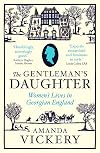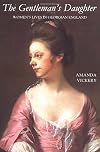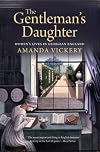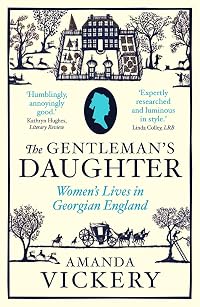
The Gentleman's Daughter: Women's Lives in Georgian England
by Amanda Vickery
On This Page
Description
What was the life of an eighteenth-century British genteel woman like? In this lively and controversial book, Amanda Vickery invokes women's own accounts of their intimate and their public lives to argue that in the eighteenth and early nineteenth centuries the scope of female experience did not diminish--in fact, quite the reverse. Refuting the common understanding that in Georgian times the daughters of merchants, the wives of lawyers, and the sisters of gentlemen lost female freedoms and show more retreated into their homes, Vickery shows that these women experienced expanding social and intellectual horizons. As they embraced a world far beyond the boundaries of their own parishes through their tireless writing and ravenous reading, genteel women also enjoyed an array of emerging new public arenas--assembly rooms, concert series, theater seasons, circulating libraries, day-time lectures, urban walks, and pleasure gardens. Based on the letters, diaries, and account books of over one hundred women from commercial, professional, and gentry families, this book transforms our understanding of the position of women in Georgian England. In their own words, they tell of their sometimes humorous, sometimes moving experiences and desires, and of their many roles, including kinswoman, wife, mother, housekeeper, consumer, hostess, and member of polite society. By the nineteenth century, family duties continued to dominate women's lives, yet, Vickery contends, the public profile of privileged women had reached unprecedented heights. show lessTags
Recommendations














Member Recommendations
Gentlemen of Uncertain Fortune: How Younger Sons Made Their Way in Jane Austen's England by Rory Muir
nessreader Male and female experience of poor gentry at end 18th, start 19th century. Really absorbing access able social history
Member Reviews
A very dry book about what it meant to be a British lady in the eighteenth and nineteenth centuries. It's a very broad subject, but for some reason Vickery only uses two women's journals and a handful of newspaper comics as her evidence. Eventually, I gave up.
A little on the academic side, but full of lively anecdotes and solid information. Great for the researcher and/or hardcore Jane Austen fan.
It looks like an interesting in-depth account of Women's lives in Upper-class Georgian England; however I'm not in the mindset to dig through this book. If I was going to write fiction based in this era this would be an invaluable resource and with the extensive index, citations and bibliography this would be a very useful resource.
I didn't read it through, so I'm not going to give it any stars. What little I did read would probably merit at least 4/5 *
I didn't read it through, so I'm not going to give it any stars. What little I did read would probably merit at least 4/5 *
Library Journal Review
"This meticulously researched social history should be welcomed by specialists in British and European women's history. Vickery (British women's history, Univ. of London) challenges the standard argument that once the industrial revolution took production out of the home, women's lives were marginalized in the domestic sphere. Using the letters, diaries, and account books of more than 100 women from the "genteel" classes, she theorizes that women's activities actually expanded as they involved themselves in new areas of community life. Indeed, she concludes that the struggles of the Victorian suffragettes may have stemmed not from a sense of oppression but from a desire to expand the gains of their Georgian show more predecessors. Unfortunately, Vickery's insistence on proving her provocative thesis overwhelms the richness of the descriptive material she presents: there is good information here on household management, servants, material culture, shopping and consumption, and female attitudes on courtship, pregnancy, motherhood, and child rearing." show less
"This meticulously researched social history should be welcomed by specialists in British and European women's history. Vickery (British women's history, Univ. of London) challenges the standard argument that once the industrial revolution took production out of the home, women's lives were marginalized in the domestic sphere. Using the letters, diaries, and account books of more than 100 women from the "genteel" classes, she theorizes that women's activities actually expanded as they involved themselves in new areas of community life. Indeed, she concludes that the struggles of the Victorian suffragettes may have stemmed not from a sense of oppression but from a desire to expand the gains of their Georgian show more predecessors. Unfortunately, Vickery's insistence on proving her provocative thesis overwhelms the richness of the descriptive material she presents: there is good information here on household management, servants, material culture, shopping and consumption, and female attitudes on courtship, pregnancy, motherhood, and child rearing." show less
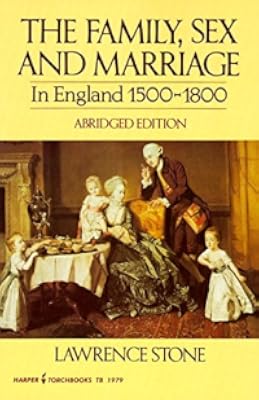
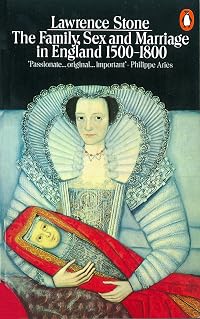
"The most important thing in English feminist history in the last ten years." Roy Porter; "The Gentleman's Daughter is the most important work of social history since Lawrence Stone's Family, Sex and Marriage. From now on, any historian writing about 18th-century women will have to address the arguments in Vickery's book... It is the first book to bring out into the open the debate about separate spheres. It succeeds on two levels, first as an academic argument of the highest order, and second as a fascinating and enjoyable read. Serious history is rarely this fun." Amanda Foreman, The Times; "Innovative, expertly researched and luminous in style." Linda Colley, London Review of Books; "Amanda Vickery's new history of women in Georgian show more England offers a revolutionary reinterpretation of the accepted script, both an academic triumph and a spell-binding read show less
Ratings
Members
- Recently Added By
Lists

Non-Fiction Worth Reading
1,015 works; 261 members

Club Read's Recommended Nonfiction Written by Women
618 works; 30 members
Author Information

8+ Works 1,026 Members
Amanda Vickery is Professor of Early Modern History, Queen Mary, University of London, and the author of the Gentleman's Daughter: Women's Lives in Georgian England (Yale University Press, 1998; Winner of the Whitfield prize, the Wolfson prize and the Longman-History Today prize) and the editor of Women, Privilege and Power: British Politics, 1750 show more to the Present (Stanford University Press, 2001). show less
Awards and Honors
Common Knowledge
- Canonical title
- The Gentleman's Daughter: Women's Lives in Georgian England
- Original publication date
- 1998
- People/Characters
- Elizabeth Shackleton
- Important places
- England, UK
- First words
- In 1820 George III died, the first iron steamship was launched, Shelley published Prometheus Unbound and an unremarkable middle-aged woman took stock of her past.
Classifications
- Genres
- History, Nonfiction, General Nonfiction, Sexuality and Gender Studies, Biography & Memoir
- DDC/MDS
- 900 — History & geography History History, geography, and auxiliary disciplines
- LCC
- HQ1599 .E5 .V47 — Social sciences The family. Marriage, Women and Sexuality The Family. Marriage. Women Women. Feminism
- BISAC
Statistics
- Members
- 516
- Popularity
- 57,869
- Reviews
- 6
- Rating
- (3.74)
- Languages
- English
- Media
- Paper, Ebook
- ISBNs
- 4
- ASINs
- 9