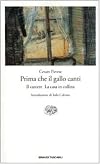
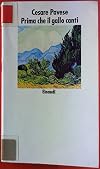
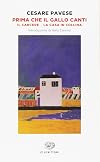
Prima che il gallo canti
by Cesare Pavese
On This Page
Description
"Il carcere" e "La casa in collina": sono i due romanzi brevi che sancirono la maturit© artistica di Cesare Pavese, scritti a distanza di dieci anni l'uno dall'altro (tra il 1938 e '39 il primo, tra il 1947 e il '48 il secondo). Come afferma Italo Calvino nel testo che apre il volume i due romanzi han tutt'e due andamento di memorie, e lo stesso tema generale: la posizione d'un intellettuale in un momento di 'scelta' politica, non d'idee, che quelle son date gi© per scelte, ma d'azione, show more di presenza. show lessTags
Recommendations

















Member Reviews
Somewhat autobiographical, two novellas. First protagonist Stefano shares some of Pavese’s characteristics: having been to prison (Pavese in 1935 by fascisti, along with Einaudi); or, living an isolated life, somewhat precarious, “Stefano si vedeva solo e precario, dolorosamente isolato”(42). His joking companions in cards were as “remote from him as if he were in a desert.” Stefano, and maybe Pavese, spoke “troppo di sé”(45). This solitude followed him all day, under the blue skies, “Quel senso di solitudine fisica che l’aveva accompagnato tutto il giorno”(59).
Stefano takes a daily dip in the mare, which Pavese could not in Torino. Stefano joins Gianino with his belt of bullets. His friend says the season’s wrong show more for bird hunting, after Summer, before Fall, but they should find “qualche merlo o qualche quaglia”(67) No! Merlo, Euro-Blackbirds, are brilliant singers, almost diatonic; I gave a talk in Milano, “Un Merlo Buon-Veneziano,” A Good Venetian Merlo(t), punning but describing paths throughout Venice where I heard Blackbirds—whom I imitated. At the end, I played my jazz waltz, “Upthrush” based on the Wood Thrush’s pentatonic song, the greatest North American birdtalk. My three dozen Italians listening wanted me to play my Upthrush again, but not my Italian, bad because I cannot roll my R’s.
Protaganist in second story, not named for thirty-five pages, when a former girlfriend asks if she can call him Corrado (163). Second novella, even closer to the author's life, set in Torino before WWII, when the city is bombed, evidently by Nazis, so all the friends in "La casa in collina,"the title, say they're Nazis, "Lo siamo tutti," to keep things without bombing and risk (162).
Pavese can write well, about natural surroundings, “La sabina licia riluceva come marmo,” the beach shone like marble (49). Or about human relations, “Le donne piú ti cercano. Proprio come le guardie.” women can chase you just like the taxman (44). As always, I learn Italian conversational words, like “fannullone.” Of course, anything ending in “oh-nay,” Italian “-one,” means a bigger one. “Fannulla,” a loafer, so fannullone, a big loafer (51).
In the first story, Gianino hunts carrying his weapon on his back, offers it to Stefano to shoot near a rock harboring quail. Stefano fires in the air, his friend finishes off the quail, offers it to Stefano to share with his girlfriend. At least they didn’t kill a Blackbird, and after all we live near a dead-end street called Quail Trail (a realtor’s name, unlike the old names—Swamp Road, Cemetery Lane).
Gianino tells him about a young woman he likes to look at, Concia, “Tanning,” with her sun-browned neck, without shoes, like all servants. Stefano sees Concia as beautiful as a goat (capra, a randy Italian standard), or between a statue and a goat, “tra la statua e la capra”(59). Meanwhile, a woman his age, Elena sometimes stays the night with him, even gives him a small armadio so he can unpack his suitcase. After he’s spent a few days talking with Gianino, Elena warns him, You don’t know what he’s done, “Non credere a quello che dice”(95). Don’t listen to what he says. He’s brutal.
The second story, House on the Hill looks backward, on younger loves, younger life--in fact, a life he feels "la vita di un altro," someone else's (147). When a woman asks where are his friends, Corrado answers, "One's married, in a bar, one moved away, so someone I saw every day, no more" (162). The wealthy are not threatened by the fire-bombing of Torino; they simply withdraw to their villas by the sea or in the hills (157).
As a teacher like Corrado, my favorite passage comes when Torino is devastated, and he goes to the empty school, still standing. The portieri is still there, whom he sends off to check on his relatives, says he'll be the doorman, for awhile. Then he enters his empty classroom and mutters off his class list, "i nomi dei ragazzi," which made him feel like an old woman praying, "mi sentii come una vecchia che borbotta preghiere"(153).
Pagination from the 1957 edition, with same cover--pretty sure same pages. show less
Stefano takes a daily dip in the mare, which Pavese could not in Torino. Stefano joins Gianino with his belt of bullets. His friend says the season’s wrong show more for bird hunting, after Summer, before Fall, but they should find “qualche merlo o qualche quaglia”(67) No! Merlo, Euro-Blackbirds, are brilliant singers, almost diatonic; I gave a talk in Milano, “Un Merlo Buon-Veneziano,” A Good Venetian Merlo(t), punning but describing paths throughout Venice where I heard Blackbirds—whom I imitated. At the end, I played my jazz waltz, “Upthrush” based on the Wood Thrush’s pentatonic song, the greatest North American birdtalk. My three dozen Italians listening wanted me to play my Upthrush again, but not my Italian, bad because I cannot roll my R’s.
Protaganist in second story, not named for thirty-five pages, when a former girlfriend asks if she can call him Corrado (163). Second novella, even closer to the author's life, set in Torino before WWII, when the city is bombed, evidently by Nazis, so all the friends in "La casa in collina,"the title, say they're Nazis, "Lo siamo tutti," to keep things without bombing and risk (162).
Pavese can write well, about natural surroundings, “La sabina licia riluceva come marmo,” the beach shone like marble (49). Or about human relations, “Le donne piú ti cercano. Proprio come le guardie.” women can chase you just like the taxman (44). As always, I learn Italian conversational words, like “fannullone.” Of course, anything ending in “oh-nay,” Italian “-one,” means a bigger one. “Fannulla,” a loafer, so fannullone, a big loafer (51).
In the first story, Gianino hunts carrying his weapon on his back, offers it to Stefano to shoot near a rock harboring quail. Stefano fires in the air, his friend finishes off the quail, offers it to Stefano to share with his girlfriend. At least they didn’t kill a Blackbird, and after all we live near a dead-end street called Quail Trail (a realtor’s name, unlike the old names—Swamp Road, Cemetery Lane).
Gianino tells him about a young woman he likes to look at, Concia, “Tanning,” with her sun-browned neck, without shoes, like all servants. Stefano sees Concia as beautiful as a goat (capra, a randy Italian standard), or between a statue and a goat, “tra la statua e la capra”(59). Meanwhile, a woman his age, Elena sometimes stays the night with him, even gives him a small armadio so he can unpack his suitcase. After he’s spent a few days talking with Gianino, Elena warns him, You don’t know what he’s done, “Non credere a quello che dice”(95). Don’t listen to what he says. He’s brutal.
The second story, House on the Hill looks backward, on younger loves, younger life--in fact, a life he feels "la vita di un altro," someone else's (147). When a woman asks where are his friends, Corrado answers, "One's married, in a bar, one moved away, so someone I saw every day, no more" (162). The wealthy are not threatened by the fire-bombing of Torino; they simply withdraw to their villas by the sea or in the hills (157).
As a teacher like Corrado, my favorite passage comes when Torino is devastated, and he goes to the empty school, still standing. The portieri is still there, whom he sends off to check on his relatives, says he'll be the doorman, for awhile. Then he enters his empty classroom and mutters off his class list, "i nomi dei ragazzi," which made him feel like an old woman praying, "mi sentii come una vecchia che borbotta preghiere"(153).
Pagination from the 1957 edition, with same cover--pretty sure same pages. show less
semi riconciliazione con Pavese, grazie a questi due racconti così vicini a "La bella estate" da sentirne l'aria. "Il carcere" è la storia di un confinato politico e della sua vita quotidiana senza slanci eroici; "In collina" racconta del rifugio preventivo di un anonimo prof fuori città, poi della sua fuga e dell'essere sopravvisuto senza aver fatto niente!
Oct 10, 2017Italian
853.912 PAV
Apr 13, 2020Italian
Ratings
Members
- Recently Added By
Author Information

316+ Works 8,100 Members
In Torino in his native Piedmont, Pavese studied English and American literature and wrote a dissertation on Walt Whitman. He read and translated Defoe, Dickens, Joyce , Dos Passos, Stein and Faulkner and his version of Melville's , Moby Dick is a classic. Except for his book of poems Lavorare stanca (Work Wearies) (1936), Pavese's chief works are show more the novels The Comrade (1948), La Casa in Collina (The House on the Hill) (1949), Prima che il gallo canti (Before the Cock Crows) (1949), La bella estate (The Beautiful Summer) (1949), and his last and best, The Moon and the Bonfire (1952). During World War II, he was head of the Rome office of the publishing house of Einaudi and, with Elio Vittorini, did much to encourage young writers. Although a member of the Communist Party, he had not joined the anti-Fascist resistance. Unhappy in love, unable to believe in Christ, and disappointed with things in postwar Italy, he finally made good on what he had often urged as the finest of "final solutions" for himself, committing suicide after winning the coveted Strega Prize, for La bella estate. (Bowker Author Biography) show less
Series
Belongs to Publisher Series
Work Relationships
Is contained in
Common Knowledge
- Canonical title*
- Prima che il gallo canti
- Original title
- Prima che il gallo canti
- Original publication date
- 1964
- Related movies*
- Prima che il gallo canti (Film TV Regione Calabria e RAI, 1992) di Mario Foglietti (Film TV Regione Calabria e RAI, 1992)
- First words
- Stefano sapeva che quel paese non aveva niente di strano, e che la gente ci viveva, a giorno a giorno, e la terra buttava e il mare era il mare, come su qualunque spiaggia.
Il carcere
Già in altri tempi si diceva la collina come avremmo detto il mare o la boscaglia.
La casa in collina - Last words
- (Click to show. Warning: May contain spoilers.)Stefano ebbe l'illusione, mentre il treno giungeva, che turbinassero nel vortice come foglie spazzate i visi e i nomi di quelli che non erano là.
Il carcere
(Click to show. Warning: May contain spoilers.)Io non credo che possa finire. Ora che ho visto cos'è guerra, cos'è guerra civile, so che tutti, se un giorno finisse, dovrebbero chiedersi: - E dei caduti che facciamo? perché sono morti? - Io non saprei cosa rispondere. Non adesso, almeno. Né mi pare che gli altri lo sappiano. Forse lo sanno unicamente i morti, e soltanto per loro la guerra è finita davvero.
La casa in collina - Original language
- Italiano
*Some information comes from Common Knowledge in other languages. Click "Edit" for more information.
Classifications
- Genres
- Fiction and Literature, General Fiction
- DDC/MDS
- 853.914 — Literature & rhetoric Italian, Romanian & related literatures Italian fiction 1900- 20th Century 1945-1999
- LCC
- PQ4835 .A846 .P68 — Language and Literature French, Italian, Spanish and Portuguese literatures Italian literature Individual authors, 1900-1960
Statistics
- Members
- 187
- Popularity
- 175,761
- Reviews
- 3
- Rating
- (3.76)
- Languages
- 5 — Czech, French, Italian, Russian, Spanish
- Media
- Paper, Ebook
- ISBNs
- 15
- ASINs
- 10