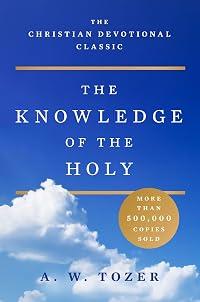
The Knowledge of the Holy
by A. W. Tozer
On This Page
Description
What is the nature of God? How to capture a real sense of God's majesty and truly live in the Spirit? This beloved book, a modern classic of Christian testimony and devotion, addresses these and other vital questions, showing how to rejuvenate prayer, meditate more reverently, understand God more deeply, and experience God's presence every day.Tags
Recommendations








Member Recommendations
Member Reviews
A classic for a reason. Tozer beautifully reflects on the essential attributes of God in short, easy-to-read chapters that stir the reader to apply the majesty of God's character to his or her own piety. Tozer rightly reminds us throughout the book that we can never separate any attribute of God from the others. God is unitary in his character; he is always merciful as he is always just as he is always love. Another brilliant aspect of Tozer's book is the equal time he spends reasoning about God's character from nature and revelation. Tozer undeniably affirms the necessity and sufficiency of Scripture, but he is not afraid of demonstrating the inner logic of the doctrine of God from reason alone. For example, to admit God is sovereign show more reinforces his omnipotence, omniscience, and freedom. Any deity who is the former must be all three.
His final chapter titled "The Open Secret" stands on its own as Tozer's final application. Knowing things about God is good and fine, but they mean nothing if they do not move us to know God in the personal and intimate kind of way. Many of our churches are hollow shells, Tozer claims, because many things are said in them about God but God is not known there. Renewing our knowledge about God precede revival. show less
His final chapter titled "The Open Secret" stands on its own as Tozer's final application. Knowing things about God is good and fine, but they mean nothing if they do not move us to know God in the personal and intimate kind of way. Many of our churches are hollow shells, Tozer claims, because many things are said in them about God but God is not known there. Renewing our knowledge about God precede revival. show less
First sentence from chapter one: What comes into our minds when we think about God is the most important thing about us. The history of mankind will probably show that no people has ever risen above its religion, and man’s spiritual history will positively demonstrate that no religion has ever been greater than its idea of God. Worship is pure or base as the worshiper entertains high or low thoughts of God. For this reason the gravest question before the Church is always God Himself, and the most portentous fact about any man is not what he at a given time may say or do, but what he in his deep heart conceives God to be like. We tend by a secret law of the soul to move toward our mental image of God. This is true not only of the show more individual Christian, but of the company of Christians that composes the Church. Always the most revealing thing about the Church is her idea of God, justas her most significant message is what she says about Him or leaves unsaid, for her silence is often more eloquent than her speech. She can never escape the self-disclosure of her witness concerning God.
I have read A.W. Tozer's Knowledge of the Holy four times now, I believe. I reviewed it in 2012, 2014, 2017, 2021, 2022, 2025. It is one of my all-time favorite books to read and reread. I always am struck by something new. I always find new quotes to share.
Can a book be both theological and devotional? It's a tricky combination to pull off, I think. But A.W. Tozer's classic Knowledge of the Holy is one of the best examples I've ever read. It is both theological--of substance and depth--and devotional--written with the pure intent to make your heart love and love greatly your Lord and Savior. Why learn more about God? So you can love him more, so you can worship him in spirit and truth. Tozer is urging readers to meditate on God, to meditate on God's glory--his majesty. He's saying DELIGHT IN GOD.
It is a short book that I'd recommend to just about anyone. It is a book EVERY Christian needs to consider picking up. Even if you're not typically a reader of theology.
Knowledge of the Holy is very reader-friendly. Each chapter is short--just three or four pages, which is why I think it would be a great choice for a devotional. The content has weight to it--it is a book ABOUT God how could it be anything else? Yet. At the same time, it is written in a style that is simple and straight-forward.
Why read A.W. Tozer's The Knowledge of the Holy?
Because…"It is impossible to keep our moral practices sound and our inward attitudes right while our idea of God is erroneous or inadequate. If we would bring back spiritual power to our lives, we must begin to think of God more nearly as He is."
Because…"What comes into our minds when we think about God is the most important thing about us."
Because…"Wrong ideas about God are not only the fountain from which the polluted waters of idolatry flow; they are themselves idolatrous. The idolater simply imagines things about God and acts as if they were true."
Because... "If we insist upon trying to imagine Him, we end with an idol, made not with hands but with thoughts; and an idol of the mind is as offensive to God as an idol of the hand."
Because…"We can never know who or what we are till we know at least something of what God is."
Because…"It is not a cheerful thought that millions of us who live in a land of Bibles, who belong to churches and labor to promote the Christian religion, may yet pass our whole life on this earth without once having thought or tried to think seriously about the being of God."
Technically, all those reasons are reasons to read the Good Book, the Word of God, Holy Scriptures. But I think the Holy Spirit can and will use Tozer's words--long after he's dead--to inspire new generations to seek God.
Favorite quotes:
It is impossible to keep our moral practices sound and our inward attitudes right while our idea of God is erroneous or inadequate. If we would bring back spiritual power to our lives, we must begin to think of God more nearly as He is.
Always the most revealing thing about the Church is her idea of God, just as her most significant message is what she says about Him or leaves unsaid, for her silence is often more eloquent than her speech. She can never escape the self-disclosure of her witness concerning God.
That our idea of God correspond as nearly as possible to the true being of God is of immense importance to us. Compared with our actual thoughts about Him, our creedal statements are of little consequence. Our real idea of God may lie buried under the rubbish of conventional religious notions and may require an intelligent and vigorous search before it is finally unearthed and exposed for what it is. Only after an ordeal of painful self-probing are we likely to discover what we actually believe about God.
Low views of God destroy the gospel for all who hold them.
The idolatrous heart assumes that God is other than He is - in itself a monstrous sin - and substitutes for the true God one made after its own likeness. Always this God will conform to the image of the one who created it and will be base or pure, cruel or kind, according to the moral state of the mind from which it emerges.
A god begotten in the shadows of a fallen heart will quite naturally be no true likeness of the true God.
The essence of idolatry is the entertainment of thoughts about God that are unworthy of Him. It begins in the mind and may be present where no overt act of worship has taken place.
The idolater simply imagines things about God and acts as if they were true.
If we insist upon trying to imagine Him, we end with an idol, made not with hands but with thoughts; and an idol of the mind is as offensive to God as an idol of the hand.
The study of the attributes of God, far from being dull and heavy, may for the enlightened Christian be a sweet and absorbing spiritual exercise. To the soul that is athirst for God, nothing could be more delightful.
An attribute of God is whatever God has in any way revealed as being true of Himself.
An attribute, as we can know it, is a mental concept, an intellectual response to God's self-revelation. It is an answer to a question, the reply God makes to our interrogation concerning himself.
The doctrine of the divine unity means not only that there is but one God; it means also that God is simple, uncomplex, one with Himself. He need not suspend one to exercise another, for in Him all His attributes are one. All of God does all that God does; He does not divide himself to perform a work, but works in the total unity of His being.
The divine attributes are what we know to be true of God. He does not possess them as qualities; they are how God is as He reveals Himself to His creatures. Love, for instance, is not something God has and which may grow or diminish or cease to be. His love is the way God is, and when He loves He is simply being Himself.
To meditate on the three Persons of the Godhead is to walk in thought through the garden eastward in Eden and to tread on holy ground.
Because we are the handiwork of God, it follows that all our problems and their solutions are theological.
The fact of God is necessary to the fact of man. Think God away and man has no ground of existence.
Sin has many manifestations but its essence is one. A moral being, created to worship before the throne of God, sits on the throne of his own selfhood and from that elevated position declares, "I AM." That is sin in its concentrated essence; yet because it is natural it appears to be good. It is only when in the gospel the soul is brought before the face of the Most Holy One without the protective shield of ignorance that the frightful moral incongruity is brought home to the conscience. In the language of evangelism the man who is thus confronted by the fiery presence of Almighty God is said to be under conviction.
The Christian religion has to do with God and man, but its focal point is God, not man. Man's only claim to importance is that he was created in the divine image; in himself he is nothing.
Unbelief is actually perverted faith, for it puts its trust not in the living God but in dying men.
For every man it must be Christ or eternal tragedy.
Abounding sin is the terror of the world, but abounding grace is the hope of mankind.
The Christian witness through the centuries has been that "God so loved the world . . ."; it remains for us to see that love in the light of God's infinitude. His love is measureless. It is more: it is boundless. It has no bounds because it is not a thing but a facet of the essential nature of God. His love is something He is, and because He is infinite that love can enfold the whole created world in itself and have room for ten thousand times ten thousand worlds beside.
God cannot change for the better. Since He is perfectly holy, He has never been less holy than He is now and can never be holier than He is and has always been. Neither can God change for the worse. Any deterioration within the unspeakably holy nature of God is impossible. Indeed I believe it impossible even to think of such a thing, for the moment we attempt to do so, the object about which we are thinking is no longer God but something else and someone less than He.
In God no change is possible; in men change is impossible to escape.
God never changes moods or cools off in His affections or loses enthusiasm. His attitude toward sin is now the same as it was when He drove out the sinful man from the eastward garden, and His attitude toward the sinner the same as when He stretched forth His hands and cried, "Come unto me, all ye that labour and are heavy laden, and I will give you rest."
God will not compromise and He need not be coaxed. He cannot be persuaded to alter His Word nor talked into answering selfish prayer. In all our efforts to find God, to please Him, to commune with Him, we should remember that all change must be on our part. "I am the Lord, I change not."
We can hold a correct view of truth only by daring to believe everything God has said about Himself.
We do God more honor by believing what He has said about Himself and having the courage to come boldly to the throne of grace than by hiding in self-conscious humility among the trees of the garden.
Hell is a place of no pleasure because there is no love there. Heaven is full of music because it is the place where the pleasures of holy love abound. Earth is the place where the pleasures of love are mixed with pain, for sin is here, and hate and ill will. In such a world as ours love must sometimes suffer, as Christ suffered in giving Himself for His own. show less
I have read A.W. Tozer's Knowledge of the Holy four times now, I believe. I reviewed it in 2012, 2014, 2017, 2021, 2022, 2025. It is one of my all-time favorite books to read and reread. I always am struck by something new. I always find new quotes to share.
Can a book be both theological and devotional? It's a tricky combination to pull off, I think. But A.W. Tozer's classic Knowledge of the Holy is one of the best examples I've ever read. It is both theological--of substance and depth--and devotional--written with the pure intent to make your heart love and love greatly your Lord and Savior. Why learn more about God? So you can love him more, so you can worship him in spirit and truth. Tozer is urging readers to meditate on God, to meditate on God's glory--his majesty. He's saying DELIGHT IN GOD.
It is a short book that I'd recommend to just about anyone. It is a book EVERY Christian needs to consider picking up. Even if you're not typically a reader of theology.
Knowledge of the Holy is very reader-friendly. Each chapter is short--just three or four pages, which is why I think it would be a great choice for a devotional. The content has weight to it--it is a book ABOUT God how could it be anything else? Yet. At the same time, it is written in a style that is simple and straight-forward.
Why read A.W. Tozer's The Knowledge of the Holy?
Because…"It is impossible to keep our moral practices sound and our inward attitudes right while our idea of God is erroneous or inadequate. If we would bring back spiritual power to our lives, we must begin to think of God more nearly as He is."
Because…"What comes into our minds when we think about God is the most important thing about us."
Because…"Wrong ideas about God are not only the fountain from which the polluted waters of idolatry flow; they are themselves idolatrous. The idolater simply imagines things about God and acts as if they were true."
Because... "If we insist upon trying to imagine Him, we end with an idol, made not with hands but with thoughts; and an idol of the mind is as offensive to God as an idol of the hand."
Because…"We can never know who or what we are till we know at least something of what God is."
Because…"It is not a cheerful thought that millions of us who live in a land of Bibles, who belong to churches and labor to promote the Christian religion, may yet pass our whole life on this earth without once having thought or tried to think seriously about the being of God."
Technically, all those reasons are reasons to read the Good Book, the Word of God, Holy Scriptures. But I think the Holy Spirit can and will use Tozer's words--long after he's dead--to inspire new generations to seek God.
Favorite quotes:
It is impossible to keep our moral practices sound and our inward attitudes right while our idea of God is erroneous or inadequate. If we would bring back spiritual power to our lives, we must begin to think of God more nearly as He is.
Always the most revealing thing about the Church is her idea of God, just as her most significant message is what she says about Him or leaves unsaid, for her silence is often more eloquent than her speech. She can never escape the self-disclosure of her witness concerning God.
That our idea of God correspond as nearly as possible to the true being of God is of immense importance to us. Compared with our actual thoughts about Him, our creedal statements are of little consequence. Our real idea of God may lie buried under the rubbish of conventional religious notions and may require an intelligent and vigorous search before it is finally unearthed and exposed for what it is. Only after an ordeal of painful self-probing are we likely to discover what we actually believe about God.
Low views of God destroy the gospel for all who hold them.
The idolatrous heart assumes that God is other than He is - in itself a monstrous sin - and substitutes for the true God one made after its own likeness. Always this God will conform to the image of the one who created it and will be base or pure, cruel or kind, according to the moral state of the mind from which it emerges.
A god begotten in the shadows of a fallen heart will quite naturally be no true likeness of the true God.
The essence of idolatry is the entertainment of thoughts about God that are unworthy of Him. It begins in the mind and may be present where no overt act of worship has taken place.
The idolater simply imagines things about God and acts as if they were true.
If we insist upon trying to imagine Him, we end with an idol, made not with hands but with thoughts; and an idol of the mind is as offensive to God as an idol of the hand.
The study of the attributes of God, far from being dull and heavy, may for the enlightened Christian be a sweet and absorbing spiritual exercise. To the soul that is athirst for God, nothing could be more delightful.
An attribute of God is whatever God has in any way revealed as being true of Himself.
An attribute, as we can know it, is a mental concept, an intellectual response to God's self-revelation. It is an answer to a question, the reply God makes to our interrogation concerning himself.
The doctrine of the divine unity means not only that there is but one God; it means also that God is simple, uncomplex, one with Himself. He need not suspend one to exercise another, for in Him all His attributes are one. All of God does all that God does; He does not divide himself to perform a work, but works in the total unity of His being.
The divine attributes are what we know to be true of God. He does not possess them as qualities; they are how God is as He reveals Himself to His creatures. Love, for instance, is not something God has and which may grow or diminish or cease to be. His love is the way God is, and when He loves He is simply being Himself.
To meditate on the three Persons of the Godhead is to walk in thought through the garden eastward in Eden and to tread on holy ground.
Because we are the handiwork of God, it follows that all our problems and their solutions are theological.
The fact of God is necessary to the fact of man. Think God away and man has no ground of existence.
Sin has many manifestations but its essence is one. A moral being, created to worship before the throne of God, sits on the throne of his own selfhood and from that elevated position declares, "I AM." That is sin in its concentrated essence; yet because it is natural it appears to be good. It is only when in the gospel the soul is brought before the face of the Most Holy One without the protective shield of ignorance that the frightful moral incongruity is brought home to the conscience. In the language of evangelism the man who is thus confronted by the fiery presence of Almighty God is said to be under conviction.
The Christian religion has to do with God and man, but its focal point is God, not man. Man's only claim to importance is that he was created in the divine image; in himself he is nothing.
Unbelief is actually perverted faith, for it puts its trust not in the living God but in dying men.
For every man it must be Christ or eternal tragedy.
Abounding sin is the terror of the world, but abounding grace is the hope of mankind.
The Christian witness through the centuries has been that "God so loved the world . . ."; it remains for us to see that love in the light of God's infinitude. His love is measureless. It is more: it is boundless. It has no bounds because it is not a thing but a facet of the essential nature of God. His love is something He is, and because He is infinite that love can enfold the whole created world in itself and have room for ten thousand times ten thousand worlds beside.
God cannot change for the better. Since He is perfectly holy, He has never been less holy than He is now and can never be holier than He is and has always been. Neither can God change for the worse. Any deterioration within the unspeakably holy nature of God is impossible. Indeed I believe it impossible even to think of such a thing, for the moment we attempt to do so, the object about which we are thinking is no longer God but something else and someone less than He.
In God no change is possible; in men change is impossible to escape.
God never changes moods or cools off in His affections or loses enthusiasm. His attitude toward sin is now the same as it was when He drove out the sinful man from the eastward garden, and His attitude toward the sinner the same as when He stretched forth His hands and cried, "Come unto me, all ye that labour and are heavy laden, and I will give you rest."
God will not compromise and He need not be coaxed. He cannot be persuaded to alter His Word nor talked into answering selfish prayer. In all our efforts to find God, to please Him, to commune with Him, we should remember that all change must be on our part. "I am the Lord, I change not."
We can hold a correct view of truth only by daring to believe everything God has said about Himself.
We do God more honor by believing what He has said about Himself and having the courage to come boldly to the throne of grace than by hiding in self-conscious humility among the trees of the garden.
Hell is a place of no pleasure because there is no love there. Heaven is full of music because it is the place where the pleasures of holy love abound. Earth is the place where the pleasures of love are mixed with pain, for sin is here, and hate and ill will. In such a world as ours love must sometimes suffer, as Christ suffered in giving Himself for His own. show less
"What comes into our minds when we think about God is the most important thing about us."
In this slim and accessible little volume, A. W. Tozer seeks to recapture some of the grandeur of God that has been missing from evangelical Christianity since, he contends, the middle of the twentieth century. He says we have reduced God to our level or see Him as like us but just more powerful, and we cajole and flatter Him so He will give us what we want. In reality, the God of the Bible crashes all our little images of Him and poses uncomfortable truths that strain our minds to even begin to comprehend. He is Uncreated; we are created, and here is the most fundamental difference and the core of what we cannot fathom. He is beyond our show more understanding, and yet He has revealed truths about Himself that we need to know, in words we can understand.
There are many basic principles Tozer states that are crucial to a right relationship with and understanding of God. First, when we imagine God to be anything other than how He has revealed Himself in Scripture, we are not worshiping the true God but a god we have made up. Second, there are truths about God that are plainly taught in Scripture that may appear contradictory, but we do not have to reconcile everything perfectly in order to believe what God has said. Third, all our failures in practical Christian living can be traced back to wrong beliefs we hold about the character and nature of God. There is nothing more critical to right living than right doctrine.
As I read this book, I was struck by how familiarly I approach God. Yes, I come to Him on the basis of His Son and the sacrifice He made on the Cross to satisfy God's justice and permit me to approach with confidence as a daughter before the throne. But I, like so many of the Christians Tozer bemoans, have lost the idea of the majesty of God, His unknowableness, His inaccessibility as Uncreated to the created like me. I have been guilty of considering the best created things I know and then upping their qualities as far as I can imagine to provide me with a picture of God — forgetting or never fully realizing that He is completely unique from everything else in the Universe and though we try to approach an understanding of Him by comparing Him with created things, we have to be careful to remember He is beyond that plane of the created. He is ultimately beyond what we can fully know.
There were three tiny quibbles I had with this book. First, Tozer twice calls the men who wrote Scripture "inspired," but it is far more accurate to state that it is Scripture that was inspired, not the men who penned it. Second, Tozer mentions in passing that man has a body, soul, and spirit, which is, I think, inaccurate, as biblically man is treated as a two-part being, physical and spiritual, with soul and spirit being used interchangeably to describe the same thing (that is, man's spiritual side). Third, in the chapter on God's sovereignty Tozer is overly simplistic in dismissing the views of Christians who fall into the Arminian and Calvinist camps. What he describes as the relation between God's complete sovereignty and man's free will is very much what I would say — but I consider myself a staunch Calvinist. These three things are tiny in comparison with the overarching whole, which is excellent, but I wanted to call them out because Tozer is not writing an inspired book, wonderful as it may be.
The style is accessible and yet formal, too. Tozer often falls into using the rich archaic of the KJV, with Thees and Thous abounding. It gives a rich texture to the language and helps elevate the ideas Tozer is discussing, putting yet more healthy distance between us and God. I am not sure that every reader would enjoy this style, but I drank it up.
Some representative quotes:
"A right conception of God is basic not only to systematic theology but to practical Christian living as well... I believe there is scarcely an error in doctrine or a failure in applying Christian ethics that cannot be traced finally to imperfect and ignoble thoughts about God." (ch. 1, Why We Must Think Rightly About God)
"The yearning to know What cannot be known, to comprehend the Incomprehensible, to touch and taste the Unapproachable, arises from the image of God in the nature of man. Deep calleth unto deep, and though polluted and landlocked by the mighty disaster theologians call the Fall, the soul senses its origin and longs to return to its source." (ch. 2, God Incomprehensible)
"What God declares the believing heart confesses without the need of further proof. Indeed, to seek proof is to admit doubt, and to obtain proof is to render faith superfluous." (ch. 4, The Holy Trinity)
"So subtle is self that scarcely anyone is conscious of its presence. Because man is born a rebel, he is unaware that he is one. His constant assertion of self, as far as he thinks of it at all, appears to him a perfectly normal thing. He is willing to share himself, sometimes even to sacrifice himself for a desired end, but never to dethrone himself." (ch. 5, The Self-Existence of God)
"Life is a short and fevered rehearsal for a concert we cannot stay to give. Just when we appear to have attained some proficiency we are forced to lay our instruments down... How completely satisfying to turn from our limitations to a God who has none." (ch. 8, God's Infinitude)
"In this world where men forget us, change their attitude toward us as their private interests dictate, and revise their opinion of us for the slightest cause, is it not a source of wondrous strength to know that the God with whom we have to do changes not? That His attitude toward us now is the same as it was in eternity past and will be in eternity to come?" (ch. 9, The Immutability of God)
"We can hold a correct view of truth only by daring to believe everything God has said about Himself." (ch. 15, The Faithfulness of God)
"The greatness of God rouses fear within us, but His goodness encourages us not to be afraid of Him. To fear and not be afraid—that is the paradox of faith." (ch. 16, The Goodness of God)
"It is a strange and beautiful eccentricity of the free God that He has allowed His heart to be emotionally identified with men. Self-sufficient as He is, He wants our love and will not be satisfied till He gets it. Free as He is, He has let His heart be bound to us forever." (ch. 20, The Love of God)
I see myself returning to this book and sharing it with others, especially new believers who need to know how different the true God is from our erroneous default views of Him. With its devotional tone, it could also be very beneficial as a small group study. Recommended. show less
In this slim and accessible little volume, A. W. Tozer seeks to recapture some of the grandeur of God that has been missing from evangelical Christianity since, he contends, the middle of the twentieth century. He says we have reduced God to our level or see Him as like us but just more powerful, and we cajole and flatter Him so He will give us what we want. In reality, the God of the Bible crashes all our little images of Him and poses uncomfortable truths that strain our minds to even begin to comprehend. He is Uncreated; we are created, and here is the most fundamental difference and the core of what we cannot fathom. He is beyond our show more understanding, and yet He has revealed truths about Himself that we need to know, in words we can understand.
There are many basic principles Tozer states that are crucial to a right relationship with and understanding of God. First, when we imagine God to be anything other than how He has revealed Himself in Scripture, we are not worshiping the true God but a god we have made up. Second, there are truths about God that are plainly taught in Scripture that may appear contradictory, but we do not have to reconcile everything perfectly in order to believe what God has said. Third, all our failures in practical Christian living can be traced back to wrong beliefs we hold about the character and nature of God. There is nothing more critical to right living than right doctrine.
As I read this book, I was struck by how familiarly I approach God. Yes, I come to Him on the basis of His Son and the sacrifice He made on the Cross to satisfy God's justice and permit me to approach with confidence as a daughter before the throne. But I, like so many of the Christians Tozer bemoans, have lost the idea of the majesty of God, His unknowableness, His inaccessibility as Uncreated to the created like me. I have been guilty of considering the best created things I know and then upping their qualities as far as I can imagine to provide me with a picture of God — forgetting or never fully realizing that He is completely unique from everything else in the Universe and though we try to approach an understanding of Him by comparing Him with created things, we have to be careful to remember He is beyond that plane of the created. He is ultimately beyond what we can fully know.
There were three tiny quibbles I had with this book. First, Tozer twice calls the men who wrote Scripture "inspired," but it is far more accurate to state that it is Scripture that was inspired, not the men who penned it. Second, Tozer mentions in passing that man has a body, soul, and spirit, which is, I think, inaccurate, as biblically man is treated as a two-part being, physical and spiritual, with soul and spirit being used interchangeably to describe the same thing (that is, man's spiritual side). Third, in the chapter on God's sovereignty Tozer is overly simplistic in dismissing the views of Christians who fall into the Arminian and Calvinist camps. What he describes as the relation between God's complete sovereignty and man's free will is very much what I would say — but I consider myself a staunch Calvinist. These three things are tiny in comparison with the overarching whole, which is excellent, but I wanted to call them out because Tozer is not writing an inspired book, wonderful as it may be.
The style is accessible and yet formal, too. Tozer often falls into using the rich archaic of the KJV, with Thees and Thous abounding. It gives a rich texture to the language and helps elevate the ideas Tozer is discussing, putting yet more healthy distance between us and God. I am not sure that every reader would enjoy this style, but I drank it up.
Some representative quotes:
"A right conception of God is basic not only to systematic theology but to practical Christian living as well... I believe there is scarcely an error in doctrine or a failure in applying Christian ethics that cannot be traced finally to imperfect and ignoble thoughts about God." (ch. 1, Why We Must Think Rightly About God)
"The yearning to know What cannot be known, to comprehend the Incomprehensible, to touch and taste the Unapproachable, arises from the image of God in the nature of man. Deep calleth unto deep, and though polluted and landlocked by the mighty disaster theologians call the Fall, the soul senses its origin and longs to return to its source." (ch. 2, God Incomprehensible)
"What God declares the believing heart confesses without the need of further proof. Indeed, to seek proof is to admit doubt, and to obtain proof is to render faith superfluous." (ch. 4, The Holy Trinity)
"So subtle is self that scarcely anyone is conscious of its presence. Because man is born a rebel, he is unaware that he is one. His constant assertion of self, as far as he thinks of it at all, appears to him a perfectly normal thing. He is willing to share himself, sometimes even to sacrifice himself for a desired end, but never to dethrone himself." (ch. 5, The Self-Existence of God)
"Life is a short and fevered rehearsal for a concert we cannot stay to give. Just when we appear to have attained some proficiency we are forced to lay our instruments down... How completely satisfying to turn from our limitations to a God who has none." (ch. 8, God's Infinitude)
"In this world where men forget us, change their attitude toward us as their private interests dictate, and revise their opinion of us for the slightest cause, is it not a source of wondrous strength to know that the God with whom we have to do changes not? That His attitude toward us now is the same as it was in eternity past and will be in eternity to come?" (ch. 9, The Immutability of God)
"We can hold a correct view of truth only by daring to believe everything God has said about Himself." (ch. 15, The Faithfulness of God)
"The greatness of God rouses fear within us, but His goodness encourages us not to be afraid of Him. To fear and not be afraid—that is the paradox of faith." (ch. 16, The Goodness of God)
"It is a strange and beautiful eccentricity of the free God that He has allowed His heart to be emotionally identified with men. Self-sufficient as He is, He wants our love and will not be satisfied till He gets it. Free as He is, He has let His heart be bound to us forever." (ch. 20, The Love of God)
I see myself returning to this book and sharing it with others, especially new believers who need to know how different the true God is from our erroneous default views of Him. With its devotional tone, it could also be very beneficial as a small group study. Recommended. show less
A re-read after many years. I came away even more impressed with Tozer's simple, succinct, clear, and profound description of God. It is a classic for a reason, or possibly many. An unvarnished truth told through a mastery of language, from the heart of one who loves the One so ... it's all here.
Immensely rich in its meaning and profoundly insightful! One of Tozer's remarkable gems, ‘The Knowledge of the Holy’ is a wonderful classic, where he deals with the Divine Attributes of God. Having a right view of God will not only allow us to worship better, but will also help us in our practical issues as well. God operates with an infinite number of attributes and all simultaneously and equally. By limiting Him we reduce His influence on the world and our lives. Nothing is more important than a right understanding of God, or thinking rightly about God. When it comes to our thinking about God, everything is at stake. We must think deeply and accurately about God if we are to know Him and worship Him rightly and truthfully.
A show more thorough reading of this book highlights so many truths about God. We are plunged into the depths of God's character and nature and are left in a state of awe and worship in the presence of a Gracious God. Tozer’s motivation for writing this book was a complaint that christians have forgotten the great writers of the past and that we no longer think particularly highly of God. Crucial to Tozer’s idea is that we worship God as It truly is, lest we come up with ideas about God which are either misguided or incomplete which would lead to a kind of idolatry; this is an idea I wholeheartedly agree with and is the motivation behind why I constantly try to understand God, Christianity and scripture.
I think Tozer does just as good a job of discussing the metaphysical attributes of God as any introductory theology textbook would do. Tozer greatly presented that Theology should never be dry. I found myself blessed as I meditated with Tozer on the majesty and the magnitude of God. This is a must-read, in my opinion, for those who are seeking God with their whole heart. I thoroughly enjoyed reading this book. It reminds me that I need to regularly take time to meditate upon the nature and attributes of God. A high view of God puts each aspect of my life into right perspective. show less
A show more thorough reading of this book highlights so many truths about God. We are plunged into the depths of God's character and nature and are left in a state of awe and worship in the presence of a Gracious God. Tozer’s motivation for writing this book was a complaint that christians have forgotten the great writers of the past and that we no longer think particularly highly of God. Crucial to Tozer’s idea is that we worship God as It truly is, lest we come up with ideas about God which are either misguided or incomplete which would lead to a kind of idolatry; this is an idea I wholeheartedly agree with and is the motivation behind why I constantly try to understand God, Christianity and scripture.
I think Tozer does just as good a job of discussing the metaphysical attributes of God as any introductory theology textbook would do. Tozer greatly presented that Theology should never be dry. I found myself blessed as I meditated with Tozer on the majesty and the magnitude of God. This is a must-read, in my opinion, for those who are seeking God with their whole heart. I thoroughly enjoyed reading this book. It reminds me that I need to regularly take time to meditate upon the nature and attributes of God. A high view of God puts each aspect of my life into right perspective. show less
Probably one of the best books I have ever read. I wish I had taken a Christian Theology class in college with this as the textbook. While this is a short book and can be read in one sitting, it definitely has to be read very carefully, thoughtfully, leisurely, meditatively and slowly. I found myself reading certain passages and then picking up my Bible. I don't think you have to agree with every single thing that Tozer presents. I think he wants the reader to search the truth on their own. I can't wait to read more books and essays by Tozer.
I always enjoy Tozer's writing style. Knowledge of the Holy is yet another wonderful, thoughtful work. This was an easy read too. The chapters are short and the topics deep. I recommend this for anyone venturing into personal holiness - it's a good launching point into longer, deeper books. Worthwhile.
Members
- Recently Added By
Lists

Top 100 Christian Books
13 works; 3 members

Develop Your Personal Christian Library
101 works; 15 members
Christianity Books You've Read
179 works; 19 members
Trinity Norman Recommended Christian Readings
170 works; 5 members

Xenos Christian Fellowship Book Suggestions
102 works; 2 members

Top 50 Books That Have Shaped Evangelical Christians
49 works; 6 members
Generation Joshua
115 works; 3 members
Author Information

387 Works 33,731 Members
Aiden W. Tozer was born in La Jose, Pennsylvania on April 21, 1897. He was raised on a farm and never received more than an elementary school education. While on his way home from the Akron, Ohio tire company where he worked as a teen, Tozer overheard a street preacher and decided to follow Christ. In 1919, he accepted an offer to pastor his first show more church in Nutter Fort, West Virginia, which began 44 years of ministry with the Christian and Missionary Alliance. He served as pastor of the Southside Alliance Church in Chicago from 1928 to 1959 and spent his final years as pastor at the Avenue Road (Alliance) Church in Toronto, Canada. He wrote more than 40 books during his lifetime including The Pursuit of God and The Knowledge of the Holy: The Attributes of God - Their Meaning in the Christian Life. He died on May 12, 1963 at the age of 66. (Bowker Author Biography) show less
Awards and Honors
Notable Lists
Series
Belongs to Publisher Series
Work Relationships
Inspired
Common Knowledge
- Canonical title
- The Knowledge of the Holy
- Original title
- The knowledge of the holy : the attributes of God, their meaning in the Christian life
- Original publication date
- 1961
- First words
- [Preface] True religion confronts earth with heaven and brings eternity to bear upon time.
What comes into our minds when we think about God is the most important thing about us. - Last words
- (Click to show. Warning: May contain spoilers.)[Preface] It is my hope that this small book may contribute somewhat to the promotion of personal heart religion among us; and should a few persons by reading it be encouraged to begin the practice of reverent meditation on the being of God, that will more than repay the labor required to produce it.
(Click to show. Warning: May contain spoilers.)There is a glorified Man on the right hand of the Majesty in heaven faithfully representing us there. We are left for a season among men; let us faithfully represent Him here.
Classifications
Statistics
- Members
- 5,257
- Popularity
- 2,588
- Reviews
- 31
- Rating
- (4.33)
- Languages
- 8 — Chinese, English, French, German, Hungarian, Spanish, Swedish, Portuguese (Portugal)
- Media
- Paper, Audiobook, Ebook
- ISBNs
- 58
- UPCs
- 1
- ASINs
- 42