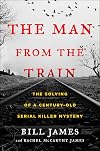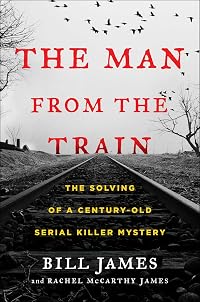
The Man from the Train: The Solving of a Century-Old Serial Killer Mystery
by Bill James, Rachel McCarthy James (Author)
On This Page
Description
An Edgar Award finalist for Best Fact Crime, this "impressive...open-eyed investigative inquiry wrapped within a cultural history of rural America" (The Wall Street Journal) shows legendary statistician and baseball writer Bill James applying his analytical acumen to crack an unsolved century-old mystery surrounding one of the deadliest serial killers in American history.Between 1898 and 1912, families across the country were bludgeoned in their sleep with the blunt side of an axe. Jewelry show more and valuables were left in plain sight, bodies were piled together, faces covered with cloth. Some of these cases, like the infamous Villasca, Iowa, murders, received national attention. But few people believed the crimes were related. And fewer still would realize that all of these families lived within walking distance to a train station.
When celebrated baseball statistician and true crime expert Bill James first learned about these horrors, he began to investigate others that might fit the same pattern. Applying the same know-how he brings to his legendary baseball analysis, he empirically determined which crimes were committed by the same person. Then after sifting through thousands of local newspapers, court transcripts, and public records, he and his daughter Rachel made an astonishing discovery: they learned the true identity of this monstrous criminal. In turn, they uncovered one of the deadliest serial killers in America.
Riveting and immersive, with writing as sharp as the cold side of an axe, The Man from the Train paints a vivid, psychologically perceptive portrait of America at the dawn of the twentieth century, when crime was regarded as a local problem, and opportunistic private detectives exploited a dysfunctional judicial system. James shows how these cultural factors enabled such an unspeakable series of crimes to occur, and his groundbreaking approach to true crime will convince skeptics, amaze aficionados, and change the way we view criminal history. show less
Tags
Recommendations















Member Reviews
In The Man From the Train, James (with research assistance from McCarthy James), tackles the unsolved ax murders that shook America in the early to mid 1900s. Using his statistician background, James analyzes the crimes to prove they were part of a series, committed by one man, and then tells you who that one man was.
This is an amazing, fascinating, gripping read (I read the last 300 pages in one sitting). James' previous true crime book, Popular Crime, is one of my all-time favorites. He has a really unique take on true crime because of his mathematics background-but don't worry if you aren't a math person (I am not in any way a math person), because James' doesn't throw formulas at you. He uses his skills to analyze data and present a show more solution that no one has come up with before. James' also has this fantastically wry writer's style, that will have you giggling at times, even in the middle of a true crime book.
I would definitely, 100% recommend this book. And I would also 100% recommend that while you're picking this book up, get James' Popular Crime. show less
This is an amazing, fascinating, gripping read (I read the last 300 pages in one sitting). James' previous true crime book, Popular Crime, is one of my all-time favorites. He has a really unique take on true crime because of his mathematics background-but don't worry if you aren't a math person (I am not in any way a math person), because James' doesn't throw formulas at you. He uses his skills to analyze data and present a show more solution that no one has come up with before. James' also has this fantastically wry writer's style, that will have you giggling at times, even in the middle of a true crime book.
I would definitely, 100% recommend this book. And I would also 100% recommend that while you're picking this book up, get James' Popular Crime. show less
Years ago, I read on a website listing top unsolved murders a report of the 1911 murders of six people in two adjacent houses on West Dale Street in Colorado Springs. These murders were of particular interest to me as I once lived on West Dale Street in Colorado Springs. Both families were apparently bludgeoned in their sleep in the middle of the night. Nothing was stolen and the houses were then closed up and the murder weapon, a bloody axe, was found leaning against the wall of one of the houses. Pretty hairy stuff to have happened just down the street from your house, even if it was seventy-odd years earlier.
So when Scribner announced recently that a book was soon to be released about a string of serial killings that occurred mostly show more between the years 1910 and 1912 in which an unknown person used an axe or similar item found at the scene to murder families in their beds in houses near railroad tracks (the 300 block of West Dale is less than three blocks from the D&RGW tracks), I knew this was a book I had to read.
Thank god I waited until a library copy was available.
While the book contains a lot of fascinating information about a truly horrific series of murders, the writing is wretched beyond words. Author Bill James began his career by self-publishing books on the statistical analytics of baseball, a springboard which secured him a job with the Boston Red Sox and a reputation that was said to influence Nate Silvers Fivethirtyeight.com and The Upshot at the New York Times. In 2011, though, he decided to change course and published Popular Crime, a disjointed mishmash about a wide variety of notorious criminal cases. He does not shy away from unlikely theories, as indicated by his assertion that President Kennedy was killed by the accidental discharge of a Secret Service officer’s weapon.
James’ conversational tone may work well in writing about baseball games but when talking about murderers, or more importantly, their victims, folksy banter comes off as disrespectful and just plain weird.
“After their marriage they moved to Centerville, Ohio, where they boarded with Mr. and Mrs. George W. Coe. (We might say they coe-habited with them [you might, but you shouldn’t]...Anna's maiden name was—"Axxe"really—but we're going to let that pass without comment.”[You should have, but didn’t])
In other cases James’ tone is almost conspiratorial which make me feel in need of a shower.
"Something in the room would later cause the chief detective to describe the perpetrator as a “moral pervert”; what that was was never revealed, but you and I know."
Shudder!
In one chapter he lists four reasons why a particular set of killings should not be considered as one of this series with the first reason being that there was insufficient information to include it. Then he immediately offers ten reasons why it should be included ending with "The absence of any factor that would make us think that it isn’t him." In short, he has two contradictory lists that each say that there is no data belonging in the other list. Go figure.
Bottom line: I’m torn on how to rank this as I’d like to give it five stars for the material but only one star for the writing which is abominable. The only thing that is keeping me reading it is the desire to find out what happens but the author's history of favoring unlikely conspiracy theories makes me wonder if I will be able to trust his conclusions. Additionally, the book is lacking an index, footnotes, pictures, or much in the way of maps that would help readers gain a better understanding of the case. While the material in this book is very interesting, the author makes enjoying the book all but impossible. The writing is disjointed. He regularly refers to cases which have yet to be mentioned in the book. At one point he admitted that newspaper accounts of a certain murder exist but admitted that he hadn’t bothered to read them. I can’t be sure what research he actually did and what material he lifted from the research of others. Sometimes I wonder why I keep reading this, and yet I do. It's like watching a car wreck. I can't turn away.
FYI: On a 5-point scale I assign stars based on my assessment of what the book needs in the way of improvements:
*5 Stars – Nothing at all. If it ain’t broke, don’t fix it.
*4 Stars – It could stand for a few tweaks here and there but it’s pretty good as it is.
*3 Stars – A solid C grade. Some serious rewriting would be needed in order for this book to be considered great or even memorable.
*2 Stars – This book needs a lot of work. A good start would be to change the plot, the character development, the writing style and the ending.
*1 Star – The only thing that would improve this book is a good bonfire. show less
So when Scribner announced recently that a book was soon to be released about a string of serial killings that occurred mostly show more between the years 1910 and 1912 in which an unknown person used an axe or similar item found at the scene to murder families in their beds in houses near railroad tracks (the 300 block of West Dale is less than three blocks from the D&RGW tracks), I knew this was a book I had to read.
Thank god I waited until a library copy was available.
While the book contains a lot of fascinating information about a truly horrific series of murders, the writing is wretched beyond words. Author Bill James began his career by self-publishing books on the statistical analytics of baseball, a springboard which secured him a job with the Boston Red Sox and a reputation that was said to influence Nate Silvers Fivethirtyeight.com and The Upshot at the New York Times. In 2011, though, he decided to change course and published Popular Crime, a disjointed mishmash about a wide variety of notorious criminal cases. He does not shy away from unlikely theories, as indicated by his assertion that President Kennedy was killed by the accidental discharge of a Secret Service officer’s weapon.
James’ conversational tone may work well in writing about baseball games but when talking about murderers, or more importantly, their victims, folksy banter comes off as disrespectful and just plain weird.
“After their marriage they moved to Centerville, Ohio, where they boarded with Mr. and Mrs. George W. Coe. (We might say they coe-habited with them [you might, but you shouldn’t]...Anna's maiden name was—"Axxe"really—but we're going to let that pass without comment.”[You should have, but didn’t])
In other cases James’ tone is almost conspiratorial which make me feel in need of a shower.
"Something in the room would later cause the chief detective to describe the perpetrator as a “moral pervert”; what that was was never revealed, but you and I know."
Shudder!
In one chapter he lists four reasons why a particular set of killings should not be considered as one of this series with the first reason being that there was insufficient information to include it. Then he immediately offers ten reasons why it should be included ending with "The absence of any factor that would make us think that it isn’t him." In short, he has two contradictory lists that each say that there is no data belonging in the other list. Go figure.
Bottom line: I’m torn on how to rank this as I’d like to give it five stars for the material but only one star for the writing which is abominable. The only thing that is keeping me reading it is the desire to find out what happens but the author's history of favoring unlikely conspiracy theories makes me wonder if I will be able to trust his conclusions. Additionally, the book is lacking an index, footnotes, pictures, or much in the way of maps that would help readers gain a better understanding of the case. While the material in this book is very interesting, the author makes enjoying the book all but impossible. The writing is disjointed. He regularly refers to cases which have yet to be mentioned in the book. At one point he admitted that newspaper accounts of a certain murder exist but admitted that he hadn’t bothered to read them. I can’t be sure what research he actually did and what material he lifted from the research of others. Sometimes I wonder why I keep reading this, and yet I do. It's like watching a car wreck. I can't turn away.
FYI: On a 5-point scale I assign stars based on my assessment of what the book needs in the way of improvements:
*5 Stars – Nothing at all. If it ain’t broke, don’t fix it.
*4 Stars – It could stand for a few tweaks here and there but it’s pretty good as it is.
*3 Stars – A solid C grade. Some serious rewriting would be needed in order for this book to be considered great or even memorable.
*2 Stars – This book needs a lot of work. A good start would be to change the plot, the character development, the writing style and the ending.
*1 Star – The only thing that would improve this book is a good bonfire. show less
Beginning with the infamous Villisca, Iowa murders, James began researching other axe murders of the time, and this became a chain of murders that had too much in common to not be connected. What he found was a remarkably large number of families, sometimes the entire family of up to nine people, all killed in the same way, with the same type of entry to the home and at the same time, often on Sundays. He found the same strange "signatures" of a kerosene lamp being lit but the chimney removed, the family's valuables displayed to show that theft wasn't the objective, and sometimes the house set on fire.
By combing through newspapers, police files and historical records, James believes he's uncovered a single man who committed over 100 show more murders between 1898 to 1912, a man whose crimes happened wherever there was a train stop to jump off from Maine to Florida to Washington.
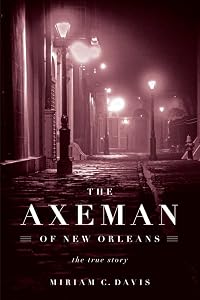
Who knew there were so many families being killed with axes over 100 years ago? James has uncovered whole families wiped out and forgotten with just a newspaper paragraph while the Moores of Villisca remain famous. If the author, a long-time author of baseball books, is correct and these murders were the work of a single man, he'd be the most prolific in American history. The research here is meticulous. James goes through each murder discussed and explains why he believes it is or isn't the work of The Man From the Train. Along the way he discusses police or court proceedings of the time, the laws, racism, lumber and saw mills, and both the "New Orleans Axe Man" and Clementine Barabet. And most surprising is that he gives a name to the killer. This is 460 pages and at that length could have benefited from an index, but it's length is mostly due to all those murders. show less
By combing through newspapers, police files and historical records, James believes he's uncovered a single man who committed over 100 show more murders between 1898 to 1912, a man whose crimes happened wherever there was a train stop to jump off from Maine to Florida to Washington.
Who knew there were so many families being killed with axes over 100 years ago? James has uncovered whole families wiped out and forgotten with just a newspaper paragraph while the Moores of Villisca remain famous. If the author, a long-time author of baseball books, is correct and these murders were the work of a single man, he'd be the most prolific in American history. The research here is meticulous. James goes through each murder discussed and explains why he believes it is or isn't the work of The Man From the Train. Along the way he discusses police or court proceedings of the time, the laws, racism, lumber and saw mills, and both the "New Orleans Axe Man" and Clementine Barabet. And most surprising is that he gives a name to the killer. This is 460 pages and at that length could have benefited from an index, but it's length is mostly due to all those murders. show less
It 'jaws.' It's folksy and sometimes the thread is hopelessly lost before reappearing several chapters down the line. There's a little of this and a little of that until finally, without annoying foreshadowing, it reaches its conclusion. If you enjoy chewing the fat about crimes that can never be solved, this is an enjoyable ramble. Not for forensic ideologists.
I'm surprised this book received so many low ratings. I have absolutely no doubt that Bill James and his daughter hold the world record for solving the coldest case. They simply screened old newspaper accounts of axe murders and compiled a list of the ones that shared the same M.O. There are about seventeen facets to the M.O. which makes the argument highly persuasive. For example, you might expect that an axe murder is done with the sharp edge of the axe and I suppose that is most often the case, at least that is how I would do it if I was so inclined. But no, all these killings were done with the blunt side of the axe head. Of course, when the serial killer started he made mistakes and refined his technique. And when fingerprinting show more was developed he began wiping away that evidence.
There is a two-chapter digression about the aftermath of the most notorious of the murders, the ones in Vilisca, Iowa but I think the Jameses tell the reader where to skip ahead to if they are not interested.
The descriptions of the murders themselves and the solving of them would have been enough to make this a worthwhile read but the Jameses also tell the story of the mortal dilemmas of those falsely accused of the crimes and of the sorry state of crime solving that allowed this serial killer to always escape detection. I found Bill James' informal diction and tone extremely enjoyable. At one point in describing the serial killer's stealth and cunning he writes that he would have shit his pants if he had been in the victim's situation!
So this deserves an Amazing! rating because they solve the crimes; not just provide a profile of some shadowy hypothetical villain for others to follow up on but actually provide a name. show less
There is a two-chapter digression about the aftermath of the most notorious of the murders, the ones in Vilisca, Iowa but I think the Jameses tell the reader where to skip ahead to if they are not interested.
The descriptions of the murders themselves and the solving of them would have been enough to make this a worthwhile read but the Jameses also tell the story of the mortal dilemmas of those falsely accused of the crimes and of the sorry state of crime solving that allowed this serial killer to always escape detection. I found Bill James' informal diction and tone extremely enjoyable. At one point in describing the serial killer's stealth and cunning he writes that he would have shit his pants if he had been in the victim's situation!
So this deserves an Amazing! rating because they solve the crimes; not just provide a profile of some shadowy hypothetical villain for others to follow up on but actually provide a name. show less
I have been a fan of Bill James ever since I discovered his first annual Baseball Abstract back in the seventies. James has a way of looking at the same data that everyone else has and coming up with very different and unique conclusions. His work eventually led to a revolution of sorts in the way that baseball General Managers think, and the game has never been the same. So, when I saw that James was applying his analytical talents to a series of 100-year-old murders that had never been solved, I jumped all over The Man from the Train.
A little over one hundred years ago, there was a series of horrific murders in which whole families in the South, Northeast, and Midwest were murdered in their sleep by an axe-wielding maniac who seems show more to have taken great delight in crushing their skulls – and performing perversions on the bodies of his female victims, many of them children. Bill James is very familiar with computers and how they can be used to search “tens of thousands and hundreds of thousands of small-town newspapers” looking for murders that shared certain characteristics. He had a hunch that an infamous family-slaughter that happened in Villisca, Iowa, in 1912 was not a one-time, random event. James felt that the murder was most likely “part of a series of similar events,” and he and his daughter set out to prove it. That they were actually able to name the killer, was as big a surprise to James as it was to anyone.
Murders of entire families are, thankfully, rare even in our own violent times, so James and his daughter feel confident that they identified almost all of the ones that occurred in this country from the late 1890s through about 1920. That was their universe. Now all they had to do was research each crime to see what, if anything, they had in common. Serial murderers tend to identify their crimes by the clues they cannot keep themselves from leaving at the crime scene. And very quickly, James and his daughter identified four “markers” shared by many of the crime sites:
1. “The heads of the victims being covered with cloth or other items, both before and after the crime.
2. The house being sealed up tight, with the window shades all drawn, at the conclusion of the crime.
3. The presence of a prepubescent female, essentially nude, among the victims.
4. The bodies being moved around the house postmortem for no obvious reason.”
But this was just the beginning. By the conclusion of their research, the pair had identified a total of thirty-four markers shared by these crimes, and it became relatively easy to identify the murders that were almost certainly committed by “the man from the train” as opposed to those that had obviously been committed by a different murderer. Statistical analysis made it almost easy for them – the hard part was first locating the information they needed to analyze. Newspapers of the day were not the most reliable reporters of facts (and I’m not sure they are much better today), so James and his daughters had to read their stories about the crimes with skepticism.
Sadly, things were very different 100 years ago when it comes to catching killers. There were no state police agencies in the country and the local police were unlikely to share information with other local police departments. Investigators were unable to tell one blood type from another, and DNA analysis was still decades away. Even distinguishing human blood from animal blood was a challenge to the investigators of the day. And because the man from the train fled the area immediately after committing one of his mass murders, several innocent people were convicted of his crimes. Some spent decades in jail, some were executed by authorities, and several were lynched (all of them black) by neighbors of the victims.
Personally, I was intrigued by the fact that the killer struck a Houston neighborhood at one point, and around 1910 worked his way east to west along a stretch of southwest Louisiana towns and into Beaumont, Texas, all places with which I’m very familiar. Because James spends so much time putting the slaughters into historical context, I come away from reading The Man from the Train with a much better appreciation for what life in this part of the country was like at the turn of the twentieth century. That may, in fact, be what ultimately sticks with me the longest from having read this one.
Bottom Line: The Man from the Train is a true crime/history combination that readers interested in criminal history are sure to appreciate. Whether or not you believe that James proves his case against the named killer is not the real point (I, for one, believes that he has). The most satisfying thing about the book is how much about the past can be recreated by someone willing to do the research, and how good Bill James still is at it. show less
A little over one hundred years ago, there was a series of horrific murders in which whole families in the South, Northeast, and Midwest were murdered in their sleep by an axe-wielding maniac who seems show more to have taken great delight in crushing their skulls – and performing perversions on the bodies of his female victims, many of them children. Bill James is very familiar with computers and how they can be used to search “tens of thousands and hundreds of thousands of small-town newspapers” looking for murders that shared certain characteristics. He had a hunch that an infamous family-slaughter that happened in Villisca, Iowa, in 1912 was not a one-time, random event. James felt that the murder was most likely “part of a series of similar events,” and he and his daughter set out to prove it. That they were actually able to name the killer, was as big a surprise to James as it was to anyone.
Murders of entire families are, thankfully, rare even in our own violent times, so James and his daughter feel confident that they identified almost all of the ones that occurred in this country from the late 1890s through about 1920. That was their universe. Now all they had to do was research each crime to see what, if anything, they had in common. Serial murderers tend to identify their crimes by the clues they cannot keep themselves from leaving at the crime scene. And very quickly, James and his daughter identified four “markers” shared by many of the crime sites:
1. “The heads of the victims being covered with cloth or other items, both before and after the crime.
2. The house being sealed up tight, with the window shades all drawn, at the conclusion of the crime.
3. The presence of a prepubescent female, essentially nude, among the victims.
4. The bodies being moved around the house postmortem for no obvious reason.”
But this was just the beginning. By the conclusion of their research, the pair had identified a total of thirty-four markers shared by these crimes, and it became relatively easy to identify the murders that were almost certainly committed by “the man from the train” as opposed to those that had obviously been committed by a different murderer. Statistical analysis made it almost easy for them – the hard part was first locating the information they needed to analyze. Newspapers of the day were not the most reliable reporters of facts (and I’m not sure they are much better today), so James and his daughters had to read their stories about the crimes with skepticism.
Sadly, things were very different 100 years ago when it comes to catching killers. There were no state police agencies in the country and the local police were unlikely to share information with other local police departments. Investigators were unable to tell one blood type from another, and DNA analysis was still decades away. Even distinguishing human blood from animal blood was a challenge to the investigators of the day. And because the man from the train fled the area immediately after committing one of his mass murders, several innocent people were convicted of his crimes. Some spent decades in jail, some were executed by authorities, and several were lynched (all of them black) by neighbors of the victims.
Personally, I was intrigued by the fact that the killer struck a Houston neighborhood at one point, and around 1910 worked his way east to west along a stretch of southwest Louisiana towns and into Beaumont, Texas, all places with which I’m very familiar. Because James spends so much time putting the slaughters into historical context, I come away from reading The Man from the Train with a much better appreciation for what life in this part of the country was like at the turn of the twentieth century. That may, in fact, be what ultimately sticks with me the longest from having read this one.
Bottom Line: The Man from the Train is a true crime/history combination that readers interested in criminal history are sure to appreciate. Whether or not you believe that James proves his case against the named killer is not the real point (I, for one, believes that he has). The most satisfying thing about the book is how much about the past can be recreated by someone willing to do the research, and how good Bill James still is at it. show less
4.5 stars
I have quite a few caveats for this book, and yet I still gave it a 4.5, which is proof of how much I enjoyed reading it. But I do want to list those caveats so that people can make an informed decision about whether the book is for them.
First of all, I can totally understand why some people might not like this book. Bill James is a much more casual, even irreverent writer than most who are writing about such dark topics. If you don't like his approach, it could put you off the whole book. And that's fair enough.
Second, this book could have really, really benefited by some appendices. There's a chart at one point in the book comparing a few of the murders that would have been hugely helpful if it was expanded to include all the show more ones he talked about and provided in the back of the book. A map showing all the murder locations would have been even better. I don't know why this didn't occur to anyone at the publishing company but it would have helped with clarity.
Because James doesn't go chronologically. He starts in the middle, goes back to the beginning, jumps to the end. This could be extremely frustrating for a reader who isn't expecting that, though it didn't bother me too much.
What James and his daughter Rachel have done is gone through newspapers from the last decade of the 19th century and the first few of the 20th and make notes of every murder incident that fits a certain pattern: near a train station or railroad, everyone in the house murdered with the blunt end of an ax, and several other details. They use the patterns they discovered to prove their thesis: that there was a serial killer riding the railroads during these years, that he went from place to place across the country killing entire families in their beds. It's grisly stuff, and if you have a weak stomach you probably wouldn't enjoy reading about the details.
But for those of us who are fascinated by true crime, it's rewarding to watch someone, a century-plus after the events, piece together what happened. I find their evidence compelling; I believe they have indeed located a pattern and there was a serial killer who was responsible for many of these murders. They list several dozen incidents and distinguish between those they think were definitely committed by their "Man from the Train" because of certain criteria being met, those they think likely were but perhaps weren't, and those they think weren't committed by their man at all. It's a through argument, and I accepted it.
A little less convincing is the fact that they actually name the man they think is the killer. I would say that it's certainly possible that they're right, but I'm not as certain as they are. At this distance of time, it's a pretty presumptuous thing to do, to point the finger at someone who's been dead for decades. A little afterword tying the string of killings to an infamous slaughter in Europe is specious, in my opinion, but it would be fun (if anything involving serial killers can be fun) if it was true.
I think this book does exactly what it sets out to do: convince readers that the authors have located a pattern which proves the existence of an early 20th-century serial killer that most people at the time never realized existed because they didn't have the resources to connect one murder in one state to another in another. I also found it enjoyable in the way good true crime can be. If you like true crime, can handle James's style and manage to follow the zigzagging chronology, I think it's definitely worth reading. show less
I have quite a few caveats for this book, and yet I still gave it a 4.5, which is proof of how much I enjoyed reading it. But I do want to list those caveats so that people can make an informed decision about whether the book is for them.
First of all, I can totally understand why some people might not like this book. Bill James is a much more casual, even irreverent writer than most who are writing about such dark topics. If you don't like his approach, it could put you off the whole book. And that's fair enough.
Second, this book could have really, really benefited by some appendices. There's a chart at one point in the book comparing a few of the murders that would have been hugely helpful if it was expanded to include all the show more ones he talked about and provided in the back of the book. A map showing all the murder locations would have been even better. I don't know why this didn't occur to anyone at the publishing company but it would have helped with clarity.
Because James doesn't go chronologically. He starts in the middle, goes back to the beginning, jumps to the end. This could be extremely frustrating for a reader who isn't expecting that, though it didn't bother me too much.
What James and his daughter Rachel have done is gone through newspapers from the last decade of the 19th century and the first few of the 20th and make notes of every murder incident that fits a certain pattern: near a train station or railroad, everyone in the house murdered with the blunt end of an ax, and several other details. They use the patterns they discovered to prove their thesis: that there was a serial killer riding the railroads during these years, that he went from place to place across the country killing entire families in their beds. It's grisly stuff, and if you have a weak stomach you probably wouldn't enjoy reading about the details.
But for those of us who are fascinated by true crime, it's rewarding to watch someone, a century-plus after the events, piece together what happened. I find their evidence compelling; I believe they have indeed located a pattern and there was a serial killer who was responsible for many of these murders. They list several dozen incidents and distinguish between those they think were definitely committed by their "Man from the Train" because of certain criteria being met, those they think likely were but perhaps weren't, and those they think weren't committed by their man at all. It's a through argument, and I accepted it.
A little less convincing is the fact that they actually name the man they think is the killer. I would say that it's certainly possible that they're right, but I'm not as certain as they are. At this distance of time, it's a pretty presumptuous thing to do, to point the finger at someone who's been dead for decades. A little afterword tying the string of killings to an infamous slaughter in Europe is specious, in my opinion, but it would be fun (if anything involving serial killers can be fun) if it was true.
I think this book does exactly what it sets out to do: convince readers that the authors have located a pattern which proves the existence of an early 20th-century serial killer that most people at the time never realized existed because they didn't have the resources to connect one murder in one state to another in another. I also found it enjoyable in the way good true crime can be. If you like true crime, can handle James's style and manage to follow the zigzagging chronology, I think it's definitely worth reading. show less
Members
- Recently Added By
Published Reviews
ThingScore 75
"The Devil came to Villisca on June 9, 1912," they begin, demonstrating a flair for the dramatic that permeates "The Man From the Train: The Solving of a Century-Old Serial Killer Mystery."
added by private library
Lists

True Crime-Serial Killers
22 works; 3 members

True Crime
216 works; 16 members

True Crime
156 works; 1 member

Books Read in 2021
5,361 works; 114 members

Unsolved Crime Books
18 works; 3 members
Author Information

82+ Works 4,213 Members
Bill James made his mark in the 1970s and 1998s with his Baseball Abstracts. He has been tearing down preconceived notions about America's national pasttime ever since. His books include The New Bill James Historical Baseball Abstract, Whatever Happened to the Hall of Fame?, Win Shares and The Neyer/James Guide to Pitchers (with Rob Neyer). show more James's essays are published annually in The Bill James Gold Mine and regularly on Bill James Online. He is currently the Senior Advisor on Baseball Operations for the Boston Red Sox. James lives in Lawrence, Kansas. show less

Some Editions
Awards and Honors
Awards
Notable Lists
Common Knowledge
- Canonical title
- The Man from the Train; The Man from the Train: The Solving of a Century-Old Serial Killer Mystery
- Original publication date
- 2017-09-19
- People/Characters
- Howard Little; Josiah Moore; Sarah Moore; Katherine Moore; Ina Stillinger; Lena Stillinger (show all 19); George Meadows; Lydia Meadows; Will Meadows; Noah Meadows; Lafayette Meadows; Louis Casaway; George Wilson; George Coe; Anna Hudson; Rollin Hudson; George Washington Hood; Emma Hood; Almeda Hood
- Important places
- Villisca, Iowa, USA; Hurley, West Virginia, USA; Colorado Springs, Colorado, USA; Paola, Kansas, USA; Rainier, Washington, USA; Marshalltown, Iowa, USA (show all 17); Houston Heights, Texas, USA; Ardenwald, Oregon, USA; Monmouth, Illinois, USA; Ellsworth, Kansas, USA; Shirley, Maine, USA; South Carolina, USA; Jacksonville, Florida, USA; West Memphis, Arkansas, USA; Radford, Virginia, USA; Cottonwood, Alabama, USA; Trenton, New Jersey, USA
- Dedication
- This book is dedicated to those who lost their lives to the violence chronicled in the following pages.
- First words
- It is a warm night, most often on a weekend.
I have long been fascinated by the notion that knowledge can be created about the past. (Preface)
The Devi came to Villisca on June 9, 1912, and to this day, if you mention "Villisca" to anyone from Iowa, the first thing they will think about is the murders. - Last words
- (Click to show. Warning: May contain spoilers.)There's no real reason to believe that it's not him.
- Publisher's editor
- Rick Horgan; Brant Rumble; John Glynn
- Blurbers
- Schechter, Harold; Weinman, Sarah
- Original language
- English US
- Canonical DDC/MDS
- 364.1523209777
- Canonical LCC
- HV6534.V55
Classifications
- Genres
- Nonfiction, General Nonfiction, History
- DDC/MDS
- 364.1523209777 — Society, government, & culture Social problems and social services Crime Criminal offenses Offenses against the person Homicide Murder Serial killers
- LCC
- HV6534 .V55 — Social sciences Social pathology. Social and public welfare. Criminology Social pathology. Social and public welfare. Criminology Crimes and offenses
- BISAC
Statistics
- Members
- 622
- Popularity
- 46,880
- Reviews
- 38
- Rating
- (3.55)
- Languages
- English
- Media
- Paper, Audiobook, Ebook
- ISBNs
- 9
- ASINs
- 4