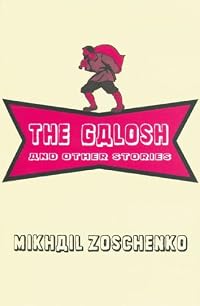
The Galosh: And Other Stories
by Mikhail Zoshchenko
On This Page
Description
Sixty-five luminous satirical tales, from a writer who recorded, with unfailing style and wit, an era's troubles and a people's voice. (Los Angeles Times) In his prime, satirist Mikhail Zoshchenko was more widely read in the Soviet Union than either Pasternak or Solzhenitsyn. His stories give expression to the experience of the ordinary Soviet citizen struggling to survive in the 1920s and '30s, beset by an acute housing shortage, ubiquitous theft and corruption, and the impenetrable new show more language of the Soviet state. Written in the semi-educated talk of the man or woman on the street, these stories enshrine one of the greatest achievements of the people of the Soviet Union-their gallows humor. In The Galosh, Zoshchenko, the self-described temporary substitute for the proletarian writer, combines wicked satire with an earthy empathy and a brilliance that places him squarely in the classic Russian comic tradition. Translated from the Russian by Jeremy Hicks. show lessTags
Recommendations















Member Reviews
This collection has 65 very short, satirical sketches, most of which were written during the period of the Soviet Union’s NEP (New Economic Policy) in the 1920’s, when as Hicks says in his excellent introduction, leaders realized “the country was in a ruinous state and that before genuinely redistributive policies could be attempted, there must first be some wealth to redistribute.” This came with a brief interval of slightly more freedom of speech, and several authors of the time took advantage of it. Zoshchenko was one of them, and quite popular at the time for his gallows humor.
In his writing you’ll find overcrowding, shared housing, an insane amount of theft, scarcity of goods, bureaucracy, and poor organization; he paints show more a picture of a nation clearly struggling in the aftermath of the revolution. What seemed liked satire of individuals was really a satire of the condition of the conditions they had been put in by the State, and he was soon attacked and censored.
My favorites:
“What Generosity” (1924) – breweries give workers reject bottles that are contaminated with filth.
“Crisis” (1925) – newlyweds can’t find a room, so they live in a bathroom that is used by other families.
“A Workshop for Health” (1926) – Crimea as a restorative vacation spot, interesting given current events.
“Pushkin” (1927) – the eviction of families living in the poet’s old home on the 90th anniversary of his death, to create the house-museum in St. Petersburg.
“A Trap” (1933) – a Soviet travels to capitalist Germany and gets trapped in a toilet, interesting given the commentary on Germans and the time it was written.
It’s not that I didn’t like the other 60 stories, but they did get repetitive. They all seem a bit absurd, and yet they were sadly reflective of life at the time. There are few heroes here; people behave to base instincts in the face of poor conditions, and grow cynical of everything around them.
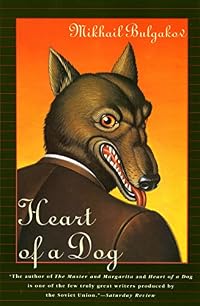
I like the collection for its window into this period of Russian history, but because the stories are so short at 2-3 pages, they just aren’t developed enough for my taste (or practically at all, and in any respect, characters, plot, etc). I recommend reading Bulgakov’s “Heart of the Dog” and Gogol’s “The Overcoat” instead, as they touch on the themes of the housing crisis and bureaucracy in the aftermath of theft, respectively, and in the context of complete stories. show less
In his writing you’ll find overcrowding, shared housing, an insane amount of theft, scarcity of goods, bureaucracy, and poor organization; he paints show more a picture of a nation clearly struggling in the aftermath of the revolution. What seemed liked satire of individuals was really a satire of the condition of the conditions they had been put in by the State, and he was soon attacked and censored.
My favorites:
“What Generosity” (1924) – breweries give workers reject bottles that are contaminated with filth.
“Crisis” (1925) – newlyweds can’t find a room, so they live in a bathroom that is used by other families.
“A Workshop for Health” (1926) – Crimea as a restorative vacation spot, interesting given current events.
“Pushkin” (1927) – the eviction of families living in the poet’s old home on the 90th anniversary of his death, to create the house-museum in St. Petersburg.
“A Trap” (1933) – a Soviet travels to capitalist Germany and gets trapped in a toilet, interesting given the commentary on Germans and the time it was written.
It’s not that I didn’t like the other 60 stories, but they did get repetitive. They all seem a bit absurd, and yet they were sadly reflective of life at the time. There are few heroes here; people behave to base instincts in the face of poor conditions, and grow cynical of everything around them.
I like the collection for its window into this period of Russian history, but because the stories are so short at 2-3 pages, they just aren’t developed enough for my taste (or practically at all, and in any respect, characters, plot, etc). I recommend reading Bulgakov’s “Heart of the Dog” and Gogol’s “The Overcoat” instead, as they touch on the themes of the housing crisis and bureaucracy in the aftermath of theft, respectively, and in the context of complete stories. show less
One of the funniest Russian books I've read. This has finally been in a wider translation recently, although at first I had to use InterLibrary Loan to get it. As the stories are chronological, you can palpably sense the author getting more depressing or harsh over time. As such, the earliest stories are laugh out loud best. Lighthearted, everything good about Russian literature from a sense of humor perspective.
This is a brilliant collection of humorous short stories set and written in the Soviet Union of the 1920s and early 1930s. The humour comes from the description of everyday situation in the communist state and providing them with a little twist at the end. This could be a useful source book for anyone researching every day life in Moscow in the early years of the Soviet Union. The translation is superb.
Ratings
Members
- Recently Added By
Author Information

147+ Works 815 Members
His first book of stories appeared in 1921 and became extraordinarily popular. However, he came under political pressure in the 1930s because some of his works, such as Youth Restored (1933), were too slyly ambiguous to fit the socialist realist model. In 1946, together with Akhmatova, he was singled out for an extraordinary attack by culture show more "boss" Andrei Zhdanov and was expelled from the Union of Soviet Writers. From then on he mostly produced translations. Zoshchenko was an extremely effective satirist who took his subjects from the paradoxes and incongruities of post-Revolutionary Russian society. He showed that human nature, which the new government was trying to change, would assert itself nonetheless. His language is fascinating. He often chooses lower-class narrators who speak in a mixture of the colloquial and of the new Soviet rhetoric---with highly comic results. During the 1930s, Zoshchenko's fiction began to explore philosophical and theoretical problems. A well-known example is Before Sunrise, the first part of which was published in 1943. In it the author analyzes his own psyche, in the process touching on the then-forbidden theories of Freud. Publication of the complete text of this work did not occur until 1972. (Bowker Author Biography) show less
Work Relationships
Contains
Common Knowledge
- Original language
- Russian
Classifications
- Genres
- Fiction and Literature, General Fiction
- DDC/MDS
- 891.7342 — Literature & rhetoric Asian Literature East Indo-European and Celtic literatures Russian and East Slavic languages Russian fiction USSR 1917–1991 Early 20th century 1917–1945
- LCC
- PG3476 .Z7 .A2 — Language and Literature Slavic languages and literatures. Baltic languages. Albanian language Slavic. Baltic. Albanian Russian literature Individual authors and works 1917-1960
- BISAC
Statistics
- Members
- 102
- Popularity
- 315,838
- Reviews
- 3
- Rating
- (3.94)
- Languages
- English
- Media
- Paper
- ISBNs
- 3
- ASINs
- 1