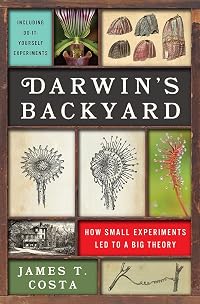
Darwin's Backyard: How Small Experiments Led to a Big Theory
by James T. Costa
On This Page
Description
"James T. Costa takes readers on a journey from Darwin's childhood through his voyage on the HMS Beagle where his ideas on evolution began. We then follow Darwin to Down House, his bustling home of forty years, where he kept porcupine quills at his desk to dissect barnacles, maintained a flock of sixteen pigeon breeds in the dovecote, and cultivated climbing plants in the study, and to Bournemouth, where on one memorable family vacation he fed carnivorous plants in the soup dishes. Using his show more garden and greenhouse, the surrounding meadows and woodlands, and even taking over the cellar, study, and hallways of his home-turned-field-station, Darwin tested ideas of his landmark theory of evolution with an astonishing array of hands-on experiments that could be done on the fly, without specialized equipment. He engaged naturalists, friends, neighbors, family servants, and even his children, nieces, nephews, and cousins as assistants in these experiments, which involved everything from chasing bees and tempting fish to eat seeds to serenading earthworms. From the experiments' results, he plumbed the laws of nature and evidence for the revolutionary arguments of On the Origin of Species and his other watershed works. Beyond Darwin at work, we accompany him against the backdrop of his enduring marriage, chronic illness, grief at the loss of three children, and joy in scientific revelation. This unique glimpse of Darwin's life introduces us to an enthusiastic correspondent, crowd-sourcer, family man, and, most of all, an incorrigible observer and experimenter."--Jacket flap. show lessTags
Recommendations





Member Reviews
I enjoyed this immensely. It's not quite a biography and not quite a science book but a bit of both. I knew nothing about Charles Darwin beyond his 5-year voyage around the world and the theory of evolution. When Darwin got back from his voyage in 1836, he was still quite a young man, only 27. He didn't publish "On the Origin of the Species" until 1859. And lived until 1882. What was he doing all that time
Turns out he was "experimentalising" at his large country estate, The Downs. Running natural experiments on a large collection of topics, all either to directly support his theory of evolution, or suggested by the theory. It's amazing to me how many topics he delved into, with complete absorption, over long periods of time. He had, show more apparently, such a force of personality, that he enlisted family and friends from around the world to gather data and send him samples. HIs children (of which he had plenty) became willing lab techs and his long-suffering wife, Emma, surrendered parts of the house (library, drawing room, etc) for experiments.
And he wrote books and delivered papers on everything he worked on. And what a range of topics: geology, earthworms, orchids, honeybees, flowers of all kinds, Venus flytraps, archeology, domestication of animals. And such meticulous observations. To learn how vines climbed, he grew vines in a terrarium, glued glass treads to the ends and plotted, on the walls of the terrarium, the motion of the growing tips of the vines. Literally watching plants grow.
He was the epitome of the 19th Century Gentleman Scientist. show less
Turns out he was "experimentalising" at his large country estate, The Downs. Running natural experiments on a large collection of topics, all either to directly support his theory of evolution, or suggested by the theory. It's amazing to me how many topics he delved into, with complete absorption, over long periods of time. He had, show more apparently, such a force of personality, that he enlisted family and friends from around the world to gather data and send him samples. HIs children (of which he had plenty) became willing lab techs and his long-suffering wife, Emma, surrendered parts of the house (library, drawing room, etc) for experiments.
And he wrote books and delivered papers on everything he worked on. And what a range of topics: geology, earthworms, orchids, honeybees, flowers of all kinds, Venus flytraps, archeology, domestication of animals. And such meticulous observations. To learn how vines climbed, he grew vines in a terrarium, glued glass treads to the ends and plotted, on the walls of the terrarium, the motion of the growing tips of the vines. Literally watching plants grow.
He was the epitome of the 19th Century Gentleman Scientist. show less
This book, focused on Charles Darwin's scientific work, is filled with suggested experiments for the reader to try, based on those conducted by the famous scientist himself. I didn't try any, but I appreciated this DYI approach to convey how Darwin worked toward his signature theory. This book also serves as an approachable introduction to Darwin's theory without getting lost in the weeds.
This is a scientific biography of Darwin that emphasizes his multitude of experiments mostly conducted in his home and on his property. There are 10 chapters, each one discussing a particular interest of Darwin’s and using excerpts of his journals and correspondence. Areas discussed include Darwin’s work with barnacles, the nature of competition and diversity, how bees construct perfectly hexagonal cells, how island are populated, mechanisms that flowers have evolved to ensure pollination, the behavior and physiology of carnivorous plants, and examining whether earthworms are responsible for the production of topsoil. Each chapter ends with experiments like Darwin’s that you can perform, since Darwin was not using the Large Hadron show more Collider, but mostly just household items.
I especially enjoyed mention of all of Darwin’s family and friends and how they assisted his work, and how each investigated topic bore on both Darwin’s Theory of Evolution and the counter proposals of theists. One can also learn a lot of natural history here, for example, all the varieties of climbing plants and the variety of behaviors that earthworms exhibit. show less
I especially enjoyed mention of all of Darwin’s family and friends and how they assisted his work, and how each investigated topic bore on both Darwin’s Theory of Evolution and the counter proposals of theists. One can also learn a lot of natural history here, for example, all the varieties of climbing plants and the variety of behaviors that earthworms exhibit. show less
Fascinating! I truly enjoyed this. The focus is experimenting, and the author uses Darwins child-like enthusiasm to inspire the reader. Darwin sound like an inspiring person to have been around. And I laughed out loud multiple times. And if you have the time and money, you can replicate Darwin's experiments yourself with the thorough guidelines at the end of each chapter.
Interesting concept. Framed as a novel, this is almost most appropriate to use as a textbook.
Ratings
Members
- Recently Added By
Lists

Top Five Books of 2019
387 works; 111 members

Science
28 works; 1 member

Books Read in 2019
4,052 works; 108 members

Books Read in 2021
5,361 works; 114 members

Books Read in 2023
5,547 works; 145 members
Author Information
9 Works 225 Members
James T. Costa is executive director of Highlands Biological Station and a professor of biology at Western Carolina University.
Awards and Honors
Classifications
Statistics
- Members
- 99
- Popularity
- 325,690
- Reviews
- 5
- Rating
- (4.45)
- Languages
- English
- Media
- Paper, Audiobook, Ebook
- ISBNs
- 5
- ASINs
- 2