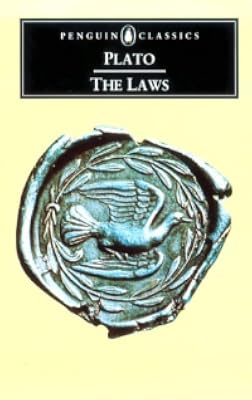
Laws
by Plato
On This Page
Description
One of the most widely studied texts of ancient philosophy and politics, Plato's Laws is his last and most substantial dialogue, debating crucial questions on the subject of law-giving and education. This two-volume edition of 1921 was prepared by the classicist Edwin Bourdieu England (1847-1936), who describes the dialogue as 'the treasury of pregnant truths which Plato in extreme old age left ... as his last legacy to humanity'. Generally held to have been written after Plato's failed show more attempt to influence Syracusan politics, it concerns the just city and its constitution, including discussions of divine revelation, the role of intelligence in the creation of laws, and natural law itself. This edition comprises a short introduction, England's helpful analyses, the Greek text of the dialogue, and extensive notes. Volume 1 is devoted to Books 1-6. show lessTags
Recommendations










Member Reviews
Magnesia, Plato's proposed city of ultimate virtue, sounds like an authoritarian nightmare. You have marriage inspectors ensuring you procreate correctly, strict travel and trading restrictions, and you better not even think of performing an unapproved poem!!
This seems directly opposed to the characteristics he admired in Socrates - a man who made it his mission to challenge authority and make the powerful look ridiculous - a man who was willing to die to achieve this.
This being possibly a later work of Plato, it perhaps demonstrates a character arc common to revolutionaries, and humans in general. We're willing to rage against the old-fashioned fuddy-duddies of our time, but once we're the ones in power, suddenly the new generation of show more change-makers become the problem.
There are, however, a few aspects of Magnesia that seem progressive to our point of view. Women have a sort of equality, despite still being considered a generally less worthy class than men. The treatment of criminals is focused on rehabilitation where possible, although execution is considered a mercy to villains who cannot be reformed.
Like a lot of Plato's works, it probably works best as a starting point for discussion on the various topics that it covers. Read it out to a friend and see how long they can last without arguing back. Maybe you'll figure something out. show less
This seems directly opposed to the characteristics he admired in Socrates - a man who made it his mission to challenge authority and make the powerful look ridiculous - a man who was willing to die to achieve this.
This being possibly a later work of Plato, it perhaps demonstrates a character arc common to revolutionaries, and humans in general. We're willing to rage against the old-fashioned fuddy-duddies of our time, but once we're the ones in power, suddenly the new generation of show more change-makers become the problem.
There are, however, a few aspects of Magnesia that seem progressive to our point of view. Women have a sort of equality, despite still being considered a generally less worthy class than men. The treatment of criminals is focused on rehabilitation where possible, although execution is considered a mercy to villains who cannot be reformed.
Like a lot of Plato's works, it probably works best as a starting point for discussion on the various topics that it covers. Read it out to a friend and see how long they can last without arguing back. Maybe you'll figure something out. show less
I love Plato, but I put off reading this for years because it just looked so dry. It isn't exactly dry. This may be down to the translation. I've looked into quite a few with a mixture of hope and horror. In the end I went for A E Taylor's (Everyman no. 275). Excellent introduction. The notes are sensible, if sparse, and many presuppose a knowledge of Greek. Still, I think it's worth trading off the notes for something readable. Taylor makes an effort to choose the word that isn't the dullest. In fact, he writes such a nice line of prose that I may look up some of his other books.
That said, there's no getting away from the fact that parts of this book are unbelievably boring. My darlings, you're just going to have to power on through show more those bits. There's a sequence of unalloyed delight in Book VII for example which is a succession of good and bad ideas, all fascinating, which he rounds off by proposing the theory of evolution.
Don't think that because he's writing about a pre-industrial society that Laws has no relevance today. There is a clear line of descent from the thoughts in this book to the gas chambers. Every time he uses the word “slave” switch it out for “Jew” and you'll see what I mean. You can do this for the target group of any authoritarian state and it holds true whether it be “intellectuals” or the “working class” etc. This isn't pleasant reading but it is required reading if you want to know your enemy. The mindset is one of complacent arrogance. What I found most frightening is that Plato doesn't consider himself evil. He looks on this sort of treatment of his fellow man as elevating the perpetrator closer to God. show less
That said, there's no getting away from the fact that parts of this book are unbelievably boring. My darlings, you're just going to have to power on through show more those bits. There's a sequence of unalloyed delight in Book VII for example which is a succession of good and bad ideas, all fascinating, which he rounds off by proposing the theory of evolution.
Don't think that because he's writing about a pre-industrial society that Laws has no relevance today. There is a clear line of descent from the thoughts in this book to the gas chambers. Every time he uses the word “slave” switch it out for “Jew” and you'll see what I mean. You can do this for the target group of any authoritarian state and it holds true whether it be “intellectuals” or the “working class” etc. This isn't pleasant reading but it is required reading if you want to know your enemy. The mindset is one of complacent arrogance. What I found most frightening is that Plato doesn't consider himself evil. He looks on this sort of treatment of his fellow man as elevating the perpetrator closer to God. show less
While Plato’s Laws is not as evocative - nor as famous - as the Republic, it is nevertheless an important complement to it, and a fascinating read – and it is also in its own right a classic of political philosophy. Whether or not you agree with Saunders' statement (in his Introduction) that "Plato could perfectly well have written the Laws when he wrote the Republic", it will nevertheless be more or less apparent after reading both that (as he continues to say) "the one should not be read without the other".
Three elderly guys, or Gentlemen rather; the unnamed Athenian Stranger, Clinias (a Cretan) and Megillos (a Spartan) are on their way from Knossos to Mount Ida and the Cave of Zeus - and after Clinias informs the other two that show more he, along with nine others, has been given the responsibility of composing a legal code for a new Cretan colony, they decide to pass the time with creating the laws for this state, which is given the name of Magnesia. It is not that much of a dialogue (although it is classified as one); it consists mainly of long monologues by the Athenian, and with the other two – very gentlemanly – mostly agreeing with him and spurring him on. They also function as representatives of their respective states when the Spartan and Cretan legislation is discussed in Book I.
I started reading Plato’s Laws in the Complete Works (Hackett edition) but decided I would also get the paperback with Saunders' translation so I could read while commuting as well (the other one being a tad too heavy for it to be practical to carry around..) Now, Plato isn’t really ideal (heh) for reading while there’s a lot of disturbances around you, so I often ended up re-reading those passages that I’d already read while on the move. Still, it never hurts to read any parts of Plato’s texts twice anyway. Initially I wasn’t entirely pleased with the subsection headings that had been added by Saunders (these are kept in the Penguin edition while they are omitted in the Hackett edition), but I decided I rather liked them when I first got used to them being there, and they will surely be useful whenever I want to look something up again.
The only thing I really disliked about Saunders' translation was his use of the term "God" - with a capital G - alongside the term "gods" (lowercase). I found that thoroughly distracting, especially as the gods are rarely left out of the discussion. Whenever Plato would write about one of the gods, he would use the term ho theos ("the god"), of which the plural would be hoi theoi - and while Christianity undoubtedly owes much of its philosophical basis to Plato, it's absurd to try to plant it into Plato's own writings in this manner. Plato takes metempsychosis for granted, and I found the way he applies that in his argumentation very intriguing. Indeed, the entire Book X (which deals with religious questions) was a remarkable read – the same goes for his argumentation for drinking parties as an educational device in Book II. Just mentioning these in particular because I particularly enjoyed them, but it should also be added that there is a clear structure to the whole of this work and that the masterful composition of the Laws very much adds to the pleasure of reading it (as in all of Plato’s work... though in a long and complex work like this one, it is an even greater accomplishment). In the final Book (XII) of the Laws there’s the introduction - or rather: innovation - of the Nocturnal Council – I suppose no one would have expected Plato to leave this new state without philosophers.
While it might not be especially tempting for anyone today to become a citizen of the proposed state of Magnesia, it can be useful to consider that things could well have looked a bit different for someone living in the fourth century BCE. And, of course, Plato's influence on political thought ever since would be difficult to overestimate. The Laws has a similar utopian character as the Republic though here theory merges with practical application; the discussion about the essence of virtue, education as acquisition of virtue, unwritten customs and their intimate relation to written law, crime and the purpose of punishment, the usefulness of preambles to the laws, the role of the Scrutineers ("our god-like 'straighteners'" fit to exercise "authority over the authorities"), and the role of the Nocturnal Council in supplementing and interpreting (or even changing) legislation.. Plato here presents an overall practical plan for the ideal state, but at the same time his philosophical ideas are very much present in the discussion.
This work is licensed under a Creative Commons Attribution-NonCommercial-ShareAlike 3.0 Unported License. show less
Three elderly guys, or Gentlemen rather; the unnamed Athenian Stranger, Clinias (a Cretan) and Megillos (a Spartan) are on their way from Knossos to Mount Ida and the Cave of Zeus - and after Clinias informs the other two that show more he, along with nine others, has been given the responsibility of composing a legal code for a new Cretan colony, they decide to pass the time with creating the laws for this state, which is given the name of Magnesia. It is not that much of a dialogue (although it is classified as one); it consists mainly of long monologues by the Athenian, and with the other two – very gentlemanly – mostly agreeing with him and spurring him on. They also function as representatives of their respective states when the Spartan and Cretan legislation is discussed in Book I.
I started reading Plato’s Laws in the Complete Works (Hackett edition) but decided I would also get the paperback with Saunders' translation so I could read while commuting as well (the other one being a tad too heavy for it to be practical to carry around..) Now, Plato isn’t really ideal (heh) for reading while there’s a lot of disturbances around you, so I often ended up re-reading those passages that I’d already read while on the move. Still, it never hurts to read any parts of Plato’s texts twice anyway. Initially I wasn’t entirely pleased with the subsection headings that had been added by Saunders (these are kept in the Penguin edition while they are omitted in the Hackett edition), but I decided I rather liked them when I first got used to them being there, and they will surely be useful whenever I want to look something up again.
The only thing I really disliked about Saunders' translation was his use of the term "God" - with a capital G - alongside the term "gods" (lowercase). I found that thoroughly distracting, especially as the gods are rarely left out of the discussion. Whenever Plato would write about one of the gods, he would use the term ho theos ("the god"), of which the plural would be hoi theoi - and while Christianity undoubtedly owes much of its philosophical basis to Plato, it's absurd to try to plant it into Plato's own writings in this manner. Plato takes metempsychosis for granted, and I found the way he applies that in his argumentation very intriguing. Indeed, the entire Book X (which deals with religious questions) was a remarkable read – the same goes for his argumentation for drinking parties as an educational device in Book II. Just mentioning these in particular because I particularly enjoyed them, but it should also be added that there is a clear structure to the whole of this work and that the masterful composition of the Laws very much adds to the pleasure of reading it (as in all of Plato’s work... though in a long and complex work like this one, it is an even greater accomplishment). In the final Book (XII) of the Laws there’s the introduction - or rather: innovation - of the Nocturnal Council – I suppose no one would have expected Plato to leave this new state without philosophers.
While it might not be especially tempting for anyone today to become a citizen of the proposed state of Magnesia, it can be useful to consider that things could well have looked a bit different for someone living in the fourth century BCE. And, of course, Plato's influence on political thought ever since would be difficult to overestimate. The Laws has a similar utopian character as the Republic though here theory merges with practical application; the discussion about the essence of virtue, education as acquisition of virtue, unwritten customs and their intimate relation to written law, crime and the purpose of punishment, the usefulness of preambles to the laws, the role of the Scrutineers ("our god-like 'straighteners'" fit to exercise "authority over the authorities"), and the role of the Nocturnal Council in supplementing and interpreting (or even changing) legislation.. Plato here presents an overall practical plan for the ideal state, but at the same time his philosophical ideas are very much present in the discussion.
This work is licensed under a Creative Commons Attribution-NonCommercial-ShareAlike 3.0 Unported License. show less
In the Republic, Plato (using his dead mentor Socrates as a mouthpiece) outlined his idea for the ideal city. The Republic is generally considered the earliest example of a utopian philosophy. The ideal city, in Plato’s view, would be ruled by a benevolent dictator, a “philosopher-king” who would be shielded from corruption but a great number of constraints on his personal freedom. Plato was antagonistic towards democracy, fearing, with some justification, the rule of the mob. It was a democratic vote, after all, that sentenced Socrates to death in 399 B.C., on the charge that Socrates corrupted the youth of Athens and introduced new gods. In general, though, it is recognized that what Plato called “democracy” would be better show more understood by the modern ear as “anarchy”: the extreme freedom and equality in which “‘there’s no compulsion either to exercise authority if you are capable of it, or to submit to authority if you don’t want to; you needn’t fight if there’s a war, or you can wage a private war in peacetime if you don’t like peace; and if there’s any law that debars you from political or judicial office, you will none the less take either if they come your way” (Republic). We should also remember that Athenian democracy really was the direct participation of its citizens (as the Greek words demo-cracy imply) and therefore unlike modern democracies, where the power and participation of individuals is mediated by elected representatives.
Written about 390 B.C., the Laws argues that the ideal city would ban music, theater and art, replacing such activities with a rigorous system of public education for both men and women. This latter idea was radical in Plato’s time. He got the opportunity to try out his political philosophy in Syracuse, working, basically, as a consultant to the king of that island kingdom. Plato failed miserably, and apparently spent several years in prison for his screw up.
At the end of his life Plato wrote a kitchen-sink book (or maybe several books that have come down to us as a single work) that tried to summarize a lifetime of political philosophizing. There is a great deal of dross in the Laws (and some of the material, some scholars argue, is probably spurious), and the minutiae it contains can dissuade even the hardiest reader from carrying on. Those interested in the heart of the matter would be well advised to read selections, as in Keith Quincy’s recent Plato Unmasked. One of the key points of the Laws, though, is Plato’s moderation of his opinion of democracy. There’s still a distinct hierarchy in the rule of law and the administration of justice, but this is now spread out among a group of “great men”:
Whether it is a matter of art, music or politics, it is only the ‘best men’ who are capable of true judgment. The true judge must not allow himself to be influenced by the gallery nor intimidated by the clamor of the multitude. Nothing must compel him to hand down a verdict that belies his own convictions. It is his duty to teach the multitude and not to learn from them.
If one looks at the United States’ system of government with a clear eye, at least some of the material in the Laws describes our situation: the masses are to be guided by shepherds who are wiser and more refined than we are. This empirical evidence perhaps argues against the soundness of both Plato’s and our own system of governance. Although our elected representatives ostensibly enact the will of their constituents it is common knowledge that they usually act in spite of us and instead deploy the will of the rich, i.e., the corporate interests that fund their election campaigns. In other words, the “good men” of our times are CEOs and others who work for the interest of themselves and their (comparatively few) shareholders. But it is exactly this conflict of interest, and how to safeguard against it, that Plato struggled with over his long career. And it is precisely this struggle that make Plato’s works on political philosophy worth reading today, despite their sometimes strange obsession with minutiae and anti-democratic ideas.
[Originally published in Curled Up with a Good Book] show less
Written about 390 B.C., the Laws argues that the ideal city would ban music, theater and art, replacing such activities with a rigorous system of public education for both men and women. This latter idea was radical in Plato’s time. He got the opportunity to try out his political philosophy in Syracuse, working, basically, as a consultant to the king of that island kingdom. Plato failed miserably, and apparently spent several years in prison for his screw up.
At the end of his life Plato wrote a kitchen-sink book (or maybe several books that have come down to us as a single work) that tried to summarize a lifetime of political philosophizing. There is a great deal of dross in the Laws (and some of the material, some scholars argue, is probably spurious), and the minutiae it contains can dissuade even the hardiest reader from carrying on. Those interested in the heart of the matter would be well advised to read selections, as in Keith Quincy’s recent Plato Unmasked. One of the key points of the Laws, though, is Plato’s moderation of his opinion of democracy. There’s still a distinct hierarchy in the rule of law and the administration of justice, but this is now spread out among a group of “great men”:
Whether it is a matter of art, music or politics, it is only the ‘best men’ who are capable of true judgment. The true judge must not allow himself to be influenced by the gallery nor intimidated by the clamor of the multitude. Nothing must compel him to hand down a verdict that belies his own convictions. It is his duty to teach the multitude and not to learn from them.
If one looks at the United States’ system of government with a clear eye, at least some of the material in the Laws describes our situation: the masses are to be guided by shepherds who are wiser and more refined than we are. This empirical evidence perhaps argues against the soundness of both Plato’s and our own system of governance. Although our elected representatives ostensibly enact the will of their constituents it is common knowledge that they usually act in spite of us and instead deploy the will of the rich, i.e., the corporate interests that fund their election campaigns. In other words, the “good men” of our times are CEOs and others who work for the interest of themselves and their (comparatively few) shareholders. But it is exactly this conflict of interest, and how to safeguard against it, that Plato struggled with over his long career. And it is precisely this struggle that make Plato’s works on political philosophy worth reading today, despite their sometimes strange obsession with minutiae and anti-democratic ideas.
[Originally published in Curled Up with a Good Book] show less
It's fascinating that Plato's final work abandons the lofty abstractions of The Symposium, Phædrus, and The Republic for a detailed legislative plan to establish a new colony in Crete. Socrates is absent as is the Theory of Forms. It's as if Plato chose to leave something concrete and practical as his last testament. Sadly, little of his literary art remains, especially in the latter half.
This was my first time reading the Laws. It is certainly more dry than the Republic and many other Platonic dialogues. That being said, the translation is excellent and the interpretive essay at the end really added to my appreciation of the dialogue. I will definitely be reading it again and recommend it to others.
A fundamental Platonic text. It is ripe in its analysis and is extremely nuanced and complicated. Nevertheless, one does not fully understand the basis of Plato (or of ancient Greek society) without this.
Members
- Recently Added By
Lists

Bibliography for Among Others
159 works; 15 members

Book wishlist
78 works; 1 member

In Our Time books
4,934 works; 2 members
Author Information

2,728+ Works 100,663 Members
Plato was born c. 427 B.C. in Athens, Greece, to an aristocratic family very much involved in political government. Pericles, famous ruler of Athens during its golden age, was Plato's stepfather. Plato was well educated and studied under Socrates, with whom he developed a close friendship. When Socrates was publically executed in 399 B.C., Plato show more finally distanced himself from a career in Athenian politics, instead becoming one of the greatest philosophers of Western civilization. Plato extended Socrates's inquiries to his students, one of the most famous being Aristotle. Plato's The Republic is an enduring work, discussing justice, the importance of education, and the qualities needed for rulers to succeed. Plato felt governors must be philosophers so they may govern wisely and effectively. Plato founded the Academy, an educational institution dedicated to pursuing philosophic truth. The Academy lasted well into the 6th century A.D., and is the model for all western universities. Its formation is along the lines Plato laid out in The Republic. Many of Plato's essays and writings survive to this day. Plato died in 347 B.C. at the age of 80. (Bowker Author Biography) show less
All Editions
Some Editions
Series
Belongs to Publisher Series
Work Relationships
Common Knowledge
- Canonical title
- Laws
- Original publication date
- 348 BC
- People/Characters
- Athenian Stranger
- Original language
- Ancient Greek
Classifications
- Genres
- Philosophy, Politics and Government, Nonfiction, General Nonfiction
- DDC/MDS
- 321.07 — Society, government, & culture Political science Systems of governments and states Political Systems Ideal state; Utopias
- LCC
- JC71 .P2633 — Political Science Political theory Political theory. The state. Theories of the state Ancient state
- BISAC
Statistics
- Members
- 1,191
- Popularity
- 20,901
- Reviews
- 14
- Rating
- (3.67)
- Languages
- 15 — Catalan, Czech, Dutch, English, Finnish, French, German, Greek (Ancient), Greek, Italian, Portuguese, Romanian, Russian, Spanish, Turkish
- Media
- Paper, Ebook
- ISBNs
- 83
- ASINs
- 15