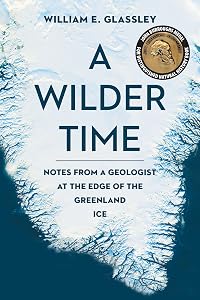
A Wilder Time: Notes from a Geologist at the Edge of the Greenland Ice
by William E. Glassley
On This Page
Description
Greenland, one of the last truly wild places, contains a treasure trove of information on Earth's early history embedded in its pristine landscape. Over numerous seasons, William E. Glassley and two fellow geologists traveled there to collect samples and observe rock formations for evidence to prove a contested theory that plate tectonics, the movement of Earth's crust over its molten core, is a much more ancient process than some believed. As their research drove the scientists ever farther show more into regions barely explored by humans for millennia--if ever--Glassley encountered wondrous creatures and natural phenomena that gave him unexpected insight into the origins of myth, the virtues and boundaries of science, and the importance of seeking the wilderness within. An invitation to experience a breathtaking place and the fascinating science behind its creation, A Wilder Time is nature writing at its best. show lessTags
Recommendations











Member Reviews
A gem in Greenland
A Wilder Time is a lyrical yet scientific appreciation of Greenland and what it has to say about Earth. William Glassley takes us along on a summer expedition to discover what Greenland actually is in paleo terms. His team of three finds that Greenland was there at the clash of continents, near the very beginning. They find rock 3.4 billion years old, right out in the landscape. They find a wall of giant orthopyroxene crystals that exist nowhere else in this size, stacked like a stockpile of bricks. Theory says they were forged in magma chambers 20 miles down, 2.8 billion years ago, but until now, we’ve never seen whole ones. In Greenland, they’re on permanent exhibition. They also find peace, tranquility, vast show more vistas, silence and an appreciation of the tiny things we’re far too busy to even know about. The less you have to think about, the more bandwidth you have for what’s in front of you. It is a delightful recounting of a wonderful adventure.
For a geologist, Glassley writes like a poet: “Suddenly, I understood Earth to be a manuscript, written in an extraordinary calligraphy, embellished with an artistry I could barely discern.” He gives all kinds of dimensions to what could have been a very dry book. Glassley himself is a unique specimen. A southern California surfer dude who by his own admission was punished and expelled from school numerous times, he managed to focus on geology and bring a nuanced appreciation of nature to everything he does. At one point he lies flat on the tundra to better locate a ptarmigan perfectly camouflaged in the lichen, and discovers the multiple fragrances of arctic flowers you cannot perceive at six feet. I think mensch is the technical term for this man.
Greenland itself is a vast treasure. It is an island that would stretch from British Columbia to Mexico and from San Francisco to Denver. Its ice sheet is still 12,000 feet thick. It still contains 600,000 cubic miles of frozen water – 10% of the water in the oceans. As it recedes, more land is exposed - and more treasures.
Glassley’s attachment to Greenland reminds me of the stories of white Americans kidnapped by Indians in the 1800s. Many who were let go, both men and women, were miserable and had to literally escape civilization to try to make it back to the tribe. There are no cases of freed Indians longing to escape the tribe and return to town life. For Glassley, Greenland is life.
David Wineberg show less
A Wilder Time is a lyrical yet scientific appreciation of Greenland and what it has to say about Earth. William Glassley takes us along on a summer expedition to discover what Greenland actually is in paleo terms. His team of three finds that Greenland was there at the clash of continents, near the very beginning. They find rock 3.4 billion years old, right out in the landscape. They find a wall of giant orthopyroxene crystals that exist nowhere else in this size, stacked like a stockpile of bricks. Theory says they were forged in magma chambers 20 miles down, 2.8 billion years ago, but until now, we’ve never seen whole ones. In Greenland, they’re on permanent exhibition. They also find peace, tranquility, vast show more vistas, silence and an appreciation of the tiny things we’re far too busy to even know about. The less you have to think about, the more bandwidth you have for what’s in front of you. It is a delightful recounting of a wonderful adventure.
For a geologist, Glassley writes like a poet: “Suddenly, I understood Earth to be a manuscript, written in an extraordinary calligraphy, embellished with an artistry I could barely discern.” He gives all kinds of dimensions to what could have been a very dry book. Glassley himself is a unique specimen. A southern California surfer dude who by his own admission was punished and expelled from school numerous times, he managed to focus on geology and bring a nuanced appreciation of nature to everything he does. At one point he lies flat on the tundra to better locate a ptarmigan perfectly camouflaged in the lichen, and discovers the multiple fragrances of arctic flowers you cannot perceive at six feet. I think mensch is the technical term for this man.
Greenland itself is a vast treasure. It is an island that would stretch from British Columbia to Mexico and from San Francisco to Denver. Its ice sheet is still 12,000 feet thick. It still contains 600,000 cubic miles of frozen water – 10% of the water in the oceans. As it recedes, more land is exposed - and more treasures.
Glassley’s attachment to Greenland reminds me of the stories of white Americans kidnapped by Indians in the 1800s. Many who were let go, both men and women, were miserable and had to literally escape civilization to try to make it back to the tribe. There are no cases of freed Indians longing to escape the tribe and return to town life. For Glassley, Greenland is life.
David Wineberg show less
This in amazing work, an homage to field work perhaps second to only Steinbeck's Log of the Sea of Cortez. I felt the bounce of the boat and chill of the ice. I too have looked down at the soaring raptor and entered their world.
The paragraphs on the voice of the tide may be my favorite passage ever, by anyone. A zodiac with three geologists is maneuvering to a enter a fjord in the west coast of Greenland to study a vein of rock at the edge of a 2 billion year old shear zone, where tectonic plates mashed, an ocean disappeared, squeezed out of existence into the earth's crust. The mountain range created has since been eroded to its very roots that are now emerging from Greenland's melting ice. There is an island at the head of the fjord show more with a channel at either side to open water. They are skimming along the sea when they run headlong into the ebb tide bore and are nearly tossed from the boat:
"Kai and I sit attenatively, hands holding the side ropes, tensely aware that things are not really under control, but relieved that the small boat is stable. John skillfully works the outboard, maneuvering cautiously through the current. We look ahead, watching the turbulent water as though searching for something but not having a clue what it might be we are looking for.
Then, as though emerging from behind a curtain, a vaguely dangerous presence asserts itself. There is no doubt it has been there all the time, but the more immediate need to keep from being thrown into the water was the only thing we thought about. Now, in a more relaxed state, perception expands and we sense a threat.
The sound of loud thunder shakes us so we look to the skies, searching for thunderheads, but we see none. The sky is mainly blue, with cotton puffs of clouds lightly sprinkled about. But the sound is pervasive, reverberating all around us, and does not stop, a deep-throated pounding rumble.
Our Zodiac is made of inflated rubber pontoons; they form the pointed bow and the sides. The other inflated cross tubes span the inside for strengthening, but they also serve as benches. The floor is a rubberized fabric over which thin boards are wedged to give stability and rigidity. It is up through the flooring that the thunder booms.
We quickly realize that the sound must be coming from huge boulders propelled by the rushing tide, tumbling over the hard rock walls and bottom of the fjord, sculpting out of the bedrock of gneisses and schists a submerged secret landscape. Minute after minute, the pounding rumble echoes up through the water, through our little boat, and into the cool air. We look at one another and at the rushing water, listen to the sounds, and hunker down a little more. John revs the engine a bit, and we make our way closer to shore. Carefully, we cruise along about a stone' throw out."
The voice of the tide. show less
The paragraphs on the voice of the tide may be my favorite passage ever, by anyone. A zodiac with three geologists is maneuvering to a enter a fjord in the west coast of Greenland to study a vein of rock at the edge of a 2 billion year old shear zone, where tectonic plates mashed, an ocean disappeared, squeezed out of existence into the earth's crust. The mountain range created has since been eroded to its very roots that are now emerging from Greenland's melting ice. There is an island at the head of the fjord show more with a channel at either side to open water. They are skimming along the sea when they run headlong into the ebb tide bore and are nearly tossed from the boat:
"Kai and I sit attenatively, hands holding the side ropes, tensely aware that things are not really under control, but relieved that the small boat is stable. John skillfully works the outboard, maneuvering cautiously through the current. We look ahead, watching the turbulent water as though searching for something but not having a clue what it might be we are looking for.
Then, as though emerging from behind a curtain, a vaguely dangerous presence asserts itself. There is no doubt it has been there all the time, but the more immediate need to keep from being thrown into the water was the only thing we thought about. Now, in a more relaxed state, perception expands and we sense a threat.
The sound of loud thunder shakes us so we look to the skies, searching for thunderheads, but we see none. The sky is mainly blue, with cotton puffs of clouds lightly sprinkled about. But the sound is pervasive, reverberating all around us, and does not stop, a deep-throated pounding rumble.
Our Zodiac is made of inflated rubber pontoons; they form the pointed bow and the sides. The other inflated cross tubes span the inside for strengthening, but they also serve as benches. The floor is a rubberized fabric over which thin boards are wedged to give stability and rigidity. It is up through the flooring that the thunder booms.
We quickly realize that the sound must be coming from huge boulders propelled by the rushing tide, tumbling over the hard rock walls and bottom of the fjord, sculpting out of the bedrock of gneisses and schists a submerged secret landscape. Minute after minute, the pounding rumble echoes up through the water, through our little boat, and into the cool air. We look at one another and at the rushing water, listen to the sounds, and hunker down a little more. John revs the engine a bit, and we make our way closer to shore. Carefully, we cruise along about a stone' throw out."
The voice of the tide. show less
 This review was written for LibraryThing Early Reviewers.
I assumed William E. Glassley’s book, A Wilder Time: Notes from a Geologist at the Edge of the Greenland Ice, would be similar to other popular science books I’ve read; books that seek to educate the general public about what it’s like to work in a particular scientific field, what is being learned, and why the field merits further study. In this case, I expected to learn what it’s like to conduct geological field research in the wilds of Greenland, and I half-expected an overly-technical discussion of rocks that would make my eyes glaze over. In the end, the book did not turn out to be what I expected.
That’s not to say that Glassley’s book didn’t educate me about geology or about the joys and difficulties of field show more research in Greenland. Or that it didn’t give a discussion or rocks. It did both. I learned things about geology, about plate tectonics, and about relevant scientific debates, but not in an overly-technical or boring manner. I also learned about the difficulties of field research in Greenland, which include clouds of mosquitos, ice-water baths, and freezing ocean currents that thunderously propel large boulders across the sea-floor (likely meaning death for anyone unfortunate enough to fall in). What I mean is that Glassley’s book turned out to be so much more than what I expected.
This is likely because Glassley isn’t some dry geologist with his head down among the rocks. He’s lyrically and appreciatively philosophical, in a scientific way, if that makes any sense. And he seems well-read outside his field, something too-often lacking in scientists (or in anyone else, for that matter). Glassley’s musings opened my eyes to insights about our world, about our origins, and even about classical mythology that, while they should perhaps be obvious to any reasonably well-read person, aren’t thoughts most people ever give sufficient time to. I’m glad Glassley takes the time to give them though, and to share his thoughts with others.
While I suspect that a scientific expedition with Glassley could be somewhat aggravating, as he seems to have a tendency to wander off by himself, lost in reveries and observations that may have little to do with the research at hand, I think he’d be a fascinating hiking partner as he would undoubtedly notice and point out things most other people would have missed. Glassley gives second-thoughts to things most people don’t even give first-thoughts to, and I feel the better, and the more enlightened, for his having shared his thoughts with me through his book.
My only wish for his book is that it had included more photos, and color photos at that. Glassley waxes lyrically about many vistas and rock formations that, while well-described, would have been nice to see in photographic form. But I read an uncorrected author's proof of the book, so perhaps the final version does contain such photos. I hope it does. In any event, the lack of photos is a minor quibble as to an otherwise marvelous, and quite unique, popular science book. Well done Dr. Glassley! show less
That’s not to say that Glassley’s book didn’t educate me about geology or about the joys and difficulties of field show more research in Greenland. Or that it didn’t give a discussion or rocks. It did both. I learned things about geology, about plate tectonics, and about relevant scientific debates, but not in an overly-technical or boring manner. I also learned about the difficulties of field research in Greenland, which include clouds of mosquitos, ice-water baths, and freezing ocean currents that thunderously propel large boulders across the sea-floor (likely meaning death for anyone unfortunate enough to fall in). What I mean is that Glassley’s book turned out to be so much more than what I expected.
This is likely because Glassley isn’t some dry geologist with his head down among the rocks. He’s lyrically and appreciatively philosophical, in a scientific way, if that makes any sense. And he seems well-read outside his field, something too-often lacking in scientists (or in anyone else, for that matter). Glassley’s musings opened my eyes to insights about our world, about our origins, and even about classical mythology that, while they should perhaps be obvious to any reasonably well-read person, aren’t thoughts most people ever give sufficient time to. I’m glad Glassley takes the time to give them though, and to share his thoughts with others.
While I suspect that a scientific expedition with Glassley could be somewhat aggravating, as he seems to have a tendency to wander off by himself, lost in reveries and observations that may have little to do with the research at hand, I think he’d be a fascinating hiking partner as he would undoubtedly notice and point out things most other people would have missed. Glassley gives second-thoughts to things most people don’t even give first-thoughts to, and I feel the better, and the more enlightened, for his having shared his thoughts with me through his book.
My only wish for his book is that it had included more photos, and color photos at that. Glassley waxes lyrically about many vistas and rock formations that, while well-described, would have been nice to see in photographic form. But I read an uncorrected author's proof of the book, so perhaps the final version does contain such photos. I hope it does. In any event, the lack of photos is a minor quibble as to an otherwise marvelous, and quite unique, popular science book. Well done Dr. Glassley! show less
This review was written for LibraryThing Early Reviewers.A Wilder Time: Notes from a Geologist at the Edge of the Greenland Ice by William E. Glassley is a very highly recommended combination of nature writing at its finest with the recording of geological discoveries and observations.
"Geology is not generally considered an enterprise rich with drama." ( pg. 60)
While perhaps this observation is true, there was a richness and drama of a sort in this account of the time William E. Glassley and his Danish colleagues, Kai Sørensen and John Korstgård, spent on six expeditions to Greenland, a place that truly defines the word "wilderness." The geologists went there to sample, photograph, and measure any rock formations that would provide evidence of the terrain's history and the tectonic show more movements. They wanted to find out how deeply the rocks had been buried, how hot they had been, and when the deformation of them occurred; and they wanted to find the place where that marked the point of collision between two continents.
While Glassley does discuss some of the amazing geological discoveries and observations he and his colleagues made, he is also poetic in his descriptions and observations of Greenland, including the overwhelming silence and the natural environment there. The scientific focus may have been the geology, but Glassley also shares his keen observations of the nature around him - the huge bumblebees, the small arctic flowers, the lichen, the arctic foxes, ptarmigan, herring, an encounter with a falcon, and an almost magical mirage.
The narrative is divided into three parts, Fractionation, Consolidation, and Emergence, each of which describes the sensory experiences that shifted his perception. The first part, Fractionation, documents the way his expectations about Greenland had been altered. Consolidation marks his coming to terms with the reality that "ignorance is an integral part of being aware." The final section, Emergence, covers what he feels, based on epiphanies he had in Greenland, we can and cannot know of the world. The book contains a glossary for those unfamiliar with geological terms. (As a secret geology geek, I was transfixed by the scientific observations of the expedition that Glassley chose to share. I desperately wanted pictures.)
A Wilder Time is a celebration of wilderness, written in poetic prose that can be appreciated by anyone who enjoys good nature writing. It is also a call to save the wilderness areas we have left.
Disclosure: My review copy was courtesy of Bellevue Literary Press.
http://www.shetreadssoftly.com/2018/03/a-wilder-time.html show less
"Geology is not generally considered an enterprise rich with drama." ( pg. 60)
While perhaps this observation is true, there was a richness and drama of a sort in this account of the time William E. Glassley and his Danish colleagues, Kai Sørensen and John Korstgård, spent on six expeditions to Greenland, a place that truly defines the word "wilderness." The geologists went there to sample, photograph, and measure any rock formations that would provide evidence of the terrain's history and the tectonic show more movements. They wanted to find out how deeply the rocks had been buried, how hot they had been, and when the deformation of them occurred; and they wanted to find the place where that marked the point of collision between two continents.
While Glassley does discuss some of the amazing geological discoveries and observations he and his colleagues made, he is also poetic in his descriptions and observations of Greenland, including the overwhelming silence and the natural environment there. The scientific focus may have been the geology, but Glassley also shares his keen observations of the nature around him - the huge bumblebees, the small arctic flowers, the lichen, the arctic foxes, ptarmigan, herring, an encounter with a falcon, and an almost magical mirage.
The narrative is divided into three parts, Fractionation, Consolidation, and Emergence, each of which describes the sensory experiences that shifted his perception. The first part, Fractionation, documents the way his expectations about Greenland had been altered. Consolidation marks his coming to terms with the reality that "ignorance is an integral part of being aware." The final section, Emergence, covers what he feels, based on epiphanies he had in Greenland, we can and cannot know of the world. The book contains a glossary for those unfamiliar with geological terms. (As a secret geology geek, I was transfixed by the scientific observations of the expedition that Glassley chose to share. I desperately wanted pictures.)
A Wilder Time is a celebration of wilderness, written in poetic prose that can be appreciated by anyone who enjoys good nature writing. It is also a call to save the wilderness areas we have left.
Disclosure: My review copy was courtesy of Bellevue Literary Press.
http://www.shetreadssoftly.com/2018/03/a-wilder-time.html show less
This review was written for LibraryThing Early Reviewers.A Wilder Time is part expedition travelogue, part introduction and discussion of plate tectonics, and part meditation on the serenity and importance of wilderness. Blended approaches can become unfocused and muddy (especially in a succinct 224 pages), but Glassey’s narrative is sublime and results in one of the better examples of all three genres in over a decade. Highly recommended for fans of John McPhee and Bill Bryson. Further recommend stretching the reading over several nights to better contemplate and enjoy this remarkable book.
This review was written for LibraryThing Early Reviewers.A Wilder Time, is a geological detective story, a memoir, and most importantly, a meditation on the importance of wilderness.
William E. Glassley writes about the smell of ice, the perfume of tundra plants, the sights and sounds and tastes and feel of everything he experiences on a month-long expedition with two geologist friends. They are working on the west coast of Greenland, researching evidence of the very early history of continents and oceans.
Much interesting geology is explained: theory, field work, procedures in the laboratory. Mixed with this, in grounded poetic language, is his sense of awe at what he is privileged to see by being there.
I found myself skimming through some of the geology, and savoring, sometimes rereading, show more the images of wild nature.
It is a short but important book. show less
William E. Glassley writes about the smell of ice, the perfume of tundra plants, the sights and sounds and tastes and feel of everything he experiences on a month-long expedition with two geologist friends. They are working on the west coast of Greenland, researching evidence of the very early history of continents and oceans.
Much interesting geology is explained: theory, field work, procedures in the laboratory. Mixed with this, in grounded poetic language, is his sense of awe at what he is privileged to see by being there.
I found myself skimming through some of the geology, and savoring, sometimes rereading, show more the images of wild nature.
It is a short but important book. show less
This review was written for LibraryThing Early Reviewers.This book makes me want to pack up my camping gear and go explore Greenland - though maybe I should wait till Spring. Glassley sweeps up the reader with his astonishing portrayal of the wilderness - clear and crisp. The geologic explorations and research of three experienced experts in the field to explain the tectonic formation and epic changes of the earth are beautifully balanced by the author's philosophic meditations on his sense of the wilderness.
On a mission to prove (or disprove) a scientific theory and settle a controversy, Glassley's documentation renders a faith in the precise research and dogged efforts to uncover the secrets of millions of years cast in stone. And yet the asides of thoughtful observations gives a sense and show more a yearning for the wild other-worldness rarely experienced by humans.
Thank goodness for the maps but would have loved pictures of the dramatic landscapes and odd rock formations he encountered. I suppose that would make another whole book. This was an interesting and enjoyable reading experience. show less
On a mission to prove (or disprove) a scientific theory and settle a controversy, Glassley's documentation renders a faith in the precise research and dogged efforts to uncover the secrets of millions of years cast in stone. And yet the asides of thoughtful observations gives a sense and show more a yearning for the wild other-worldness rarely experienced by humans.
Thank goodness for the maps but would have loved pictures of the dramatic landscapes and odd rock formations he encountered. I suppose that would make another whole book. This was an interesting and enjoyable reading experience. show less
This review was written for LibraryThing Early Reviewers.Members
- Recently Added By
Lists

Chronological 2018
17 works; 1 member

Phi Beta Kappa reading list
260 works; 8 members
Author Information
3 Works 101 Members
William E. Glassley is a geologist at the University of California, Davis, and an emeritus researcher at Aarhus University, Denmark. He lives in Santa Fe, New Mexico.
Awards and Honors
Common Knowledge
- Original publication date
- 2018
- Important places
- Greenland
- Blurbers
- McKibben, Bill; Francis, John; Elder, John; Griffin, William L.; Hild, Martha Hickman; Selverstone, Jane
Classifications
- Genres
- Science & Nature, Nonfiction, General Nonfiction, Travel, Biography & Memoir
- DDC/MDS
- 559.8 — Natural sciences & mathematics Earth sciences; geology Earth sciences of Australasia, Pacific Ocean islands, Atlantic Ocean islands, Arctic islands, Antarctica, extraterrestrial worlds Arctic and Antarctic regions
- LCC
- QE70 .G53 — Science Geology Geology General
- BISAC
Statistics
- Members
- 88
- Popularity
- 364,588
- Reviews
- 15
- Rating
- (4.47)
- Languages
- English
- Media
- Paper, Ebook
- ISBNs
- 2
- ASINs
- 2