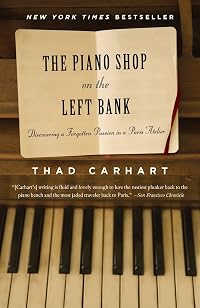
The Piano Shop on the Left Bank: Discovering a Forgotten Passion in a Paris Atelier
by Thad Carhart
On This Page
Description
The author passes a little storefront in Paris every day and finally enters to find a shop filled with dismantled pianos where, on Fridays, local people gather to discuss music, love, and life over a glass of wine.Tags
Recommendations






















Member Reviews
It works. It's a memoir that actually works. In fact it works so well that it reads like a story and I'm still having trouble figuring out if large swatches of it were made up. But that's not the most impressive part of this book. It does not focus on the author. Let me rephrase that because these days it's important: I typically don't read memoirs because I appear to be allergic to texts that are designed to elevate the author's ego instead of telling an authentic story. This is not one of those, even though it is all about the author. He is not the subject. So what is this memoir about?
Here we have a memoir that explores humanity through acute observations of culture and human behavior. But it's not a text book or a dry summing up. show more Neither is it a novel or an autobiography.
The central core of the book is an old piano workshop in Paris. It is inhabited by either typical Parisians or eccentrics, depending on if you're European or not. Being from Europe these people seemed just regular folk. Living in the US I can see them being seen as eccentric or even crazy.
We learn about the personal history of the author with pianos and piano playing. We learn about the obsessions and fascinations of others and pianos and we mostly learn about how music gets us to a place that can't be obtained through logic or pure reasoning. And it's all told in a way that allows anyone access to those experiences, be it second hand, through this book.
Do I sound overly excited about this book? Having read dozens of non-fiction books that are all thinly veiled ego pumps I have to say: yes I am very excited about this work. show less
Here we have a memoir that explores humanity through acute observations of culture and human behavior. But it's not a text book or a dry summing up. show more Neither is it a novel or an autobiography.
The central core of the book is an old piano workshop in Paris. It is inhabited by either typical Parisians or eccentrics, depending on if you're European or not. Being from Europe these people seemed just regular folk. Living in the US I can see them being seen as eccentric or even crazy.
We learn about the personal history of the author with pianos and piano playing. We learn about the obsessions and fascinations of others and pianos and we mostly learn about how music gets us to a place that can't be obtained through logic or pure reasoning. And it's all told in a way that allows anyone access to those experiences, be it second hand, through this book.
Do I sound overly excited about this book? Having read dozens of non-fiction books that are all thinly veiled ego pumps I have to say: yes I am very excited about this work. show less
Carhart, who seems to have been encouraged by Alberto Manguel to write this book, tells us about how the chance discovery of a piano workshop in the Paris quartier where he was living with his family rekindled his interest in the instrument he had learnt as a child. The book is partly a memoir of the process of getting caught up in a quirky little bit of local culture, the sort of thing that it is very difficult to penetrate as an outsider in France, but it is also an account of the social and technical history of the piano, and an exploration of the slightly forgotten idea of music-making for private enjoyment. Nothing very profound, but a pleasant read that might just make you dust off that piano that’s been lurking unplayed in your show more drawing-room for the last few decades… show less
As an amateur pianist from age 4 (thanks to a piano teacher mother), this memoir about pianos resonated with me. Like the author, I mostly play for my own pleasure, although I also enjoy accompanying choirs, soloists, and playing for church. At the time this book was written, Carhart was an expat living in Paris. His daily route took him past a piano repair shop. Eventually his curiosity got the best of him, and it resulted in a friendship with the shop’s owner, Luc, a newly restored piano for his home, and renewal of piano lessons to improve his skill. Carhart incorporates information about the history of the piano, piano manufacturers (mostly European), and great pianists. This is one of those books I know I’ll be recommending to show more all of my music-loving friends for years to come. show less
To call this lovely book lyrical just seems so, well, twee. Yet, try as I might, nothing else seems as apropos. So, lyrical it is. Tad Carhart has woven threads of love of music, theories of learning, personal history, Parisian oddities, technical background and interesting eccentrics into a delightful little story that was fun and quick to read. I'm so happy to have found this book and benefitted from our authors obsession.
I had the wonderful fortune of popping this book in my suitcase before a quick trip to Paris. What a great little book that says so many things about so many things! At its core, it is the author's "re" discovery of his love of piano, both playing the instrument and the its origins and history. He begins his journey towards this passion by meeting a really interesting gentleman, Luc, who runs an "atelier" or open studio that at first blush, is about repairs of same. But it is so much more. I think this is a discovery for the reader, so describing too much would take away the beauty. However, the story touches on what it feels like to reconnect with a passion (it could be any one really, painting, drawing, other instruments) as an adult, show more both the hurdles and the wisdom therein. Also, it's about finding joy with others in something you just really love to do. I took a LOT away from this little book and I thank the author for sharing his path through this quiet, rather reclusive world of deep-feeling music/piano lovers in his neighborhood, and a bit beyond. show less
I’m not a musician. My singing is so egregious that I whisper happy birthday and the national anthem. I play no instruments. The only time I’ve had any contact with a piano was during one summer 50 years ago when I used a neighbor’s beginner’s books to pick out a very few tunes. I never even learned to play chopsticks. So, it’s amazing that Thad Carhart’s book about his love for and intimacy with the piano was one which I read with relish, looking forward during the day to the moments I’d be able to immerse myself in it. He even made the mechanics of the piano fascinating and gave me a feeling for the differences in the concert styles of Liszt, Beethoven, and Chopin.
Thad relates that whenever he sees a piano he’s show more compelled to open the soundboard to see who the maker was, where it was produced and, often, he will sit and play it. As an avid reader I can relate: whenever I go to someone’s home who has a shelf or more of books I always stand and read the names of the books, perhaps gleaning a bit of knowledge about the reader(s) in the family. And Thad is equally as drawn to piano shops as I am to bookstores. A good portion of this book is devoted to his entrance to, interest in, and friendship with the owner of the piano shop near his home. The friendship with a shop that buys, repairs, and rebuilds pianos feeds his obsession and leads him on to much more to do with pianos.
I was fascinated by all the information on the mechanics of pianos, the training of pianists, and the business of the piano shop. It takes a very interesting and well written book to make someone ignorant of music read about pianos with such fascination. show less
Thad relates that whenever he sees a piano he’s show more compelled to open the soundboard to see who the maker was, where it was produced and, often, he will sit and play it. As an avid reader I can relate: whenever I go to someone’s home who has a shelf or more of books I always stand and read the names of the books, perhaps gleaning a bit of knowledge about the reader(s) in the family. And Thad is equally as drawn to piano shops as I am to bookstores. A good portion of this book is devoted to his entrance to, interest in, and friendship with the owner of the piano shop near his home. The friendship with a shop that buys, repairs, and rebuilds pianos feeds his obsession and leads him on to much more to do with pianos.
I was fascinated by all the information on the mechanics of pianos, the training of pianists, and the business of the piano shop. It takes a very interesting and well written book to make someone ignorant of music read about pianos with such fascination. show less
For the love of pianos. Carhart was living in France, in Paris, writing, when he decided to enter a piano shop near his home. It was a piano repair shop, he saw, and there were many different pianos there.
The visit awakened a long-time love of pianos. Having taken lessons as a child, Carhart knew he was no piano genius, but he loved pianos. When he went back and asked whether they sold used pianos from time to time he was put off. Yes, they did, sometimes, but...And when he went back again and again and asked the same questions he continued to get the same vague brushoff.
He told a friend of this, a friend who played, and she said to drop her name and he would be let in. It seems odd, doesn't it, that a shop would be reluctant about show more advertising its sales? But it wasn't, not when he understood. He did go back and mention that a friend of his had bought her piano there, and the owner started to loosen up. After a few more times Carhart was accepted and allowed to peruse the pianos for sale. He learned that the owner always wanted to make sure that his pianos found the right owners, rather like an animal shelter wants to find the right companion humans for its animals. He chose one to buy and had it delivered.
It needed tuning, of course, after moving. Tuning became a major part of the experience after Carhart accepted the recommendation of the piano shop by bringing in an older tuner who had to be monitored, for he had a tendency to drink too much. The work this man did was extraordinary. Carhart's understanding of tuning increased immeasurably, and as a result we are treated to a detailed examination of the process.
A non-fiction book about pianos. It could be dryer than dust but it isn't. There are the lively descriptions of the elderly piano shop owner and the new one, as well as of the tuner. There are the reactions of friends, the compulsion of Carhart to start taking lessons again. And the pianos themselves. Many differences among them, from their physical appearance to the type of sound they make. Carhart even travels to Italy to see first-hand what is considered the finest piano currently being made: Fazioli.
It is no wonder my own piano tuner enthusiastically recommended this book. I already had it on my shelves but had not read it, so down it came. Strengthening in me too, the love I have always had for pianos. show less
The visit awakened a long-time love of pianos. Having taken lessons as a child, Carhart knew he was no piano genius, but he loved pianos. When he went back and asked whether they sold used pianos from time to time he was put off. Yes, they did, sometimes, but...And when he went back again and again and asked the same questions he continued to get the same vague brushoff.
He told a friend of this, a friend who played, and she said to drop her name and he would be let in. It seems odd, doesn't it, that a shop would be reluctant about show more advertising its sales? But it wasn't, not when he understood. He did go back and mention that a friend of his had bought her piano there, and the owner started to loosen up. After a few more times Carhart was accepted and allowed to peruse the pianos for sale. He learned that the owner always wanted to make sure that his pianos found the right owners, rather like an animal shelter wants to find the right companion humans for its animals. He chose one to buy and had it delivered.
It needed tuning, of course, after moving. Tuning became a major part of the experience after Carhart accepted the recommendation of the piano shop by bringing in an older tuner who had to be monitored, for he had a tendency to drink too much. The work this man did was extraordinary. Carhart's understanding of tuning increased immeasurably, and as a result we are treated to a detailed examination of the process.
A non-fiction book about pianos. It could be dryer than dust but it isn't. There are the lively descriptions of the elderly piano shop owner and the new one, as well as of the tuner. There are the reactions of friends, the compulsion of Carhart to start taking lessons again. And the pianos themselves. Many differences among them, from their physical appearance to the type of sound they make. Carhart even travels to Italy to see first-hand what is considered the finest piano currently being made: Fazioli.
It is no wonder my own piano tuner enthusiastically recommended this book. I already had it on my shelves but had not read it, so down it came. Strengthening in me too, the love I have always had for pianos. show less
Members
- Recently Added By
Lists

Books Read in 2019
4,052 works; 108 members

Paris, City of Lights
103 works; 17 members

John Carey's Sunday Best
82 works; 3 members

Mustich's 1000 Books to Read Before You Die: A Life Changing List
1,001 works; 20 members
Author Information

3 Works 1,615 Members
Thad Carhart has lived in France for much of his life. He was educated at Yale and Stanford, and worked in northern California as a consultant in the entertainment business before returning to Europe twelve years ago
Awards and Honors
Notable Lists
Common Knowledge
- Original publication date
- 2000
- Important places
- Paris, France
- Dedication
- for Simo
- First words
- Along a narrow street in the Paris neighborhood where I live sits a little store front with a simple sign stencilled on the window: 'Desforges Pianos: outillage, fournitures'.
- Last words
- (Click to show. Warning: May contain spoilers.)He looked at Mathilde and then at me, and said simply, 'You can never have too many dream pianos.'
- Blurbers
- Petroski, Henry; Tremain, Rose; Carey, John
- Canonical DDC/MDS
- 786.2194436
Classifications
- Genres
- Biography & Memoir, Travel
- DDC/MDS
- 786.2194436 — Arts & recreation Music Keyboard, mechanical, electrophonic, percussion instruments Pianos [formerly: keyboard string instuments] General principles, musical forms, instruments
- LCC
- ML650 .C32 — Music Literature on music Literature on music History and criticism Instruments and instrumental music
- BISAC
Statistics
- Members
- 1,459
- Popularity
- 16,128
- Reviews
- 42
- Rating
- (3.96)
- Languages
- 5 — Dutch, English, German, Italian, Portuguese
- Media
- Paper, Audiobook, Ebook
- ISBNs
- 19
- ASINs
- 5