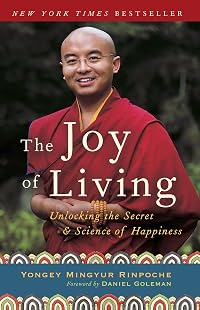
The Joy of Living: Unlocking the Secret and Science of Happiness
by Yongey Mingyur Rinpoche
On This Page
Description
For millennia, Buddhists have enjoyed the limitless benefits of meditation. But how does it work? And why? The principles behind this ancient practice have long eluded some of the best minds in modern science. Until now. In this groundbreaking work, world-renowned Buddhist teacher Yongey Mingyur Rinpoche invites us to join him in unlocking the secrets behind the practice of meditation. Working with neuroscientists at the Waisman Laboratory for Brain Imaging and Behavior, Yongey Mingyur show more provides clear insights into modern research indicating that systematic training in meditation can enhance activity in areas of the brain associated with happiness and compassion. He has also worked with physicists across the country to develop a fresh, scientifically based interpretation of the Buddhist understanding of the nature of reality.With an infectious joy and insatiable curiosity, Yongey Mingyur weaves together the principles of Tibetan Buddhism, neuroscience, and quantum physics in a way that will forever change the way we understand the human experience. Using the basic meditation practices he provides, we can discover paths through everyday problems, transforming obstacles into opportunities to recognize the unlimited potential of our own minds. With a foreword by bestselling author Daniel Goleman, "The Joy of Living" is a stunning breakthrough, an illuminating vision of the science of Buddhism and a handbook for transforming our minds, bodies, and lives. show lessTags
Recommendations














Member Reviews
The Joy of Living: Unlocking the Secret & Science of Happiness by Yongey Mingyur Rinpoche is fascinating. One must be familiar with the tenets of Buddhism to grasp its fullest meanings and benefits. Much of Mingyur’s discussion was focused on understanding how the mind works. As a world-renowned Buddhist, he was able to bring to bear his Tibetan background, and that of the neurosciences practiced at some American universities.
Underlying his framework, this monk taught his followers the correct ways to meditate. His teachings were based on Buddha’s philosophy, and years of personal experiences. He stressed “object” and “objectless” meditation. How to quiet one’s mind, and observe the thoughts, perceptions, feelings, and show more images that arise. Mention was made of an individual’s correct posture, and what it means to experience “emptiness” that doesn’t mean void.
The pictures in our head are unreal. They appear mainly through five senses of sight, smell, hearing, taste, and touch. The sixth sense proprioceptive sensations are considered a mystery, for people are largely unaware of them. Mingyur stressed that many tend to rely more on a particular sense when they meditate. But regardless, his advice was to take things slowly, and be patient. He wrote that because of individual differences people tend to progress at different rates. The key was to start meditation with brief moments throughout the day, and gradually build up. Its benefits will nurture better health, peace of mind, a greater understanding of sentient beings, lovingkindness, and more compassionate living. show less
Underlying his framework, this monk taught his followers the correct ways to meditate. His teachings were based on Buddha’s philosophy, and years of personal experiences. He stressed “object” and “objectless” meditation. How to quiet one’s mind, and observe the thoughts, perceptions, feelings, and show more images that arise. Mention was made of an individual’s correct posture, and what it means to experience “emptiness” that doesn’t mean void.
The pictures in our head are unreal. They appear mainly through five senses of sight, smell, hearing, taste, and touch. The sixth sense proprioceptive sensations are considered a mystery, for people are largely unaware of them. Mingyur stressed that many tend to rely more on a particular sense when they meditate. But regardless, his advice was to take things slowly, and be patient. He wrote that because of individual differences people tend to progress at different rates. The key was to start meditation with brief moments throughout the day, and gradually build up. Its benefits will nurture better health, peace of mind, a greater understanding of sentient beings, lovingkindness, and more compassionate living. show less
A book that may transform your life. If you enjoy works by Eckhart Tolle, this book might be for you. I feel like every buddhist teacher has a unique perspective and can tell you something new. Or maybe just remind you.
Remind you, that you are not the thoughts you think.
Remind you, to free yourself of the illusion that your thoughts are always trustworthy. And your thoughts can be really convincing.
Remind you, to notice the gaps between you and the thoughts and emotions you have.
We are not slaves to our thoughts. Everyone wants to be happy and avoid suffering. In that, we are all the same. And we are all the same in much more. I feel more deeply connected and compassionate with all the beings due to the book.
Mindfulness is a journey, show more not a destination. I gladly embark on this journey.
Thank you, Rinpoche Yongey Mingyur. show less
Remind you, that you are not the thoughts you think.
Remind you, to free yourself of the illusion that your thoughts are always trustworthy. And your thoughts can be really convincing.
Remind you, to notice the gaps between you and the thoughts and emotions you have.
We are not slaves to our thoughts. Everyone wants to be happy and avoid suffering. In that, we are all the same. And we are all the same in much more. I feel more deeply connected and compassionate with all the beings due to the book.
Mindfulness is a journey, show more not a destination. I gladly embark on this journey.
Thank you, Rinpoche Yongey Mingyur. show less
A masterpiece!
No other introduction to the Buddhist science-of-mind and associated practice of meditation has been so gentle and "forgiving" as Yongey Mingyur Rinpoche's "The Joy of Living."
Mind you, I am NOT saying that Buddhists are not forgiving, I am saying that we, ourselves, are often unforgiving of ourselves when practicing meditation for the first time. This book helps the beginner get past one's own unforgiving nature which seems to be one of the biggest stumbling blocks to continuing practice.
It is also refreshing to know that one CAN be mindful even when one "loses focus", as long as one is aware of losing focus. This helps one feel successful, even when one is grappling with the "monkey-mind" and even daily interactions of a show more busy existence.
Though Rinpoche (addressing him by his honorific title) explains that it is impossible (and counterproductive during meditation) to conceptualize regarding Buddhist science of mind, he does a wonderful job of putting the ideas and philosophy into terms that Westerners can make sense of. Coupling that with Western scientific ideas as he does, one gains a direct recipe for attaining happiness.
It is difficult for me to paraphrase or cull the ideas presented in this book, but I can vouch for their resonance with recent discoveries and theories of prominent neuroscientists. (Read "The Mindful Brain" by Dan Siegel, M.D. for an overview and excellent references.)
I will use this book as a guide for my own practice.
Note that the Buddhist "science-of-mind" or "philosophy", as Yongey Mingyur Rinpoche describes it here is NON-sectarian, non-religious, and can be applied by anyone and everyone. I recommend this book highly! show less
No other introduction to the Buddhist science-of-mind and associated practice of meditation has been so gentle and "forgiving" as Yongey Mingyur Rinpoche's "The Joy of Living."
Mind you, I am NOT saying that Buddhists are not forgiving, I am saying that we, ourselves, are often unforgiving of ourselves when practicing meditation for the first time. This book helps the beginner get past one's own unforgiving nature which seems to be one of the biggest stumbling blocks to continuing practice.
It is also refreshing to know that one CAN be mindful even when one "loses focus", as long as one is aware of losing focus. This helps one feel successful, even when one is grappling with the "monkey-mind" and even daily interactions of a show more busy existence.
Though Rinpoche (addressing him by his honorific title) explains that it is impossible (and counterproductive during meditation) to conceptualize regarding Buddhist science of mind, he does a wonderful job of putting the ideas and philosophy into terms that Westerners can make sense of. Coupling that with Western scientific ideas as he does, one gains a direct recipe for attaining happiness.
It is difficult for me to paraphrase or cull the ideas presented in this book, but I can vouch for their resonance with recent discoveries and theories of prominent neuroscientists. (Read "The Mindful Brain" by Dan Siegel, M.D. for an overview and excellent references.)
I will use this book as a guide for my own practice.
Note that the Buddhist "science-of-mind" or "philosophy", as Yongey Mingyur Rinpoche describes it here is NON-sectarian, non-religious, and can be applied by anyone and everyone. I recommend this book highly! show less
A Gen X Buddhist monk who's hip (or whatever the Xer word for that is) to science tells us how to meditate and shows scientifically, why we should meditate. The evidence is that rigorous and disciplined meditation can actually change the brain. Change your mind, change your life. This kid's got it going on and likely has a bright and productive future ahead. Proof of reincarnation?
I just finished Joy of Living by Yongey Mingyur Rinpoche. A great book for the New Year. This book combines meditation practice with some scientific backround on how different parts of the brain and the rest of your body are impacted by meditation. I enjoyed the humor and lightheartedness of the author - definitely someone I would like to learn more about. And a wonderful narration by Campbell Scott!
Buddhist philosophy, meditation technique, combined with hard science explained in layman terms, and entertaining personal anecdotes, into a very persuasive and easily-approached whole. Highly recommended.
this was the right book at the right time for me. Rinpoche is both a Buddhist monk and a scientific thinker who has talked and worked with many scientists. I enjoyed very much the synthesis of ideas and the many meditation techniques shared. It's a simple book but it's given me a lot to think about. I've always been Buddhist in philosophy but I think this is the book that will push me into actual practice.
Members
- Recently Added By
Author Information

26+ Works 1,251 Members
All Editions
Some Editions
Classifications
Statistics
- Members
- 651
- Popularity
- 44,665
- Reviews
- 13
- Rating
- (4.24)
- Languages
- 10 — Chinese, Danish, Dutch, English, Finnish, German, Italian, Polish, Portuguese (Portugal), Spanish
- Media
- Paper, Audiobook, Ebook
- ISBNs
- 19
- ASINs
- 5