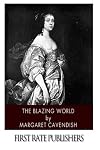
The Blazing World
by Margaret Cavendish
On This Page
Description
I had rather die in the adventure of noble achievements, than live in obscure and sluggish security' In 1666, Margaret Cavendish had a vision- there was a crack in reality at the North Pole leading to a utopian parallel universe, where gender roles, scientific orthodoxy and political norms had been razed to the ground. She slipped through the portal and returned with the first science fiction novel in English - an explosive account of the Blazing World.Tags
Recommendations






















Member Reviews
First I'll get out of the way the fact that, like later utopias such as Erewhon, Looking Backward, etc, this can at times turn into an unbearably tedious cross between fictional ethnography and political manifesto.
But that's not important because we all know how to skim. What is important is that this is a 17th century novel in which Our Heroine gets abducted but then her abductors die when their boat accidentally sails to another world that's attached to theirs at the North Pole. She survives and gets rescued and ends up marrying this new world's emperor, who apparently doesn't care much about ruling because he puts her in charge of this world full of fox-men and bird-men and fish-men and insect-men. And she changes things and then show more realises this breaks everything so changes things back, and then she starts chatting with spirits and ends up communicating soul-to-soul with the author in our world, so it's like two Mary Sues in one, plus playing with the fourth wall, it's fantastic.
(There are bits where the author's talking about how she's super ambitious and this way she gets to transcend all possible earthly glory by being the creator of an entire world, and I can't tell whether I want to hug her or nod and be all "So true.")
And then, and then! The Empress discovers that her country back in her own world is under threat from foreign kingdoms, so she and the author lead a fleet back there in her golden submarine (seriously I'm not making this up) and tell her king there "Yo, Majesty, I got this," and put the fear of hell into those foreign kingdoms, and then they do it again when some of said kingdoms are hesitant about paying tribute.
Seriously, 17th century girlpower for the win. show less
But that's not important because we all know how to skim. What is important is that this is a 17th century novel in which Our Heroine gets abducted but then her abductors die when their boat accidentally sails to another world that's attached to theirs at the North Pole. She survives and gets rescued and ends up marrying this new world's emperor, who apparently doesn't care much about ruling because he puts her in charge of this world full of fox-men and bird-men and fish-men and insect-men. And she changes things and then show more realises this breaks everything so changes things back, and then she starts chatting with spirits and ends up communicating soul-to-soul with the author in our world, so it's like two Mary Sues in one, plus playing with the fourth wall, it's fantastic.
(There are bits where the author's talking about how she's super ambitious and this way she gets to transcend all possible earthly glory by being the creator of an entire world, and I can't tell whether I want to hug her or nod and be all "So true.")
And then, and then! The Empress discovers that her country back in her own world is under threat from foreign kingdoms, so she and the author lead a fleet back there in her golden submarine (seriously I'm not making this up) and tell her king there "Yo, Majesty, I got this," and put the fear of hell into those foreign kingdoms, and then they do it again when some of said kingdoms are hesitant about paying tribute.
Seriously, 17th century girlpower for the win. show less
****.5
At first I thought it was a bland rip-off of Gulliver's Travels, but then I double checked the dates, and this book was written before Jonathan Swift was even born! In that context, it's amazingly prescient.
There's some delightful philosophical musing, and Cavendish was clearly well read and well informed on the latest scientific developments of the day.
Less successful for the modern reader are the sections on politics. While there are certainly some good points, and she clearly desired to create a utopian society with more prosperity and opportunities for everyone regardless of sex or skin colour, she adheres strongly to the aristocracy with a ruling monarch. Considering her own situation at the time this is perhaps easily show more forgiven, especially since such ideas are still popular among many people 350+ years later. The bigger problem is that the minutia of the English Civil War and subsequent Restoration are exceedingly boring to anyone without a strong interest in the history of the period, and reading about them veiled in the allegory of The Blazing World didn't make them any more appealing to me. show less
At first I thought it was a bland rip-off of Gulliver's Travels, but then I double checked the dates, and this book was written before Jonathan Swift was even born! In that context, it's amazingly prescient.
There's some delightful philosophical musing, and Cavendish was clearly well read and well informed on the latest scientific developments of the day.
Less successful for the modern reader are the sections on politics. While there are certainly some good points, and she clearly desired to create a utopian society with more prosperity and opportunities for everyone regardless of sex or skin colour, she adheres strongly to the aristocracy with a ruling monarch. Considering her own situation at the time this is perhaps easily show more forgiven, especially since such ideas are still popular among many people 350+ years later. The bigger problem is that the minutia of the English Civil War and subsequent Restoration are exceedingly boring to anyone without a strong interest in the history of the period, and reading about them veiled in the allegory of The Blazing World didn't make them any more appealing to me. show less
this was definitely the most painful book to get through but now im salty that i actually kinda liked it. there was just enough homoeroticism, girlboss behaviour, and utter chaos to redeem it. (fellas is it gay if your soul leaves ur body to kiss and embrace ur bestie's soul while repeatedly declaring ur love for her?)
The rating here is a very conflicted four, because this is a very well written book of-its-time, but it has not aged well. In particular the ‘different races do different things well’ is heavy handed, and the section on ‘Jewish Cabbala’ was just, urgh.
This is utopian fiction, but rather than being about a utopia for all, it seems to be about utopia for one. By which the person gets abducted, and then becomes the uncontested leader of a new world. Where there are jewels beyond compare, and people to do their bidding.
Overall, fascinating in a ‘reading historical texts’ way, but I don’t recommend it as pleasure reading.
This is utopian fiction, but rather than being about a utopia for all, it seems to be about utopia for one. By which the person gets abducted, and then becomes the uncontested leader of a new world. Where there are jewels beyond compare, and people to do their bidding.
Overall, fascinating in a ‘reading historical texts’ way, but I don’t recommend it as pleasure reading.
http://nwhyte.livejournal.com/2308871.html
For all the primacy of Frankenstein, I reckon this must be one of the earliest known sf books by a woman, at least in English. The Duchess of Newcastle was a well-known eccentric of Restoration England - Samuel Pepys has several awestruck entries in his diary about simply wanting to look at her in astonishment, including her visit to the Royal Society - and wrote various pieces including this exploration of politics, science, religion and learning from 1668.
Her unnamed heroine, kidnapped by sea from her home, is blown by storms to the North Pole and thence to another world which adjoins ours there. The inhabitants immediately make her their Empress, and we then settle down for a hundred pages show more or so of exposition and world-building, some of it a little satirical, some simply speculative and imaginative (some of it perhaps inspired by her visit to the Royal Society the previous year). The Empress then causes further point-of-view confusion by inviting the Duchess of Newcastle to come visit her on her own planet, and, using otherworldly technology, exterminates all of England's military enemies to ensure that Britain can be Top Nation.
It's a undisciplined, rollicking, diverting ramble through the mind of one of the era's most interesting personalities, and I'm really surprised that it is not better known - I think I came across it only browsing Wikipedia, though I then found an essay about it in Speculative Fiction 2012 when I was already half way through. I also detect one or two elements which surely Swift must have put directly into Gullver's Travels; he would surely have known and read this. show less
For all the primacy of Frankenstein, I reckon this must be one of the earliest known sf books by a woman, at least in English. The Duchess of Newcastle was a well-known eccentric of Restoration England - Samuel Pepys has several awestruck entries in his diary about simply wanting to look at her in astonishment, including her visit to the Royal Society - and wrote various pieces including this exploration of politics, science, religion and learning from 1668.
Her unnamed heroine, kidnapped by sea from her home, is blown by storms to the North Pole and thence to another world which adjoins ours there. The inhabitants immediately make her their Empress, and we then settle down for a hundred pages show more or so of exposition and world-building, some of it a little satirical, some simply speculative and imaginative (some of it perhaps inspired by her visit to the Royal Society the previous year). The Empress then causes further point-of-view confusion by inviting the Duchess of Newcastle to come visit her on her own planet, and, using otherworldly technology, exterminates all of England's military enemies to ensure that Britain can be Top Nation.
It's a undisciplined, rollicking, diverting ramble through the mind of one of the era's most interesting personalities, and I'm really surprised that it is not better known - I think I came across it only browsing Wikipedia, though I then found an essay about it in Speculative Fiction 2012 when I was already half way through. I also detect one or two elements which surely Swift must have put directly into Gullver's Travels; he would surely have known and read this. show less
This peculiar story was written in the mid-seventeenth century by Margaret Cavendish, Duchess of Newcastle. It features an unnamed female protagonist who is abducted and then escapes and is transported from her own "Philosophical World" to the "Blazing World" of the title, where she is hospitably received and becomes Empress.
The Blazing World is populated something like the planet Mongo, with bear-men, fox-men, fish-men, bird-men, spider-men, lice-men, and others besides. The Empress consults all of these according to their specialties, regarding natural history, physics, logic, and other "philosophical" topics, and this section of the book gets rather slow--especially with the small type of the Dover Thrift Edition I read. One show more highlight of this section, on the other hand, is Cavendish's detailed set of character identifications for Ben Jonson's The Alchemist as a drame à clef regarding John Dee and Edward Kelly (35). This passage is connected with the Empress' further ambition "to make a Cabbala" (46).
Turning from her various animal-men subjects to the world of incorporeal spirits, the Empress is next introduced to ... the Duchess of Newcastle--that is, her author, with whom she develops a "platonic love." The Duchess pleads for intervention with Fortune on behalf of her maligned husband the Duke, and this motive accounts for much of the remainder of the first and longer of the story's two parts.
The second part is livelier on the whole, and involves the Empress receiving news that her home country in the Philosophical World is under threat. So she confers with the Duchess, and they develop and execute an operation by which they effect the military and political supremacy of the "King of EFSI," the Empress' former sovereign.
An epilogue in Cavendish's own voice touts her accomplishment in world-creation, and boasts herself superior in that respect to the mere conquerors of great empires such as Alexander and Caesar. She also sets herself above Homer, in giving her characters grounds to resolve their conflicts without fatal violence. She generously extends to her readers the option of becoming her subjects in the Philosophical World, but allows that if they prefer to create their own worlds, they can and should do so.
While the style of The Blazing World is dated, its freedom from later literary conventions often lends it a great deal of charm. Persevering through some of the denser bits is genuinely worthwhile, as the whole text is not that long. It was originally published as a "work of fancy" bound together with her "serious" Observations upon Experimental Philosophy (ix). Her philosophical biases are decidedly modern, and while The Blazing World has been instanced as a forerunner of science fiction, it does hold up as an unusual source of instruction in the magick of cosmopoeia. show less
The Blazing World is populated something like the planet Mongo, with bear-men, fox-men, fish-men, bird-men, spider-men, lice-men, and others besides. The Empress consults all of these according to their specialties, regarding natural history, physics, logic, and other "philosophical" topics, and this section of the book gets rather slow--especially with the small type of the Dover Thrift Edition I read. One show more highlight of this section, on the other hand, is Cavendish's detailed set of character identifications for Ben Jonson's The Alchemist as a drame à clef regarding John Dee and Edward Kelly (35). This passage is connected with the Empress' further ambition "to make a Cabbala" (46).
Turning from her various animal-men subjects to the world of incorporeal spirits, the Empress is next introduced to ... the Duchess of Newcastle--that is, her author, with whom she develops a "platonic love." The Duchess pleads for intervention with Fortune on behalf of her maligned husband the Duke, and this motive accounts for much of the remainder of the first and longer of the story's two parts.
The second part is livelier on the whole, and involves the Empress receiving news that her home country in the Philosophical World is under threat. So she confers with the Duchess, and they develop and execute an operation by which they effect the military and political supremacy of the "King of EFSI," the Empress' former sovereign.
An epilogue in Cavendish's own voice touts her accomplishment in world-creation, and boasts herself superior in that respect to the mere conquerors of great empires such as Alexander and Caesar. She also sets herself above Homer, in giving her characters grounds to resolve their conflicts without fatal violence. She generously extends to her readers the option of becoming her subjects in the Philosophical World, but allows that if they prefer to create their own worlds, they can and should do so.
While the style of The Blazing World is dated, its freedom from later literary conventions often lends it a great deal of charm. Persevering through some of the denser bits is genuinely worthwhile, as the whole text is not that long. It was originally published as a "work of fancy" bound together with her "serious" Observations upon Experimental Philosophy (ix). Her philosophical biases are decidedly modern, and while The Blazing World has been instanced as a forerunner of science fiction, it does hold up as an unusual source of instruction in the magick of cosmopoeia. show less
I was very surprised to learn that many people believe Cavendish's work can be summarized, and that you don't need to read it, because the ideas are all that matters. The ideas aren't all that interesting, despite various editors and commentators' attempts to make her a feminist icon or whatever (n.b.: if you're really into the history of philosophy and science in the 17th century, you might well find it interesting to work out where Cavendish sits in the various debates of the period; suffice to say, the ideas she has are not all that often very good).
What is interesting is her style: it's a bit like reading Gulliver-era Swift. Everything is perfectly clear, without being monotonous or boring; Cavendish was, I would say, a great show more anti-Ciceronian. 21st century readers will find her far, far more readable than most prose writers of her era (compare Milton and Cavendish, for instance). Perhaps people have mentioned this before; I'm at the start of my reading/reading about Cavendish, and all I have to go on so far is the introduction to the Penguin edition, which is full of 'information' about how the author delighted in "the subversive potential of generic and intellectual hybridization," and uses the phrase "hermaphrodites of nature" as if it were an example of this... when, in the text, it's used as a criticism of dualism. God the early 90s were bad for literary criticism. show less
What is interesting is her style: it's a bit like reading Gulliver-era Swift. Everything is perfectly clear, without being monotonous or boring; Cavendish was, I would say, a great show more anti-Ciceronian. 21st century readers will find her far, far more readable than most prose writers of her era (compare Milton and Cavendish, for instance). Perhaps people have mentioned this before; I'm at the start of my reading/reading about Cavendish, and all I have to go on so far is the introduction to the Penguin edition, which is full of 'information' about how the author delighted in "the subversive potential of generic and intellectual hybridization," and uses the phrase "hermaphrodites of nature" as if it were an example of this... when, in the text, it's used as a criticism of dualism. God the early 90s were bad for literary criticism. show less
Members
- Recently Added By
Lists

Isaac Arthur’s Book Recommendations
98 works; 3 members

Review 3
41 works; 1 member

Books Read in 2025
4,128 works; 98 members
Author Information

37+ Works 1,201 Members
Awards and Honors
Notable Lists
Series
Belongs to Publisher Series
Work Relationships
Common Knowledge
- Original publication date
- 1666
- First words
- A Merchant travelling into a foreign Country, fell extreamly in Love with a young Lady; but being a stranger in that Nation, and beneath her, both in Birth and Wealth, he could have but little hopes of obtaining his desire; h... (show all)owever his Love growing more and more vehement upon him, even to the slighting of all difficulties, he resolved at last to Steal her away; which he had the better opportunity to do, because her Father's house was not far from the Sea, and she often using to gather shells upon the shore accompanied not with above two to three of her servants it encouraged him the more to execute his design.
- Last words
- (Click to show. Warning: May contain spoilers.)In these and the like Recreations, the Emperor, Empress, and the Nobility pass their time.
- Canonical DDC/MDS
- 823.4
Classifications
Statistics
- Members
- 251
- Popularity
- 129,867
- Reviews
- 12
- Rating
- (3.17)
- Languages
- 8 — Catalan, Dutch, English, French, Galician, Portuguese, Spanish, Swedish
- Media
- Paper, Audiobook, Ebook
- ISBNs
- 61
- UPCs
- 1
- ASINs
- 23