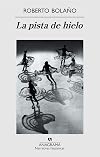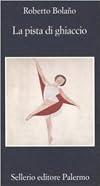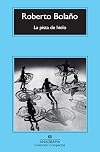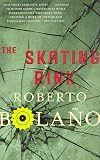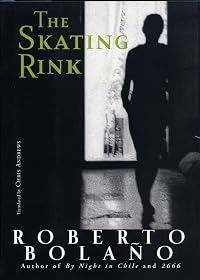
The Skating Rink
by Roberto Bolaño
On This Page
Description
When figure skater Nuria Marti is dropped from the Olympic team, a civil servant secretly uses public funds to build her a skating rink in the ruins of a seaside mansion, but Nuria has affairs and soon the rink becomes a crime scene.Tags
Recommendations









Member Reviews
The three narrators are what make this book interesting. Three narrative perspectives, the interests and worldviews of which Bolaño had to keep track. Thinking of it this way makes me see the book as a small feat.
I will not spoil the ending, but I will say that the revelation of the crime holds a randomness that strikes me as accurate, accurate to a certain kind of violence, as if it had bubbled out of an unrelated desperation, a pervasive, underlying desperation within which violence appears at random.
I got a bit tired of and bothered by the underdeveloped character of Nuria, but what do we see of Bolaño’s female characters—that they are physically “beautiful” and that’s about it.
I will not spoil the ending, but I will say that the revelation of the crime holds a randomness that strikes me as accurate, accurate to a certain kind of violence, as if it had bubbled out of an unrelated desperation, a pervasive, underlying desperation within which violence appears at random.
I got a bit tired of and bothered by the underdeveloped character of Nuria, but what do we see of Bolaño’s female characters—that they are physically “beautiful” and that’s about it.
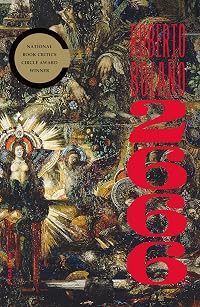
I rated this book as a 4 but really wanted to give it a 4.5. Compared to Savage Detectives and 2666, it is a smaller story, less complex, but, as usual with Roberto Bolaño's books, written beautifully, better than a 4.
Bolaño writes using multiple first person voices offering different perspectives. The personalities of the characters, their way of speaking is distinctive. In Savage Detectives and 2666, he wrote from multiple perspectives but also setting the scenes in diverse geographical locations over a length of time. The realization I had while reading this book, something I knew but hadn't really hit me, is that each character's observations are as if they are unedited, they describe scenes in detail and in a 'natural' voice, show more the way that a person's mind might see the scene, quickly scanning the details, thoughts that we might have but edited out when speaking.
The story is told in the three voices of the main male characters, Remo Moran, a successful businessman and writer, Enric Rosquelles, a midlevel bureaucrat for the city of "Z". Both of these characters are in love with Nuria Marti, an ice skater who wants to skate professionally. The third voice, Gaspar Heredia is a Mexican poet who works at the local campground (does this sound familiar?) and who lacks the proper papers to be in the country. He is in love with Caridad, a homeless and unstable woman who lives at the campground. Right from the beginning, you find out that there has been a murder but the identity of the murdered woman is not revealed until near the end of the book.
Unlike the two big books, this story takes place during a single summer at the Spanish seaside town of "Z", and, although the characters wander off to Barcelona, the actual story takes place in one place. Because of this focussed setting, I think it's probably more accessible, easier to read, maybe an introduction to the type of work that the author creates. It can be read quickly, or, in order to relish the language, savored over time. show less
Bolaño writes using multiple first person voices offering different perspectives. The personalities of the characters, their way of speaking is distinctive. In Savage Detectives and 2666, he wrote from multiple perspectives but also setting the scenes in diverse geographical locations over a length of time. The realization I had while reading this book, something I knew but hadn't really hit me, is that each character's observations are as if they are unedited, they describe scenes in detail and in a 'natural' voice, show more the way that a person's mind might see the scene, quickly scanning the details, thoughts that we might have but edited out when speaking.
The story is told in the three voices of the main male characters, Remo Moran, a successful businessman and writer, Enric Rosquelles, a midlevel bureaucrat for the city of "Z". Both of these characters are in love with Nuria Marti, an ice skater who wants to skate professionally. The third voice, Gaspar Heredia is a Mexican poet who works at the local campground (does this sound familiar?) and who lacks the proper papers to be in the country. He is in love with Caridad, a homeless and unstable woman who lives at the campground. Right from the beginning, you find out that there has been a murder but the identity of the murdered woman is not revealed until near the end of the book.
Unlike the two big books, this story takes place during a single summer at the Spanish seaside town of "Z", and, although the characters wander off to Barcelona, the actual story takes place in one place. Because of this focussed setting, I think it's probably more accessible, easier to read, maybe an introduction to the type of work that the author creates. It can be read quickly, or, in order to relish the language, savored over time. show less
The Skating Rink. Bolano holds our heads in the murk and ooze of an anonymous Spanish ruin like a goddam baptism. Opaque and atmospheric and admittedly narrow-scoped, but perfect in realizing and stomping out its small circumscribed territory. THE SKATING RINK is very much a minor work, with minute and petty motivations and consequences, but still surgically articulated and detailed.
The Skating rink is told through the successive narratives of three male characters, one a corrupt petty Gov’t official, one a small town entrepreneur and the third a poet (the Bolano Character). The plot, as do the male characters, circle around a beautiful professional figure skater called Nuria, who has lost her place on the Spanish national team & in the process her training venue. The Gov’t official obsessed with Nuria, steps in to save the day & with delusions of heroic worth, diverts Gov’t money to fund the building of a secret skating rink in an abandoned villa, high up on the coast. Of all the novels by Bolano this is the closest to an out and out crime story, although seen through the lens of this particular writer, show more there is a murder, there are signposts alerting you along the way (the outline of a knife visible through clothing, the mental instability of one the characters etc.), and, although the murder is solved, when the body is found about two-thirds of the way through the book, it is almost an after thought. In this book there is no Detective, sleuthing away, the crime is mundane, an occurrence, there is no cry for justice, this is all about implication, or how to avoid it. The three men are not bothered by who has died, or how, just how it affects their lives. There’s no honour here, no heroism that's not sullied by self interest, or self regard. So although this book features a death, someone is actually murdered, this merely acts as a spotlight onto the characters, making The Skating Rink a Detective tale where the crime is secondary to the protagonists involved.
This book had me puzzled, it reminded me of another book, and at first I thought it was Lawrence Durrell’s “ The Alexandria Quartet” which as a tetralogy offers us four perspectives via four novels on the same series of events. But that wasn’t it. It was then I realised that it was a tale I’d read last year in Ryunosuke Akutagawa’s Rashomon and 17 other stories, this tale "In the bamboo grove" concerns the murder of a traveller & the alleged rape of his wife, and is told through the differing perspectives of the various witnesses, all of who have their own agenda (including the deceased), yet with this story, there is blood and passion, which although it appears in the Skating Rink it’s more theoretical. Yes the official obsesses over the skater, yet it’s how it affects him, not her, that concerns him, and although the entrepreneur sleeps with Nuria, this seems to be more of a convenience between them both.
http://parrishlantern.blogspot.co.uk/2011/02/skating-rink.html show less
This book had me puzzled, it reminded me of another book, and at first I thought it was Lawrence Durrell’s “ The Alexandria Quartet” which as a tetralogy offers us four perspectives via four novels on the same series of events. But that wasn’t it. It was then I realised that it was a tale I’d read last year in Ryunosuke Akutagawa’s Rashomon and 17 other stories, this tale "In the bamboo grove" concerns the murder of a traveller & the alleged rape of his wife, and is told through the differing perspectives of the various witnesses, all of who have their own agenda (including the deceased), yet with this story, there is blood and passion, which although it appears in the Skating Rink it’s more theoretical. Yes the official obsesses over the skater, yet it’s how it affects him, not her, that concerns him, and although the entrepreneur sleeps with Nuria, this seems to be more of a convenience between them both.
http://parrishlantern.blogspot.co.uk/2011/02/skating-rink.html show less
Costa Brava noir rife with corruption and a homicidal miasma as refracted through three fragmented POVs which overlap and occlude with a masterful touch.
Anche gli antipatici soffrono per amore. Già questo basterebbe. Ma ciò che conta è la nostalgia di un'attesa che non si è realizzata, che non si realizza in nessuna vita. Il ricordo del momento in cui tutto avrebbe potuto essere non ci risparmia e il nodo alla gola è una emozione dolce e struggente.
[audiolibro]
[audiolibro]
Bolaño é incrivelmente criativo, e começa esse livro com o que parece ser o interrogatório de três personagens, mas não sabemos nem mesmo que crime foi cometido.
Members
- Recently Added By
Lists

Books about sports
65 works; 3 members
Author Information

101+ Works 28,230 Members
Some Editions
Series
Belongs to Publisher Series
Common Knowledge
- Canonical title
- The Skating Rink
- Original title
- La pista de hielo
- Original publication date
- 1993
- Epigraph
- If I must live then let it be rudderless, in delirium —Mario Santiago
- Last words
- (Click to show. Warning: May contain spoilers.)What's gone is gone, that's what I say, you have to keep looking ahead...
- Blurbers
- Shy, Todd; Eder, Richard; Banville, John; Prose, Francine; Krauss, Nicole; Kerr, Sarah (show all 9); Anderson, Sam; Lethem, Jonathan; Mason, Wyatt
- Original language
- Spanish
Classifications
- Genres
- Fiction and Literature, General Fiction, Mystery
- DDC/MDS
- 863.64 — Literature & rhetoric Spanish Literature Spanish fiction 20th Century 1945-2000
- LCC
- PQ8098.12 .O38 .P5713 — Language and Literature French, Italian, Spanish and Portuguese literatures Spanish literature Provincial, local, colonial, etc. Spanish America
- BISAC
Statistics
- Members
- 728
- Popularity
- 39,070
- Reviews
- 28
- Rating
- (3.67)
- Languages
- 11 — Dutch, English, Estonian, Finnish, French, German, Italian, Polish, Portuguese, Spanish, Swedish
- Media
- Paper, Audiobook, Ebook
- ISBNs
- 30
- ASINs
- 9