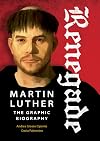
Renegade: Martin Luther, The Graphic Biography
by Dacia Palmerino, Andrea Grosso Ciponte (Illustrator)
On This Page
Description
The life of reformer Martin Luther in graphic novel format… Five hundred years ago a brash young monk single-handedly confronted the most powerful institutions of his day. His bold stand sparked the Protestant Reformation and marked one of the great turning points in history. Martin Luther, a spiritual and historical giant, is loved and hated to this day?and for good reason. The anniversary of the revolution he helped start has produced a spate of doorstop-sized biographies. Luckily, today show more there exists a more accessible format that does justice to such a colorful, complex character and his tumultuous life and times - the graphic novel. In a world of grinding poverty, plague, and religious superstitions, a child of laborers distinguishes himself at university - until a lightning-bolt conversion lands him in a monastery. There his personal battles with disillusionment and doubt culminate in a cry for freedom. The rest is the stuff of history and legend: Luther's revolt against Rome with the nailing of ninety-five theses to the church door in Wittenberg; his time spent incognito at Wartburg Castle, where he famously throws an inkpot at the devil; his seditious translation and publication of the Bible in the language of the people; his scandalous marriage to former nun Katharina von Bora; and, in later years, his ugly tirades against peasants, Anabaptists, and Jews. Each chapter of Luther's life comes vividly to life thanks to cutting-edge graphic techniques, meticulous historical research, and compelling writing. This could be the biggest breakthrough for Martin Luther since the Gutenberg press. show lessTags
Recommendations













Member Reviews
Summary: A richly illustrated graphic biography of the life of Martin Luther, covering the major events of his life from boyhood to death, and the setting in which that life took place.
I’m not a graphic novel person. I’ve only reviewed one graphic novel on this blog and I was ambivalent about it. So I had my doubts when this new “graphic biography” of Martin Luther arrived for review. Add to that the spate of books on Luther on the 500th anniversary of the Reformation, and you had the recipe for skepticism. Instead, I have to admit that my encounter with this work was powerful, leaving me thinking about Luther’s life in a fresh way.
The artist’s palette is dominated by reds, earth tones, dark blues, grays, and black. Somehow, show more this worked in capturing the setting of Luther’s life–urban streets filled with rats, plague, poverty, and violent justice; castles and churches for isolated study and refuge, public disputation and conflict; sumptuously clothed churchmen and demonic figures; night-time journeys of lightning filled terror, kidnapping, scenes of slaughter from the Peasants War, and a final journey to death. This preview serves as a good sample of the graphic character and quality of the work.
The artwork and selection of episodes from Luther’s life brought a familiar story from church history to fresh life. We glimpse Luther’s strict upbringing amid the horrors of plagues and burnings at the stake, a severity of discipline and the justice of God. We trace the turmoil of a young man struggling under a sense of his own inadequacy before a righteous God, vowing to become a monk to the disappointment of his father, finding no relief in confessions, penances, journeys to Rome or counsel with Father Staupitz. We accompany him in his study of Romans at Wittenberg, until his stunning realization that the righteous lives by faith, that by faith we are made righteous.
Renegade-screen capture
Screen capture from trailer
We trace the beginnings of the Reformation to the posting of the 95 Theses in response to Father Johann Tetzel’s marketing of indulgences to build St. Peter’s Basilica. We glimpse the power of the newly invented printing press in circulating his ideas, and fomenting discontent, which must be quashed by Rome. We see the dawning realization of this monk that he is not defending Rome from excesses and errors but facing Rome’s power to excommunicate and condemn him, and his courageous statement before the Diet of Worms:
“Unless I am convinced by the testimony of Scripture or clear reason, I am bound by the biblical texts I have quoted. My conscience is captive to the Word of God. Therefore I cannot and I will not recant anything. I cannot act contrary to my conscience. So help me God! Amen.”
The artist imaginatively captures Elector Frederick’s daring ploy to secret Luther away to Wartburg Castle, the temptations he faces as he hides out in idleness, and the determination to translate the scriptures into the vernacular. Subsequently he goes free, returns to Wittenberg, and provides shelter for nuns who, influenced by Luther’s ideas, have left the convent. He marries one of these, Katharina von Bora, who basically tells him she should marry her!
What we encounter less in the histories of Luther are the Peasant’s War touched off in part by his ideas, particularly as they are extended by the radical theologian, Thomas Muntzer. Muntzer’s rallying cry, “Omnia sunt communia” (“all things in common”) fuels a violent peasant revolt leading to seizure of property, the execution of a count, and a bloody forceful suppression of the rebellion ending in the execution of Muntzer, supported by Luther who writes against their rebellion and disobedience, even while realizing how his own ideas have fueled their acts.
We also see, in the final narrative of his life, and his fatal trip to Eisleben and Mansfeld in February 1546, his increasing hostility toward the Jews, against whom he speaks in his last sermon in the town of his birth, the conclusion of negotiations with Count Albrecht to protect his family’s mining interests, and his deathbed affirmation of faith, with his final written words, “We are all beggars, that is true.”
There are gaps, to be sure, particularly between 1530 and 1546 which are the period of consolidating this new movement of Reformation churches. It would have been delightful to have a chapter on “table talk” and Luther’s domestic life. But what this biography helpfully does is help us understand the arc of Luther’s life and the backdrop of disparities of wealth and poverty that made his ideas so volatile, beyond even his ability to control them. It highlight’s Luther’s breakthrough insight on justification by faith, and his climactic encounter at Worms.
As the book trailer for this work emphasizes, this is no “door stop” biography. But it could serve well as a means to educate a new generation on the anniversary of the Reformation about this pivotal figure and his times.
____________________________
Disclosure of Material Connection: I received this book free from the publisher via LibraryThing. I was not required to write a positive review. The opinions I have expressed are my own. show less
I’m not a graphic novel person. I’ve only reviewed one graphic novel on this blog and I was ambivalent about it. So I had my doubts when this new “graphic biography” of Martin Luther arrived for review. Add to that the spate of books on Luther on the 500th anniversary of the Reformation, and you had the recipe for skepticism. Instead, I have to admit that my encounter with this work was powerful, leaving me thinking about Luther’s life in a fresh way.
The artist’s palette is dominated by reds, earth tones, dark blues, grays, and black. Somehow, show more this worked in capturing the setting of Luther’s life–urban streets filled with rats, plague, poverty, and violent justice; castles and churches for isolated study and refuge, public disputation and conflict; sumptuously clothed churchmen and demonic figures; night-time journeys of lightning filled terror, kidnapping, scenes of slaughter from the Peasants War, and a final journey to death. This preview serves as a good sample of the graphic character and quality of the work.
The artwork and selection of episodes from Luther’s life brought a familiar story from church history to fresh life. We glimpse Luther’s strict upbringing amid the horrors of plagues and burnings at the stake, a severity of discipline and the justice of God. We trace the turmoil of a young man struggling under a sense of his own inadequacy before a righteous God, vowing to become a monk to the disappointment of his father, finding no relief in confessions, penances, journeys to Rome or counsel with Father Staupitz. We accompany him in his study of Romans at Wittenberg, until his stunning realization that the righteous lives by faith, that by faith we are made righteous.
Renegade-screen capture
Screen capture from trailer
We trace the beginnings of the Reformation to the posting of the 95 Theses in response to Father Johann Tetzel’s marketing of indulgences to build St. Peter’s Basilica. We glimpse the power of the newly invented printing press in circulating his ideas, and fomenting discontent, which must be quashed by Rome. We see the dawning realization of this monk that he is not defending Rome from excesses and errors but facing Rome’s power to excommunicate and condemn him, and his courageous statement before the Diet of Worms:
“Unless I am convinced by the testimony of Scripture or clear reason, I am bound by the biblical texts I have quoted. My conscience is captive to the Word of God. Therefore I cannot and I will not recant anything. I cannot act contrary to my conscience. So help me God! Amen.”
The artist imaginatively captures Elector Frederick’s daring ploy to secret Luther away to Wartburg Castle, the temptations he faces as he hides out in idleness, and the determination to translate the scriptures into the vernacular. Subsequently he goes free, returns to Wittenberg, and provides shelter for nuns who, influenced by Luther’s ideas, have left the convent. He marries one of these, Katharina von Bora, who basically tells him she should marry her!
What we encounter less in the histories of Luther are the Peasant’s War touched off in part by his ideas, particularly as they are extended by the radical theologian, Thomas Muntzer. Muntzer’s rallying cry, “Omnia sunt communia” (“all things in common”) fuels a violent peasant revolt leading to seizure of property, the execution of a count, and a bloody forceful suppression of the rebellion ending in the execution of Muntzer, supported by Luther who writes against their rebellion and disobedience, even while realizing how his own ideas have fueled their acts.
We also see, in the final narrative of his life, and his fatal trip to Eisleben and Mansfeld in February 1546, his increasing hostility toward the Jews, against whom he speaks in his last sermon in the town of his birth, the conclusion of negotiations with Count Albrecht to protect his family’s mining interests, and his deathbed affirmation of faith, with his final written words, “We are all beggars, that is true.”
There are gaps, to be sure, particularly between 1530 and 1546 which are the period of consolidating this new movement of Reformation churches. It would have been delightful to have a chapter on “table talk” and Luther’s domestic life. But what this biography helpfully does is help us understand the arc of Luther’s life and the backdrop of disparities of wealth and poverty that made his ideas so volatile, beyond even his ability to control them. It highlight’s Luther’s breakthrough insight on justification by faith, and his climactic encounter at Worms.
As the book trailer for this work emphasizes, this is no “door stop” biography. But it could serve well as a means to educate a new generation on the anniversary of the Reformation about this pivotal figure and his times.
____________________________
Disclosure of Material Connection: I received this book free from the publisher via LibraryThing. I was not required to write a positive review. The opinions I have expressed are my own. show less
 This review was written for LibraryThing Early Reviewers.
A very nicely conceived and executed illustrated romp through the life of Martin Luther as well as an interesting perspective on 16th century Europe. More than just a "cartoon" version of history - this is quite nuanced and suitable for readers across the board. Brava.
This review was written for LibraryThing Early Reviewers.Renegade- Martin Luther, The Graphic Biography: Not about the awesome Styx or JayZ songs
October 31st, 1517: Young monk, Martin Luther nails documents to the front door of the Wittenberg Castle Church. On the pages were printed 95 theses defining man's relationship with God and religion. These were tumultuous times and blasphemy is a dangerous game for renegades and suicidal fools anxious to receive the lash.
2017 marks the five hundredth anniversary of this event. Martin Luther rallied against the Pope and started a revolution in thought that shook the cornerstones of known Christianity. The writing and distribution of Luther's 95 theses, caused ripples in our social structures still in evidence.
Slated for release on 10/08/2017
Preorders show more available
Renegade: Martin Luther, The Graphic Biography (Dacia Palmerino, Andrea Ciponte)
160 pages
Plough Publishing House
ISBN-10: 0874862078
ISBN-13: 978-0874862072
I have bastardized a bit of this, but bear with me as I am far from being a religious historian. I will leave the hard core cross comparison to those with stronger background experience.
Luther's history is incredibly fascinating. After a classic schooling, Martin Luther was left with more questions than answers. He found himself in dismay, attempting to reconcile his religious beliefs with the world around him. He frustratingly finds that they fail to be cohesive. During a walk in the countryside (I cannot tell if this is legend or fact) a brewing storm sent a bolt of lightning into a nearby tree. Luther took this as divine instruction, changed directions in his life and entered the monastic life.
Martin was in a conundrum, spending multiple sessions every day in confession. He felt that no matter how devout he was, the Church advised that he was a sinner in peril and would never be allowed into Heaven without being even more penitent. His concern for the state of his immortal soul weighed on him and his conflicted feelings increased. How could his soul be always at risk while the Catholic church allowed people to buy forgiveness of sins? If you dropped money into coffers, buying penance for yourself or loved ones seemed very wrong.
Luther invests a great deal of time in solitary study and comes to terms with a belief that is contrary to the teachings of the Church. His belief is that (as the Bible states) his Faith alone is needed to save him from damnation. The Church, the Pope, and all other earthly institutions are nothing more than tools being used as diversions between mankind and God.
Luther spends time translating the Bible from Latin to German and distributing it to the masses. This allows the Everyman to have a direct relationship with the words and instructions of the Christian God. The direct relationship removes the need to join the cattle call for multiple daily Mass, which served value only as lip service in his eyes. Mass then becomes worship for those who attend.
Palmerino's writing in this Graphic Novel was wonderful. I was concerned at first that this was going to be a chore to read, with the initial pages being presented a bit dry, feeling like the reader is preparing to be lectured on theology. After a short introduction, however, Renegade moves to Luther's ingress to school and branches the story. It immediately picks up in an easy to read manner. Reading this is less like Sunday school and more like a well crafted Hollywood Biopic.
The story itself is paired nicely with some absolutely stunning artwork by Ciponte. The framing of the story with the imagery really brings Luther to life again rather than simply being viewed as a Reformist whose bones are long since turned to dust. Watching the facial expressions change panel by panel as he makes deep personal realizations causes the pages glow with a Human element that must have taken a great deal of passion and forethought.
The artistic design also wavered between styles. In many areas, it was a purposeful rough and divisive; in others, it was almost stream of consciousness, with pages and phrases from the Bible floating around Luther's personal universe.
The words and art have a gentle interaction, taking difficult religious topics and complex political situations and placing them in a highly consumable presentation. A fine example of this is a full page spread showing Martin after he identifies that monastic vows are not permanent life long vows. In this page spread, Luther is getting married, the panels pan outward showing his happy marriage day. As each panel gets further from him and his bride, the final panel shows dark silhouettes of dead hanging from nooses, with the chapel in their background. The imagery and metaphor are haunting.
I would consider this graphic novel suitable for any age group 8 and above and highly recommend it for any history buff, religiously minded or not. As a primer to the topic, this media may have a huge benefit and I would be interested in seeing the Plough publishing house put out more work in this style, even potentially for other religions.
Bonus thought- Did Piers Anthony base his Devil Character in the series 'The Incarnations of Immortality' on Martin Luther? There is a segment of this Graphic Novel where Luther is in disguise and hiding from the authorities. He goes a bit crazy being secreted away and unable to be himself. He feels himself falling apart and in the Graphic Novel, it presents him as being visited by a hallucinatory succubus. The hyper religious 'good man' who is tainted by a succubus is how Anthony's character evolves 'For Love of Evil', being that the best person to keep the goodness in line is someone who loves God enough to be able to set his love aside and play the game fairly. I performed a bit of side research and it looks like this is documented in Martin's writings, so I find the correlation to another series I love to be an unexpected joy.
---
Disclosure: This Graphic Novel was provided for review purposes by the Publisher. Even a free cupcake is still a cupcake. If it were a disgusting cupcake, I would not eat it and instead, choose to throw it into a trash receptacle. Sometimes, the free cupcake has beautiful pillows of cream cheese frosting piled on top and a moist delicious carrot cake interior. You do not question it, you just dive into the blissful cakey goodness and enjoy the cupcake. Carrot cake is the best. I will fight you at the flagpole after school if you disagree. show less
October 31st, 1517: Young monk, Martin Luther nails documents to the front door of the Wittenberg Castle Church. On the pages were printed 95 theses defining man's relationship with God and religion. These were tumultuous times and blasphemy is a dangerous game for renegades and suicidal fools anxious to receive the lash.
2017 marks the five hundredth anniversary of this event. Martin Luther rallied against the Pope and started a revolution in thought that shook the cornerstones of known Christianity. The writing and distribution of Luther's 95 theses, caused ripples in our social structures still in evidence.
Slated for release on 10/08/2017
Preorders show more available
Renegade: Martin Luther, The Graphic Biography (Dacia Palmerino, Andrea Ciponte)
160 pages
Plough Publishing House
ISBN-10: 0874862078
ISBN-13: 978-0874862072
I have bastardized a bit of this, but bear with me as I am far from being a religious historian. I will leave the hard core cross comparison to those with stronger background experience.
Luther's history is incredibly fascinating. After a classic schooling, Martin Luther was left with more questions than answers. He found himself in dismay, attempting to reconcile his religious beliefs with the world around him. He frustratingly finds that they fail to be cohesive. During a walk in the countryside (I cannot tell if this is legend or fact) a brewing storm sent a bolt of lightning into a nearby tree. Luther took this as divine instruction, changed directions in his life and entered the monastic life.
Martin was in a conundrum, spending multiple sessions every day in confession. He felt that no matter how devout he was, the Church advised that he was a sinner in peril and would never be allowed into Heaven without being even more penitent. His concern for the state of his immortal soul weighed on him and his conflicted feelings increased. How could his soul be always at risk while the Catholic church allowed people to buy forgiveness of sins? If you dropped money into coffers, buying penance for yourself or loved ones seemed very wrong.
Luther invests a great deal of time in solitary study and comes to terms with a belief that is contrary to the teachings of the Church. His belief is that (as the Bible states) his Faith alone is needed to save him from damnation. The Church, the Pope, and all other earthly institutions are nothing more than tools being used as diversions between mankind and God.
Luther spends time translating the Bible from Latin to German and distributing it to the masses. This allows the Everyman to have a direct relationship with the words and instructions of the Christian God. The direct relationship removes the need to join the cattle call for multiple daily Mass, which served value only as lip service in his eyes. Mass then becomes worship for those who attend.
Palmerino's writing in this Graphic Novel was wonderful. I was concerned at first that this was going to be a chore to read, with the initial pages being presented a bit dry, feeling like the reader is preparing to be lectured on theology. After a short introduction, however, Renegade moves to Luther's ingress to school and branches the story. It immediately picks up in an easy to read manner. Reading this is less like Sunday school and more like a well crafted Hollywood Biopic.
The story itself is paired nicely with some absolutely stunning artwork by Ciponte. The framing of the story with the imagery really brings Luther to life again rather than simply being viewed as a Reformist whose bones are long since turned to dust. Watching the facial expressions change panel by panel as he makes deep personal realizations causes the pages glow with a Human element that must have taken a great deal of passion and forethought.
The artistic design also wavered between styles. In many areas, it was a purposeful rough and divisive; in others, it was almost stream of consciousness, with pages and phrases from the Bible floating around Luther's personal universe.
The words and art have a gentle interaction, taking difficult religious topics and complex political situations and placing them in a highly consumable presentation. A fine example of this is a full page spread showing Martin after he identifies that monastic vows are not permanent life long vows. In this page spread, Luther is getting married, the panels pan outward showing his happy marriage day. As each panel gets further from him and his bride, the final panel shows dark silhouettes of dead hanging from nooses, with the chapel in their background. The imagery and metaphor are haunting.
I would consider this graphic novel suitable for any age group 8 and above and highly recommend it for any history buff, religiously minded or not. As a primer to the topic, this media may have a huge benefit and I would be interested in seeing the Plough publishing house put out more work in this style, even potentially for other religions.
Bonus thought- Did Piers Anthony base his Devil Character in the series 'The Incarnations of Immortality' on Martin Luther? There is a segment of this Graphic Novel where Luther is in disguise and hiding from the authorities. He goes a bit crazy being secreted away and unable to be himself. He feels himself falling apart and in the Graphic Novel, it presents him as being visited by a hallucinatory succubus. The hyper religious 'good man' who is tainted by a succubus is how Anthony's character evolves 'For Love of Evil', being that the best person to keep the goodness in line is someone who loves God enough to be able to set his love aside and play the game fairly. I performed a bit of side research and it looks like this is documented in Martin's writings, so I find the correlation to another series I love to be an unexpected joy.
---
Disclosure: This Graphic Novel was provided for review purposes by the Publisher. Even a free cupcake is still a cupcake. If it were a disgusting cupcake, I would not eat it and instead, choose to throw it into a trash receptacle. Sometimes, the free cupcake has beautiful pillows of cream cheese frosting piled on top and a moist delicious carrot cake interior. You do not question it, you just dive into the blissful cakey goodness and enjoy the cupcake. Carrot cake is the best. I will fight you at the flagpole after school if you disagree. show less
Renegade: Martin Luther, The Graphic Biography by Andrea Grosso and Dacia Palmerino
This graphic biography begins to pull you into the story of Martin Luther with the extremely attractive, oversized cover featuring Martin Luther as a young monk, realistically drawn on a scarlet background. It’s irresistible!
With symbolic colors, realistic drawings and simple text we are introduced to Martin Luther during his strict childhood. Life was hard. As Luther grew to manhood during these turbulent times, it’s amazing to follow him (in simple text and pictures) as he struggles to formulate his ideas. He determined that each man should be able to read the Scriptures as they were written, free of interpretation, extra text or any other show more additions. Therefore, he translated the Latin Scriptures into German for the ordinary man, and circulated these books thanks to the invention of the new Gutenberg printing press. This began the “Reformation”period.
The graphic novel format covered a lot of information in a small space. I felt like I learned a lot about this period in history. It would be great to read in a family circle setting. I will be putting it down to read again later because so much is shown it’s a challenge to take it all in. I want to go back and focus on the beautiful illustrations.
I received this book through LibraryThing's Early Reviewer program. It was provided to me free by Plough Publishing House. show less
This graphic biography begins to pull you into the story of Martin Luther with the extremely attractive, oversized cover featuring Martin Luther as a young monk, realistically drawn on a scarlet background. It’s irresistible!
With symbolic colors, realistic drawings and simple text we are introduced to Martin Luther during his strict childhood. Life was hard. As Luther grew to manhood during these turbulent times, it’s amazing to follow him (in simple text and pictures) as he struggles to formulate his ideas. He determined that each man should be able to read the Scriptures as they were written, free of interpretation, extra text or any other show more additions. Therefore, he translated the Latin Scriptures into German for the ordinary man, and circulated these books thanks to the invention of the new Gutenberg printing press. This began the “Reformation”period.
The graphic novel format covered a lot of information in a small space. I felt like I learned a lot about this period in history. It would be great to read in a family circle setting. I will be putting it down to read again later because so much is shown it’s a challenge to take it all in. I want to go back and focus on the beautiful illustrations.
I received this book through LibraryThing's Early Reviewer program. It was provided to me free by Plough Publishing House. show less
This review was written for LibraryThing Early Reviewers.Great artwork and faithful to actual history. The graphic images are just that – sometimes quite graphic on the painfulness of life in the 16th century, and oftentimes very close to actual images. As I read it, I wondered if they had applied sketch marks to actual pictures. Nonetheless, 'Renegade' provides a great overview of Luther's life, with its highs and lows. Based on the graphicness of the images and the details of the story itself, I would suggest around 12-13 years old as the youngest suitable audience.
This review was written for LibraryThing Early Reviewers.Renegade comes in a format that is unfamiliar to me, a graphic biography. When I entered the contest in which I won it, I was not sure what I was getting in to. It is not the gore I was worried about but a biography told in cartoons.
I knew a little about Martin Luther, that he nailed his 95 theses to the church door and started the process that became the Protestant Reformation, or Revolt, depending on your perspective. In high school, Augustinian Academy, I learned that he had been an Augustinian monk but that is about as far as I got before opening Renegade.
What I found is an entertaining, easy to read introduction to the high points of its subject’s life. The pictures are colorful and easy to understand. The text captures the story show more line in the accompanying caption balloons. The stage is set in the dark times of the Black Death, the controversy over the purported sale of indulgences and power struggles between Church and crowns. Luther’s tale is told as beginning with a strict disciplinarian mother, a soul searching for God’s will, the lightning bolt that misses him and it continues into the discovery of new understandings of faith. The recognition of his status as a sinner dependent totally on the mercy of God for his salvation is shown as leading to many of his later tenets, such as the translation of the Bible into German, sola scriptura, his challenge to papal authority, and that priests and nuns should marry. His dismay at the politicization of his movement and his antisemitism are included in the saga. One thing I really like about this work is that I do not see it as advancing a particular agenda. From my Catholic (partly formed by Augustinians) viewpoint, I see an unfortunate soul driven by turbulent times into grave error with tragic consequences. I can see how a follower of Luther’s theology would see an enlightened scholar who arrives at truths that had eluded so many others.
I recommend this as a first introduction to Martin Luther. After reading this you will have a general understanding of his life. If you choose to read on you can do so with a framework in which to organize the contents of more detailed biographies. show less
I knew a little about Martin Luther, that he nailed his 95 theses to the church door and started the process that became the Protestant Reformation, or Revolt, depending on your perspective. In high school, Augustinian Academy, I learned that he had been an Augustinian monk but that is about as far as I got before opening Renegade.
What I found is an entertaining, easy to read introduction to the high points of its subject’s life. The pictures are colorful and easy to understand. The text captures the story show more line in the accompanying caption balloons. The stage is set in the dark times of the Black Death, the controversy over the purported sale of indulgences and power struggles between Church and crowns. Luther’s tale is told as beginning with a strict disciplinarian mother, a soul searching for God’s will, the lightning bolt that misses him and it continues into the discovery of new understandings of faith. The recognition of his status as a sinner dependent totally on the mercy of God for his salvation is shown as leading to many of his later tenets, such as the translation of the Bible into German, sola scriptura, his challenge to papal authority, and that priests and nuns should marry. His dismay at the politicization of his movement and his antisemitism are included in the saga. One thing I really like about this work is that I do not see it as advancing a particular agenda. From my Catholic (partly formed by Augustinians) viewpoint, I see an unfortunate soul driven by turbulent times into grave error with tragic consequences. I can see how a follower of Luther’s theology would see an enlightened scholar who arrives at truths that had eluded so many others.
I recommend this as a first introduction to Martin Luther. After reading this you will have a general understanding of his life. If you choose to read on you can do so with a framework in which to organize the contents of more detailed biographies. show less
This review was written for LibraryThing Early Reviewers.Haven't spent much time with this format, but I enjoyed it, even if the art was a touch too video-gamey for my taste. The artwork provides a window into a very different world in a much more immediate way than the written word. The book presents Luther warts and all - no hagiography here. The author did a solid job expressing the theological nature of Luther's work. I'm not sure the right balance was struck in terms of frames per episode, but I was impressed at how much ground was covered with very little text. I haven't been able to find an account of Luther's death that grounds the Hollywoodesque moment with his daughter Magdalena at the end of the book; maybe he did report such a vision. Overall I was pleased with the accuracy.
Some show more of the art and subject matter is not for the young ones, but I can see this being a useful resource for older children who enjoy graphic novels.
I received this book through the LibraryThing Early Reviewers program in exchange for a review. show less
Some show more of the art and subject matter is not for the young ones, but I can see this being a useful resource for older children who enjoy graphic novels.
I received this book through the LibraryThing Early Reviewers program in exchange for a review. show less
This review was written for LibraryThing Early Reviewers.Members
- Recently Added By
Author Information
2 Works 47 Members
Awards and Honors
Common Knowledge
- People/Characters
- Luther, Martin, 1483-1546
- Important events
- Reformation
Classifications
- Genres
- Nonfiction, Graphic Novels & Comics
- DDC/MDS
- 284.1092 — Religion Christian denominations Protestant denominations of Continental origin and related bodies Lutheran Reformed Biography And History Biography
- LCC
- BR325 .P2613 — Philosophy, Psychology and Religion Christianity Christianity History By period Modern period Luther, Martin
- BISAC
Statistics
- Members
- 46
- Popularity
- 648,514
- Reviews
- 14
- Rating
- (3.68)
- Languages
- English, German
- Media
- Paper, Ebook
- ISBNs
- 3