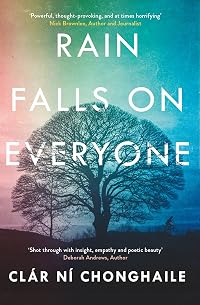
Rain Falls on Everyone
by Clár Ní Chonghaile
On This Page
Description
"Powerful, thought-provoking, and at times horrifying; yet also a compelling story of friendship against all the odds"--Nick Brownlee Plagued by his past, a young Rwandan immigrant is pulled into Dublin's criminal underworld. But a chance encounter and an unlikely friendship soon offer him a lifeline.Tags
Member Reviews
I received an e-arc of this book from the publisher via NetGalley in exchange for my honest review. This did not affect my opinion of the book in any way.
What a book! It's been a few days since I finished reading this, and I'm still not sure I can make sense of what I thought about it. This is easily one of the best books I've read this year, that much I know. But trying to coherently explain why that is, is entirely another matter...
Rain Falls on Everyone is a book that just resonated with me right from the start. Clár's gorgeous writing style managed to draw me in and keep me wanting always more. This was one of those fairly rare occasions where I really couldn't bring myself to put the book down: every time I thought I ought to show more close up, a little voice in my head kept telling me "Just one more chapter... it won't be too much longer, will it?". And so I ended up taking this book everywhere with me until it was over... exactly at the right moment within the story and definitely way too early for me.
I don't know what magic the author employed to get me hooked, but whatever it was, it worked! I was immediately drawn into Theo's and Deirdre's stories and I didn't really want to say goodbye at the end, and never throughout the reading did I find a dull moment. The characters were so amazingly real, I felt like I could actually meet them on the street, while at the same time being interesting and diverse enough that their stories really did deserve to be told. From racism to dealing with trauma, from domestic violence to drug abuse, there really isn't a single controversial topic that Clár shies from. Issues that are often trivialised and dismissed as always affecting "someone else" could actually touch anyone's life at any time, even those beyond suspicion. Starting out as small, they creep up on you and grow subtly until it's just too late to be rid of them without paying a significant price. It's an ugly truth, and one that this book represents without ever trying to sugarcoat reality.
Personally, I have a particular interest in books relating in some way to the topic of immigration and as a result often end up reading quite a lot. It's fairly unusual, however, for me to find no flaws with the way this defining experience is portrayed. This was not the case here. Theo's experiences of being a foreigner in a country which until recently wasn't very used to diversity, dealing with trauma and survivor's guilt, racism and the difficulty of "fitting in" are described very realistically, in incredibly vivid detail, free of the usual cliches and stereotypes. The realism of it all is definitely aided by the wonderful setting, so much so that I could basically see the Dublin streets in front of my eyes, and hear the accent in characters' dialogues. Having been to Dublin myself in the past, this book had the added bonus of letting me enjoy a little trip down memory lane.
Overall, this was a fantastic read, one of those books that I felt deeply and that will stay with me for a long time. Harrowing and tender, it will make you laugh and cry, it will inspire and frighten you, but above all it will make you think about all the forgotten Theos and Deirdres that somewhere, in this great big world, are fighting to keep their story going on for just a little bit longer and, maybe, have a happy ending after all.
For this and more reviews, visit Book for Thought. show less
What a book! It's been a few days since I finished reading this, and I'm still not sure I can make sense of what I thought about it. This is easily one of the best books I've read this year, that much I know. But trying to coherently explain why that is, is entirely another matter...
Rain Falls on Everyone is a book that just resonated with me right from the start. Clár's gorgeous writing style managed to draw me in and keep me wanting always more. This was one of those fairly rare occasions where I really couldn't bring myself to put the book down: every time I thought I ought to show more close up, a little voice in my head kept telling me "Just one more chapter... it won't be too much longer, will it?". And so I ended up taking this book everywhere with me until it was over... exactly at the right moment within the story and definitely way too early for me.
I don't know what magic the author employed to get me hooked, but whatever it was, it worked! I was immediately drawn into Theo's and Deirdre's stories and I didn't really want to say goodbye at the end, and never throughout the reading did I find a dull moment. The characters were so amazingly real, I felt like I could actually meet them on the street, while at the same time being interesting and diverse enough that their stories really did deserve to be told. From racism to dealing with trauma, from domestic violence to drug abuse, there really isn't a single controversial topic that Clár shies from. Issues that are often trivialised and dismissed as always affecting "someone else" could actually touch anyone's life at any time, even those beyond suspicion. Starting out as small, they creep up on you and grow subtly until it's just too late to be rid of them without paying a significant price. It's an ugly truth, and one that this book represents without ever trying to sugarcoat reality.
Personally, I have a particular interest in books relating in some way to the topic of immigration and as a result often end up reading quite a lot. It's fairly unusual, however, for me to find no flaws with the way this defining experience is portrayed. This was not the case here. Theo's experiences of being a foreigner in a country which until recently wasn't very used to diversity, dealing with trauma and survivor's guilt, racism and the difficulty of "fitting in" are described very realistically, in incredibly vivid detail, free of the usual cliches and stereotypes. The realism of it all is definitely aided by the wonderful setting, so much so that I could basically see the Dublin streets in front of my eyes, and hear the accent in characters' dialogues. Having been to Dublin myself in the past, this book had the added bonus of letting me enjoy a little trip down memory lane.
Overall, this was a fantastic read, one of those books that I felt deeply and that will stay with me for a long time. Harrowing and tender, it will make you laugh and cry, it will inspire and frighten you, but above all it will make you think about all the forgotten Theos and Deirdres that somewhere, in this great big world, are fighting to keep their story going on for just a little bit longer and, maybe, have a happy ending after all.
For this and more reviews, visit Book for Thought. show less
Theo was born in Rwanda, one of three children of a Hutu father and a Tutsi mother. When the genocide began his family tried to escape the violence but failed; his final memory of his father was of him committing a violent act. He has no memory of what happened to the rest of his family, only a memory of being on his own and trying to hide from all the sights and sounds of violence. He was spotted in a refugee camp by an Irish aid-worker who took him to Ireland to be fostered by her sister and brother in law. He struggles to learn English but, with a deeply felt love of words and language, he masters it and then goes on to learn to speak Irish. He comes to enjoy the fact that his strong Irish accent confuses all those who ask him show more “where are you from?” He loves his foster parents and does manage to make a new life for himself however, the traumatic events he has experienced continue to haunt and unsettle him and eventually he finds himself sucked into the murky world of drugs and criminal gangs in Dublin. Aged twenty two and unable to get any other work, he takes a job in a restaurant where he meets co-worker, Deidre, a forty year old woman with three children and a violent husband. An unlikely friendship with her soon develops and offers him hope that he will, eventually, be able to find a way to resolve the mess his life has become.
One major theme in this story is an exploration of memory: its reliability, its unreliability and its shifting shape. Some of the reflections which remain with me focus on whether memories remain true when seen through a different prism; how can you remember what you cannot name or find the words for, and whether the very act of remembering changes memory. This one theme would make this an ideal choice for reading groups to discuss but there are so many more in this brilliant novel – love, loss, grief, forgiveness, redemption, reconciliation, survival against the odds, violence, racism, bigotry, friendship – and there are more. One of the impressive things about the story is the way in which the author created such a coherent whole from this wide range of themes, subtly making them the influences which shaped her characters’ lives and experiences.
Although the friendship between Theo and Deidre was, on the face of it, an unlikely one, it soon became clear that they were both running away from something. They each needed to discover that running away does not allow you to escape what is within you, what you are trying to avoid; instead you need to find the strength to face your own demons and then find a way to move forward. I also enjoyed the fact that although Ireland and Rwanda may appear to be very different countries, each has a history of internecine violence, and each is now engaged in the process of reconciliation, making this another experience they shared. I found her exploration of the plight of Theo as a newly arrived refugee in Ireland, without the language to describe what had happened to him, to be very moving and thought-provoking.
It is hard to know how to do justice to this beautifully paced and nuanced book but it is one of the most moving novels I have ever read. The author has created characters, even the more minor ones, who are three-dimensional, often flawed and always entirely credible. Her use of language is searing, powerful and yet so delicately poetic; I loved the way in which she used Theo’s fascination with language, to explore the love, power and meaning of words; to map his discovery of the fact that words are keys to understanding. There were so many times during my reading that I had to stop and reflect on what I had just read, and then go back and re-read it to appreciate the power and beauty of the narrative.
This is an intensely moving and, at times, heart-breaking story which will haunt my memories for a long time. There were many times when it moved me to tears and yet, because it also had, even in its darkest moments, a powerful thread of survival and optimism running through it, I was able to believe in a better, more optimistic world for the characters.
Last year I read Clár’s debut novel, "Fractured", and had wondered whether her next one, could possibly be as good – I was not disappointed: in fact I think that it is maybe even better. I just hope that it will attract the widespread recognition that it deserves, and that it will be considered for literary awards. show less
One major theme in this story is an exploration of memory: its reliability, its unreliability and its shifting shape. Some of the reflections which remain with me focus on whether memories remain true when seen through a different prism; how can you remember what you cannot name or find the words for, and whether the very act of remembering changes memory. This one theme would make this an ideal choice for reading groups to discuss but there are so many more in this brilliant novel – love, loss, grief, forgiveness, redemption, reconciliation, survival against the odds, violence, racism, bigotry, friendship – and there are more. One of the impressive things about the story is the way in which the author created such a coherent whole from this wide range of themes, subtly making them the influences which shaped her characters’ lives and experiences.
Although the friendship between Theo and Deidre was, on the face of it, an unlikely one, it soon became clear that they were both running away from something. They each needed to discover that running away does not allow you to escape what is within you, what you are trying to avoid; instead you need to find the strength to face your own demons and then find a way to move forward. I also enjoyed the fact that although Ireland and Rwanda may appear to be very different countries, each has a history of internecine violence, and each is now engaged in the process of reconciliation, making this another experience they shared. I found her exploration of the plight of Theo as a newly arrived refugee in Ireland, without the language to describe what had happened to him, to be very moving and thought-provoking.
It is hard to know how to do justice to this beautifully paced and nuanced book but it is one of the most moving novels I have ever read. The author has created characters, even the more minor ones, who are three-dimensional, often flawed and always entirely credible. Her use of language is searing, powerful and yet so delicately poetic; I loved the way in which she used Theo’s fascination with language, to explore the love, power and meaning of words; to map his discovery of the fact that words are keys to understanding. There were so many times during my reading that I had to stop and reflect on what I had just read, and then go back and re-read it to appreciate the power and beauty of the narrative.
This is an intensely moving and, at times, heart-breaking story which will haunt my memories for a long time. There were many times when it moved me to tears and yet, because it also had, even in its darkest moments, a powerful thread of survival and optimism running through it, I was able to believe in a better, more optimistic world for the characters.
Last year I read Clár’s debut novel, "Fractured", and had wondered whether her next one, could possibly be as good – I was not disappointed: in fact I think that it is maybe even better. I just hope that it will attract the widespread recognition that it deserves, and that it will be considered for literary awards. show less
Members
- Recently Added By
Author Information
3 Works 37 Members
Classifications
Statistics
- Members
- 16
- Popularity
- 1,522,757
- Reviews
- 2
- Rating
- (4.33)
- Languages
- English
- Media
- Paper, Ebook
- ISBNs
- 3
- ASINs
- 2