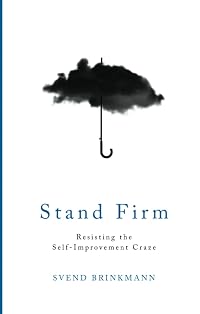
Stand Firm: Resisting the Self-Improvement Craze
by Svend Brinkmann
On This Page
Description
The pace of modern life is accelerating. To keep up, we must keep on moving and adapting - constantly striving for greater happiness and success. Or so we are told. But the demands of life in the fast lane come at a price: stress, fatigue and depression are at an all-time high while our social interactions have become increasingly self-serving and opportunistic.How can we resist today?s obsession with introspection and self-improvement? In this witty and bestselling book, Danish philosopher show more and psychologist Svend Brinkmann argues that we must not be afraid to reject the self-help mantra and ?stand firm?. The secret to a happier life lies not in finding your inner-self but in coming to terms with yourself in order to co-exist peacefully with others. By encouraging us to stand firm and get a foothold in life, this insightful anti-self-help guide offers a sobering and realistic alternative to life-coaching, positive thinking and the need always to say ?yes!?
. show less
Tags
Recommendations
























Member Reviews
In a subversion of the typical seven-step self-help guide, he offers his own seven steps, inspired by the ancient Stoics, on resisting the fetishisation of the self: cut out navel-gazing, focus on the negative, say No, suppress your feelings, sack your coach, read a novel and dwell on the past.
Quote from a review.
Svend Brinkmann is a popular Danish psychologist - and this anti-self-help-book was his big hit a few years ago. His humorous and self-ironic approach - deliberately exaggerating - help to get his point across. I disagree with his fundamental beliefs in pragmatism, but still he has a lot to offer in this critique of the endless demand for change, personal growth and positive thinking.
Our news organisation change every 12-18 show more months with sacking people and reorganisation and moving departments (and people) to and fro and it’s just crazy that you just settle in and start to know the new people, then another move, another way to do things.
I would like to tell my boss this next time he presents a new plan (it will happen in October) these words from Brinkmann:
“When someone presents plans for innovation and ‘visions’ for the future, tell them that everything was better in the old days. Explain to them that the idea of ‘progress’ is only a few hundred years old — and is, in fact, destructive.” show less
Quote from a review.
Svend Brinkmann is a popular Danish psychologist - and this anti-self-help-book was his big hit a few years ago. His humorous and self-ironic approach - deliberately exaggerating - help to get his point across. I disagree with his fundamental beliefs in pragmatism, but still he has a lot to offer in this critique of the endless demand for change, personal growth and positive thinking.
Our news organisation change every 12-18 show more months with sacking people and reorganisation and moving departments (and people) to and fro and it’s just crazy that you just settle in and start to know the new people, then another move, another way to do things.
I would like to tell my boss this next time he presents a new plan (it will happen in October) these words from Brinkmann:
“When someone presents plans for innovation and ‘visions’ for the future, tell them that everything was better in the old days. Explain to them that the idea of ‘progress’ is only a few hundred years old — and is, in fact, destructive.” show less
This was an interesting read! I agreed with some of the points Mr Brinkmann made, but definitely not all. For instance, I think his idea of Western culture is a bit excessive, but his ideas regarding self-help books match entirely with my own experience.
I think meditation and mindfulness can actually help finding the peace of mind the stoics liked so much, helping us to be more stable instead of being caught up in the moment all the time, and in a way it encourages us not to attach so much meaning to our own thoughts and feelings.
I also think that this book has a rather narrow definition of 'the self' - I agree there are large parts of who we are that are defined by the way we interact with the outside world, but people living outside show more society don't lose their idea of self. Even if parts of it are a narrative we construct ourselves, and parts of it are simple biology. I'll have to read more on this.
Also, while I agree that not all emotions are to be expressed, they all are valid. Just because you think you shouldn't be mad doesn't mean you're not mad, and trying to push that away will come back to bite you. The point is not to repress that madness, but to look at it, and say: "Ah. I'm mad, and I'm not going to act upon it" and let it be.
That said, I wholeheartedly agree with the notion that, at least for me, it's past time to stop trying to be a more perfect version of me. This is it. There is no end to that process, there is always something else that can be improved, which means you're always falling short. That way lies despair.
Time to accept that a lot of life is mediocre at best, and that's no ones' fault. Some parts are awesome, some parts suck, most of it is.. ok. Forcing yourself to adopt positive mindsets only makes everything so much worse. Cherish the good things, because they are real and amazing and temporary. Be prepared for bad things, because life is never only good. Do good, because that's valuable in itself, not because it makes you feel good (although it's a nice side effect).
I'm pretty sure I won't manage to become the dignified stoic this book recommends me to be, but then, it also taught me to stop striving for such things, so I'll just be my slightly messy perceived self and be ok with that. show less
I think meditation and mindfulness can actually help finding the peace of mind the stoics liked so much, helping us to be more stable instead of being caught up in the moment all the time, and in a way it encourages us not to attach so much meaning to our own thoughts and feelings.
I also think that this book has a rather narrow definition of 'the self' - I agree there are large parts of who we are that are defined by the way we interact with the outside world, but people living outside show more society don't lose their idea of self. Even if parts of it are a narrative we construct ourselves, and parts of it are simple biology. I'll have to read more on this.
Also, while I agree that not all emotions are to be expressed, they all are valid. Just because you think you shouldn't be mad doesn't mean you're not mad, and trying to push that away will come back to bite you. The point is not to repress that madness, but to look at it, and say: "Ah. I'm mad, and I'm not going to act upon it" and let it be.
That said, I wholeheartedly agree with the notion that, at least for me, it's past time to stop trying to be a more perfect version of me. This is it. There is no end to that process, there is always something else that can be improved, which means you're always falling short. That way lies despair.
Time to accept that a lot of life is mediocre at best, and that's no ones' fault. Some parts are awesome, some parts suck, most of it is.. ok. Forcing yourself to adopt positive mindsets only makes everything so much worse. Cherish the good things, because they are real and amazing and temporary. Be prepared for bad things, because life is never only good. Do good, because that's valuable in itself, not because it makes you feel good (although it's a nice side effect).
I'm pretty sure I won't manage to become the dignified stoic this book recommends me to be, but then, it also taught me to stop striving for such things, so I'll just be my slightly messy perceived self and be ok with that. show less
Danish psychologist Svend Brinkman encourages those of us who are sick to death of society’s obsession with self-help, self-improvement, self-development, self-esteem – to say no! He is is well-read, witty, and humourous, and the voice of reason in a culture of emotion and self. What a breath of fresh air!
A reviewer writing The Sydney Morning Herald aptly summarizes Brinkman’s work: In a subversion of the typical seven-step self-help guide, he offers his own seven steps, inspired by the ancient Stoics, on resisting the fetishisation of the self: cut out navel-gazing, focus on the negative, say No, suppress your feelings, sack your coach, read a novel and dwell on the past.
Brinkman is upfront that his novel is not for everyone: show more those who are content in the self-race our society has created and continues to propagate – well, Stand Firm is not for those people. But if, like me, you reject the find-and-develop-yourself ideology as the panacea to happiness and success in our modern society – well, Stand Firm is a must read!
_______________
Best Quotes: (so many!)
On the paradox of society, and our failed attempts to improve working-class lives: I see this so clearly in my work as a public educator where new curriculum, being introduced as we speak at a cost of tens of millions of dollars, perpetrates self-development, self-esteem, follow-your-passion (until I could gag!):
“As a society, we see the paradox machine at work on a bigger scale and in all sorts of contexts: for example, attempts to liberate the working class and its progeny by deploying critical and anti-authoritarian ‘learning by doing’ have merely reproduced inequality (and even exacerbated it in recent years), as these children have found themselves unable to navigate diffuse education structures with their myriad demands for autonomy and self-development. The offspring of the middle and upper classes have encountered no such problems.“ (23)
On the danger of the Yes hat:
“The Stoics see nothing wrong with positive experiences per se, but don’t see pursuing as many of them as possible as an end in itself. In fact, such a pusuit, decked out in a Yes hat and the latest fashionable gear, might stop you achieving peace of mind, the virtue that the Stoics cherish most … But in the accelerating culture, peace of mind is no longer deemed a desirable state. It’s a problem. People with peace of mind are precisely the type who are founded enough to knock back all sorts of (unreasonable) requirements and demands. That is not an asset in an era when the idea is the liquid, flexible, changeable individual.” (51)
On the value of literature in a world of psychobabble:
“I am convinced that the novels of Charles Dickens, Vladimir Nabakov and Cormac McCarthy (some of my favourites) will make us better people than Anthony Robbins’ coaching guides or Martin Seligman’s positive psychology. Admittedly, comparing fiction with self-help is like comparing apples with pears – but what they have in common is that they both explore what it is to be human and what life is all about.” (93) show less
A reviewer writing The Sydney Morning Herald aptly summarizes Brinkman’s work: In a subversion of the typical seven-step self-help guide, he offers his own seven steps, inspired by the ancient Stoics, on resisting the fetishisation of the self: cut out navel-gazing, focus on the negative, say No, suppress your feelings, sack your coach, read a novel and dwell on the past.
Brinkman is upfront that his novel is not for everyone: show more those who are content in the self-race our society has created and continues to propagate – well, Stand Firm is not for those people. But if, like me, you reject the find-and-develop-yourself ideology as the panacea to happiness and success in our modern society – well, Stand Firm is a must read!
_______________
Best Quotes: (so many!)
On the paradox of society, and our failed attempts to improve working-class lives: I see this so clearly in my work as a public educator where new curriculum, being introduced as we speak at a cost of tens of millions of dollars, perpetrates self-development, self-esteem, follow-your-passion (until I could gag!):
“As a society, we see the paradox machine at work on a bigger scale and in all sorts of contexts: for example, attempts to liberate the working class and its progeny by deploying critical and anti-authoritarian ‘learning by doing’ have merely reproduced inequality (and even exacerbated it in recent years), as these children have found themselves unable to navigate diffuse education structures with their myriad demands for autonomy and self-development. The offspring of the middle and upper classes have encountered no such problems.“ (23)
On the danger of the Yes hat:
“The Stoics see nothing wrong with positive experiences per se, but don’t see pursuing as many of them as possible as an end in itself. In fact, such a pusuit, decked out in a Yes hat and the latest fashionable gear, might stop you achieving peace of mind, the virtue that the Stoics cherish most … But in the accelerating culture, peace of mind is no longer deemed a desirable state. It’s a problem. People with peace of mind are precisely the type who are founded enough to knock back all sorts of (unreasonable) requirements and demands. That is not an asset in an era when the idea is the liquid, flexible, changeable individual.” (51)
On the value of literature in a world of psychobabble:
“I am convinced that the novels of Charles Dickens, Vladimir Nabakov and Cormac McCarthy (some of my favourites) will make us better people than Anthony Robbins’ coaching guides or Martin Seligman’s positive psychology. Admittedly, comparing fiction with self-help is like comparing apples with pears – but what they have in common is that they both explore what it is to be human and what life is all about.” (93) show less
Писнало ли ви е от гурута, психоаналитици, "душевни треньори", лайф коучинг и други подобни шитни? Струва ли ви се, че това с "ученето през целия живот" не е зле да има все пак някакви граници? Чудите ли се какво толкова търсят тия, които се опитват да "намерят себе си"?
Книгата на Двенд Бринкман не е лоша като замисъл и се опитва да приведе философската традиция на стоицизма в съвременния свят и живот. От show more изпълнението на замисъла може да се иска още, като първата глава, относно "намирането на себе си" може да се каже, че не само е най-добра, а и всички останали нататък са все развитие на същата тема.
Като цяло, стоическата философия е доста хубаво нещо и ако я приемете за лична философия даже само отчасти, това не само ще ви спести много нерви, но някои смятат дори че тя показва един от пътищата за смислен, дълбоко удовлетворителен живот. show less
Книгата на Двенд Бринкман не е лоша като замисъл и се опитва да приведе философската традиция на стоицизма в съвременния свят и живот. От show more изпълнението на замисъла може да се иска още, като първата глава, относно "намирането на себе си" може да се каже, че не само е най-добра, а и всички останали нататък са все развитие на същата тема.
Като цяло, стоическата философия е доста хубаво нещо и ако я приемете за лична философия даже само отчасти, това не само ще ви спести много нерви, но някои смятат дори че тя показва един от пътищата за смислен, дълбоко удовлетворителен живот. show less
Klar kritik af selvudviklingens indtog i privat- og arbejdslivet. Der er vel ikke som sådan noget nyt i det, Brinkmann skriver, men han gør det på en måde, der er umiddelbart forståelig, underholdende og lærerig. Og bedst af alt sætter han ord på en modstand, som jeg og mange andre har imod konstante krav til "personlig udvikling" , "innovation" og "den bedst mulige version af dit autentiske jeg".
Det er en god idé! Jeg går helt ind for et revideret syn på hvor meget man skal udvikle sig personligt for at stå til tjeneste for arbejdet eller samfundet som sådan.
Svend har også fat i noget rigtigt i sidste kapitel hvor han pragmatisk ser tilbage.
Resten af bogen er en undermålig gymnasieopgave, sludder-for-en-sladder med en stak referencer til litterære kilder, men uden en sammenhængende stærk argumentation.
Han har en rød tråd, den er "gør oprør, vær modsat". Det rækker ikke. Det er heller ikke nok, autoritært at sige til læseren "... du forstår nu at...".
Jeg er overbevist om at Brinkmann kan meget mere end dette, og er dybt skuffet over at have spildt min tid på bogen. Hvis du prøver, og er skuffet efter show more første (eventuelt også andet) kapitel, så lad være med at fortsætte! show less
Svend har også fat i noget rigtigt i sidste kapitel hvor han pragmatisk ser tilbage.
Resten af bogen er en undermålig gymnasieopgave, sludder-for-en-sladder med en stak referencer til litterære kilder, men uden en sammenhængende stærk argumentation.
Han har en rød tråd, den er "gør oprør, vær modsat". Det rækker ikke. Det er heller ikke nok, autoritært at sige til læseren "... du forstår nu at...".
Jeg er overbevist om at Brinkmann kan meget mere end dette, og er dybt skuffet over at have spildt min tid på bogen. Hvis du prøver, og er skuffet efter show more første (eventuelt også andet) kapitel, så lad være med at fortsætte! show less
Alles gaat tegenwoordig maar sneller en sneller en we voelen constant druk om ons maar te blijven ontwikkelen. Een hoop mensen grijpen daarom naar zelfhulpboeken en -cursussen die ons weer in contact willen laten komen met ons innerlijke zelf. Svend Brinkmann, hoogleraar Psychologie aan de Universiteit van Aalborg, hekelt deze ‘zelfhulpcultuur’ en geeft een verfrissend antwoord op alle zogenaamde positieve psychologie.
Svend Brinkmann leert je hoe je kunt samenwerken met anderen én toch volledig jezelf kunt zijn, door gewoon af en toe nee te zeggen en bovenal stevig in je schoenen te staan. Geïnspireerd door onder meer de filosofie van de stoïcijnen is
Svend Brinkmann leert je hoe je kunt samenwerken met anderen én toch volledig jezelf kunt zijn, door gewoon af en toe nee te zeggen en bovenal stevig in je schoenen te staan. Geïnspireerd door onder meer de filosofie van de stoïcijnen is
Apr 29, 2019Dutch
Members
- Recently Added By
Lists

Books Read in 2018
4,360 works; 110 members
Author Information
41 Works 459 Members
Svend Brinkmann was living the relatively sedate life of a professor of psychology at Aalborg University when Stand Firm was published. The book was an overnight sensation in Denmark and catapulted him into the media limelight as a leading public intellectual and cultural critic. Svend now travels widely to host events and lecture on the big show more questions of modern life. He has featured in several documentaries, and presented Live Fast on Danish television and the Meaningful Life series on national radio. show less
Common Knowledge
- Canonical title*
- Stå fast : vägra vår tids utvecklingstvång
- Original title
- Stå fast : et upgør med tidens udviklingstvang
- Original publication date
- 2015
- Original language*
- Danska
- Canonical DDC/MDS
- 158.1
*Some information comes from Common Knowledge in other languages. Click "Edit" for more information.
Classifications
Statistics
- Members
- 136
- Popularity
- 241,381
- Reviews
- 9
- Rating
- (3.43)
- Languages
- 5 — Danish, Dutch, English, Italian, Swedish
- Media
- Paper, Audiobook, Ebook
- ISBNs
- 15
- ASINs
- 2