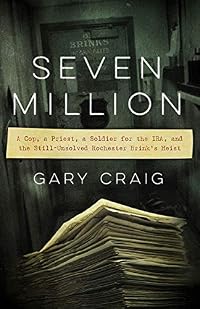
Seven Million: A Cop, a Priest, a Soldier for the IRA, and the Still-Unsolved Rochester Brink's Heist
by Gary Craig
On This Page
Description
Winner of the Rochester City Newspaper's Best Locally Written Book On a freezing night in January 1993, masked gunmen walked through the laughably lax security at the Rochester Brink's depot, tied up the guards, and unhurriedly made off with $7.4 million in one of the FBI's top-five armored car heists in history. Suspicion quickly fell on a retired Rochester cop working security for Brinks at the time--as well it might. Officer Tom O'Connor had been previously suspected of everything from show more robbery to murder to complicity with the IRA. One ex-IRA soldier in particular was indebted to O'Connor for smuggling him and his girlfriend into the United States, and when he was caught in New York City with $2 million in cash from the Brink's heist, prosecutors were certain they finally had enough to nail O'Connor. But they were wrong. In Seven Million, the reporter Gary Craig meticulously unwinds the long skein of leads, half-truths, false starts, and dead ends, taking us from the grim solitary pens of Northern Ireland's Long Kesh prison to the illegal poker rooms of Manhattan to the cold lakeshore on the Canadian border where the body parts began washing up. The story is populated by a colorful cast of characters, including cops and FBI agents, prison snitches, a radical priest of the Melkite order who ran a home for troubled teenagers on the Lower East Side of Manhattan, and the IRA rebel who'd spent long years jailed in one of Northern Ireland's most brutal prisons and who was living underground in New York posing as a comics dealer. Finally, Craig investigates the strange, sad fate of Ronnie Gibbons, a down-and-out boxer and muscle-for-hire in illegal New York City card rooms, who was in on the early planning of the heist, and who disappeared one day in 1995 after an ill-advised trip to Rochester to see some men about getting what he felt he was owed. Instead, he got was what was coming to him. Seven Million is a meticulous re-creation of a complicated heist executed by a variegated and unsavory crew, and of its many repercussions. Some of the suspects are now dead, some went to jail; none of them are talking about the robbery or what really happened to Ronnie Gibbons. And the money? Only a fraction was recovered, meaning that most of the $7 million is still out there somewhere. show lessTags
Recommendations















Member Reviews
In Seven Million: A Cop, a Priest, a Soldier for the IRA, and the Still-Unsolved Rochester Brink’s Heist, author and reporter Gary Craig unravels all the intersecting narratives of the 1993 Brink’s Depot Heist, in which masked men stole $7 million. Craig, a reporter from Rochester’s Democrat & Chronicle newspaper, followed the case as it unfolded, but became particularly involved after the death of Ronnie Gibbons, a man tangentially related to the heist.
Craig admirably traces the lives of the principle suspects, Tom O’Connor, Sam Millar, and Father Patrick Moloney, filling in necessary backstory as each enters the narrative. O’Connor, a former officer with the Rochester Police Department, links the principles together and so show more Craig spends the greatest amount of time on him, especially as O’Connor connects with the second part of Craig’s narrative. Carefully using the autobiography of Millar, formerly with the IRA, to explore the Irish connection between the suspects, Craig also demonstrates how Rochester and New York, while located at opposite ends of I-90, shared many cultural connections. Moloney proves an interesting character, as he was in possession of the stolen money, but appears to have used it to fund his charitable work as he understood it. The heist and subsequent Rochester Police and FBI investigations occupy the majority of Craig’s narrative to the point that his focus on Gibbons seems an afterthought at first.
Gibbons, a boxer in New York City, was likely involved in the planning of the heist, but Millar did not use him to execute the theft. Feeling owed a portion of the take, Gibbons confronted someone in Rochester and disappeared. Long a cold case, the pieces of this part of the puzzle only became evident when portions of Gibbons’s remains were discovered near where Lake Ontario connects with the Saint Lawrence Seaway. While this discovery put pressure on some of the men connected, it yielded no more answers than the FBI investigation in the 1990s.
Craig admits that the narrative will likely forever remain unsolved, as about $5 million is still missing. Despite the lack of a proper dénouement, Craig’s narrative represents the culmination of decades of research through tens of thousands of pages of documents and numerous interviews. Craig is always clear when he speculates about something, though he does so cautiously and with a firm base in the evidence. If he could not solve the case, it’s likely no one will. With this in mind, his writing belongs amongst the best of the true-crime genre and will entertain readers who enjoy similar work. As someone from Rochester, I can say that his description of the city and its surrounding environs will delight those with an interest in local history. show less
Craig admirably traces the lives of the principle suspects, Tom O’Connor, Sam Millar, and Father Patrick Moloney, filling in necessary backstory as each enters the narrative. O’Connor, a former officer with the Rochester Police Department, links the principles together and so show more Craig spends the greatest amount of time on him, especially as O’Connor connects with the second part of Craig’s narrative. Carefully using the autobiography of Millar, formerly with the IRA, to explore the Irish connection between the suspects, Craig also demonstrates how Rochester and New York, while located at opposite ends of I-90, shared many cultural connections. Moloney proves an interesting character, as he was in possession of the stolen money, but appears to have used it to fund his charitable work as he understood it. The heist and subsequent Rochester Police and FBI investigations occupy the majority of Craig’s narrative to the point that his focus on Gibbons seems an afterthought at first.
Gibbons, a boxer in New York City, was likely involved in the planning of the heist, but Millar did not use him to execute the theft. Feeling owed a portion of the take, Gibbons confronted someone in Rochester and disappeared. Long a cold case, the pieces of this part of the puzzle only became evident when portions of Gibbons’s remains were discovered near where Lake Ontario connects with the Saint Lawrence Seaway. While this discovery put pressure on some of the men connected, it yielded no more answers than the FBI investigation in the 1990s.
Craig admits that the narrative will likely forever remain unsolved, as about $5 million is still missing. Despite the lack of a proper dénouement, Craig’s narrative represents the culmination of decades of research through tens of thousands of pages of documents and numerous interviews. Craig is always clear when he speculates about something, though he does so cautiously and with a firm base in the evidence. If he could not solve the case, it’s likely no one will. With this in mind, his writing belongs amongst the best of the true-crime genre and will entertain readers who enjoy similar work. As someone from Rochester, I can say that his description of the city and its surrounding environs will delight those with an interest in local history. show less
 This review was written for LibraryThing Early Reviewers.
Keep in mind that often-used "follow the money" advice when reading this intriguing true crime book. It opens in 1993 with a heist at the Brink's depot in Rochester NY. In chapter one, the reader is introduced to the guards, along with the masked thieves who stole over seven million dollars on that February day. Though the culprits remain anonymous at the beginning, readers do get to know the Brink's guards early on. The heist itself goes so smoothly that it's a no-brainer to conclude that someone on the inside (probably a guard) took part. Chapter by chapter, the many investigators become familiar -- and mostly likeable -- as they follow numerous leads to hunt down the thieves and money, and in particular, a small quantity of marked show more One hundred-dollar bills of the stolen millions. There are local investigators. State investigators. And Federal Bureau of Investigation (FBI) agents, some of whom are counter-intelligence because of the suspected Irish Republican Army (IRA) connections. The inside-man suspect, a retired- cop-turned-Brink's guard, Tom O'Conner, has ties to an American IRA support organization, as does a New York City priest,Father Patrick Maloney, who runs a charity in that city for runaway teens. The priest is the link to where only some of the stolen bills surface. The other suspect connected to the IRA is Sam Millar, a man O'Conner helped smuggle into the US after Millar had been released from Long Kesh, the infamous penitentiary in Ireland where IRA political prisoners serve their time.
The book's long title gives readers a clue as to its many interconnecting parts. The many parts are well managed and the tracking of the Brink's stolen money is what keeps this true crime story moving. It reads like a mystery novel. Its author, Gary Craig, a man with thirty-years experience as a newspaper reporter, admits in the Acknowledgements that the book has "multiple narrative threads with converging chronologies." There's also a Part II -- Finding Ronnie -- and at first it just seemed like an addendum. However, in my humble opinion, I think it's a narrative thread that needed to be explored because a former New York boxer, Ronnie Gibbons, disappears. He's a man with connections to Millar, and to Father Maloney in NYC, and in a unique way to the Brink's heist. It adds a second mystery to the still-unsolved Brink's heist -- only 2 mil of the 7 million since 1993 has surfaced.
Gary Craig's meticulous research, his attention given to the many investigative details, along with his storytelling abilities, all blend together to make this an extremely satisfying true crime tale. He effectively keeps himself as reporter out of the main chapters and writes first-person only in the Epilogue. As Gary Craig reflects and updates there, he skillfully allows his readers to think for themselves, to perhaps read between the lines, and to draw their own conclusions about the still- missing millions. I highly recommend this book.
Thank you, LibraryThing Early Reviewers. show less
The book's long title gives readers a clue as to its many interconnecting parts. The many parts are well managed and the tracking of the Brink's stolen money is what keeps this true crime story moving. It reads like a mystery novel. Its author, Gary Craig, a man with thirty-years experience as a newspaper reporter, admits in the Acknowledgements that the book has "multiple narrative threads with converging chronologies." There's also a Part II -- Finding Ronnie -- and at first it just seemed like an addendum. However, in my humble opinion, I think it's a narrative thread that needed to be explored because a former New York boxer, Ronnie Gibbons, disappears. He's a man with connections to Millar, and to Father Maloney in NYC, and in a unique way to the Brink's heist. It adds a second mystery to the still-unsolved Brink's heist -- only 2 mil of the 7 million since 1993 has surfaced.
Gary Craig's meticulous research, his attention given to the many investigative details, along with his storytelling abilities, all blend together to make this an extremely satisfying true crime tale. He effectively keeps himself as reporter out of the main chapters and writes first-person only in the Epilogue. As Gary Craig reflects and updates there, he skillfully allows his readers to think for themselves, to perhaps read between the lines, and to draw their own conclusions about the still- missing millions. I highly recommend this book.
Thank you, LibraryThing Early Reviewers. show less
This review was written for LibraryThing Early Reviewers.When I saw Seven Million…by Gary Craig on early review offered by Library Thing I was enchanted. I am an avid reader of true crime, I remember well the Lufthansa heist, as well as the Irish troubles. I was a child when Bobby Sands died. There were a lot of Irish in our town, and I remember vividly the picture of him in the paper, skeletal and frozen in death. I wondered why.
We were Catholic. There was only one Protestant family on our street, and yet we all believed in Christ the Savior. What was all this hate and killing about?
And so I greatly looked forward to Mr. Craig’s book as I did not know this story.
It is a deeply researched book about the Brinks Robbery in Rochester and the broad cast of characters that may have been show more involved and their connections to the IRA , IRA societies and clubs, and IRA activities both in the States and in Northern Ireland. So deeply researched in fact that I fear we lose the forest for the trees. Mr. Craig buries us with minutia that without a program we get hopelessly set adrift
Everything carries the same weight and the book loses focus. Ironically, the most focused and easiest to read as well as most emotional part is the last which Mr. Craig devotes to Ronnie Gibbons.
The other characters, the cop, Tom O’Connor; the priest Pat Moloney, and the soldier Millar, save for his time in the horrific prison Long Kesh, are curiously flat, lost amongst the detail.
The narrative, too, gets muddied as the thread disappears for pages. It is indeed a difficult book to follow, which is a shame since there is so much here.
I was struck by the depiction of Long Kesh, the abominable cruelty. How do sentient beings expect people treated so barbarically to react? And, my God, all claiming to act in the name of Jesus!
We get lost, we get so lost as human beings, so many of us are lost right now, and this is what this book tells us.
Worth the read? Absolutely.
If for no other reason than to keep that arc bending toward justice. show less
We were Catholic. There was only one Protestant family on our street, and yet we all believed in Christ the Savior. What was all this hate and killing about?
And so I greatly looked forward to Mr. Craig’s book as I did not know this story.
It is a deeply researched book about the Brinks Robbery in Rochester and the broad cast of characters that may have been show more involved and their connections to the IRA , IRA societies and clubs, and IRA activities both in the States and in Northern Ireland. So deeply researched in fact that I fear we lose the forest for the trees. Mr. Craig buries us with minutia that without a program we get hopelessly set adrift
Everything carries the same weight and the book loses focus. Ironically, the most focused and easiest to read as well as most emotional part is the last which Mr. Craig devotes to Ronnie Gibbons.
The other characters, the cop, Tom O’Connor; the priest Pat Moloney, and the soldier Millar, save for his time in the horrific prison Long Kesh, are curiously flat, lost amongst the detail.
The narrative, too, gets muddied as the thread disappears for pages. It is indeed a difficult book to follow, which is a shame since there is so much here.
I was struck by the depiction of Long Kesh, the abominable cruelty. How do sentient beings expect people treated so barbarically to react? And, my God, all claiming to act in the name of Jesus!
We get lost, we get so lost as human beings, so many of us are lost right now, and this is what this book tells us.
Worth the read? Absolutely.
If for no other reason than to keep that arc bending toward justice. show less
This review was written for LibraryThing Early Reviewers.In 1993, a group of unknown robbers stole more than $7 million from a Brinks depot in Rochester, New York. In spite of lax security measures at the facility, it quickly became clear that it was an inside job - one of the small number of people ending their work day at the depot fed the robbers information and may have even let them in. And very quickly, it became clear that the robbers at least had ties to the Irish Republican Army, then in the throes of conflict with the British before reconciliation. In the end, only $2 million was recovered, and only a couple of people went to jail for the crime - the rest has never been recovered and a former boxer turned illegal casino manager turned up dead, with no proof that the suspected show more murderer did it.
True Crime fans, especially, will like Gary Craig's telling of the story, though at times it's hard to sort out the players without a program - there are lots of players involved and some share last names, for instance. Craig is a reporter from Rochester who's been investigating the crimes - the robbery and murder - for many years, and he clearly knows his stuff. But ultimately, the book leaves the reader hanging a bit given that the money's still missing and the murderer got away with it. Recommended, though. show less
True Crime fans, especially, will like Gary Craig's telling of the story, though at times it's hard to sort out the players without a program - there are lots of players involved and some share last names, for instance. Craig is a reporter from Rochester who's been investigating the crimes - the robbery and murder - for many years, and he clearly knows his stuff. But ultimately, the book leaves the reader hanging a bit given that the money's still missing and the murderer got away with it. Recommended, though. show less
This review was written for LibraryThing Early Reviewers.One prosecutor called it "just a robbery case that involved a whole lot of money." Hardly. The 1993 Brink's depot robbery in Rochester, New York, the fifth largest robbery in U.S. history, netted the thieves $7.4 million dollars, most of which has never been recovered. Four people were arrested and tried, including a retired cop, a Catholic priest, and a former member of the Irish Republican Army; two were convicted and went to prison. Two-thirds of the way through, the focus of the story shifts to a philosophy-spouting boxer on the periphery of the case who vanished and whose body parts eventually washed ashore in Lake Ontario. Craig is honest about the many questions remaining, with the location of the money being only one; any show more speculation is based on known, solid facts. This is a thoroughly researched, highly readable account of the case by a longtime reporter for the Rochester Democrat and Chronicle who has covered the story from its beginning. Not surprisingly, the film rights have been sold; it should make a crackerjack movie. show less
This review was written for LibraryThing Early Reviewers.I live in Rochester and am old enough to remember the 1993 Brinks Depot robbery and aftermath. Maybe that is why I enjoyed this book so much. Because it is a subject and area I am experienced in, it does make reviewing the book difficult, but hopefully I am not being biased. Gary Craig wove a very compelling narrative, and the book moved quickly and I was continuously interested. The nature of the actual events does leave one feeling slightly unhappy at the end, but his epilogue I feel was well reasoned and he spelled out very clearly why he came to the conclusions he did. Because of my proximity to the scene I did find myself driving past locations, which is a good example of how compelling the story was. I highly recommend this true show more crime book. show less
This review was written for LibraryThing Early Reviewers.So Jeff Bezos net worth is now $100 billion dollars. So why would any one want to know about any missing $7 million from a loosely secure Brink's depot heist in Rochester NY in 1993? Because the way investigative journalist Gary Craig meticulously details its narrative for one. Because the $7,000.000.00 are in cash, used cash and untraceable and because the heist suggests a team of highly professional operators, albeit on the wrong side of the Law. Among the Brink's security guard is an ex-cop of Irish Ancestry who helped IRA (the Irish Republican Army) hands gain clandestine asylum in the USA. It is enough to suggest to the press that the heist is a way for this organization to have access to funds that their more legitimate show more fundraisers does not bring in such quantity. The heist is captivating. Then comes a long surveillance of suspects by the FBI that allows the author to describe the motivations of each suspect, the ex-IRA political prisoner and comic book store keeper turned mystery writer, the Catholic Priest who helps kids in difficult neighborhood through a cash based charitable organization, a talented boxer at the end of his career who now needs his share of the heist to pay for his divorce attorney.
The trial of some of the suspects is well described in showing how even with part of the cash found, the investigators and the prosecution do not succeed into establishing clearly the causation between the cash presence in duffel bags and the presumed authors. Also 5 of the 7 million are missing. The book remains open-ended for this reason and can be best described as a "cold case" or a partially resolved case. Even the IRA's involvement may be dubious at best after you went through all the possibilities and discover that the professionals you thought had committed the heist are in fact very amateurish in how they attempt to dispose of it. The author is very attached to the atmosphere he describes, not always the most glamorous of places, from boxing rings to clandestine casinos or border towns by lake Ontario. At times, the reader will get lost in the meanders of the investigation and confuse all the Irish names of the book, but do not despair...there is a fantastic index with all these names at the end. The forensics of the murder remind also the reader that this is not a mystery novel but it is based on a true story. show less
The trial of some of the suspects is well described in showing how even with part of the cash found, the investigators and the prosecution do not succeed into establishing clearly the causation between the cash presence in duffel bags and the presumed authors. Also 5 of the 7 million are missing. The book remains open-ended for this reason and can be best described as a "cold case" or a partially resolved case. Even the IRA's involvement may be dubious at best after you went through all the possibilities and discover that the professionals you thought had committed the heist are in fact very amateurish in how they attempt to dispose of it. The author is very attached to the atmosphere he describes, not always the most glamorous of places, from boxing rings to clandestine casinos or border towns by lake Ontario. At times, the reader will get lost in the meanders of the investigation and confuse all the Irish names of the book, but do not despair...there is a fantastic index with all these names at the end. The forensics of the murder remind also the reader that this is not a mystery novel but it is based on a true story. show less
This review was written for LibraryThing Early Reviewers.Members
- Recently Added By
Author Information
1 Work 26 Members
Gary Craig is a reporter on the Rochester Democrat and Chronicle's Watchdog team, focusing on public safety and criminal justice. He has covered the Brink's depot heist for over twenty years. He has won numerous state and national journalism awards. This is his first book.
Classifications
- Genres
- Nonfiction, General Nonfiction, Politics and Government, Sociology, History
- DDC/MDS
- 364.15 — Society, Government, and Culture Social problems and social services Crime Criminal offenses Offenses against the person
- LCC
- HV6661 .N72 — Social sciences Social pathology. Social and public welfare. Criminology Social pathology. Social and public welfare. Criminology Crimes and offenses
- BISAC
Statistics
- Members
- 26
- Popularity
- 1,038,374
- Reviews
- 11
- Rating
- (3.83)
- Languages
- English
- Media
- Paper, Ebook
- ISBNs
- 2
- ASINs
- 2